Dress in the Cart, Text in Drafts: From Guilt to Honest Limits
Finding Clarity in the Dress Cart Spiral
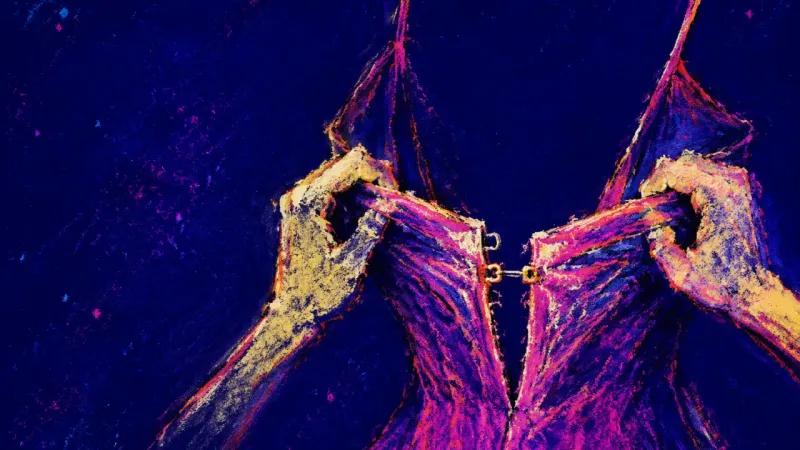
If you're a late-20s city friend reading the bridesmaid group chat on your lunch break, then checking your bank app like it might magically tell you what kind of person to be, you're probably in wedding guilt—not a character flaw.
When Maya (name changed for privacy), a 29-year-old marketing coordinator in Toronto, came to me, she started with Wednesday at 12:36 p.m. in the PATH food court. She peeled back the lid on microwaved soup while fluorescent light bounced off her phone screen, someone nearby dropped a tray, and she kept switching between the bridesmaid chat, the dress checkout page, and her RBC app. The phone felt warm in her palm. Her chest tightened. Her stomach dropped the way it does on TTC Line 1 when the train jolts before you've got a hand on the pole.
"I do want to show up," she told me. "I just don't know if I can do all of this. And if I bow out now, will it look like I don't care?"
As I listened, the real shape of the problem came into focus. She wanted to keep the bond intact and be the friend who says yes. She also feared the cost, the private resentment, and the version of herself that would agree beyond her real limits. She kept saying she was still thinking, but her body had already started paying for the delay. This isn't just a dress decision; it's a belonging decision with a dress attached.
The guilt had the texture of a seat belt locked too tight across the sternum—one of those pressures that makes every small movement feel louder than it is. I told her, softly, "You're not failing friendship. You're standing in a loaded doorway. Let's make a map of the fog, and then you get to choose from clarity instead of panic."
Choosing the Compass: A Decision Cross for a Bridesmaid Dilemma
Before I touched the deck, I guided her through my pre-meeting three-minute cosmic breathing: four counts in, a small hold, six counts out. I use it the same way I dim the dome before a planetarium show. It isn't about drama. It's about helping the nervous system stop ricocheting long enough to notice what is actually there.
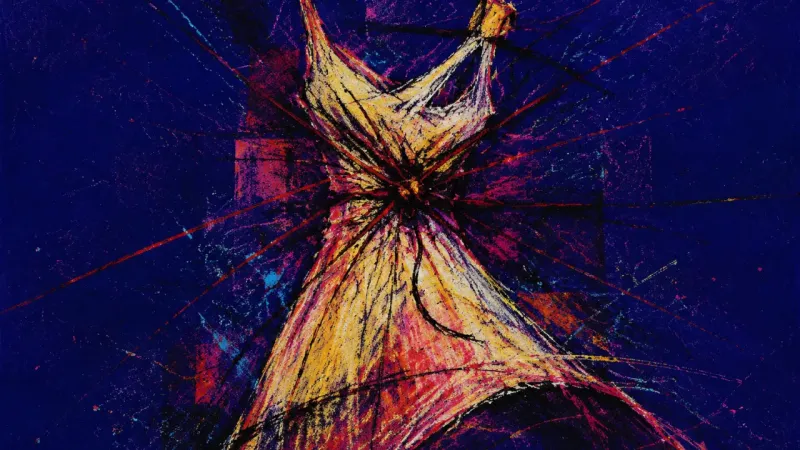
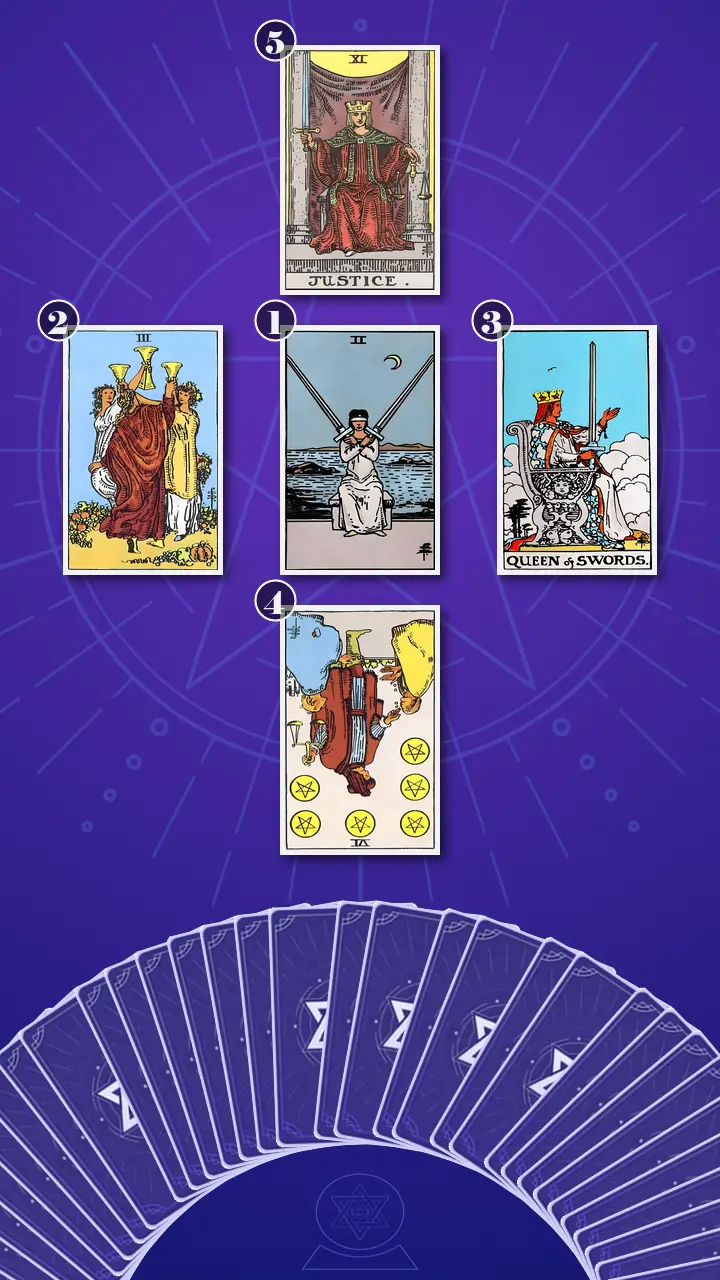
I use tarot the way I use a star map in Tokyo: not to tell anyone where they must go, but to show the forces already shaping the sky so they can navigate with their eyes open. For Maya's bridesmaid decision paralysis, I chose a Decision Cross, a five-card decision spread built for emotionally loaded either-or questions. It is just wide enough to separate the freeze itself from the emotional pull of saying yes, the truth-telling function of saying no, the hidden imbalance underneath both, and the wiser standard that can replace guilt. That's how tarot works best for decision fatigue—like a structured mirror, not a verdict.
I told her what I would be listening for. The center card would show the visible stalemate. The left card would show what buying the dress was trying to preserve. The right card would show what bowing out was trying to protect. The card beneath would reveal the hidden weight pulling on both options. The card above would show the principle strong enough to hold a clean answer.
Reading the Crossroads
The Freeze That Calls Itself "One More Day"
"Now we're looking at the position that presents the visible stalemate: the concrete freeze between purchasing the dress and sending a message to bow out," I said as I turned the first card.
The card was the Two of Swords, upright.
"This is you with two tabs open for days—checkout on one side, apology draft on the other—and calling that still deciding," I told her. "You're not missing information. You're protecting yourself from the emotional consequence of making either future real."
The energy here was blocked Air: thought so overpacked it had stopped moving. The blindfold mapped to selective avoidance, and the crossed swords over the chest mirrored the way her body was physically bracing against the choice. Leaving it in the cart is still a choice—just one that charges you in stress first.
Maya gave a quick laugh with a bitter edge. "That is brutally accurate." Her fingers tightened once around her mug and then loosened. The wince came first, then the nod. That was the moment the freeze stopped masquerading as prudence.
The Pull of the Circle
"Now we're looking at the position that reveals what buying the dress is trying to preserve emotionally, especially belonging, celebration, and loyalty."
The card was the Three of Cups, upright.
I pointed to the lifted cups and the figures in motion. "This yes isn't fake. This is the part of you that can already picture the getting-ready photos, the laughter, the group dinner, the private relief of saying, 'I showed up.' Buying the dress isn't just a purchase here. It's entry into the circle and a real friendship milestone you actually care about."
This card carried balanced Water: affection, celebration, visible belonging. "So no," I told her, "we are not going to solve this by pretending you don't want to be there. You do. The question is whether the yes would come from joy—or from fear that stepping back will get mistaken for lack of love."
She looked down at the card for a long second. "That's exactly the split," she said. "I want to celebrate her. I just don't want to quietly hate everything I had to do to make it work."
The Sentence That Clears the Screen
"Now we're looking at the position that reveals what bowing out is trying to protect, especially clear limits, truth, and self-respect."
The card was the Queen of Swords, upright.
"This," I said, "is the grown-up version of care. Not a six-paragraph Notes app apology. One clean text you can actually stand behind."
The energy here was refined Air in balance: direct thought, clean boundaries, no cruelty. The upright sword and open hand said it perfectly—direct facts, open tone, no punishment. Kind does not need a six-paragraph apology. Clear is kinder than indefinite.
I asked her to hear the sentence in the room, not send it yet. "I love you, and I need to be honest that I can't commit to the bridesmaid role."
I watched her shoulders drop a little. Her mouth pressed together, then softened. "That makes me nervous," she said, "but it also feels cleaner than all the versions where I keep explaining myself into a corner."
"Exactly," I told her. "Warmth instead of fog. Honesty instead of overexplaining."
The Hidden Math Nobody Wants to Admit
"Now we're looking at the position that uncovers the deeper imbalance making the choice heavier than it looks, including money, reciprocity, and the fear of becoming the difficult friend."
The card was the Six of Pentacles, reversed.
Whenever a hidden-factor card lands like this, I reach for one of my astronomy habits. I call it Dark Matter Detection. In space, the unseen mass is often what bends the entire system. In readings, it is the cost nobody has fully named yet.
So I named it with her. "Dress. Alterations. Shoes. Travel. Gift. Pre-events. Ubers. Maybe PTO. And then the line item people skip because it isn't in the checkout total: emotional labor. The work of staying easy, cheerful, and flexible while your budget and bandwidth are already flinching."
This was distorted Earth—exchange tilted off center. Like a Splitwise total that's technically shared but clearly not equally easy for everyone to carry. "A yes made from guilt doesn't stay generous for long," I said. "If the only way to prove you care is to ignore your own capacity, the math is already rigged."
Her reaction came in three beats. First the stillness: her breath caught high in her chest. Then the recognition: her gaze drifted off-screen, replaying the quiet running total she'd been doing in her head. Then the release: one heavy exhale, followed by a small, exhausted smile. "This is exactly it," she said. "I felt guilty for even counting the cost."
"Counting it doesn't make you selfish," I told her. "It makes the exchange visible. Fairness that excludes you isn't fairness."
When Justice Put the Whole Commitment on the Scales
The Guiding Principle at the Top of the Cross
When I turned over the final card, the room went very still. The little moon-phase lamp on my desk caught the card's edge, and even through the screen I could see Maya stop moving. This was the card above the dilemma—the inner standard that could replace guilt.
The card was Justice, upright.
I always have a private flash of the planetarium when Justice appears. Years of explaining celestial motion taught me that an orbit tells the truth about what is being counted. A body doesn't move according to guilt, optics, or wishful thinking. It moves according to force, mass, and proportion. Justice asks for that same honesty from a human decision.
The energy here was balance restored: self-honesty, proportion, clean accountability. Not "How do I avoid disappointing everyone?" but "What choice is still fair when every line item is included, including me?" To make that practical, I used what I call Gravity Assist Simulation. I asked her to picture each option as a flight path: one week after the text, one month after the spending, the morning after the wedding. Which route conserved fuel she actually had? Which one looked loving on launch and depleted her in orbit?
I named the trap as cleanly as I could. She had been treating the most uncomfortable option as the most moral one, waiting for guilt to disappear before allowing herself to choose. But guilt is loud, not necessarily wise. Carrying both answers had become its own form of suffering.
You do not have to prove love by overruling your limits; put the whole commitment on the scales and let truth, not guilt, make the call.
I let the sentence hang for a moment.
She didn't soften right away. Her face tightened first, and I saw a flash of anger move through it. "But if I do that," she said, "doesn't that mean I should have been clearer sooner? Like I've already made this harder?"
"It means you're human," I said. "And that today is still a better time for truth than next week."
I watched the next reaction unfold in layers. First, a brief freeze: her hand stopped halfway to her mug and her breath stalled. Then the cognitive shift: her eyes unfocused as if she were replaying Thursday night with new subtitles. Then the emotional release: her jaw unclenched, her shoulders dropped, and she let out a long breath that sounded almost surprised. Her eyes watered a little—not with clean cinematic certainty, but with that slightly disoriented look people get when the fog lifts and the path becomes visible enough to require a real step.
I asked her, "With this lens, think back to last week. Was there a moment when this would have changed how your body felt?"
She nodded slowly. "Thursday. I was adding up the hotel and the gift and everything else. I kept telling myself that the guilt meant I should say yes. But I think the guilt was just loud. The no was already there."
That was the breakthrough. Not from caring to not caring, but from self-erasing care to honest care. From guilt-tight hesitation and private resentment to the first real movement toward steadier self-respect and calmer connection.
From Guilt to a Clean Answer
When I stepped back from the individual cards, the whole spread told one coherent story. The Two of Swords showed that the first problem was not lack of information but the freeze around naming capacity. The Three of Cups confirmed that her affection was real. The Queen of Swords showed that bowing out could be honest, warm, and adult. The reversed Six of Pentacles exposed the hidden imbalance: she had been measuring loyalty by how much inconvenience she could absorb without complaint. Justice replaced that entire measuring system with proportion.
The blind spot was clear: she had been treating guilt as proof of responsibility. The transformation direction was just as clear: shift from proving care through automatic compliance to expressing care through honest limits and a clear answer.
I told her that in astronomy, interstellar navigation is not about forcing a dramatic leap. It is about making the next accurate course correction with the fuel, timing, and conditions you actually have. So I gave her three very earthly next steps.
- Run the Full-Cost Yes AuditDuring one 10-minute lunch break, open Notes or Google Docs and make three short lines: money, time, emotional bandwidth. Write the next three biggest expenses with rough numbers—dress, travel, gift—or whatever is most real for you right now.If your brain says, "This is petty," that's usually the old pattern trying to keep the math invisible. Rough numbers are enough.
- Draft the Four-Sentence Truth TextWrite one message that includes care, truth, a clear answer, and warmth. Read it out loud once in your apartment or on a walk, then edit for clarity rather than universal approval. Send it at a pre-decided time this week—lunch break or early evening, not 1 a.m.If you are wondering how to step down as a bridesmaid without ruining the friendship, keep it short on purpose. You are communicating a decision, not arguing a court case.
- Do the 60-Second Body-Before-Buy CheckBefore you purchase anything or send anything, unclench your jaw, drop your shoulders, and ask, "Does this feel like willingness or panic?" If you do step down, offer one form of support you can genuinely sustain this month—coffee, a playlist, or showing up fully as a guest if invited.Choose one small gesture, not a substitute bridesmaid performance. Support counts more when it is real than when it empties you out.
None of these steps were about making the decision pretty. They were about making it clean. That is the real difference between people-pleasing around wedding expenses and adult friendship: one hides the cost until resentment blooms; the other tells the truth while there is still room for warmth.
A Week Later: The Quiet Proof
Three days later, Maya sent me a screenshot of a four-sentence text. She had stepped down from the bridesmaid role, offered to take her friend for coffee the next week, and then sat alone with a flat white in a Queen West café watching the typing dots appear and disappear. Clear, a little shaky, still kind.
That is what a Journey to Clarity usually looks like when it is real. Not a magical certainty drop. Not a tarot card making the choice for you. Just a cleaner exhale, a steadier spine, and a decision you can still respect the next morning. This is why I trust a Decision Cross tarot spread for an either-or friendship choice: it does not hand down a verdict. It gives your own wisdom enough structure to speak.
Sometimes the heaviest part is not the price tag at all, but that tight-chest moment when one honest limit suddenly feels like it might cost you your place in the friendship.
If care did not have to be proven through overextending yourself, what answer would feel the cleanest in your body right now—even if all you can find today is the first honest sentence of it?
Every reading at AceTarot is a Journey to connect with inner wisdom and empower next step.
Learn more about our Journey to Clarity.