When 'Being Nice' Meant Open Access: One Rule for Exam-Week Notes

The 11:14 p.m. Phone Glow
If you’re a uni student in Toronto whose phone suddenly lights up with “hey stranger, do you have your notes?” the night before a midterm, and your first reaction is resentment followed immediately by guilt, I already know the shape of the problem. When Maya (name changed for privacy) booked a session with me, she didn’t ask for a grand life reading. She asked the question a lot of organized students secretly google during exam season: how do I say no to classmates asking for notes without sounding rude? In her own plainest language, it was this: people only text me before exams for notes, and I keep sending them anyway.
As she spoke, I could practically see the scene she was describing: 11:14 PM on a Wednesday in Robarts Library, fourth-floor silent study, annotated slides open beside a practice quiz, fluorescent lights buzzing overhead, the dry air catching in her throat, her laptop fan warming the heel of her hand. Then the phone screen flashed—“hey stranger, do you have your notes for tomorrow?”—and her stomach dropped so fast she stopped breathing for a beat.
“I don’t want to be rude,” she told me, “but this is getting old.” What made it so hard was the split-second contradiction underneath it: she wanted to stop being treated like an exam resource, but she was terrified that one clear boundary would make her socially expensive. The resentment in her sounded like a fizzy drink shaken hard and never opened—sweet on the outside, pressure building under the cap. I told her, gently, that I wasn’t here to make her colder. I was here to help her draw a map through the fog and find clarity without turning kindness into unlimited access.

Choosing the Compass: A Relationship Spread for Exam-Week Boundaries
I asked her to put her phone face down for a moment, take one slow breath, and hold the exact exam-week text in her mind—not as a mystical ritual, just as a way to stop the panic-scroll in her nervous system. Then I shuffled until the pace of her voice changed and the moment felt specific enough to read.
For this kind of situation, I use a five-card Relationship Spread. This is how tarot works best for me: not as vague prediction, but as pattern recognition. Maya’s pain was not abstract decision fatigue. It lived inside a repeated two-person interaction: her stance, the other person’s motive, the exchange between them, the hidden fear underneath it, and the healthiest next move. A bigger spread like the Celtic Cross would have dragged in unrelated life domains. This smaller, boundary-focused relationship reading kept the pressure point exactly where it belonged.
I showed her the map before I turned the cards. The left card would show her current stance—the unmet need and the over-giving habit that kept collapsing the boundary before it became language. The center would name the actual exchange pattern. The lower card would reveal the hidden block, especially the fear of awkwardness or exclusion. And the top card, the most important one in this reading, would tell us what kind of sentence could turn private resentment into a clean response.
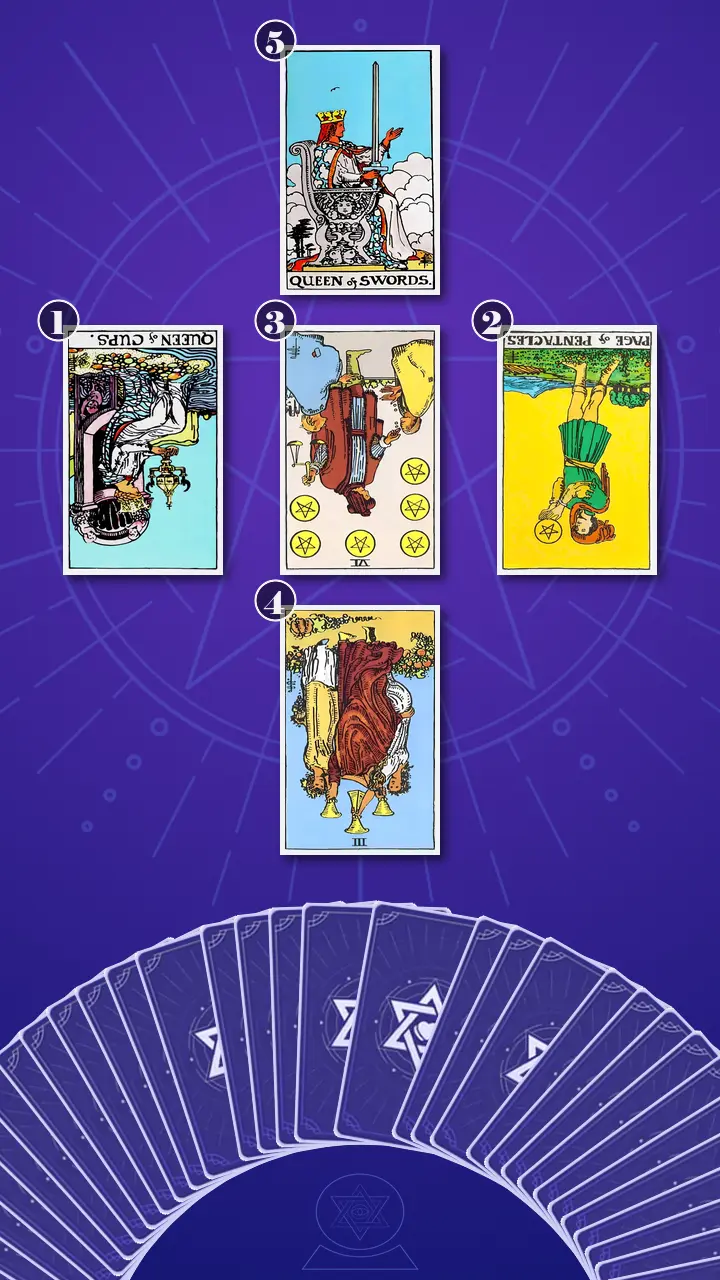
Reading the Pattern Beneath the Ping
Position 1: The Boundary That Dies in the Drafts
I turned over the card representing Maya’s current stance, unmet need, and the habit of over-giving that made the boundary collapse before it was spoken. It was the Queen of Cups, reversed.
I told her exactly what I saw in modern terms: 10:58 PM before an exam, the request comes in, and before she has even checked what she wants, she is already managing the other person’s possible feelings. In the Rider-Waite image, the Queen’s cup is ornate and closed. Her feelings are real, but they are sealed inside. Instead of saying, “I actually don’t want to send this tonight,” she performs ease. It is care in excess—so much emotional attunement that her own preference gets edited out.
“It’s the whole message-box loop,” I said. “You type the boundary. You read it back. You hear the imaginary version of them thinking you’re harsh. You delete it. Then you attach the PDF and tell yourself, it’ll take two seconds, even while another part of you is saying, I actually don’t want to do this.”
Maya froze with her water bottle halfway to her mouth. First her breath snagged. Then her eyes lost focus for a second, like she was replaying a familiar screen in her head. Then she laughed once, dry and embarrassed. “That is so accurate it feels rude,” she said. I smiled and shook my head. “Not rude. Precise. The problem isn’t that you’re kind. It’s that your kindness keeps getting forced into default open-access mode.”
Position 2: The Student Reaching for the Product
Next I turned the card showing the other person’s current stance and the practical motivation behind only reaching out before exams. It was the Page of Pentacles, reversed.
I was careful here, because this card is not a villain card. It looks less like malice and more like convenience mixed with poor preparation. In real life, this is the classmate who stayed quiet for weeks, built no real study system, and then appears twenty-four to forty-eight hours before the exam asking for the polished product they did not make. The Page’s attention is on the pentacle itself—the resource, the notes, the file, the practical payoff. This is effort in deficiency. They are reaching for access under pressure, not necessarily for closeness.
“So I don’t have to build a whole courtroom case about whether they’re secretly a terrible person?” she asked.
“Exactly,” I said. “You don’t need to diagnose their character. Just read the timing. If someone only becomes warm when they need your Google Drive, the timing is the information.”
Position 3: The Download Link at the Center
At the center of the spread—the place that defines the actual exchange pattern between them—I turned over the Six of Pentacles, reversed.
This was the card that made the whole thing legible. I described the scene plainly: Maya sends the neatly organized PDF or the shared folder link, gets a quick “lifesaver” and maybe two heart reactions, and the interaction ends the moment the resource lands. The scales on this card are tilted. The giving is uneven. Her notes have stopped functioning like a favor inside a mutual connection and started functioning like a one-click download link. It is a one-way tap: her labor flows out, and the exchange shuts off right after the thank-you.
“Kind doesn’t mean open access,” I told her. “And being useful is not the same as being valued.” I watched that sentence land. Her shoulders dropped a fraction. She exhaled through her nose and muttered, “Exactly.” That was the moment her resentment stopped looking petty and started looking informative. A quick yes can buy short-term peace and long-term resentment. This card was not calling her selfish. It was naming fairness.
Position 4: The Group-Chat Weather
Then I turned the card identifying the hidden block to boundary-setting—the fear of social fallout, awkwardness, or losing belonging. It was the Three of Cups, reversed.
I told her this was the deeper knot. The hardest part was not actually the notes. It was the class social web she imagined after the boundary. One firm text, and suddenly her mind was leaping to screenshots, weird group-chat weather, and the fear of becoming “the difficult one.” In this position, the card showed blockage: harmony had become more important than honesty, and the desire to feel included was quietly outranking self-respect.
“Campus life can feel like a tiny algorithm,” I said. “One awkward moment starts to feel like it could define your whole feed. But ask yourself something hard: are you protecting a friendship here, or are you protecting the fantasy that being endlessly easygoing guarantees belonging?”
She went very still. Her fingers tightened once around the sleeve of her sweatshirt, then loosened. Her gaze dropped to the card and stayed there. “I’m not scared of the notes,” she said finally. “I’m scared of the vibe after.” There it was—the belonging wound underneath the practical issue, clean enough to see.
When the Queen of Swords Changed the Share Settings
Position 5: The Sentence That Holds the Line
When I reached for the final card, the air in my room shifted. A late wind brushed the curtain beside my desk, and after four reversed cards full of spill, drag, and social static, the whole reading seemed to inhale. This last position shows the healthiest boundary posture and the communication quality that can turn private resentment into a clear next response. I turned it over: the Queen of Swords, upright.
I felt my own artist brain light up. Whenever I see this card after a spread like this, I think of my Mondrian Grid Method. A messy canvas does not become clear because the colors apologize to each other; it becomes clear because someone is brave enough to draw the black lines. So I divided Maya’s fog into clean blocks: her labor, the classmate’s urgency, the wider group vibe, and her rule. Only one of those blocks belonged to her. The Queen of Swords is not cold. She is structured. In modern life, she sounds like this: “I’m not sharing full notes before exams anymore, but I can tell you the topics I’m focusing on.” Precise limit. Open hand. No punishment. No blur. One queen absorbs the room; the other names the rule.
I could see Maya trapped in the familiar exam-night frame again in her mind—laptop open, color-coded notes glowing, phone buzzing, guilt arriving before preference had time to stand up. She had been acting as if clarity itself were unkind.
You do not need to keep proving you’re nice by over-giving; lift the Queen of Swords’ clear blade and let one honest sentence draw the line.
She stopped moving completely. Her hand hovered over her lip balm. Then her eyes drifted past my shoulder, unfocused, as if she were replaying every “hey stranger” she had answered with a smiley face. When she finally spoke, it wasn’t relief first. It was a flash of anger, quiet but real. “But then I’ve basically been training people to expect this,” she said.
“No,” I said, and I kept my voice steady. “It means you have been using the only tool that felt socially safe. Now you need a better one. You don’t need a courtroom case to set a study boundary. A boundary is not a punishment; it is a clear statement of what access to you does and does not include.”
That was when the change moved through her body. Her jaw unclenched first. Then her shoulders dropped, slow and surprised, as if they had been holding up more of the semester than she realized. Her eyes brightened—not with instant certainty, but with that slightly disorienting feeling that comes after a room finally gets proper light. Relief was there, yes, but so was a flicker of new vulnerability, the dizziness of understanding that if the path is clearer, the next step is now actually hers. I asked her, “Using this lens, was there a moment last week when one honest sentence would have changed the night?”
She nodded. “The one in Robarts. If I’d said it then, I probably would’ve felt uncomfortable for five minutes instead of resentful for the next two hours.”
I asked her to do something very unglamorous and very powerful right there on the call: open her Notes app and write one sentence that began with “I’m not sharing...” or “I can offer...” She typed slowly, stopped once to breathe out, then finished the line without adding a backstory. That was the hinge of the reading: not from kind to cold, but from resentment-and-guilt-driven over-giving to calmer, more selective generosity with clearer self-respect. From protecting the vibe at all costs to protecting her actual bandwidth.
The One-Sentence Access Rule
Taken together, the spread told a very clean story. Maya’s first instinct was accurate—she could feel the imbalance immediately—but her Queen of Cups reversed habit made her manage other people’s comfort before honoring her own. The other person was operating from convenience, not necessarily closeness. The Six of Pentacles reversed named the one-way note-sharing pattern for what it was: uneven access to real labor. And the Three of Cups reversed revealed the blind spot: she was treating short-term harmony as proof of belonging, when in reality the pattern was teaching her that keeping access open was the price of staying included.
I told her the transformation direction was simple, even if not emotionally effortless: move from proving you’re nice through over-giving to stating one simple access rule and letting other people’s reactions belong to them. Help had to become a choice with terms, not a social tax. I also told her I wanted her next move to be boring, repeatable, and small. The best boundaries usually are.
When she asked, “Okay, but what do I actually do the next time the text comes in?” I gave her three concrete next steps. I borrowed from two tools I use a lot: my Oscars Speech Training, which keeps people from turning a clean boundary into a nervous acceptance speech, and my Jazz Solo Planning, which means deciding your safe notes before the pressure hits.
- Save a screenshot-sized script tonightOpen your Notes app before bed and save one copy-paste reply for exam-week requests from classmates: “I’m not sharing full notes before exams anymore, but I can tell you the topics I’m focusing on.” Use it the next time someone reaches out last minute instead of drafting from scratch in the heat of the moment. This takes two minutes.I use my Oscars Speech Training here: if the boundary cannot fit comfortably in a screenshot, guilt will turn it into a full acceptance speech. One clean sentence can hold more than a paragraph of guilt.
- Do the 10-minute face-down pauseWhen the notification hits this week, put your phone face down for ten minutes before you reply. During that pause, write one line only: “What do I genuinely want to offer here, if anything?” Then check one body cue—jaw, shoulders, or breath—before you answer.If ten minutes feels impossible, make it two. Their urgency does not automatically become your emergency, and the pause is about interrupting reflex, not becoming cold.
- Pick one smaller-help option for this exam cycleChoose your limit in advance for this semester: no full PDFs, no sends after 8 PM, or topics-only replies. If you still want to help, offer one smaller alternative—chapters to review, topics likely to matter, or the course outline—instead of your full polished notes.This is my Jazz Solo Planning move: decide your three safe notes before the song starts. Consistency matters more than perfect wording, and you are allowed to offer less than full access.

A Week Later, the Quiet Proof
Six days later, I got a message from her with a screenshot. Someone had texted the night before a quiz. She pasted the line from her Notes app, offered topics instead of the full file, and stopped there. The reply she got back was short—“all good, thanks anyway”—and that was it. No social explosion. No tribunal. Just a momentary jolt, then silence.
She told me she slept properly that night. In the morning, her first thought was still, what if they think I’m difficult?—and then she laughed, made coffee, and opened Anki. Clear, but still human. That is usually how real change looks when a tarot reading lands: not a new personality, just one less self-betrayal and one sturdier piece of self-respect.
When belonging feels a little fragile, even a small “not this time” can hit your body like a social risk, which is why your stomach drops before you’ve even decided what you want to say.
If access to your notes stopped being the price of seeming easy to be around, what one simple share-setting—what one honest sentence—might feel clean enough to try next time?