From Guilt-Pressure to Measured Support: Saying Yes as a Bridesmaid

Finding Clarity on the 4/5 Train: The Heart Emoji That Felt Like a Contract
You got the “Will you be my bridesmaid???” text and suddenly you’re doing rent math, PTO math, and friendship math all at once—classic Sunday Scaries, but make it wedding season.
Jordan told me that line like she hated how accurate it sounded.
When she first booked with me, she described the exact moment: 8:47 AM on a Wednesday, wedged on the downtown 4/5, shoulders pinned between a tote bag and someone’s backpack. Her phone buzzed with the bridesmaid group chat; the screen glowed that too-bright subway-white under flickering fluorescents. She toggled to her bank app—just a quick check—then back to the chat, thumb hovering over a heart emoji like it was a legal signature.
She’d typed one version of the reply in Notes that was basically confetti: Omg yes of course!! She’d deleted it, rewrote it, deleted it again. You write I’m so excited. You think flights, dress, deposit, rent. You write anything you need. You think please don’t make this my whole personality for four months.
“I want to be there for her,” Jordan said when she sat across from me later that week, “but I can’t quietly bankroll this. And I’m scared my ‘reasonable’ boundary will sound like a rejection.”
The pressure wasn’t an idea in her voice—it was physical. A jaw held too still. A tight chest that made every sentence come out a notch higher than she meant. Her hands kept checking her phone face-down on the table, like another notification might land and decide the whole thing for her.
I nodded, slow and unflinching. “We’re going to treat this like a real decision, not a vibe. Not because you love her less—because you want your yes to be sustainable. Let’s make a map through the fog. This is a Journey to Clarity, not a performance review for being a ‘good friend.’”

Choosing the Compass: The Celtic Cross · Context Edition
I’m Luca Moreau—Paris-trained perfumer by trade, intuitive consultant by habit. I’ve spent fifteen years watching how tiny, invisible forces shape big human decisions: a top note that turns sharp on skin, a pause in a conversation that changes the whole room, a “sure!” text that becomes a months-long agreement.
I asked Jordan to take one breath that actually reached her ribs, then another. Not as a ritual for mystery—just a clean transition for her nervous system. I spritzed a paper blotter with a bright, cleansing citrus accord and set it near her water glass. “This is just to bring your body back online,” I said. “When we’re activated, we agree too fast.”
“Today,” I told her—and you—“we’ll use the Celtic Cross · Context Edition.”
It’s my go-to when someone’s stuck at a career crossroads-style fork, but in relationships: you’re feeling stuck, you’ve got decision fatigue, and the real issue isn’t the choice—it’s the fear underneath the choice.
This version keeps the classic Celtic Cross structure, but the positions are tuned for boundary-setting before commitment. It separates the emotional meaning of the invitation (why you care) from the pressure point (why you freeze), then tracks the path from fear-based compliance to clean communication. In other words: it shows how tarot works as a practical tool—pattern recognition, not prophecy.
Here’s what mattered most for Jordan:
Card 1 would name the true heart of the ask—what this invitation is really touching in her.
Card 3 would expose the root fear that makes boundaries feel socially dangerous.
Card 7—our key position—would show the exact inner stance she needs so her yes/no stays consistent once the group chat gets loud.
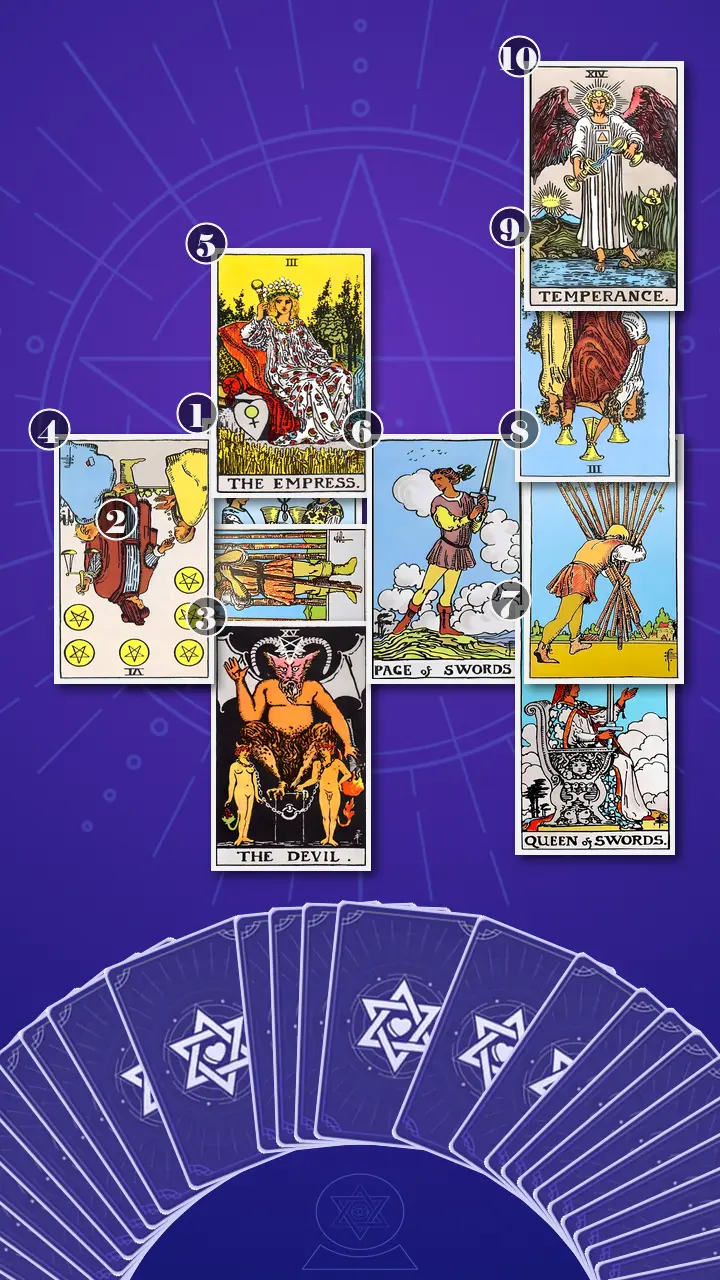
Reading the Map: From Two Cups to Loose Chains
Position 1: The invitation’s true core
“Now we turn over the card that represents the invitation’s true core—what this bridesmaid ask is really touching in you.”
Two of Cups, upright.
It was almost tender how quickly Jordan’s face changed. This card is the eye-to-eye moment: two people meeting as equals, each holding a cup, not one person pouring themselves out to prove something.
I said, “This is the real bond. The part of you that pictures standing next to her on the day and thinks, this matters. Not because you owe her—because the friendship is real.”
Then I anchored it in modern life, the way it actually shows up: this is like you wanting to say ‘I’m in,’ but only if the plan honors both people’s reality—time, money, bandwidth—instead of assuming unlimited availability.
Energy-wise, the Two of Cups is balance. It’s mutuality. It’s a reminder that the healthiest bridesmaid yes is a shared agreement, not a one-sided absorption of stress.
Jordan let out a small laugh that wasn’t amused—more like the sound you make when something lands too close. “That’s… annoyingly accurate,” she said. “Like, it’s sweet, but also—” She shrugged. “It’s a lot.”
“Yeah,” I said. “Sweet doesn’t mean scope-free.”
Position 2: The boundary pressure point
“Now we look at the boundary pressure point—what makes you hesitate or over-agree before you’ve clarified terms.”
Nine of Wands, reversed.
I pointed to the bandage, the guarded stance—then flipped the meaning into what reversal often shows: not heroic resilience, but the brittle edge of someone who has already been carrying too much.
Modern translation: this is like opening the chat and immediately thinking, ‘Here we go again,’ because you’re remembering past times you got stuck doing more than you agreed to.
In energy terms, this is a deficiency—stamina is low—and also a blockage: the boundary doesn’t come out as calm clarity. It comes out later as fatigue, avoidance, or that quiet “soft ghosting” that makes you look flaky even when you care.
I asked her the question I always ask with this card: “What’s the first ‘small’ task you would resent if it landed on you?”
Jordan didn’t even have to think. “Planning calls,” she said. “Because they’re never one call. It turns into Calendly links multiplying like gremlins.”
“Good,” I said. “That’s your early-warning system. Resentment isn’t a character flaw—it’s a dashboard light.”
Position 3: The root fear driving people-pleasing
“Now we turn over the root fear—what you believe is at stake if you set limits.”
The Devil, upright.
The room got quieter in that way it does when the truth shows up without asking permission. Even the street noise outside my window seemed to thin for a second, like the city took a step back to listen.
This card doesn’t mean you’re doing anything wrong. It means something inside you is treating this invitation like a trap.
Modern translation: this is you feeling like you have to earn your place in the friendship by being endlessly accommodating, even though no one explicitly asked for that level of sacrifice.
I used the echo technique I trust here—because shame is sneaky, and this card can sting if you name it bluntly.
“Think of it like a loyalty subscription you never agreed to,” I said. “Auto-renew guilt. Hidden fees. And cancellation panic.”
Then I gave her the inner monologue in three beats, like I was reading it off her body:
“(1) The fear thought: ‘If I set limits, I’ll lose her.’ (2) The body response: jaw tight, stomach drop, that little spike when the chat pings. (3) The reality-check sentence: ‘That’s fear talking, not a contract.’”
Jordan swallowed hard—one of those swallows that’s not about water. Her gaze went slightly unfocused, like she was replaying a dozen group-chat moments on fast forward. Then she exhaled, quiet.
I added the line she needed right then, the one that releases the hook without judging her for having it: A boundary is not a breakup—it's a scope.
And because The Devil loves to disguise itself as morality, I said it plainly: “Belonging-through-compliance is a scam. You don’t have to buy safety with overextending.”
Position 4: The prior pattern shaping expectations
“Now we look at the prior pattern in your friendship or group roles that shapes what people expect from you.”
Six of Pentacles, reversed.
This is the fairness card—scales, giving, receiving—turned upside down. Not villainy. Imbalance.
Modern translation: this is like saying ‘Don’t worry, I’ll cover it,’ and later realizing you’re the only one stretching your budget and schedule to make everything work.
In energy terms, it’s an excess of giving and a deficiency of receiving. The pattern trains people. Not because they’re evil—because humans learn what the system allows.
Jordan nodded too fast, like she was embarrassed to be seen. “I’m always the one who makes it happen,” she said. “Even when I’m trying not to be.”
“That’s important data,” I told her. “Because this bridesmaid ask didn’t land on neutral ground. It landed on your existing ‘reliable one’ brand.”
That word—brand—made her grimace in recognition. Marketing managers don’t get to pretend brand isn’t real.
Position 5: Your conscious intention
“Now we turn over your conscious intention—what you want your support to represent without self-betrayal.”
The Empress, upright.
This card is warmth with resources. Not martyrdom. Not hustle-helping. It’s the version of support that’s fertile and steady.
Modern translation: this is you wanting to be genuinely supportive—showing up, cheering, helping—while also needing your support to fit inside your real life rather than taking it over.
Energy-wise, the Empress is abundance—but abundance is not the same as limitlessness. It’s having enough because you’re rooted in what’s real: time, money, nervous system capacity.
“Your yes comes from warmth,” I said. “And the boundary you need is the one that protects your capacity to stay kind. Because resentment is what actually threatens closeness.”
Jordan’s shoulders lowered a fraction, like her body preferred that framing: boundaries as relationship-care, not rejection.
Position 6: The next practical opening
“Now we turn over the next practical opening—what clarity step is available before you decide.”
Page of Swords, upright.
This is the turning point where emotions stop spinning and language becomes a tool. The Page doesn’t promise it’ll be comfortable. It promises it’ll be clear.
Modern translation: this is you choosing to ask, ‘What are the actual events and costs?’ instead of trying to guess and then feeling trapped by your own assumptions.
And per our echo design, I gave her a script swap—something that would feel normal in her world.
“Replace ‘I’ll see’ with: ‘Quick questions so I can commit honestly.’ Treat it like project scoping,” I said. “Because that’s what it is.”
I slid her a three-question micro-list, the kind you could screenshot and send without turning it into a TED Talk:
“1) What events are you thinking (shower/bach/rehearsal)? 2) Is there a rough budget range? 3) Are you expecting bridesmaids to plan anything, or is someone leading?”
Jordan’s face softened with actual relief. “Wait,” she said, like she was testing whether she was allowed to do this. “I can ask that?”
“Yes,” I said. “Don’t send a vibes-based yes to a logistics-based role.”
When the Queen of Swords Spoke: The Line That Protects the Friendship
Position 7 (Key Card): Your strongest boundary skill
“Now we turn over the card that represents your strongest boundary skill—the inner stance to embody so your yes/no stays consistent.”
Queen of Swords, upright.
The air in the room changed—cleaner, sharper, like a window cracked open after something heavy. This was the core of the reading.
Setup (the trap you’ve been living in): Jordan was stuck in that subway moment on repeat—chat open, bank app open, thumb hovering over “send,” trying to sound thrilled while quietly doing rent math. She wasn’t choosing a role; she was trying to avoid being misread.
Delivery (the sentence that cuts through the fog):
Stop trying to be the ‘easy’ bridesmaid and start being the honest one—hold your boundary like the Queen of Swords holds her sword: upright, simple, and impossible to misunderstand.
I let the silence sit. Not dramatic—just enough for her nervous system to hear the difference between performing and deciding.
Reinforcement (what happened in her body, in layers): First, Jordan went still—like her breath paused at the top of her chest and her hands forgot they were gripping her phone. Then her eyes unfocused for a second, as if she was replaying every message she’d over-edited to sound “chill.” Her jaw—so tight when she arrived—shifted, the muscles loosening as if they’d been waiting for permission. Finally, she exhaled through her nose, a shaky little release that sounded half like relief and half like grief.
“But if I’m that direct,” she said, and there it was—an unexpected flash of anger under the fear—“doesn’t it mean I’ve been doing it wrong? Like… I’ve been lying?”
I didn’t rush to soothe her. I stayed with the truth of the moment. “It doesn’t mean you were lying,” I said. “It means you were surviving the social pressure with the tools you had. The Queen isn’t a weapon. She’s a line.”
This is where my Social Pattern Analysis comes in—the way I diagnose hidden interaction barriers. “In group dynamics,” I told her, “people-pleasing creates a foggy interface. Everyone keeps tapping the same button—Jordan will handle it—because the system has learned that’s what works. The Queen changes the interface. One clean sentence rewrites the social pattern.”
Then I gave her the technique, exactly as promised: one honor + one limit + one offer (optional). And the anti-overexplaining cue that makes it stick:
Stop after the period.
I set a 10-minute timer on my phone and handed her my notebook. “Two lists,” I said, “like a formula.”
“I can do (max three items). I can’t do (max two). Turn each ‘can’t’ into one clean sentence. No apology padding.”
She started writing. Halfway through, her chest tightened—she actually pressed her palm to it, surprised. I nodded at the signal like it was useful information, not a verdict. “Shorten it by half,” I said. “If you start drafting paragraphs, you’re trying to manage someone else’s feelings.”
Then I asked, exactly as I always do at the hinge of a reading: “Now, with this new lens, can you think of one moment last week where you could’ve said one clean sentence—and your body would’ve felt different?”
Jordan stared at the corner of the table, then smiled once, small and tired. “Friday,” she said. “Destination bachelorette idea. Everyone heart-reacted. I heart-reacted. I opened Google Flights like I was possessed.”
“That’s the shift,” I said gently. “From pressure-driven compliance to grounded self-respect. From performing ‘easygoing support’ to stating your terms.”
Position 8: External expectations and logistics
“Now we turn over the card for external expectations and logistics—what the wedding system may assume from you.”
Ten of Wands, upright.
Jordan actually laughed—rueful, immediate. “Of course,” she said.
Modern translation: this is you getting added to planning threads, errands, and ‘quick favors’ until you’re suddenly doing weekly labor for an event that isn’t yours.
I painted the sensory mini-scene, because this is how scope creep becomes real: phone buzzing in bursts, calendar blocks filling, shoulders rising toward your ears while you tell yourself it’s fine. One “quick favor” becomes three planning calls, two Venmo requests that hit at 11:30 PM with a “no rush :)”, and a spreadsheet you didn’t ask to own.
Energy-wise, this is excess—too much load—and the cost is visibility. The figure in the card can’t see where they’re going because their arms are full. That’s what unclear agreements do: they block your line of sight to your own life.
“This is why boundaries have to happen before the pile forms,” I said. “Afterward, it feels personal. Beforehand, it’s just planning.”
Position 9: Social hopes and fears
“Now we look at social hopes and fears—what you’re afraid will happen socially if you set a boundary, and what you’re secretly hoping for instead.”
Three of Cups, reversed.
This is the group-chat card. Upright, it’s celebration. Reversed, it’s cliques, comparison, performative fun, and that awful sensation that an emoji can rank you.
Modern translation: this is you worrying that if you can’t do the expensive trip, you’ll be quietly judged in the group or feel like the odd one out at every wedding event.
I said the line that often unlocks this position without blaming anyone: Belonging you have to buy isn’t belonging.
Jordan’s eyes flicked up to mine—quick, searching—then she nodded once, grounded. The fear wasn’t that the bride would hate her. The fear was being seen as the difficult one in a circle that moves fast and rewards enthusiasm.
“Your hope,” I said, “is to feel included without going broke or burning out. To be able to celebrate without being swallowed.”
Position 10: The most empowering direction
“Finally, we turn over the most empowering direction—what a sustainable yes (or a clean no) looks like emotionally and practically if you lead with clarity.”
Temperance, upright.
As a perfumer, I can’t see Temperance without thinking of formulation: not more of everything—the right ratio. Two cups, poured back and forth until the blend becomes stable on skin.
Modern translation: this is you agreeing to the ceremony and a local dinner, declining a costly trip, and staying genuinely supportive because you aren’t secretly overwhelmed.
Energy-wise, Temperance is balance and integration. Not all-in. Not all-out. Measured participation that stays kind over time.
“This is the outcome I want for you,” I told her. “Support that’s real and sustainable rather than performative.”
From Insight to Action: The One-Page Bridesmaid Scope (and a Little Sillage Control)
Here’s the story the spread told, cleanly: the invitation is real love (Two of Cups) and real desire to nurture (Empress). But you’re walking in with depleted stamina and a history of being the reliable organizer (Nine of Wands reversed + Six of Pentacles reversed). The root driver isn’t actually the dress—it’s guilt-based loyalty that turns an invitation into a trap (The Devil). Without terms, the wedding machine will stack tasks until you can’t see your own calendar (Ten of Wands). And the social fear—being judged in the group—tempts you back into compliance (Three of Cups reversed). The antidote is the Queen of Swords: one clean sentence, early. The integration is Temperance: a measured yes you can actually follow through on.
Your cognitive blind spot is thinking that warmth requires flexibility, and that clarity is “drama.” In reality, vagueness is what creates drama later. The transformation direction is exactly this: move from performing ‘easygoing support’ to stating two or three concrete non-negotiables before you commit.
And because I’m me, I’ll add one more practical layer from my perfumer’s toolkit. Think of your boundary like sillage—the trail a fragrance leaves. Too much, and it floods the room. Too little, and nobody can read you. First impression calibration through sillage control means: short message, clear projection, no extra cloud of justification. Your boundary should be detectable—and contained.
Here are your next steps—actionable advice, not a personality transplant:
- Send the 3-question clarity text (24–48 hours)Text the bride: “I’m so honored. Quick questions so I can commit honestly: 1) What events are you thinking (shower/bach/rehearsal)? 2) Is there a rough budget range you want everyone to stay within? 3) Are you expecting bridesmaids to plan the bachelorette, or is someone leading that?”If your nervous system spikes, keep it text-based and send it during a calm window—not late-night doom-scroll time.
- Write your two non-negotiables as numbersBefore you reply “yes,” decide: “$___ total cap” and “___ PTO days max for wedding-related travel.” Put them in Notes like they’re real constraints—because they are.Treat it like logistics, not a moral debate. Numbers reduce spiraling and make your boundary easier to repeat.
- Use the Stop-After-the-Period scriptDraft one sentence: “I’d love to be there with you, and I’m not able to do a destination bachelorette.” Add one optional offer only if it’s true: “I can do a local night out or help with something smaller here.” Then stop after the period.Write three versions (long/medium/Queen-short) and only send the shortest. If someone pushes, repeat once without adding new justifications.

A Week Later: Ownership, Not Certainty
A week after our session, Jordan texted me a screenshot: her message to the bride—short, warm, unmistakable. Three questions. One budget cap written down. One clean sentence about the destination bachelorette. No paragraph. No apology essay.
“She said ‘totally get it’ and answered everything,” Jordan wrote. “And I didn’t throw my phone across the apartment.”
It wasn’t a fairytale ending. It was better: a small proof that her belonging didn’t evaporate the moment she became specific.
She told me she slept through the night for the first time in days. In the morning, her first thought was still, What if I’m the difficult one?—but this time she exhaled and thought, I’m the honest one. Then she made coffee and didn’t open Google Flights.
That’s what I mean by a Journey to Clarity: not certainty, not perfection—ownership. A sustainable yes. A clean no. Measured participation that stays real.
When you’re trying to be the easiest person to love, even a happy invitation can feel like a test you can’t afford to fail—so your chest tightens while you type a “yes” that doesn’t include you.
If you trusted that your belonging doesn’t need to be earned through overextending, what’s the smallest, clearest boundary you’d be willing to say out loud before you commit?
Every reading at AceTarot is a Journey to connect with inner wisdom and empower next step.
Learn more about our Journey to Clarity.