When They Forgot Your Birthday: Leaving Excuses for One Honest Text

Finding Clarity in the 11:47 PM Thread Spiral
When Maya (name changed for privacy) sat down across from me, I knew her real question was bigger than, “They forgot my birthday—should I say something?” What she was really asking was the thing people type into Google after midnight: how do I bring up a forgotten birthday without sounding needy?
She told me about a Wednesday at 11:47 PM in her condo kitchen in Toronto: the fridge buzzing, streetlight cutting through the blinds, her phone warming her palm as she scrolled back to the date and watched her own thumb hover over “hey, can I be honest?” The tile was cold under her bare feet. Instagram had already served her three birthday-dinner Stories from Ossington, all candles and clinking glasses, and now her chest felt heavy in that specific way small hurts do when they are no longer small.
She said, “I know it’s just a birthday, but it still stung.”
I nodded. “Explaining it away does not make it hurt less.” Then I told her the sentence I felt land in the room right away: “You keep calling it small; your body keeps treating it like it mattered.” Her throat tightened just hearing that, and I could see the deeper split underneath it—the wanting to be acknowledged, and the fear that naming the hurt would make her look like too much. “Let’s not force a verdict tonight,” I said. “Let’s make a map and find some clarity.”

Choosing the Compass: How This 4-Card Tarot Spread Works
I asked Maya to put both feet on the floor and take one slow breath while I shuffled. I do not treat that as a mystical performance. It is simply the moment where the nervous system stops doom-scrolling and starts noticing what is actually true.
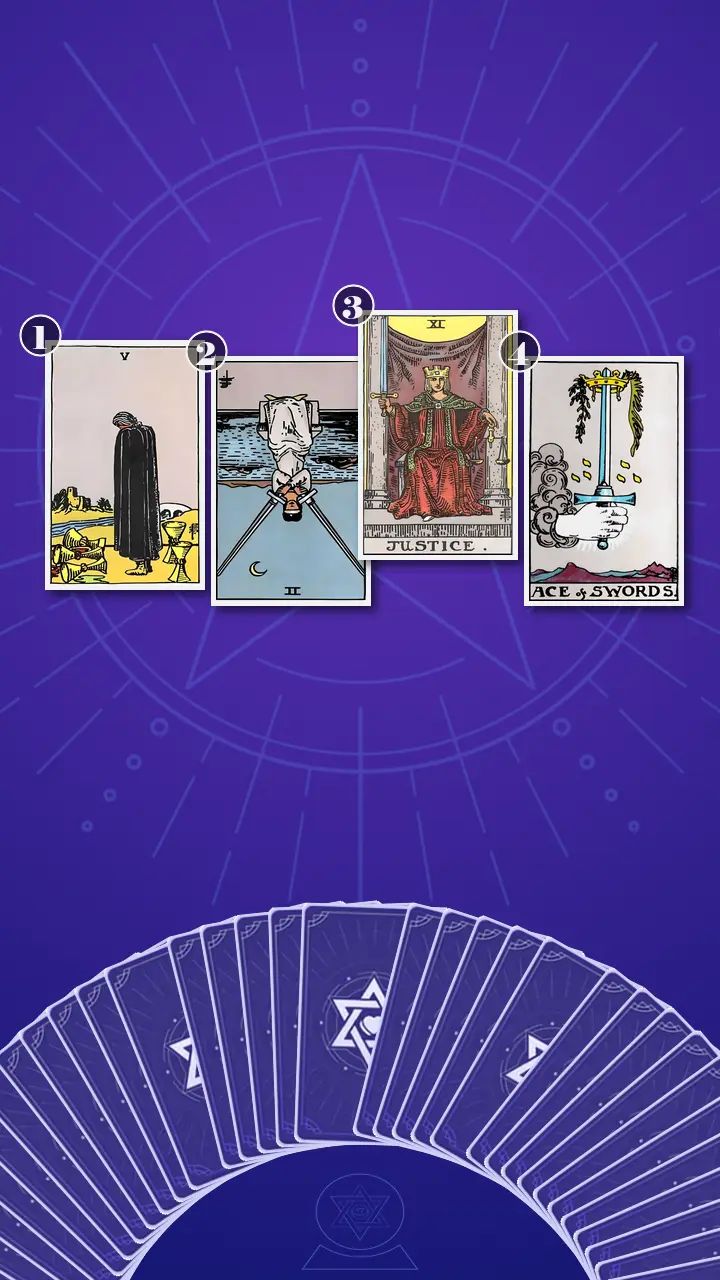
For her, I used a four-card spread I rely on often for relationship communication: Situation-Obstacle-Advice-Outcome · Context Edition. When people ask me how tarot works in a real-life dilemma like a missed birthday text, this is the kind of structure I trust most. It is compact enough to stay honest, but complete enough to show the whole mechanism: the visible hurt, the internal block, the corrective principle, and the next step. In other words, present symptom, deeper block, boundary truth, actionable clarity.
I laid the cards left to right in a clean line, with the third card slightly raised. I told her why. “The first card will show the immediate hurt and the pattern of minimizing it. The second will show the self-protective story keeping you frozen. The third is the hinge—your boundary principle, the part of you that knows what fair acknowledgment sounds like. And the fourth will not predict their response. It will show the grounded communication step that gives you real information.”
That matters to me. I do not use tarot to tell people what another person secretly meant. I use it for card meanings in context, so the reading helps us stop guessing and start seeing.
Reading the Bridge from Hurt to Honesty
Position 1: The Cup That Kept Spilling at Midnight
I turned over the first card. “This position presents the immediate hurt and the concrete pattern of minimizing it after the forgotten birthday.” The card was Five of Cups, upright.
I told Maya this card was painfully precise. In modern life, it looks like turning the forgotten birthday into a tiny emotional crime scene you keep revisiting: scrolling back to the date, rereading the thread, watching yourself minimize it in real time, and letting one omission eclipse the rest of the relationship before you have even decided what it means. The energy here is real feeling, but with fixation in excess. Water is doing its job by telling the truth of disappointment; attention is getting stuck on the spill.
I pointed to the image in the card as I read it: the three spilled cups, the dark-cloaked figure bent toward what is gone, the bridge still waiting in the background. “What hurts,” I said, “is not only the silence. It is the stack of meanings underneath it—thoughtfulness, effort, being held in mind. The bridge here is the conversation you have not crossed into yet.”
Maya let out a quick, Fleabag-dry laugh and shook her head. “That’s so accurate it’s almost rude.”
“Good,” I said gently. “Because this card is where we stop pretending your reaction needs a stronger legal basis before it counts.” Her fingers, which had been gripping the sleeve of her sweater, loosened a little. The first layer of shame had started to lift.
Position 2: The Draft That Called Itself Maturity
I turned to the next card. “This position reveals the self-protective story that keeps you frozen between speaking up and staying quiet.” The card was Two of Swords, reversed.
This one gave me the exact texture of her stalemate. In modern life, it is the deadlock of drafting and deleting the text, trying to find a tone that names the hurt without sounding high-maintenance, until the effort to stay neutral becomes its own kind of suffocation. The energy here is blocked Air: thought trying to control feeling so hard that both end up jammed.
I told her it was very Severance. There was the polished startup version of her who could answer six Slack messages, set birthday reminders for everyone else, and keep the whole emotional calendar running. Then there was the private version on the edge of the bed after midnight, in the phone glow, replaying the same loop: If I say it, I sound like too much; if I do not, I cannot stop thinking about it. The train keeps moving. The conversation does not.
Her jaw shifted as if she had only just noticed how tightly she was holding it. I watched her inhale, pause, and look down at the cards instead of at me. That was the recognition I wanted. Deep synchronization, not dramatic agreement.
“This is the point,” I told her, “where self-silencing starts dressing itself up as maturity.” I let that sit for a beat, then added the line I knew she needed before we moved on: “You do not need a closing argument to name a bruise.”
When Justice Put the Hurt on the Scales
Position 3: The Boundary Keeper
When I turned over the third card, the room seemed to straighten with it. Even the soft radiator noise in the corner faded into the background. “This position identifies the boundary principle or inner truth that can interrupt the excuse-making loop,” I said. The card was Justice, upright.
By this point, Maya had spent days in the same late-night thread spiral—phone light on her face, chest heavy, trying to decide whether the real problem was that they forgot or that she still cared enough to feel hurt. She had been acting like the only safe move was to be the least inconvenient version of herself.
“This is not about proving you are low-maintenance; it is about placing the hurt on the scales and letting honesty weigh more than excuses.”
I paused after I said it. Maya went still in three clear beats. First came the physical freeze: her breath stopped halfway in her chest, and her hand hovered over the table like she had forgotten what she was about to do. Then came the cognitive shift: her eyes lost focus for a second, as if she were replaying the chat thread, the birthday date, the Instagram posts, all of it, but through a different lens. Then came the release: a long exhale from deep in her ribs, shoulders dropping so suddenly it was almost visible relief. Her eyes shone, not with full tears, but with that startled brightening that comes when someone realizes they have been arguing against themselves for days.
Then the complicated part arrived, exactly where real insight usually hurts a little. She frowned and said quietly, “But if that’s true, then I’ve been harder on myself than on them.”
“Yes,” I said. “And that does not make you foolish. It means you were protecting belonging the only way you knew how.” I felt my old Wall Street instincts flicker to life then; Justice always does that to me. Back on the trading floor, the most dangerous number in a model was often the cost nobody bothered to enter. So I used one of my own diagnostic tools with her, what I call Opportunity Cost Visualization. “If we weigh the options honestly,” I said, “silence is not the neutral choice. Silence has a carrying cost: more midnight decoding, more resentment, more self-doubt, and no new data. One honest sentence has short-term discomfort, yes—but it also has the only real chance of clarity.”
I leaned forward slightly. “Needing acknowledgment is not the same as begging for care. Justice is not a courtroom. It’s a fairness check: impact versus accusation. You are allowed to say what landed without turning it into a prosecution.”
Then I asked her, “Now, with this new lens, think back to last week—was there a moment when this insight could have changed how you felt?”
She gave a small, almost embarrassed smile. “Honestly? The second time I reopened the thread. I would’ve stopped trying to make myself sound chill in my own head.”
That was the hinge of the whole reading: from self-silencing and excuse-making to clear self-respect and relational clarity. Not certainty. Not control. Just a steadier standard that finally included her.
Position 4: The Sentence That Could Actually Be Sent
I turned over the final card. “This position points to a grounded next step in communication that restores clarity without forcing an outcome.” The card was Ace of Swords, upright.
This card always feels like clean air after a stuffy room. In modern life, it is the moment the Notes app draft gets shorter instead of longer. No essay. No padded legal brief. Just one direct message clear enough that the relationship has to respond to reality instead of her silence. The energy here is balanced, refined Air: thought serving truth instead of hiding it.
“A clean sentence gives reality something to answer,” I told her. “This is the subject line, not the whole memo.” I gave her a simple example out loud: “Hey, I want to be honest about something. When my birthday passed without a message, it stung. I’d like to clear the air if you’re open.”
She looked at me, then back at the Ace, and I could see the fear was still there—but now it had company. There was relief in it too. The kind that comes when the path forward is exposed enough to make your stomach flip, but no longer foggy. That is the difference between clarity and control. She could choose the sentence. She could not choose the response.
From Private Courtroom to Boardroom Clarity
When I pulled the four cards together, the story became simple in the best way. First, the forgotten birthday genuinely hurt, and the hurt mattered because being remembered carries meaning for Maya. Then the overthinking kicked in—not because she lacked intelligence, but because she had learned to equate being easygoing with being lovable. That is why the private courtroom started running: she kept translating the other person’s behavior generously while treating her own feelings like weak evidence needing extra proof. Justice interrupted that distortion. The transformation direction was clear: move from proving you are low-maintenance to stating what mattered and observing how the relationship responds.
Her blind spot was not that she cared too much. It was that she kept holding herself to a harsher standard than the other person. She worried more about sounding fair than about whether she was abandoning herself. Once she saw that, the next steps became practical.
Maya looked at me and said, “I get it in theory. But I honestly don’t have these perfect ten-minute windows after work. By the time I do, I’m already in bed and spiraling.”
I smiled. “Then we do not wait for the perfect window. We use the smallest doorway available.” I gave her a version of my 10-minute rapid assessment and one boardroom-style decision tool—not to turn love into a spreadsheet, but to stop vague dread from running the meeting.
- The 10-Minute Fact-Impact-Invitation DraftOpen your Notes app on your lunch break, on the TTC, or before bed. Write only three lines: what happened, how it landed, and one simple invitation. Read it out loud once while standing up with both feet flat, then set a 10-minute timer and stop when it ends.If the old loop says it sounds dramatic, remember this: naming impact is not the same as putting someone on trial. Do the clean version, not the perfect version.
- The Boardroom-Style Medium CheckBy Friday, score text, voice note, and in-person from 1 to 5 on three criteria: likelihood you will actually do it, likelihood you will stay plain, and likelihood you will start calm. Pick the highest total. Choose the medium that makes honesty most likely, not the one that looks coolest.If you are torn, cap the message at three sentences max. The goal is follow-through, not performance.
- The Throat-Chest-Stomach PauseThe next time you feel the urge to reopen the thread late at night, put one hand on your chest and one on your throat for 60 to 90 seconds before touching your phone again. Name one feeling in plain words—hurt, embarrassed, resentful, lonely—then ask what you are trying to avoid by explaining it away.Do it while the kettle boils or while brushing your teeth. Small counts. The point is to interrupt the spiral before it becomes the whole night.
I told her these were next steps, not commandments. The whole point was to make room for low-drama acknowledgment. One honest message. One clearer read. Let the response reveal the capacity.

A Week Later: Ownership, Not Certainty
Five days later, I got a message from Maya. She had sent the three-line text on Friday evening from outside St. Andrew station, before she could talk herself into a longer disclaimer-filled version. Afterward, she sat alone with an iced coffee for twenty minutes, a little shaky, a little sad, and deeply relieved. The next morning, she told me, her first thought was still, “What if I made it awkward?” But this time she caught the thought, smiled at it, and did not let it run the day.
That is the kind of proof I trust most. Not a cinematic ending. Not instant certainty. Just one person who stopped submitting her feelings to an internal review board before letting them speak. This four-card Situation-Obstacle-Advice-Outcome tarot spread for a forgotten birthday conversation did exactly what I hoped it would do: it moved her from self-silencing and excuse-making toward clear self-respect and a more truthful read of the relationship in front of her.
So many of us know the feeling of staring at a quiet thread with a tight throat and heavy chest, trying to decide whether asking to be remembered will make us harder to keep.
If you let go of sounding effortlessly okay for just a moment, what simple truth would you want to place on the scales and let this relationship hear?