Performing Family Harmony in Photos: Choosing One Clean Truth
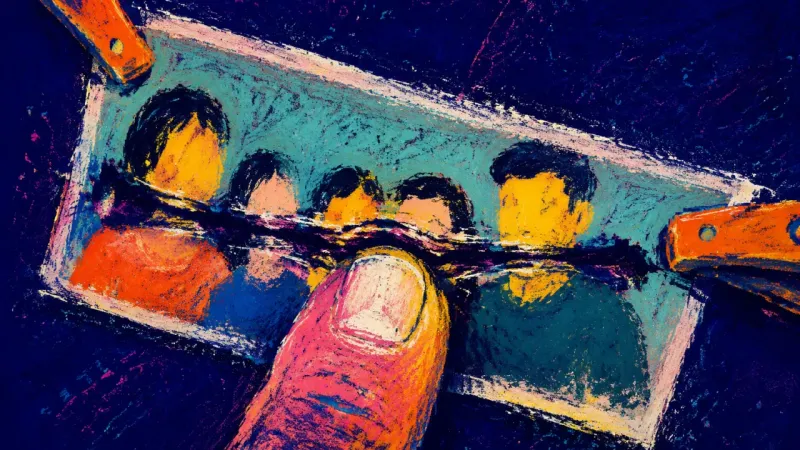
The Smile That Arrived Before the Choice
I met Maya (name changed for privacy), a 28-year-old Toronto project coordinator who could make a chaotic client deck look calm by 6 p.m. She was skilled at turning disagreement into a clean timeline, a tidy Asana board, and a Slack update in which every stakeholder appeared aligned. The same skill followed her home. When a family camera appeared after a strained conversation, she automatically straightened her shoulders, arranged the people around her, and made the moment look easier than it had felt.
She told me about the previous Sunday at precisely 3:16 p.m. in a North York dining room. She had still been holding her fork when a dismissive joke landed and the conversation collapsed into a silence no one wanted to examine. The overhead light hummed above lukewarm roast potatoes. A relative lifted a phone, the flash caught in a glass of water, and someone said, “Come on, everyone in.”
“My cheeks lifted before I even thought about it,” Maya said. “I leaned in, told everyone where to stand, and checked the photo afterward. All I could think was, ‘If my face shows what just happened, I’ll become the problem.’”
Her question was not whether she loved the people in the photograph. It was why she kept producing performative family harmony when her jaw was locked, her breath was barely reaching her ribs, and part of her wanted someone to notice. She described a guarded sadness that felt like rain trapped behind a laminated project dashboard: everything on the surface showed green, while pressure gathered where no one could see it.
“Why do I keep pretending we’re fine in every family photo?” she asked. “I don’t want to ruin the moment, but I’m not even sure whose moment I’m protecting.”
I told her, “You can love the people in the picture and still feel alone in the moment it was taken. Those truths do not cancel each other out.” I also made clear that I would not use tarot to pronounce her family healthy, broken, safe, or doomed. I wanted to help her see the pattern between the tense room and the polished image, then identify where an actual choice might become available. “Let’s give this fog a structure,” I said. “The clarity we’re looking for is not a verdict on your family. It is a more accurate view of what happens inside you when the camera comes out.”
A Focus Mark for the Five-Card Shadow Spread
I asked Maya to place both feet on the floor, take one ordinary breath, and hold the question without trying to improve it. I shuffled slowly. The pause was not a supernatural ceremony; it was a transition from rehearsing the family story to observing the mechanism beneath it.
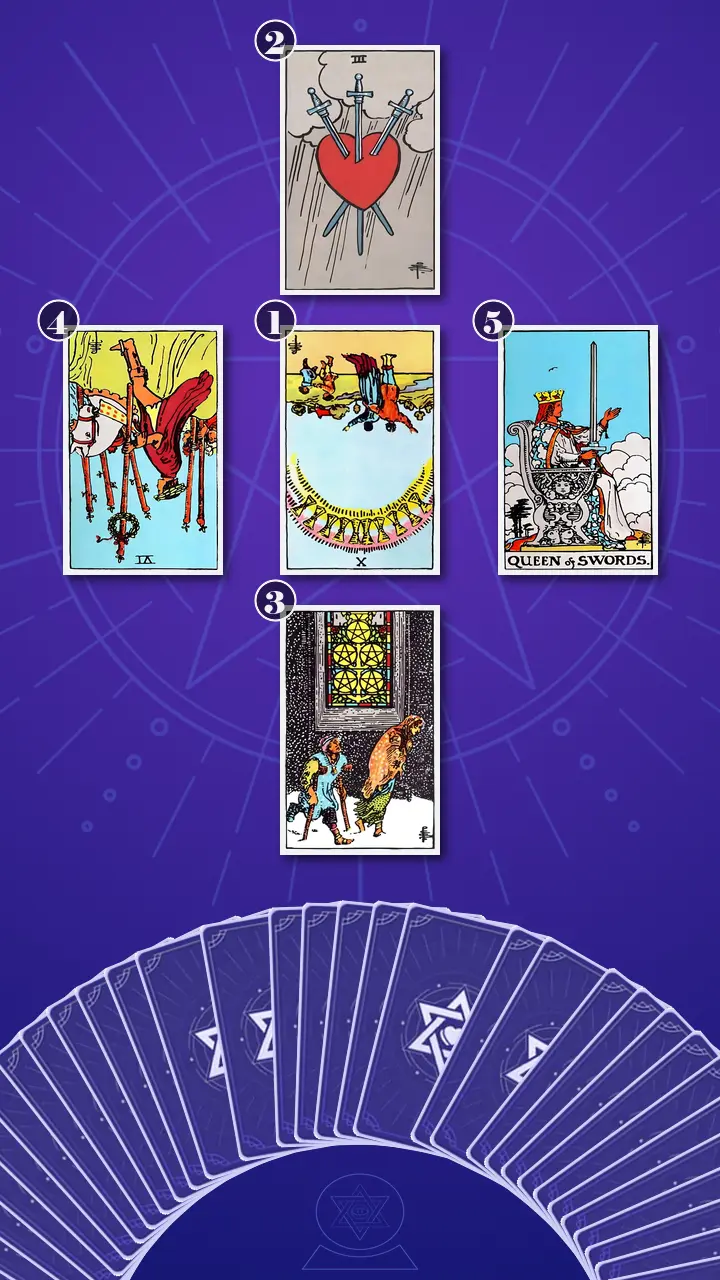
I chose the five-card Shadow Spread and placed it in a cross. For anyone wondering how tarot works in a question like this, I use the cards as an external cognitive map rather than a prediction device. Card meanings in context can make an automatic emotional sequence visible, allowing a person to examine it without treating every fear as fact.
The center card would show Maya’s family-photo persona: the smile, the physical closeness, and the visual management other people could see. The vertical axis would reveal the feeling edited out of the frame and the protective fear underneath it. The left-hand card would show the habit that kept the performance running, while the right-hand card would offer an integrative response. The layout resembled a camera’s focus mark over a developing photograph: what was visible at the center, what lay above and below it, and where a different choice could enter.
This tightly focused structure suited Maya’s question better than a larger predictive spread. She was not asking me to analyse every relative or forecast the next family gathering. She was asking why her own expression changed before she consciously chose it. Persona, hidden feeling, protective fear, maintaining pattern, and integration were the smallest sufficient sequence for answering that question responsibly.
Reading What the Camera Kept Out
The Rainbow Everyone Knows How to Post
The first card I turned occupied the family-photo persona position, revealing the observable smile, physical closeness, and image management Maya used to make the relationship appear uncomplicated. It was the Ten of Cups, reversed.
In the Rider-Waite-Smith image, ten cups form a rainbow above a celebrating family. Arms are raised, children dance, and a home waits in the distance. It is almost aggressively photo-ready. Reversed, however, the card did not declare that Maya’s family lacked love or that every happy moment was false. It revealed a blockage between the ideal of harmony and the relationship as she actually experienced it.
I described the moment when Maya became the art director of the family feeling. A tense comment had barely landed, but the camera appeared, so she raised her cheeks, pulled everyone closer, checked the lighting, agreed to another take, and selected the frame that could have opened a perfect Instagram holiday carousel. The scene reminded me of The Bear: warmth, history, irritation, loyalty, and unresolved pain can occupy the same table. A bright photograph may capture the warmth without resolving anything else.
I read the reversed water energy as a blockage intensified by overcorrection. The harder Maya tried to reproduce the Ten of Cups rainbow, the less permission remained for the emotional weather inside the room. The image improved while her access to her own reaction narrowed. Her helpfulness created immediate relief because no confrontation occurred, but it also kept genuine closeness and successful presentation from being measured separately.
Maya gave a short laugh with no amusement in it. “That’s so accurate it’s almost cruel.” Her fingertips pressed against the edge of the table, and her smile appeared for half a second before she caught it happening again.
“I understand why it stings,” I said. “But the card is not accusing you of being fake, and it is not erasing the affection that does exist. It is showing us that the photograph has been given two jobs: preserve a memory and certify that the whole relationship is fine. One image cannot do both reliably.”
I asked her what happened first when someone said “photo”: did she change her expression, move closer, or make herself useful? She answered immediately. “I organize everyone. If I’m directing the shot, I don’t have to feel what was happening before it.”
The Sentence Beneath the Caption
The next card I turned represented the feeling edited out of the photograph: the guarded hurt, disappointment, or longing the harmonious image could not express. It was the Three of Swords, upright.
I placed its gray rain beside the reversed Ten of Cups rainbow. The contrast was direct. The exposed heart did not ask Maya to condemn the entire family relationship; it asked her to acknowledge one wound with enough precision that it no longer had to hide beneath the generic word “fine.”
Maya had already told me about Sunday at 8:47 p.m., when she sat on the edge of her bed in her shared Toronto apartment and compared six nearly identical photographs. The radiator clicked beside her. Her phone felt warm in her palm as she deleted the frame where her face looked distant, chose the brightest image, and typed, “Love this lot.” She could still remember the exact joke and the abrupt change of subject that came before the photograph, yet she kept telling herself the moment was too small to mention.
I read the Three of Swords as air moving into balance through specificity. Its clarity could feel sharp, but its purpose was not to create more pain. It separated three data points: what was said, how the room changed, and what Maya concluded the change meant about her place in the family. Without that distinction, a precise hurt became either “nothing” or proof that the entire relationship was broken. Neither extreme gave her useful information.
“What exact moment are you still carrying when you look at the final picture?” I asked.
Her breathing paused. Her eyes shifted away from the cards as though she were replaying the dining room, and her thumb rubbed once across her index finger. Then she exhaled. “I keep saying it was nothing, but I remember the wording. I tried to explain why the joke bothered me, and someone changed the subject before I finished.”
I nodded. “That is enough to name. You do not have to turn it into a family-wide judgment. The Three of Swords is asking for an accurate note in the album: this sentence hurt, the room moved on, and I felt left behind.”
The first movement toward change was not confrontation. It was allowing the hurt to become thinkable before Maya decided whether it should be spoken, kept private, or shared only with someone she trusted.
The Admission Price for Belonging
The third card I turned occupied the protective-fear position, revealing what Maya believed the performance was preventing: blame, emotional distance, or removal from the family circle. It was the Five of Pentacles, upright.
Two figures moved through snow outside an illuminated stained-glass window. I was careful with this card because it is easy to make frightened people more frightened by treating an image of exclusion as a forecast. I told Maya plainly, “This card is not predicting rejection. It is showing us the anticipated consequence that makes an automatic smile feel safer than an honest expression.”
I read its earth energy as a deficiency of felt support rather than proof that support did not exist. Maya’s nervous system was behaving as though relational shelter were scarce and visual cooperation were the admission pass. A neutral face could feel like a revoked membership card before anyone had actually responded to it.
I asked her to revisit the TTC Line 1 ride home after the gathering. She had watched the train lights flicker across the dark window while imagining what would have happened if she had not smiled. Someone might have asked what was wrong. Someone else might have accused her of making the afternoon awkward. The family chat might have gone quiet. In her mind, she was already outside the lit window before any of those events had occurred.
“If I stop performing,” she said, “I might be standing outside the warmth.”
“Let’s separate three possibilities,” I replied. “Is that fear based on a consequence happening now, a familiar pattern from earlier relationships, or an untested prediction?”
Her throat moved before she answered. She could name times when uncomfortable feelings had been dismissed or redirected. She could not name evidence that one unsmiling photograph had ever destroyed the family bond. I watched recognition tighten her chest before it loosened anything: the fear was not irrational, but part of it had been promoted from possibility to certainty without a present test.
“One honest feeling is not a family-wide verdict,” I said. “And noticing an untested prediction does not obligate you to test it in the most exposed way. You can gather evidence gently. Privacy, pausing, and choosing one trusted person all remain available.”
The Hearts That Scored the Performance
The fourth card I turned represented the self-reinforcing rule that maintained the mask: retakes, captions, and favourable reactions providing short-term relief while preserving emotional distance. It was the Six of Wands, reversed.
The upright card shows a rider elevated above a crowd, carrying a laurel wreath and receiving public recognition. Reversed, its fire was blocked and turned inward. Maya’s energy was being spent securing visible approval, then using that approval to regulate private doubt. The photograph became a performance report.
She recognised the scene at once. At 9:12 p.m. in her kitchen, after the selected image entered the family group chat, she opened it again each time a heart appeared. The kettle clicked off. Blue phone light filled the dark room. She checked which relatives had reacted, reread “Love this lot,” and felt her stomach drop when the replies slowed.
“The hearts can confirm that the picture worked without confirming that you felt understood,” I told her.
I connected the pattern to the skill for which Maya was praised at her agency. When a project became tense, she rewrote the update until every stakeholder appeared aligned. That behaviour had professional value when it clarified a plan. In the family, however, the same personal algorithm kept treating emotional tension as a presentation problem. Like an old app that still performed one familiar task while draining the battery, the strategy remained functional enough to escape review.
Maya looked from the reversed Six of Wands to the Ten of Cups. Her mouth tilted into a tired, bittersweet smile. “I thought I was preserving the family,” she said. “Maybe I was preserving the version that gets approved.”
“For a few minutes, approval gives you relief,” I said. “Then the original hurt remains untouched, and you feel lonelier because the affection is landing on the image rather than the experience you wanted acknowledged. That does not make the hearts insincere. It means they are answering a different question.”
When the Queen’s Sword Separated Truth from Performance
The Boundary-Keeper at the Right Edge of the Cross
Before I turned the final card, the radiator in the consultation room stopped knocking. The sudden quiet seemed to clear a small space around the spread. A narrow strip of late light crossed the table as I revealed the card that would represent Maya’s integrative quality and next practice: the Queen of Swords, upright.
I centred her vertical sword as an instrument of distinction rather than aggression. Her other hand remained open. The image held both boundary and dialogue, while the clearing sky showed that acknowledging difficult weather did not require Maya to control the whole emotional forecast.
I read the Queen’s air as balance: clear, proportionate honesty anchored in self-trust. She did not demand a dramatic confrontation, a public correction beneath the photograph, or total disclosure to the family group chat. She offered the kind of sentence Maya might use in a clean project scope: “I am willing to say this; I am not willing to carry that.” In family language, it could become, “I am willing to take the photo, but I do not want the earlier tension to disappear just because we smiled.”
This was selective honesty, not compulsory exposure. Maya could share the sentence with one trusted person, save it in Notes, say it later, or decide that the safest boundary was private. The Queen separated what Maya felt, what she knew, what she was willing to discuss, and what other people might choose to do with that information.
At that point I reached for a method I call Inherited Belief Stratigraphy. On an archaeological site, a trench wall may contain a recent repair, an older floor, and a foundation built for a vanished social order. Treating them as one layer destroys the record. I drew three horizontal lines on a sheet of paper and labelled them: present event, learned rule, inherited fear.
On the first line I wrote: “A joke hurt; the subject changed; the camera appeared.” On the second: “Visible discomfort makes me responsible for ruining the moment.” On the third: “If I stop being easy to include, belonging may be withdrawn.” I told Maya that a tarot reading could not prove where the deepest layer began or diagnose her family history. The point was to ask which belief described present evidence and which might be an older survival rule she had never consciously selected.
For a moment, I remembered the clean wall of an excavation trench under late-afternoon light, each band of soil holding a different century. A structure built last year should not be mistaken for an ancient foundation. In the same way, Maya had been treating an inherited or repeatedly reinforced fear as though it were current, uncontested evidence. The Queen’s sword could distinguish the layers without turning the excavation into a search for someone to blame.
I asked Maya to picture Sunday at 3:16 again: the joke landing, the room closing, the phone rising. Her cheeks had lifted before choice arrived. She had been trapped between two extremes: perform happiness or expose everything and risk becoming the crisis.
Harmony is not proved by a perfect smile; practice one clean boundary, like the Queen’s upright sword separating truth from performance.
I let the sentence remain between us for several quiet seconds.
Her inhale stopped halfway. The fingers of her right hand hovered above the table, as if the old automatic gesture of arranging everyone had been interrupted mid-motion. For several seconds her gaze lost focus; I could see her replaying the raised phone, the joke, and six edited frames. Then her eyebrows drew together and her eyes shone. “But doesn’t that mean I’ve been doing this wrong for years?” she asked, anger entering before relief. I answered, “No. It means the performance had a protective job. Understanding that job lets you decide whether it still serves you; it does not turn survival into a character flaw.” Her jaw shifted once. Her fist loosened. A breath came out from somewhere low in her chest, and both shoulders dropped. The release left a brief blankness on her face, almost vertigo. “So I have a choice,” she said softly. “That’s better. It’s also... mine.” I waited, then asked, “Now, using this new view, think back to last week: was there a moment when this insight could have changed how you felt?”
Maya returned to Monday morning at her agency desk near King Street West. A coworker had asked about her weekend, and she had shown the family picture before immediately opening Slack. “I could have said, ‘The photo looks warm, but dinner felt tense,’” she told me. “That would have been true without turning my coworker into my therapist or making my family sound terrible.”
“Exactly,” I said. “A photo can be a memory without becoming evidence that everything is fine.”
I then invited her to set a ten-minute timer and open a private note with three lines: “What happened,” “what I felt,” and “what I am willing to share.” She did not have to send it or tell anyone that day. I asked her to stop, close the note, and return to an ordinary task if her body became overwhelmed. Continuing and pausing were both choices; the exercise was meant to increase agency, not create another performance standard.
This was the reading’s central transition: from guarded sadness and automatic harmony performance to self-trusting, selective honesty and cautious boundary-setting. It was not yet a repaired family relationship. It was the first moment Maya could see a middle path between a perfect smile and a total emotional detonation.
What the Photograph Could Never Prove
From the Polished Rainbow to One Accurate Sentence
I gathered the five cards into one coherent account. Whether it began in childhood or was reinforced over many later gatherings, Maya had learned that making tension visible could place belonging at risk. The reversed Ten of Cups showed the current persona built around that rule. The Three of Swords identified the specific hurt the persona concealed. The Five of Pentacles revealed why concealment felt protective, while the reversed Six of Wands showed how group-chat approval rewarded the strategy without meeting the underlying need. The Queen of Swords restored choice through a boundary precise enough to protect both truth and privacy.
The spread’s central metaphor was not that Maya’s family was a ruined structure. In archaeology, a fracture is information: it shows where pressure travelled, which material shifted, and what needs examination before rebuilding. The crack between the cheerful image and Maya’s bodily experience did not determine the fate of the whole relationship. It showed where she had been carrying more structural weight than one person or one expression could reasonably hold.
I named the cognitive blind spot directly: Maya had begun treating anticipated blame as present evidence and one neutral expression as powerful enough to endanger the entire family bond. That inflated her responsibility. It also disguised the cost of the performance, because avoiding awkwardness for thirty seconds looked safer than acknowledging the loneliness that followed her home.
The transformation direction was deliberately modest. She did not need to manufacture warmer feelings, refuse every photograph, expose private pain, or confront the whole family. Her key shift was from automatically performing happiness to naming one honest feeling or boundary to one trusted person before or after the photo. She could smile, pause, participate, decline, share, or keep something private, provided the decision belonged to her.
The Lineage Artifact Review and Two Small Next Steps
I translated the insight into an exercise I call The Lineage Artifact Review. Archaeologists do not preserve every object because it is old, nor destroy every object because its original world has changed. I invited Maya to treat the family-photo tradition the same way. She could consciously preserve photographs as memories if she valued them, while burying the obsolete rule that every picture must certify emotional harmony.
Her mouth tightened. “But I don’t even get thirty seconds,” she said. “My aunt is already asking for the photo while everyone’s putting on their coats. If I wait, it’ll look pointed.”
I adjusted the plan around the real obstacle. The pause could happen after the picture, and it did not need to be announced. If someone asked, Maya could use the neutral sentence, “I’ll share it later.” A private boundary did not have to become a public lesson.
- The 30-Second Memory-or-Proof Pause. At the next family gathering, Maya would open Notes before sending the photograph and type either “memory” or “proof.” If the honest answer was “proof,” she would set a 30-minute timer before deciding whether to send it, edit it for an ordinary reason such as lighting, or keep it private. This was her Lineage Artifact Review in miniature: preserve the photo ritual if it still held value, but bury the rule that the image had to prove everyone was fine. If waiting felt conspicuous, she would say only, “I’ll share it later.” One word in Notes was enough; she did not owe the group chat an explanation.
- One Breath, One Clean Truth. Before the next photo, Maya would place both feet on the floor, take one full breath, and privately name the feeling already present: hurt, guarded, irritated, hopeful, or tired. After the visit, she would text one trusted friend, “The photo looked warm, but I felt tense after that conversation,” and stop there unless she genuinely wanted to continue. If she preferred privacy, she could keep the same sentence in a ten-minute Notes draft under “what happened, what I felt, what I am willing to share.” If the sentence might invite a debate, she could add, “I’m not looking for an argument; I just want to be accurate about my experience.” She remained free to pause or end the exchange if the response became blaming.
I stressed that these were experiments, not moral tests. In a highly reactive or unsafe family context, Maya could choose observation instead of disclosure. Even noticing the jaw tighten before changing her expression would count as evidence that choice was beginning to return.
The actionable advice was small because the pattern had once served a protective function. I did not want Maya to replace compulsory smiling with compulsory honesty. The Queen of Swords asked for discernment: “You do not have to expose everything or perform happiness; you can choose one clean truth.”

A Week Later, the Picture Stayed a Memory
Six days later, I received a message from Maya. At another family gathering, someone had lifted a phone while the room still carried a small, unresolved tension. Maya had felt her cheeks prepare to rise. This time she kept both feet on the floor for one breath and silently named what was already there: “guarded.”
She still joined the photograph. She let someone else arrange the pose, allowed her expression to settle without checking whether it looked warm enough, and did not inspect every face afterward. Before sending anything, she opened Notes and typed “proof.” She set the 30-minute timer.
During that pause, she texted her roommate: “The photo looked warm, but I felt tense after that conversation.” Her roommate replied, “Tea or space?” Maya chose tea. No one solved the family dynamic that night, and Maya did not need them to. One person had met the experience that the picture could not hold.
Her aunt still posted the frame with three red hearts. Maya felt the old pinch, then slept through the night. In the morning her first thought was, “What if I overreacted?” She smiled; the thought was present, but it no longer got the final vote.
I thought of the spread’s cross as a focus mark once more. Tarot had not changed Maya’s relatives, predicted their reactions, or granted her permission she did not already possess. It had made the sequence observable: hurt, fear, performance, approval, loneliness. Once she could see that sequence, she could interrupt it. The spread offered the map; Maya chose the next step.
That was the quiet proof of her Journey to Clarity. She had not reached perfect certainty. She had moved from a fixed smile and private loneliness toward self-trust, deliberate participation, and a cautious boundary. A fracture had become information, and information had become choice.
If the camera comes out after the room has gone tense, a bright smile may still arrive while your jaw locks and your breath shortens. That response may be trying to keep you inside the family picture. You can respect what it once protected without abandoning what your body already knows happened.
If you let one honest feeling exist without making it responsible for the whole family bond, what small Queen-of-Swords scope line, or private memory-or-proof choice, would feel more like you this week?