On-Call Raise vs Your Weekends: Turning a Binary Choice into Terms

Finding Clarity in the Sunday Scaries Calendar Spiral
You’re a mid-level engineer in a city where rent keeps climbing, and an on-call rotation offer lands like a raise and a threat in the same email—classic work-life tradeoff.
That’s how Jordan (name changed for privacy) started our session—already half-apologizing, like the fact they hadn’t replied yet was some kind of moral failing instead of a normal human response to a complicated deal.
They described Sunday, 6:59 p.m. in their Toronto condo living room: laptop open, Google Calendar on one side, the on-call email on the other. The air felt dry from the heat being on. The dishwasher hummed in the background like a low, steady engine. Jordan kept zooming in on Saturday plans and zooming out to next month, as if the perfect calendar view would make the choice safe.
“I want the raise,” they said, voice careful in that way people get when they’re trying to sound rational while their body is already bracing. “But I don’t want my life to become a notification.”
I watched their jaw work—tight, like they’d been chewing something invisible all week—and their shoulders stayed slightly lifted, as if a Slack ping might come from the ceiling at any moment. The overwhelm wasn’t abstract. It was physical: a clenched jaw, a keyed-up stomach, a nervous system that didn’t believe weekends were real.
“Okay,” I said gently, letting my tone stay practical. “We’re not going to force a yes or no today. We’re going to get you out of the buzz. Let’s make a map. Our whole journey is toward clarity—especially the kind you can stand behind on a random Wednesday at 8:52 p.m. when your phone vibrates.”

Choosing the Compass: The Decision Cross · Context Edition
I invited Jordan to take one slow breath and, just for a moment, notice what their body did when they imagined replying “yes,” and what it did when they imagined replying, “I have a few questions first.” Not as a spiritual ritual—more like a systems check. In my Jungian work, the body is often the earliest messenger.
As they exhaled, I shuffled and explained what I was choosing for them: “Today, we’ll use a spread called the Decision Cross · Context Edition.”
For anyone reading who’s ever Googled ‘tarot spread for on-call rotation decision’ at midnight: this spread is built for exactly this kind of career crossroads—when it feels like a binary yes/no, but the real problem is that each option has hidden terms you haven’t been shown yet. This version keeps the clean structure of two paths, then sharpens the tradeoffs by naming the hidden cost of each path before we go deeper to the actual psychological driver and, finally, the most grounded next step.
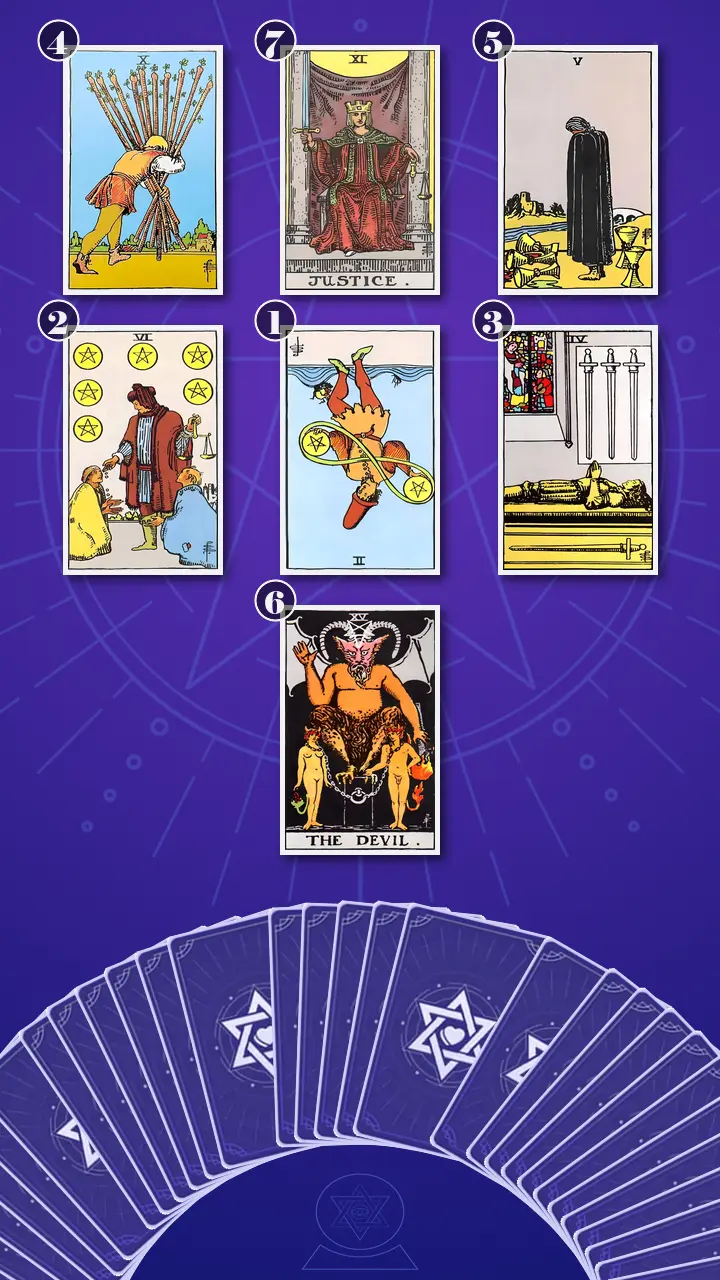
I pointed to the layout as I dealt. “The center card shows what’s happening right now—how the offer is already affecting you. The left is Path A—accepting on-call and what it truly gives you. The right is Path B—declining or renegotiating and what it protects. The top cards show the hidden cost of each path. Then we’ll go down to the root fear—what’s actually steering this. And we’ll end with guidance: how to decide in a way that protects your self-respect and your weekends.”
Reading the Map: Pager Duty, Weekends, and the Parts You Don’t Say Out Loud
Position 1 — The Observable Spiral: Two of Pentacles (reversed)
“Now we’re turning over the card that represents what’s happening right now—the observable decision paralysis behaviors and the work-life imbalance triggered by the offer,” I said.
Two of Pentacles, reversed.
“This is you toggling between the offer email and your weekend plans like you’re running two critical apps at once,” I told them, keeping my voice plain. “One tab is budget anxiety—Toronto rent is real. The other tab is recovery—weekends are when you become a person again. You keep reopening the message and your calendar because you’re trying to create certainty in a system that’s inherently unpredictable. Like you can spreadsheet your way into safety.”
Reversed, that juggling energy becomes a blockage: not flexibility, but strain. The infinity loop on the card reads like endless tab-switching—your mind trying to keep two currencies spinning without dropping either. But the background sea is choppy; it’s not a stable environment. And that’s the point: you’re trying to solve a moving system from inside the wave.
I heard my own internal flashback—Venice, years ago, teaching intuition to cruise staff. When the sea was rough, the schedule looked “fine” on paper, but everyone’s nervous system knew the truth before the captain said a word. You can’t negotiate with the ocean by refreshing a spreadsheet.
Jordan let out a short laugh that had a bitter edge. “That’s… yeah. That’s exactly what I’m doing. It’s kind of brutal hearing it said out loud.”
I nodded. “And I want you to hear this next line, because it’s not an insult. It’s a diagnosis with compassion: You’re not indecisive—you’re trying to make a permanent decision with temporary information.”
Their shoulders dropped a fraction, like something loosened when I took shame off the table.
Position 2 — Path A’s True Pull: Six of Pentacles (upright)
“Now we’re turning over the card that represents what accepting the on-call rotation genuinely provides—not just what you hope it provides,” I said.
Six of Pentacles, upright.
“This card is the raise relief,” I told them. “The kind that hits when you check your banking app after dinner and see rent and groceries lined up like inevitabilities. The offer says: your output is real, and it will show up in your account.”
Then I pointed to the scales in the figure’s hand. “But it also highlights a power dynamic. Someone is distributing resources, and someone is absorbing disruption. Money is one side. Your off-hours are the other.”
Upright, the energy is balance—but only if the exchange is actually fair. “So Path A isn’t just ‘ambition,’” I said. “It’s an exchange. And exchanges can be negotiated. Rotation frequency, response-time expectations, escalation rules, comp time—those aren’t vibes. Those are terms.”
Jordan’s eyes narrowed slightly, not in anger—more like recognition. “So it’s not like… I’m being tested. It’s a trade.”
“Exactly,” I said. “A trade, not a test.”
Position 3 — Path B’s Pull: Four of Swords (upright)
“Now we’re turning over the card that represents what declining—or renegotiating—protects and restores, especially around weekends and recovery,” I said.
Four of Swords, upright.
I let my voice slow down, to match the card’s stillness. “This is the version of your weekend where your phone is face-down, Slack is closed, and you can feel your nervous system unclench,” I said. “It’s not ‘doing nothing.’ It’s maintenance. A recovery window.”
I described it like a split-screen—same Saturday, different nervous system. One version: Trinity Bellwoods, sunlight, laughter arriving on time. Another version: the same table, but your neck stays tight and your hand keeps drifting to your phone under the edge of the bench, like you’re secretly monitoring a system.
Upright, the Four of Swords is balance through deliberate pause. “Path B protects something important,” I said. “Not comfort. Capacity. The ability to think clearly on Monday. The ability to show up as yourself with friends. That’s infrastructure, not indulgence.”
Jordan swallowed and looked at the card a little longer than the others. “I miss that version of my weekend,” they said quietly.
Position 4 — The Hidden Cost of Yes: Ten of Wands (upright)
“Now we’re turning over the card that represents the hidden cost of accepting—how the added responsibility could impact energy, relationships, and burnout risk,” I said.
Ten of Wands, upright.
“This is the part nobody puts in the offer email,” I said, and I watched Jordan’s jaw tighten again on instinct. “You accept the rotation, and at first it’s manageable—until ‘just this one escalation’ becomes a pattern. Your sprint commitments don’t shrink, but now you’re carrying an invisible load on top. The cost isn’t one weekend. It’s the slow takeover of bandwidth.”
I tapped the image where the bundle blocks the figure’s face. “You can’t even see where you’re going. Like carrying groceries without a bag—doable for two blocks, miserable for twenty minutes, and you’re staring at the weight instead of the destination.”
Upright, this card is an excess of responsibility—too much carried by one person, too few boundaries around what’s yours to hold. “And I’m going to say a line that’s blunt because it’s protective: More money isn’t worth it if it quietly buys your nervous system.”
Jordan winced. “I’ve seen this happen to people,” they admitted. “They’re still at the same job, but… they disappear from plans. Like their life shrinks.”
“Yes,” I said. “And we’re not here to shame ambition. We’re here to prevent unconscious over-responsibility from becoming your identity.”
Position 5 — The Hidden Cost of No (or Pushback): Five of Cups (upright)
“Now we’re turning over the card that represents the hidden cost of declining—what feelings and narratives might surface after you protect your weekends,” I said.
Five of Cups, upright.
“This is the emotional hangover,” I said. “You decline—or you push back—and later you replay the number you didn’t take. You scroll LinkedIn, you see a promotion post, and your brain turns it into evidence. ‘I left money on the table.’”
Upright, this is a blockage of perspective—not because you’re dramatic, but because the mind fixates on what’s spilled. “The card literally asks you to turn around,” I said. “Because two cups are still upright. Sleep. Friendships. Sanity. Recovery. The part of you that can still enjoy a Saturday without scanning for a siren.”
Jordan exhaled through their nose, like they were trying not to argue with themselves. “Okay,” they said. “So even if I don’t take it, I’m not losing everything.”
“Exactly,” I replied. “You’re trading one kind of gain for another. The difference is whether you do it consciously.”
Position 6 — The Driver Under the Driver: The Devil (upright)
“Now we’re turning over the card that represents the underlying influence shaping the decision—the core fear and psychological trap that makes this feel identity-defining,” I said.
The Devil, upright.
Jordan didn’t move at first. Their eyes went still, like they’d just heard a word that hit too close. I kept it painfully ordinary, because that’s how this card works in modern life.
“This is the moment on the TTC,” I said. “Your phone vibrates, and before you even read it, your shoulders jump and your jaw locks. It’s not even urgent—just a teammate asking a question. You reply instantly anyway. The internal OS says: ‘If I’m not fast, I’m replaceable.’”
Upright, The Devil isn’t about evil. It’s about attachment—a binding belief that runs like a background subscription you forgot you agreed to. “The chain is loose,” I said, pointing to the image. “But your body is acting like it’s welded.”
Then I gave them the line that needed to be said cleanly: “Golden handcuffs are still handcuffs—even when they’re labeled ‘growth.’”
Jordan’s mouth opened, then closed. “Oof,” they said, sharp and quiet at the same time.
“That ‘oof’ is important,” I told them. “Because it means we found the real lever. This decision feels dangerous because it’s not just about weekends—it’s about worth. And when worth is on the line, your mind will do anything to avoid choosing.”
Position 7 — The Integration Move: Justice (upright)
“Now we’re turning over the card that represents guidance for integration—the most grounded next step, how to decide and communicate in a way that protects self-respect and long-term sustainability,” I said.
The room felt quieter as I turned it, like even the dishwasher hum faded into the walls.
Justice, upright.
“Make it terms, not vibes,” I said, almost automatically—because this card is allergic to ambiguity. “Justice is contract energy. Written spec energy. Clear runbook energy. It’s you holding the scale yourself instead of letting the culture hold it for you.”
Upright, Justice is balance through structure: weigh, then speak. It doesn’t ask you to be fearless. It asks you to be explicit.
And this is where I used my Choice X-Ray—my way of reading hidden costs and benefits like I’m scanning for stress fractures before they become injuries. “If we X-ray this offer,” I said, “we’re not scanning for a ‘right answer.’ We’re scanning for hidden clauses. What does ‘available’ actually mean? What is ‘fair’ here? What will be in scope when you’re on-call? What will be explicitly deprioritized?”
Jordan’s eyes flicked up. “So the decision isn’t… ‘Am I committed?’ It’s ‘Is this agreement real?’”
I nodded. “Yes.”
Then I leaned into the key moment.
Setup: Jordan was still stuck in Sunday 6:59 p.m.—offer email beside the calendar, jaw tight, stomach buzzing—trying to pick the “right” answer like it was a personality test. Their brain wanted a guarantee that no one would judge them later. Their body wanted proof that weekends would remain theirs.
Delivery:
Stop treating your weekends as the price of proving yourself; put the offer on the scales, name your terms, and choose what you can stand behind.
I let it hang for a beat.
Reinforcement: Jordan’s reaction came in layers. First, a tiny freeze—breath held, like their lungs paused to listen. Then their gaze unfocused, as if they were replaying every after-hours ping that had taught them “fast equals safe.” Finally, their shoulders softened and their hands unclenched on their own, fingers opening like they’d been gripping an invisible steering wheel.
“But…” Their voice rose with a flash of heat—an unexpected edge of anger. “If I do that, if I ask for terms, doesn’t that mean I’ve been doing it wrong? Like I’ve been… letting it happen?”
I didn’t rush past it. “It means you’ve been surviving inside a culture that trains people to confuse availability with worth,” I said. “That’s not ‘wrong.’ That’s adaptation. Justice is just you updating the system.”
I slid the guidance into something they could do with their hands, not just their mind. “Set a 10-minute timer,” I said. “Write three non-negotiables—frequency, response expectations, recovery/comp time. Then draft one message with three questions. Stop when the timer ends, even if it’s imperfect. If your body spikes—tight chest, racing thoughts—you pause and come back later. Clarity works better when you’re not braced.”
I watched their face change: the tightness around the mouth eased, but their eyes stayed bright, like the moment after you step off a boat and the dock still feels like it’s moving. Relief, and the vulnerability of having an actual next step.
“Now,” I asked, “with this new lens—terms, not vibes—think back to last week. Was there a moment when you could’ve asked one clarifying question instead of pre-paying the anxiety with instant replies?”
Jordan stared at the Justice card, then nodded once. “Wednesday night,” they said. “A teammate asked a question. I answered immediately. I could’ve said, ‘Happy to look tomorrow— is this urgent or can it wait?’ I didn’t even consider that.”
“That’s the shift,” I said softly. “Not from ‘overthinking’ to ‘perfect confidence.’ From overwhelm and fear-driven indecision to calm self-trust built on explicit boundaries and fair terms.”
The One-Page Justice Sheet: Actionable Next Steps for an On-Call Offer
I gathered the whole spread into one clean story—because this is where tarot becomes practical. The Two of Pentacles reversed showed that the stuckness wasn’t a logic problem; it was a capacity problem. The Six of Pentacles admitted the raise is real relief—and a real exchange. The Four of Swords named weekends as recovery infrastructure, not a treat. The Ten of Wands warned that vague expectations turn “stepping up” into chronic over-responsibility. The Five of Cups showed the emotional backlash story you’d tell yourself if you protected your time. The Devil exposed the shadow contract—availability equals worth. And Justice brought the antidote: clear agreements.
The blind spot wasn’t that Jordan didn’t know what they wanted. It was that they were trying to decide inside ambiguity, like they had to guess expectations and then live with the consequences. The transformation direction was simple and brave: move from trying to pick the “right” option to naming non-negotiables and negotiating terms before committing.
“Your boundaries don’t need to be cute,” I told them. “They need to be clear.”
I also offered one of my cruise-trained frameworks—the Port Decision Model. “On ships, you don’t decide whether to dock based on vibes,” I said. “You decide based on windows, conditions, and terms. And you always know your exit plan. We’re going to treat your next 48 hours like a docking window: one clear message, one set of terms, one check-in date.”
- The 3-Question Clarity AskIn one Slack or email to your manager, ask three bullet questions: (1) rotation frequency + typical page volume, (2) response-time expectations + escalation rules, (3) comp time or additional pay when weekends are disrupted. Send it once—no follow-up essays.Set a 15-minute timer. When it goes off, hit send. If you start rewriting, copy/paste your draft into Notes, close the laptop for 20 minutes, and do not open Google Calendar in that window.
- Your “On-Call Non-Negotiables” Doc (3 Items Only)Open a fresh doc titled “My on-call non-negotiables” and write exactly three items (for example: “No daytime weekend work unless Sev-1,” “Comp time next business day after overnight incident,” “If I’m primary, feature deadlines are adjusted that week”). Bring this to the conversation so you’re negotiating from values, not adrenaline.If you feel guilty writing them, write them as policy for someone you care about. Notice how reasonable they look on paper.
- Reality Testing: A 48-Hour Trial BoundaryBefore you decide, run a 48-hour experiment: schedule a 2-hour “protected block” this weekend (e.g., Saturday 11:00 a.m.–1:00 p.m.) with Slack notifications off and your phone on Do Not Disturb. Choose one exception method for true emergencies only (a phone call for Sev-1). Track what your body does when you’re truly off.Tell one friend, “I’m doing a mini reset,” so you’re less tempted to check. Two hours is enough data to disrupt the ‘I’m irresponsible if I’m unreachable’ story.

A Week Later: Ownership, Not Certainty
Six days later, Jordan messaged me a screenshot—not of the offer, not of a pro/con spreadsheet, but of a short Slack draft with three bullet questions. Under it they wrote: “Sent it. Didn’t over-explain. My heart was pounding, but I did it.”
They also added one line that made me smile because it was so specific: “I did the two-hour block. The first ten minutes were brutal. Then it got… quiet.”
They weren’t magically fearless. The transformation was smaller and more real than that: they were building calm self-trust through explicit boundaries and fair terms, instead of trying to think their way into certainty.
(Clear but fragile, in the best way: they told me they slept a full night for the first time in weeks—then woke up and still thought, “What if I mess this up?” Only this time, they exhaled and opened their non-negotiables doc instead of reopening the email.)
That’s what I mean by a Journey to Clarity. Not a foretold outcome—an ownership shift. The moment you stop treating pager duty or after-hours coverage like an identity test and start treating it like a negotiable agreement. It’s why the Decision Cross · Context Edition works so well for a work-life balance decision: it pulls you from chaos into terms.
When a raise is on the table, it can feel like your weekends become the proof of your worth—so your body stays braced, jaw tight, waiting for a ping that hasn’t even been promised yet.
If you didn’t have to pick the “right” answer today—only name one non-negotiable and ask for one piece of clarity—what would you ask for first?