From Overwhelm and Tab-Switching to a Two-Week Lane: What Comes First

Finding Clarity in the 8:47 p.m. Tab-Switch
If you’re a Toronto tech PM who can ship features but can’t pick whether to tackle money, dating, or your apartment first—because it all feels urgent at once—this is for you.
Alex (name changed for privacy) arrived with her tote still on her shoulder, like she might have to run back into the week at any moment. She was 29, sharp-eyed in that way people get when they’ve trained themselves to notice every possible failure point before it happens.
She described Monday at 8:47 p.m. on Line 1 heading north: harsh fluorescent light, a faint wet-coat smell, her phone vibrating like a tiny alarm. Slack. Banking app. A dating chat. A cleaning checklist. Over and over. She said, “I’m doing so much—why does nothing feel handled?” and her jaw tightened as if her molars were doing overtime.
When she finally looked up at me, she gave me the line that sat under all the rest: “If I pick one thing, everything else will fall apart.”
Overwhelm, in her body, wasn’t a vague emotion. It was a tight chest with restless hands—like her nervous system was stuck tapping refresh, wired-but-tired, sprinting in place until the end-of-day crash hit and she’d realize she’d spent another night organizing life instead of living it.
I let the silence do some work. “You’re not lazy—you’re negotiating four emergencies with one nervous system,” I said. “Let’s treat this like a map problem, not a character flaw. We’re here to find clarity—specifically, what actually comes first when your to-do list keeps trying to turn your life into a four-way fire drill.”

Choosing the Compass: A Tarot Spread for Overwhelm and Prioritizing
I asked Alex to take one slow breath—not as a ritual for the universe, but as a hard reset for attention. While she did, I shuffled in that steady, repetitive way that makes room for honesty. “Hold your question exactly as it is,” I told her. “Work, money, love, home—what first?”
“Today,” I said, “we’ll use a spread I call the Energy Diagnostic Map (7) · Context Edition.”
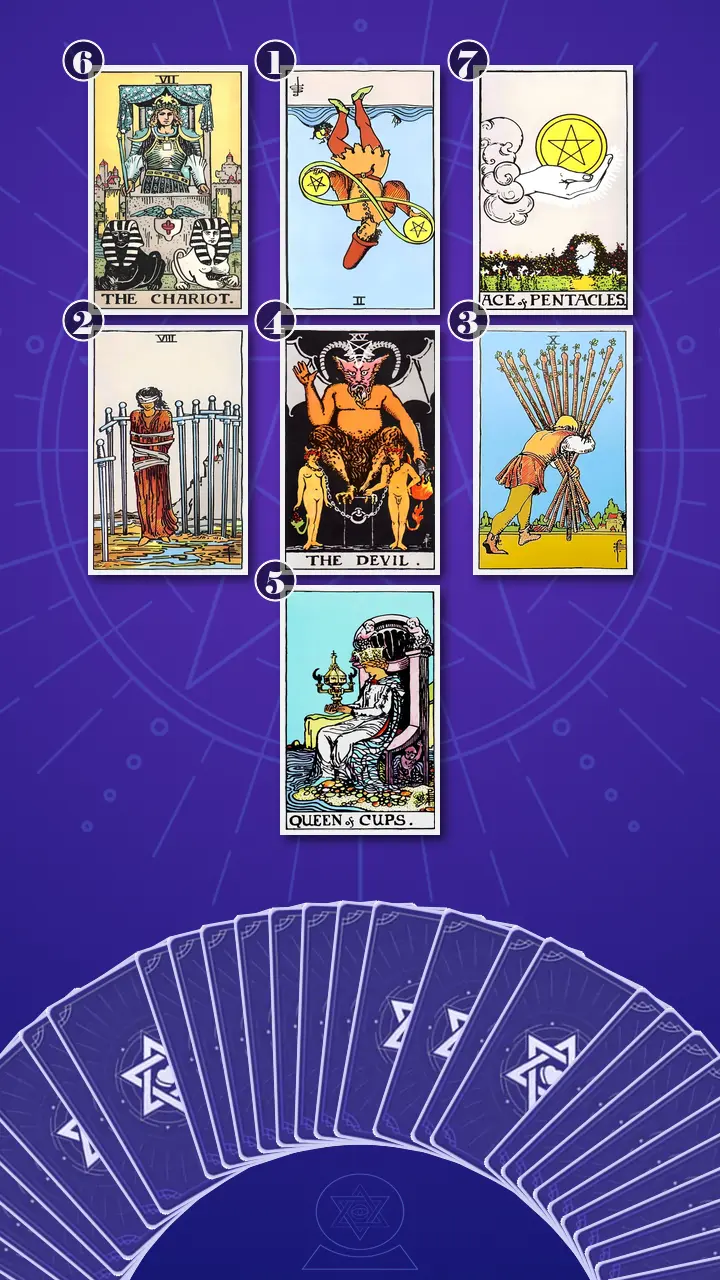
If you’re reading because you’ve googled things like how to prioritize when everything feels urgent or to-do list keeps repeating the same tasks, this is why I like this layout: Alex’s issue isn’t a neat two-option fork in the road. It’s panoramic overwhelm—multiple domains colliding, with task-switching as a coping mechanism. So instead of forcing a binary choice, this spread shows (1) the surface loop, (2) the internal rulebook behind it, (3) the external load, (4) the true blockage, then (5) the available resource, (6) the turning point, and (7) the next grounded step.
I pointed to the center position. “This one is the hub. It tells us what’s actually keeping the loop running—usually something more personal than time management.” Then I traced the diagonal positions. “And these are the bridge out: a shift in how you steer, and then one small step that makes it real in the physical world.”
Reading the Map: When “Busy All Day Still Behind” Has a Pattern
Position 1 — Surface loop: what Alex is actively doing that keeps the list cycling
“Now flipped over,” I said, “is the card that represents the surface loop: what you’re actively doing that keeps work/money/love/home cycling.”
Two of Pentacles, reversed.
I didn’t have to dramatize it. The image itself does that: juggling, waves behind, the infinity ribbon that says this never ends.
“This is 9:41 a.m. and you swear today you’ll focus—then you bounce: Slack message, bank balance check, a half-drafted reply to someone you’re dating, then a quick scan of your cleaning checklist. By lunch you’ve ‘handled’ ten tiny things, but the one high-impact task—the boundary email, the auto-transfer decision, the hard conversation—is still untouched.”
The reversed energy here is a blockage: adaptability turning into an endless performance. You’re moving, but you’re not advancing. It’s like having four browser tabs blaring audio at once and calling it multitasking.
Alex let out a small laugh that didn’t land as humor. It was half recognition, half defeat. “That’s… yeah. That’s my whole evening. Just a quick check. Just a quick check. Then suddenly it’s midnight.”
I nodded. “The card isn’t calling you incapable. It’s calling the loop what it is: motion that looks like control.”
Position 2 — Inner tug-of-war: the belief that makes choosing “what first” feel dangerous
“Now flipped over,” I said, “is the card that represents the inner tug-of-war—the mental story that makes choosing feel dangerous.”
Eight of Swords, upright.
“You open your planner and instantly start running disaster simulations: ‘If I do work first, I’m a bad partner. If I do love first, I’ll fall behind. If I do money first, I’m anxious and boring. If I do home first, I’m irresponsible.’ You end up frozen, doing the least risky micro-task because it doesn’t force a real choice.”
This is Air energy in excess: intelligence turned inward as a cage. The bindings look tight, but they’re not locked. The blindfold is the key symbol—your mind is reacting to imagined consequences more than present reality.
Alex’s gaze drifted off the card for a second, like she was watching a familiar clip play in her head. Her fingers tightened around her water glass, then loosened. “I keep trying to find the perfect order,” she said quietly. “Like… if I could just solve the sequence, I could finally relax.”
“And the trap,” I said, “is that the perfect sequence is a myth your anxiety sells you.”
Position 3 — External pressure: the real-world demands amplifying urgency
“Now flipped over,” I said, “is the card that represents external pressure—what’s coming at you from the outside.”
Ten of Wands, upright.
“Your week feels like carrying four backpacks at once: the job that rewards instant replies, the money tab always open in your head, the relationship maintenance you don’t want to mess up, and the apartment that never feels finished. Even small requests feel heavy because your arms are already full—so everything becomes urgent by default.”
This energy is Fire in excess: responsibility without breath. In the card, the wands block the figure’s view. That’s what overload does—it steals perspective. It’s not that you don’t know how to prioritize; it’s that your arms are already full.
Alex’s shoulders rose toward her ears without her noticing. “My job rewards being responsive,” she said. “It’s how I get praised. If I go DND, I feel like I’m… breaking some law.”
“That makes perfect sense,” I replied. “You’re trained to treat everything as urgent because urgency gets rewarded.”
Position 4 — Core blockage: the hidden attachment that turns prioritizing into self-worth drama
“Now flipped over,” I said, “is the card that represents the core blockage—the hidden attachment that turns prioritizing into a test of your worth.”
The Devil, upright.
The room felt a shade quieter. Outside, a streetcar bell sounded and then faded, like punctuation.
“Late at night, you’re not even doing tasks—you’re checking the list like it’s proof you’re a competent adult. Rest feels ‘illegal’ until everything is handled, so you keep tightening your own rules. The trap isn’t the workload; it’s the idea that your worth is on trial in every domain.”
I watched Alex’s face change as the words landed—first a blink that held too long, then a slight wince at the corner of her mouth, then a swallow.
I said the line plainly, because it deserved plainness: Your to-do list isn’t a plan. It’s a chain you keep tightening to prove you’re okay.
This is attachment energy in excess: control seeking safety. The important symbol here is that the chains are loose. The pressure is real, but the rule—prove yourself constantly—is the part you can choose to loosen.
Alex looked down at her hands like she was meeting them for the first time. “That’s… brutal,” she said, and then—unexpectedly—she laughed once, sharp and embarrassed. “I literally check the list like a scoreboard. Like, if it’s long, I’m failing.”
I didn’t rush to reassure her. I let the honesty breathe. “If you were an archaeologist,” I said, “I’d call this the moment you realize you’re not fighting the weather—you’re fighting the scaffolding you built to survive the weather.”
Position 5 — Available resource: what Alex already has that can restore discernment
“Now flipped over,” I said, “is the card that represents your available resource—what you already have that can restore discernment.”
Queen of Cups, upright.
“Before you touch Slack or your bank app, you sit on the edge of the bed for three minutes. Phone face-down. One hand on your chest. You notice: tightness, irritability, and a need for one thing to be simpler today. You choose a priority based on what would actually support you—not what would look impressive.”
This is Water in balance. The closed cup matters: feelings-with-boundaries. Not a flood. Not denial. A container.
Alex’s breathing changed—just slightly. Her shoulders dropped a fraction like someone had lowered the volume on the room.
“You can replace app-checking with self-checking,” I said. “Not as a big healing project. As a three-minute data point.”
She nodded once. “I can do three minutes,” she said, like she was surprised that it counted.
When The Chariot Took the Reins: A Turning Point at a Career Crossroads
Position 6 — Key turning point: the mindset shift that turns urgency into direction
I held my hand above the next card for a beat. “This is the pivotal one,” I said. “The card that reorganizes the whole system.”
“Now flipped over,” I continued, “is the card that represents the key turning point—the shift that turns ‘everything is urgent’ into a direction you can actually follow.”
The Chariot, upright.
“You stop asking, ‘What’s the correct order for my whole life?’ and decide, ‘For the next two weeks, I’m leading with one lane.’ You put a protected block on your calendar, set one boundary—DND, no extra meetings, no late-night spirals—and accept that other domains will be ‘good enough’ temporarily while momentum builds.”
The Chariot’s energy is Fire in balance: not frantic, but directed. The two sphinxes—the black and white pulls—are the voices Alex hears all day. One says work stability. The other says love, home, money, don’t drop me. The driver doesn’t silence them by force; he holds the reins steadily enough that the argument stops running the route.
My mind flashed, as it often does, to digs I led years ago—cities that thrived because they stopped expanding in every direction and fortified one road, one port, one trade route. Civilizations don’t collapse because they choose one priority. They collapse because they refuse to choose, spending everything on keeping every frontier equally defended until none of them hold.
That is my Historical Case Matching at work: comparing a life choice to a civilization crossroads. Alex isn’t failing at adulthood. She’s trying to govern four provinces at once with the budget of one nervous system.
And here’s the Civilization Pattern Recognition piece: frantic responsiveness looks like prosperity for a while, but it’s also a classic rise-and-decline signal—too much perimeter, not enough center.
Setup: Picture that 11:30 PM moment: you’re folding laundry with restless hands, phone hot from switching apps, still feeling behind. That’s the loop begging for a perfect order. The shift starts when you stop negotiating with the whole list at once.
Delivery:
Stop trying to keep every ball in the air at once; choose a direction and hold the reins like The Chariot.
For a second, Alex went still in a way that felt physical.
Reinforcement: I watched the reaction move through her in layers—(1) a tiny freeze: her breath paused, fingers hovering as if she’d been about to reach for her phone; (2) a cognitive seep: her eyes lost focus, like she was replaying a week of tab-switching at double speed; (3) an emotional release: a slow exhale that softened her jaw, followed by a blink that made her eyes glassy, not with tears exactly, but with the relief of being accurately seen.
“But… if I choose,” she said, and the resistance came out as a flash of irritation, “doesn’t that mean I’ve been doing it wrong? Like I wasted all this time?”
I kept my voice even. “It means you were using the best tools you had for the job you thought you were doing: proving you’re okay. The Chariot isn’t here to shame you. It’s here to give you agency.”
Then I added the sentence I wanted her to borrow, not admire: Clarity doesn’t come first—momentum does.
I leaned in slightly. “Now, use that new lens and look back at last week. Was there a moment—one moment—where choosing a two-week lane would’ve changed how you felt?”
Alex didn’t answer immediately. She pressed her tongue to the back of her teeth, thinking. “Tuesday,” she said finally. “I was on the TTC platform, and I had a deadline and my landlord portal pinged and I had a date Thursday and I—” She stopped, then shook her head. “If I’d just picked work for two weeks and protected one hour, I wouldn’t have done that spiraling thing at 1 a.m.”
“That’s the crossing,” I said. “Not from chaos to perfection. From overwhelm to a first stitch of self-trust.”
In the language of this reading, this is the step from her starting state—juggling while staring at an internal rulebook—toward the desired state: a values-based rhythm where one domain gets focus at a time without self-worth being on the line.
The First Brick: Turning Insight into Actionable Advice
Position 7 — Next grounded step: the smallest concrete action that makes the first priority real
“Now flipped over,” I said, “is the card that represents the next grounded step—the smallest concrete action that makes your first priority real in daily life.”
Ace of Pentacles, upright.
“Instead of another master plan, you do one tangible ‘first brick’: set up a small auto-transfer, block a deep-focus session, send the one message that schedules the relationship check-in, or clear one home zone until it’s actually done. It’s not dramatic—but it makes tomorrow feel 5% more resourced.”
This is Earth in balance: a seed you can hold. And because I know Alex’s pattern—how quickly a plan becomes another chain—I said it the way I’d say it to a brilliant graduate student who keeps rewriting their thesis outline instead of writing the first paragraph:
One brick beats one more blueprint.
Alex blinked, then gave a small, practical nod. “Okay,” she said. “But I genuinely don’t know what to choose. Work is loud. Money is… always open in my brain. Love feels fragile. And my apartment makes me feel like I’m failing at being a person.”
“That’s real,” I said. “So we don’t pick based on what screams the loudest. We pick based on Long-Term Value Assessment: which ‘brick’ buys you the most future breathing room.”
Then I used one of my favorite archaeologist’s tools as a communication strategy—what I call the Time Stratigraphy Method. “We separate what’s an impulse layer from what’s lasting value,” I said. “Urgency is often just the topsoil. Let’s find the foundation.”
We talked for two minutes. Alex realized that the constant money-tab in her head was draining her focus at work and making her short in dating. For her, money stability wasn’t about impressing anyone. It was about quieting the background noise.
“So money is your lane?” I asked.
She hesitated, then nodded. “For two weeks. Just two weeks.”
I smiled. “That’s The Chariot talking. Not forever. Long enough for momentum.”
The Two-Week Lane Commitment: A Small Plan That Actually Holds
I summarized the story the spread had told us, because this is where tarot becomes useful rather than poetic: Alex’s present is the Two of Pentacles reversed—constant task-switching that looks like productivity. Under it sits the Eight of Swords—an internal rule that says choosing is dangerous because it exposes failure. The Ten of Wands confirms the pressure is real; she’s carrying too much and being rewarded for it. At the center, The Devil reveals the true bind: the to-do list has become a measure of worth. The Queen of Cups offers the counterbalance—self-attunement before optimization. The Chariot gives direction—choose a lane and steer. And the Ace of Pentacles demands the first brick—make it tangible.
The cognitive blind spot is subtle but brutal: Alex has been treating prioritizing like a morality test—if she chooses wrong, it proves she’s incompetent. The transformation direction is the opposite: choosing one lane is not self-neglect; it’s leadership. It’s withdrawing your self-worth from the performance review your list keeps trying to run.
I offered her a plan using my Voyage Log Technique—the way ancient navigators crossed rough water: not by controlling the sea, but by keeping a log, choosing a heading, and making consistent, correctable adjustments.
- Body–Mood–Need Check (10 minutes total)Set a timer for 10 minutes. Before you open Slack, your bank app, or texts, write three bullets only: (1) body sensation, (2) mood, (3) one need. Example: “tight chest,” “wired,” “need: one clear next step.”If you feel silly or impatient, keep it even smaller—three bullets, no journaling spiral. One slow breath counts as completion.
- Pick a Two-Week Lane (and stop renegotiating daily)Choose ONE domain to lead with for 14 days (not forever). Put it somewhere you’ll see it: a calendar banner, phone wallpaper, or a sticky note that says, “For two weeks, I’m leading with: MONEY.” Block a protected hour on your calendar 3x this week for that lane.Expect your brain to yell, “But what about everything else?” Treat it like a predictable notification, not an instruction. One protected hour is success.
- The First Brick Protocol (make it physically real)Choose one action that turns the lane into something you can point to. For money: set up an automatic transfer (even $25) to savings right now. Name the transfer something calming like “Future Me.”Make it stupidly small on purpose. If resistance spikes, shrink it again ($10). When it’s set, stop. Completion builds trust.

A Week Later: The Quiet Proof
A week later, Alex messaged me a screenshot: a confirmation screen from her bank—$25 scheduled to move automatically every Friday. Under it she wrote, “It’s not life-changing. But my brain is… quieter.”
She added a second message, almost as an afterthought: “I still woke up and thought, ‘What if I picked the wrong lane?’ But then I remembered it’s two weeks, not a lifetime, and I went back to sleep.”
That’s what a Journey to Clarity often looks like in real life: not a thunderclap, but a small, repeatable proof that you can steer. The Chariot doesn’t promise you’ll never feel pulled again. It promises you can hold the reins without strangling yourself.
When you’re lying in bed with a tight chest, refreshing your list like it’s proof you’re competent, it’s not that you don’t know how to prioritize—it’s that choosing one thing feels like risking your worth.
If you gave yourself permission to choose one lane for just the next two weeks—no lifetime promises—what would you want to protect first so tomorrow feels even 5% easier to live in?