From Calendar Panic to Clean Boundaries: Dropping One Thing First

Sunday Scaries and the Solid-Block Calendar
If you keep rewriting the same “sorry I’m swamped” message and never hit send because you’re trying to sound perfectly reasonable, that’s overwhelm + guilt in a trench coat.
Jordan showed up on my screen on a Sunday night—9:06 p.m. in a small NYC apartment where the radiator kept clicking like it had its own anxious rhythm. Their Google Calendar was open in week view, and it was exactly what they’d warned me about: solid color blocks, like someone had filled the entire week with highlighter until there was no paper left. The brightness from the laptop hit their face too hard in the dark, and I watched their jaw tighten the way people do when they’re trying to hold a boundary with their teeth.
“It’s packed for six weeks,” they said, voice steady in that specific way you get when you’ve been steady all day and you’re running on fumes now. “I don’t even need more time, I need less on my calendar. But I can’t figure out what to drop first without it… looking like I can’t handle my job.”
I could almost feel what they meant in my own body: tight shoulders inching up like they were trying to become earmuffs; a restless buzz under the ribs; that heavy chest-drop that lands when you look at the week and realize there’s no breathing room anywhere. Wanting relief and time back—desperately—while fearing that dropping commitments will disappoint people and damage your credibility.
“Okay,” I said, keeping my voice calm in the way I learned years ago on a trading floor—when panic didn’t stop the market and it didn’t stop your heart, either. “We’re not going to fix your entire life tonight. We’re going to get you clarity on one thing: what to set down first, in a way you can defend—professionally and emotionally.”

Choosing the Compass: The Celtic Cross · Context Edition
I asked Jordan to put their phone face-down for just a minute—no Slack jump-scares, no group-chat scheduling negotiations—and to take one slow breath that went all the way into their belly. Not as a mystical ritual. As a nervous-system handoff: from reacting to choosing.
“Tonight,” I told them, “we’ll use the Celtic Cross · Context Edition.”
If you’ve ever wondered how tarot works in a practical, ethical way, this is one of my favorite demonstrations. The Celtic Cross isn’t just a vibe check—it’s a system map. And Jordan’s problem wasn’t a single decision like ‘cancel dinner’ versus ‘skip a workout.’ It was an entire calendar ecosystem: present overload, the immediate tipping point, the deeper hook underneath the yeses, the habits that keep repeating, the workplace pressure, and then—crucially—what sustainable balance looks like once you finally make a cut.
In this version, two positions are tuned to the question. Position 2 becomes: what do you drop first to create relief? And Position 10 becomes: not a fixed fate—an integration blueprint, because the goal isn’t prediction. It’s self-leadership.
“Here’s what I’ll be listening for,” I said. “The first card will name what your overwhelm actually looks like day-to-day—not in theory. The crossing card will show what needs to be dropped first for immediate relief. And the last card will show the rhythm that keeps things stable after the first cut—so you don’t just rebound into overcommitting again.”
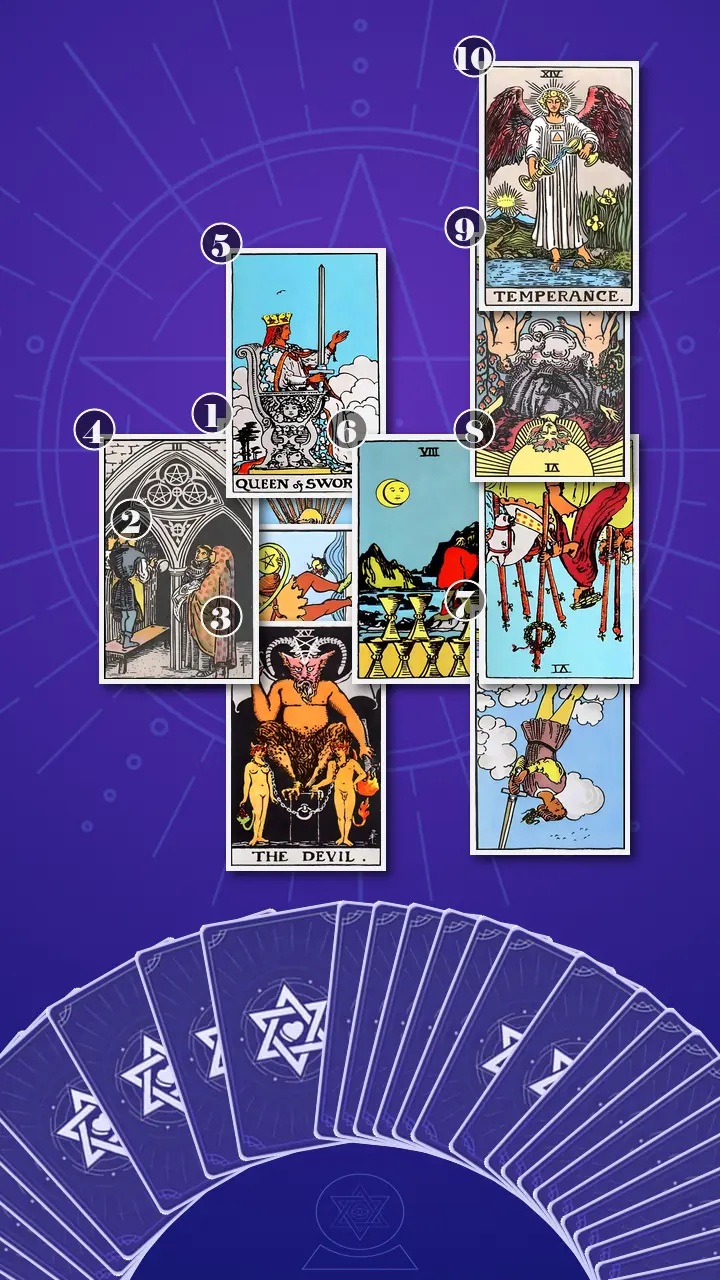
The Cross of Overcommitment: What to Drop First
Position 1 — Current reality of overwhelm: what the packed calendar feels like day-to-day
“Now we turn over the card representing your current reality of overwhelm—what the packed calendar feels like day-to-day, and how it’s showing up behaviorally,” I said.
Ten of Wands, upright.
Even through a webcam, the image had weight. The figure bent forward under a bundle so big it blocks his view; he can’t see the road clearly—only the next few painful steps.
“This,” I told Jordan, “is the week view that looks ‘organized’ but still makes your chest feel heavy. It’s like your schedule is so stacked you can’t see the priority behind the meetings—only the next block on the calendar.”
I framed it the way I always do: as energy dynamics, not moral judgment. “Ten of Wands is excess—too much responsibility carried too tightly, often alone. It’s reliability performed at the cost of oxygen. The more you grip, the less you can see.”
Jordan let out a small laugh—quick, a little bitter. “That’s… yeah. It’s so accurate it’s almost rude.” Their eyes flicked away from the screen like they were bracing for me to tell them they’d ‘done it to themselves.’
“I’m not here to shame you,” I said gently. “This card is actually neutral. It’s just saying: your system has crossed the point where ‘trying harder’ is no longer a strategy. It’s a posture.”
Position 2 — The immediate pressure point: what needs to be dropped first to create relief
“Now we turn over the card representing the immediate pressure point—the pattern that needs to be dropped first to create relief,” I said.
Two of Pentacles, reversed.
“This is the juggling card,” I explained, “but reversed it’s not skillful juggling—it’s reactive switching. The infinity loop becomes a trap.”
And I used the most modern translation I know for it—because Jordan didn’t need poetry. They needed recognition. “This is the too many browser tabs problem. Slack, email, calendar, Notes, Notion, a doc you’re supposed to edit, a thread you’re supposed to answer—14 tabs open, cursor bouncing, and nothing truly finishing.”
I watched Jordan’s shoulders lift like they were about to defend themselves, then drop with a tight exhale. The exact response the card tends to pull when it lands cleanly: not dramatic tears—just that oh. You saw me.
“Reversed Two of Pentacles is blockage,” I said. “It blocks usable time. Even when you technically have ‘a free hour,’ it doesn’t feel free because your brain is still alt-tabbing. So what do you drop first? Not the biggest thing. The switching.”
“So… like, pause one recurring thing?” Jordan asked, cautious. As if even saying it out loud might trigger a Slack notification.
“Exactly,” I said. “One repeating item that fractures your day into confetti.”
Position 3 — Underlying driver: the deeper fear that keeps you saying yes
“Now we turn over the card representing the underlying driver—the deeper motive or fear that keeps you saying yes and keeps the calendar full,” I said.
The Devil, upright.
Jordan went still. Not frozen in fear—more like their attention snapped into place. This card has that effect when the question is boundaries.
“People misunderstand The Devil as ‘bad,’” I told them. “But in a work-life context, it’s often the invisible subscription you didn’t consciously sign up for.”
I leaned closer to my screen. “Look at the chains. They’re loose. That’s the key. This is an optional chain that still feels impossible to refuse. The unspoken contract: responsiveness equals worth.”
Jordan swallowed, and I noticed the jaw clench—the same jaw clench that shows up when someone drafts a decline and then deletes it. Their eyes flicked down like they were picturing an invite on their phone.
“The inner line here is,” I said, giving it to them without judgment: “If I say no, they’ll remember it forever. Freedom versus safety. You’re not just managing tasks—you’re managing the fear that one ‘no’ will rewrite your reputation.”
“It sounds so dramatic when you say it,” Jordan murmured. “But that’s… literally what it feels like.”
“That’s why optimizing the calendar doesn’t work,” I said. “If the engine underneath is attachment—being needed as a stand-in for worth—the schedule will refill no matter how pretty the time blocks look.”
Position 4 — Recent pattern that built the overload
“Now we turn over the card representing the recent pattern that built the overload—how you got to a six-week packed stretch,” I said.
Three of Pentacles, upright.
“This one is important,” I told Jordan. “Because it says your busyness isn’t random. It’s partly a success pattern.”
I described the cathedral scene: the craftsperson consulted, plans in hand, people asking for input. “This is like when you became the go-to person,” I said, “and every collaboration felt like a good opportunity—until the opportunities stacked into a six-week wall.”
Energy-wise, Three of Pentacles is balance in its healthy form: contribution, competence, being valued for your brain. But in Jordan’s context, it’s also the feeder line into Ten of Wands: “Your reliability attracted more requests.”
Jordan nodded slowly, like they were letting themselves accept a truth they usually turned into self-blame.
Position 5 — What you already know you need: your conscious strategy
“Now we turn over the card representing what you already know you need—your conscious strategy for boundaries and prioritization,” I said.
Queen of Swords, upright.
“There she is,” I said, and my tone warmed. “The part of you that can make a clean cut without being cruel.”
Queen of Swords is balance when it’s healthy Air: discernment, clean language, policy-level clarity. I told Jordan, “This is the visual of ‘decide once, then communicate clearly.’ It’s the difference between a two-sentence Slack message and a twelve-sentence apology essay you wrote to avoid discomfort.”
I used the echo technique on purpose, because Jordan needed to feel it in their hands, not just understand it intellectually. “Picture your iPhone Notes app,” I said. “A blank note. No paragraphs. No preamble. Just a clean line: ‘I’m at capacity for the next six weeks.’ Your thumb hovering over Send. Heart racing… and then, once you choose, a tiny click of calm.”
Jordan’s eyes softened with relief, then tightened with nerves. “I can feel my brain trying to add context,” they admitted. “Like, immediately.”
“Of course,” I said. “That urge to over-explain is your nervous system trying to buy safety. But Queen of Swords says: soften the tone, not the boundary.”
Position 6 — Next likely movement: the near-term step that actually reduces load
“Now we turn over the card representing the next movement—what reduces the load in the near term if you follow the insight,” I said.
Eight of Cups, upright.
“This is not rage-quitting,” I said immediately, because New York brains tend to jump to extremes. “This is a values-based exit. Deliberate.”
I translated the moonlit walk into Jordan’s real life. “Think of it like a subway exit,” I said. “Stepping off the train one stop early to breathe. Choosing a different route. It looks fine on paper to stay on—but in your body, it costs too much.”
Jordan pressed their lips together, the way you do when you can name the thing you dread but don’t want to say it yet.
“Which commitment do you keep revisiting with dread?” I asked. “That’s usually the first cup to set down.”
They stared at their calendar off-screen for a second. “There’s a standing meeting,” they said quietly. “Weekly. It’s… not even that useful. But it’s visible.”
“That’s your Eight of Cups,” I said. “Leaving what ‘counts as participation’ to protect what counts as capacity.”
Position 7 — Your role in the pattern: self-talk and decision style
“Now we turn over the card representing your role in the pattern—the self-talk and decision style that tightens or loosens overwhelm,” I said.
Page of Swords, reversed.
“This is the hyper-scanner,” I told them. “The part of you that believes vigilance equals safety.”
Reversed Page of Swords is excess in the mind: over-monitoring, constant refreshing, drafting replies in your head, checking the calendar again even when the decision is obvious.
“This is like treating every new message as urgent,” I said, “so your nervous system never gets the signal it’s allowed to stop.”
Jordan gave a tiny nod—almost embarrassed. “I check Slack like it’s going to bite me if I don’t.”
“That’s exactly the energy,” I said. “And it feeds the Two of Pentacles reversed. Switching becomes your coping mechanism—and your drain.”
Position 8 — External pressure: workplace/social cues that make dropping something feel risky
“Now we turn over the card representing external pressure—workplace and social expectations that make dropping something feel risky,” I said.
Six of Wands, reversed.
“This is the shaky scoreboard,” I said. “Like there’s a crowd watching—even if the crowd is mostly imaginary.”
Reversed, Six of Wands is deficiency of secure recognition. It’s the feeling you have to keep proving you’re on top of things, that visibility equals safety. In NYC corporate culture, it can look like: staying on optional status meetings, sending after-hours updates, saying yes so no one can accuse you of slipping.
“Your ‘yes’ doesn’t prove worth if it bankrupts your capacity,” I said, and I saw Jordan’s eyebrows lift as if the sentence hit a tender spot. “It just proves you can ignore your own limits.”
Position 9 — Hopes and fears: what dropping something will mean
“Now we turn over the card representing your hopes and fears about dropping something—what you’re afraid it will mean, and what you hope it will fix,” I said.
The Lovers, reversed.
“This card is about alignment,” I told Jordan. “And reversed, it’s the fear that any choice will send the wrong signal.”
In real life, this looks like the draft-delete loop: you start writing a decline, then you imagine the other person taking it personally, and you say yes because it feels relationally safer. You treat every ‘no’ like it risks a relationship, a reputation, a future opportunity.
“What you want,” I said, “is alignment—doing fewer things that actually match your values. What you fear is the relational cost of choosing.”
Jordan’s gaze drifted, unfocused for a moment, like they were replaying an invite that landed Tuesday morning and the stomach-drop that came with it.
“I’m scared the first thing I drop will be the thing everyone remembers,” they said.
“That’s the reversed Lovers fear,” I said. “But it also points to the antidote: name your criteria for alignment before you negotiate with anyone else’s expectations.”
When Temperance Poured Between Two Cups
“We’ve reached the top of the staff,” I said. “This is the integration blueprint—the card that shows what sustainable balance looks like once you make the first cut.”
For a beat, the room felt quieter. Even through the audio compression of Zoom, I could hear Jordan’s radiator click and then pause, like it was listening too.
Position 10 — Integration blueprint: what keeps balance stable after the cut
“Now we turn over the card representing your integration blueprint—what sustainable balance looks like and what keeps it stable,” I said.
Temperance, upright.
Temperance isn’t glamorous. It doesn’t promise an empty calendar and a new life. It promises something better: a repeatable rhythm.
Setup. I said, “You know that moment—11:30 p.m., Google Calendar glowing in a dark NYC apartment, Slack still open, dragging meetings by 15 minutes like it’ll magically create oxygen. The schedule looks ‘organized,’ but your chest still feels heavy.”
Delivery.
Stop trying to carry everything to prove you’re capable; start mixing your time like Temperance, with clear buffers and deliberate pacing.
I let the silence sit there for a second—long enough for it to stop sounding like advice and start sounding like permission.
Reinforcement. Jordan’s reaction came in a chain, not a single beat. First, a brief freeze—like their breathing paused halfway in. Then their eyes unfocused, staring just past the camera as if they were rewatching the last two weeks of calendar Tetris. Then the exhale: slow, chest-first, the kind that makes shoulders sink a fraction. Their mouth opened, closed, and opened again.
“But if I do that,” they said, voice sharper than before, a flash of defensiveness mixed with grief, “doesn’t it mean I’ve been doing it wrong this whole time?”
That was the vulnerability under the competence. The part people don’t post on Instagram.
“It means you’ve been trying to solve a system problem with a willpower solution,” I said. “On Wall Street we had a phrase: you don’t fix risk by staring at the screen harder. You change the structure. Temperance is structure.”
I brought in my signature lens—because Jordan didn’t need another motivational quote. They needed a decision model. “I use something I call a Risk-Reward Matrix and a three-scenario forecast,” I said. “Not to turn your life into a spreadsheet—just to stop your fear from pretending it’s data.”
“Scenario A: you keep everything. The short-term reward is no one is disappointed. The cost is predictable: exhaustion, missed details, resentment. Scenario B: you make one clean cut and add one real buffer. The reward is throughput stabilizes—your work quality goes up. The cost is one mildly uncomfortable conversation. Scenario C: you slash impulsively and then overcompensate. That one looks like ‘relief’ for a night and chaos the next day.”
I watched Jordan’s forehead smooth, like their brain finally had something to stand on. Not certainty—just a framework.
“Now,” I asked them, “with this new lens—can you think of a moment last week when this insight would’ve changed how you felt? A Slack invite, a meeting series, a social plan?”
Jordan’s eyes darted to the side. “Tuesday,” they said. “10:03 a.m. An invite landed for a meeting I didn’t need to attend. My stomach dropped anyway. I accepted before I even checked.”
“That’s the moment,” I said. “Temperance would have asked for one breath. One buffer. One clean sentence.”
And I anchored it in the transformation I was seeing happen in real time: “This isn’t just about a schedule. This is a step from overwhelm-and-guilt toward steadier confidence in boundaries—where credibility comes from choosing what you can do well, and communicating limits early.”
I offered the micro-reset exactly as a safe experiment, not a demand. “Let’s do a 10-minute ‘Boundary + Buffer’ reset,” I said. “Stop anytime if it spikes anxiety.”
“Open your calendar and find one recurring item you dread. Add a 25–45 minute buffer right after it this week—even if you label it just ‘Buffer.’ Then draft a two-sentence message: ‘I can’t make this work for the next six weeks. Can we pause it until [date] or handle async?’ You don’t have to send it tonight. Just save it as a template.”
Jordan nodded, slower this time. The nod of someone realizing they can run a small experiment instead of fixing their whole personality.
The Boundary + Buffer Rhythm: Actionable Advice for the Next 48 Hours
When I zoomed out and looked at the whole spread, the story was clean: Three of Pentacles showed how Jordan’s competence made them the default helper. Ten of Wands showed the load became too heavy to carry without losing perspective. Two of Pentacles reversed showed the real drain wasn’t just volume—it was constant switching. The Devil revealed the hidden contract—always available equals worthy. Queen of Swords offered the antidote: a one-line policy. Eight of Cups gave the embodied move: step away from one “fine on paper” commitment. The outer cards—Page of Swords reversed, Six of Wands reversed, Lovers reversed—explained the environment and mindset that kept the loop alive. And Temperance made it practical: one clean boundary, one real buffer, repeat.
The cognitive blind spot was also clear: Jordan believed credibility was protected by saying yes. But the spread kept pointing to a sharper truth: credibility is doing what you said you’d do—so choose what you can actually do well. Overcommitting doesn’t protect your reputation; it quietly risks it.
“A packed calendar isn’t a time problem—it’s a boundary problem wearing a planner costume,” I said. Jordan smiled, but it was the kind of smile you give when something is both funny and painfully true.
To make this usable—something Jordan could do on a Monday morning without a spiritual crisis—I switched into what I call my boardroom mode. “Let’s make this concrete,” I said. “We’ll treat your next six weeks like a portfolio. Not because you’re a robot—because your time is a limited asset, and your fear keeps spending it without permission.”
- Write the 6-week filter sentenceOpen your Notes app and write: “For the next six weeks, my priority is ____; if it doesn’t support that, it gets renegotiated.” Keep it to one sentence. Read it before you accept any new invite.If your brain tries to make it perfect, set a 2-minute timer. Choose a “good enough” priority and move on.
- Save the Two-Sentence No (as a snippet)Create a keyboard shortcut or Slack snippet: “I’m at capacity for the next six weeks, so I can’t take this on. Happy to revisit after [date] / or I can respond async.” Use it for one request this week.Boundary rule: apologize no more than once, and don’t offer an alternative you can’t truly keep. If you freeze, draft it to yourself first.
- Pause one recurring drain (your “First Cup”)Identify the recurring meeting/commitment you keep revisiting with dread. Label it “First Cup” in your calendar. Then, within business hours, send a short message to pause it for 2 weeks (not forever).Expect the guilt spike. Name it: “This is the discomfort of disappointing someone.” Keep the message short anyway.
- Add one real buffer (the Temperance move)This week, add a 15–30 minute “Recovery Buffer” after one high-switching block (like a meeting-heavy afternoon). Protect it like travel time—no errands, no catch-up.If you’re tempted to fill it, shrink it to 15 minutes rather than deleting it. The goal is a repeatable rhythm, not a perfect schedule.
I also gave Jordan my pre-commitment trick from the trading floor—the kind that keeps you from renegotiating with panic. “Before you send the pause message,” I said, “put both feet on the ground, one hand on your desk, one breath in. Then you execute the two-sentence script. No extra clauses. We’re not debating your worth with Slack.”

A Week Later: Ownership, Not Certainty
Six days later, Jordan messaged me on a Tuesday afternoon. “Did it,” they wrote. “Paused the weekly series for two weeks. Used the snippet. Added a 30-min buffer right after my worst meeting block. No one freaked out.”
Then a second text: “I still woke up thinking, ‘what if I messed up?’ But I noticed my jaw wasn’t clenched. And I didn’t do calendar Tetris at midnight.”
That’s what I mean by a Journey to Clarity: not a perfect life, not a magically empty schedule—just the first proof that you can set something down and the world doesn’t end. A calendar with intentional space where priorities are visible and defensible. A steadier kind of confidence built from one clean boundary and one real buffer.
When your calendar is packed for weeks, it’s not just the logistics—it’s the tight-jaw fear that dropping one thing will be the moment people decide you’re ‘not as competent as they thought.’
If you trusted that credibility comes from doing fewer things well (not doing everything), what’s the one commitment you’d pause first—just for the next six weeks—to give yourself a real buffer?