Is Your Old Student ID a Permission Slip? The One Real Send Experiment
The Permission Slip in Your Wallet
If you’re early-career, living on spreadsheets and iced coffee, and every time you open your wallet at a transit gate you see an outdated campus card and suddenly feel imposter syndrome kick in, you’re not alone.
Alex (name changed for privacy) sat across from me in my little Toronto studio space on a rainy weekday evening, coat still damp at the cuffs. They didn’t look “messy” in the way people imagine anxiety—no shaking hands, no dramatic tears. It was subtler than that: a tightness held behind the sternum, like they’d been bracing for a low-grade impact all day.
They told me about 8:12 AM at Bloor–Yonge, that familiar fluorescent buzz and the TTC gates that never feel patient. “I tap my PRESTO, it beeps, and when I flip my wallet closed my thumb hits my old student ID,” they said, rubbing the edge of their wallet without noticing. “The plastic’s warm from my hand. And then my chest does this… clamp.”
In their voice, I heard the contradiction that shows up at so many career crossroads: wanting to make a confident next move as the person you are now, while fearing that without the “student” version of you, you won’t be legitimate.
They exhaled, sharp and small. “It’s weird that I still carry this card, like it means something. And then I do what I always do. I open my laptop later and… I plan. I research. I build another Notion board. I’m not lazy. I’m just trying to get it right.”
The uncertainty wasn’t an abstract cloud. It was a bodily thing—like trying to walk through downtown in winter with your coat zipped too high: protected, but you can’t quite breathe.
I nodded, keeping my voice steady and human. “We can work with this. Let’s try to make a map out of the fog—not to predict your whole life, but to understand what that card in your wallet is actually doing in your decision-making. Our goal today is finding clarity you can act on, without needing a past version of you to sign off.”

Choosing the Compass: A Tarot Spread for Identity in Transition
I asked Alex to take one slow breath—nothing mystical, just a nervous system handoff from “performing competence” to “telling the truth.” While I shuffled, I invited them to hold the question in plain language: Old student ID in my wallet—what past self drives my next move?
“Today,” I said, “we’ll use a spread I call the Four-Layer Insight Ladder · Context Edition.”
For you reading along—this is how tarot works at its most practical. When the question is anchored to a concrete object cue (like an old student ID you keep touching), a minimal spread can be more precise than something sprawling. This ladder layout moves from the observable trigger (what you do in that wallet moment), to the past-self imprint you’re consulting, to the fear it’s protecting, and then it separates that fear from the actual gift your past self built. The last two cards force the reading into integration and next steps—agency over prediction.
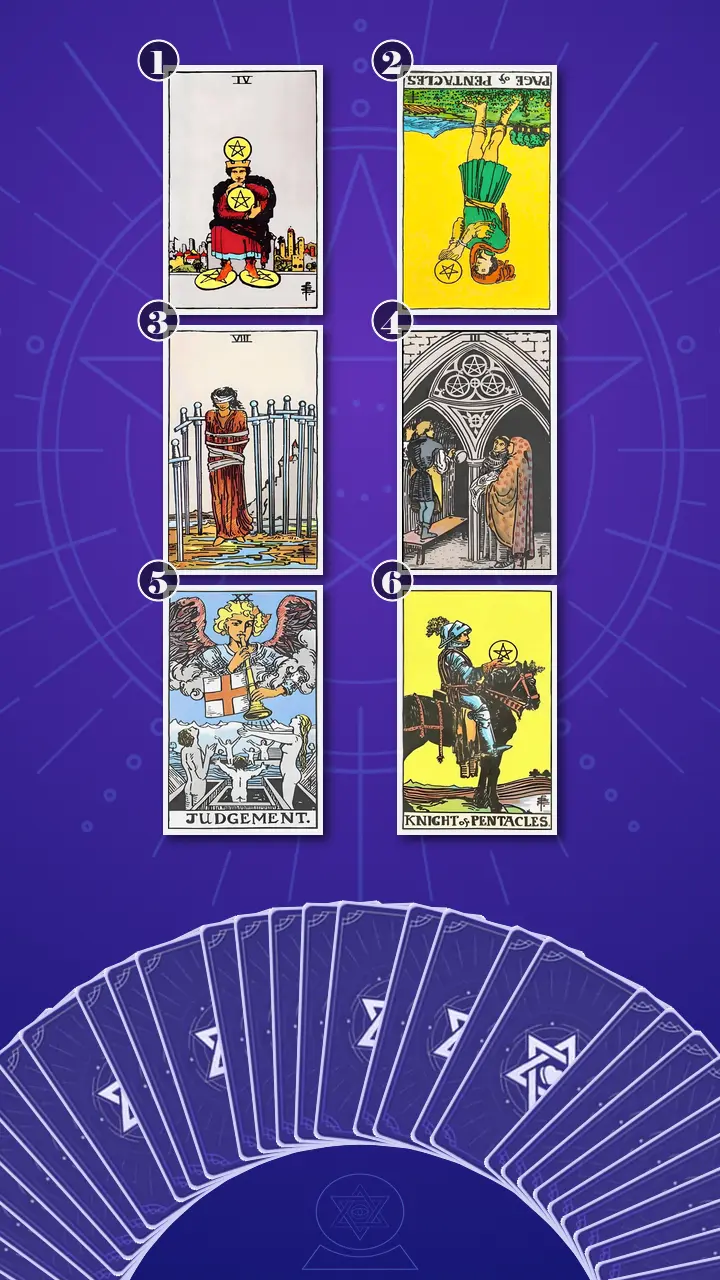
I pointed to the empty grid on the table, a simple 2×3. “Card 1 will show the present-day trigger—what happens right before you stall. Card 3 is the shadow: what fear is running the system. And Card 5 is our bridge—the identity update that unlocks your next move.”
Reading the Map: Six Cards, One Old Rule
Position 1: The Wallet Moment That Freezes You
I turned over the first card. “Now flipped, is the card representing the present-day trigger and the exact way the past is showing up in your current behavior—the wallet moment.”
Four of Pentacles, upright.
“This is so literal it’s almost funny,” I said, and Alex’s mouth twitched like they wanted to laugh but didn’t want to admit how seen they felt. “In modern life, it’s exactly what you described: you’re at a checkout or transit gate, the old student ID flashes in your wallet, and it becomes a tiny ritual. You touch it like a charm, and suddenly your brain clamps down—control the risk, control the optics, control the timeline.”
“Four of Pentacles energy is security-seeking,” I continued. “Not bad. Protective. But in excess it becomes a grip. The figure presses the pentacle to their chest like, ‘If I hold this close enough, nothing can change me.’”
Alex let out a small, bitter laugh—quick, almost embarrassed. “That’s… so accurate it’s kind of rude.”
I smiled, not because it was amusing, but because the laugh meant the pattern had a name now. “Sometimes the first relief is just being able to say, ‘Oh. That’s what I’m doing.’ And I want to normalize this: Planning can be a socially acceptable form of hiding. It feels responsible. It looks impressive. But it can also be a way of not being seen.”
Their fingers loosened from the wallet. Not completely. Just a millimeter.
Position 2: The Past Self You’re Still Consulting
I flipped the second card. “Now flipped, is the card representing the specific past-self identity you’re still carrying and unconsciously consulting before you act.”
Page of Pentacles, reversed.
“This is the ‘eternal student’ card when it’s reversed,” I said. “Late at night you’re comparing certificate options, reading ‘day in the life’ posts, and tweaking your LinkedIn headline like it’s a grade. The student ID isn’t just nostalgia—it’s a system you consult: ‘Am I qualified enough to attempt this?’”
Reversed Page energy is deficiency of application, not deficiency of intelligence. “It’s ‘tutorial mode’ forever. You collect tools, frameworks, tabs—Coursera, Google Career Certificates, Udemy—like if you build the perfect syllabus, the fear won’t touch you.”
I watched Alex’s eyes drop to the card, then dart away, as if caught in the act. “I literally have a Google Sheet called ‘certifications to take,’” they said. “It just… keeps growing.”
I nodded. “That’s the split-screen here: ‘productive’ actions that feel safe versus ‘exposed’ actions that create movement. The Page is capable. The Page is earnest. But reversed, the Page waits to be evaluated before they live.”
Alex laughed again, softer this time. “I really do treat my life like a syllabus. I miss having a rubric.”
“That sentence,” I said gently, “is a clue. Not a flaw.”
Position 3: The Fear This Past Self Is Protecting You From
I turned over the third card. “Now flipped, is the card representing what this past self is protecting you from—the core fear or constraint that keeps you in ‘student mode’.”
Eight of Swords, upright.
“Here’s the choke point,” I said. “This is the mental cage card. In modern life: you draft the message, hover over ‘Send,’ and your mind produces a rulebook.”
I spoke it the way it shows up in the body, not as theory. “I can’t apply yet because ___.I should take one more course.Then I’ll feel legit.”
As I described it, I could practically see their Thursday-night kitchen counter: laptop glow, too-bright LED strip, Notion open to a ‘Career Pivot Plan,’ another tab screaming ‘top skills for [role],’ phone warm from doomscrolling. The kettle clicks off. The jaw stays clenched.
“Eight of Swords is blockage,” I continued, “but notice the symbolism: the bindings are loose. The trap feels total, but it’s largely made of inherited evaluation logic—like you’re still being graded, even though no one is holding the rubric anymore. External reality: no one is stopping you. Internal policy: you act like there’s a gatekeeper.”
Alex went through a three-beat reaction I’ve learned to respect. First: a tiny freeze—breath caught, shoulders lifting. Second: their gaze unfocused, like they were replaying a specific moment at work. Third: a slow exhale through the nose, shoulders dropping a fraction.
“Oh,” they said quietly. “That’s the exact rule I live under.”
“If you made the next move this week and it didn’t go perfectly,” I asked, “what’s the most painful story your brain says that would prove about you?”
They didn’t answer right away. Their thumb found the edge of their wallet again. “That I’m not actually competent,” they said. “That I was only good when I was being… assessed.”
I let that land. There’s a particular vulnerability in realizing your fear is less about the decision and more about being seen without a scaffold.
Position 4: The Gift You Get to Keep
I flipped the fourth card. “Now flipped, is the card representing the useful gift from that past self you can keep—without staying stuck in the old identity.”
Three of Pentacles, upright.
“Good,” I said, and meant it. “Because this tells me the answer isn’t ‘stop learning.’ It’s ‘relocate learning.’”
In modern life, Three of Pentacles looks like this: you put your work where feedback can touch it. You ask a teammate for input. You share a draft with a mentor. You volunteer for one cross-functional task. You build a tiny portfolio sample. “Legitimacy starts to come from contribution and iteration,” I said, “not from collecting proof.”
This card is balance—Earth energy used constructively. “You’re not trying to become a different person overnight,” I told Alex. “You’re graduating from ‘being evaluated’ to ‘being in practice.’”
Alex’s posture changed—still cautious, but less collapsed inward. “So you’re saying… my past self is useful. Just not as… a stamp of approval.”
“Exactly.” I tapped the edge of the card lightly. “Your past self is a toolkit—not a permission slip.”
When Judgement Spoke: From External Approval to Internal Calling
Position 5: The Identity Update That Unlocks the Next Move
I held the fifth card for a half-second longer than the others. The room got quieter in that ordinary way it does when the truth approaches—rain against the window, the soft whir of a building’s heat, even my own breath suddenly audible.
“We’re flipping the most pivotal card now,” I said. “This represents the key integration shift that updates your identity and unlocks your next move.”
Judgement, upright.
Judgement is one of those cards people misread because of the word. It isn’t a cosmic courtroom. It’s a wake-up call.
Setup (what you’re stuck inside): “The next time your thumb hits that old student ID at a TTC gate or a coffee shop register,” I said, “notice the exact second your brain tries to trade choice for preparation. That trade feels safer. It also keeps you in the same loop.”
Delivery (the sentence that changes the whole spread):
Stop treating the old badge as permission—answer the trumpet and step forward as who you are now.
I let the words hang for a beat, like a bell that keeps vibrating after you strike it.
Alex’s reaction came in layers. First, their face went still—eyes widening just slightly, as if the room had shifted a few inches. Then their throat moved in a swallow they didn’t quite finish. Their shoulders, which had been perched all session, began to come down. It wasn’t a dramatic collapse. It was a slow release, like unclenching a jaw you didn’t know you’d been holding.
“But if I do that,” they said, and there was a flash of anger under the fear, “doesn’t it mean I was wrong to do all that prep? Like… I wasted time?”
I didn’t rush to soothe them. I’ve excavated enough sites to know that you don’t call a lower layer ‘wrong’ just because you’re building on top of it. “No,” I said. “It means you were surviving with the tools that worked in a structured world. And now you’re in a different era of your life.”
This is where my own mind always goes—an inner flash of my old field notebooks, Cambridge archives, and the way civilizations pivot. “In archaeology,” I told them, “we find cities at crossroads. Sometimes they keep using an old gate even after the trade routes shift. The gate isn’t stupid. It’s familiar. It once protected the city. But eventually, if you keep forcing all movement through the old gate, you choke your own growth.”
Then I used my Historical Case Matching the way I use it in every consultation—quietly, as a lens. “Your student identity was a strong institution—deadlines, feedback, clear legitimacy. That’s like a civilization with stable currency and known laws. But now you’re at the stage where the ‘laws’ have to be internal: values, direction, self-defined standards. That’s not collapse. That’s an evolution in governance.”
Alex’s eyes got glossy, not from sadness exactly—more like the relief of finally having the right name for the thing. They breathed in, careful, and on the exhale their shoulders dropped again, deeper this time. Then there was a moment of new vulnerability: a slight dizziness behind the eyes, the kind that comes after you’ve been bracing for too long.
I said the core message plainly: “You don’t need the student version of you to approve your next move—you’re allowed to answer your own call now. And—this matters—Being ready isn’t a certificate. It’s a choice you practice.”
“Now,” I asked, “with this lens, can you think of a moment last week when that old ID ‘rule’ showed up, and this insight could’ve changed how it felt in your body?”
They closed their eyes for a second. “Sunday night,” they said. “The Sunday Scaries. I was watching people announce promotions, and I opened Notion like it was… a life raft.”
“That’s the shift,” I said. “From nostalgia-and-self-doubt-driven overpreparing to grounded confidence built through a self-defined identity. Not certainty. But authority.”
Position 6: The Next Step That Proves Movement Is Possible
I turned the final card. “Now flipped, is the card representing a concrete next step you can take within the next week to act from your present self—not your student self.”
Knight of Pentacles, upright.
“This is intentionally unsexy,” I said, and Alex smiled despite themself. “Your next step is: pick one practical action under an hour and complete it. Not ‘reinvent your life.’ Just ‘close one loop.’ Send one email. Book one informational chat. Submit one draft. The steadiness builds identity the way a gym builds muscle: repetition, not a label.”
Knight of Pentacles is Earth energy in balance—not clinging, building. “You don’t need more proof—you need one honest rep,” I added, watching that sentence hit like something they’d wanted permission to believe.
No New Tabs, One Real Send: Actionable Advice for the Next 7 Days
I leaned back and stitched the spread into one coherent story for them.
“Here’s the arc I see,” I said. “The Four of Pentacles shows you gripping the old ID like a stabilizer at the exact moment you’re about to be seen choosing. The reversed Page shows the past self you consult—the student who feels safe when there’s a rubric. The Eight of Swords names the cost: internal rules that feel like reality. Then the Three of Pentacles reveals the part worth keeping: you’re genuinely good at learning through feedback and collaboration. Judgement turns the whole system: the authority moves from institution to inner calling. And the Knight says: make it real with one steady, measurable action.”
“Your cognitive blind spot,” I said gently, “is thinking the problem is ‘not enough information.’ But the deeper issue is ‘who gets to authorize your move.’ You’ve been treating readiness like something you earn from a system. The transformation direction is to treat readiness as something you practice through small, real-world reps.”
Then I brought in one of my own intervention tools—my Time Stratigraphy Method. “Think of your urge to research as the topsoil layer—loud, recent, reactive. Under it is a deeper layer: lasting value. The question isn’t ‘What will make me feel safest tonight?’ It’s ‘What will still matter to me in six months?’ We separate impulse from value, like separating layers in a dig. That’s how you stop being yanked around by the newest tab you opened.”
Alex frowned, practical. “But I honestly don’t even have five minutes some days. Work is chaos, and by the time I’m home I’m fried.”
“Good,” I said, because this was real life entering the room. “Then we design this like a tiny expedition, not a personality transplant.”
I set a boundary in plain language: No new tabs. One real send.
- The 10-Minute “No New Tabs” ExperimentSet a timer for 10 minutes. Close every course/certification page and do one action that creates a real-world loop: draft and send a 3-sentence message requesting a 15-minute informational chat, or open your email and schedule one check-in with a mentor.If your chest tightens, do the smaller version: write the message and save it as a draft. Practice counts—this is an exposure rep, not a verdict.
- One Closed Loop Task (Under 60 Minutes)Choose one task you can finish in under an hour that closes a loop: submit one application draft, book one meeting, or deliver one small work sample (even imperfect) to a real person.Expect the thought “this is too small to count.” That’s the old rubric talking. Let the Knight of Pentacles win by finishing, not by impressing.
- The 5-Minute Permission Slip CheckWrite the rule your brain offers (e.g., “I can’t pivot until I have X”). Under it, write one counterline: “I’m allowed to test this in a small way without earning readiness first.”Do it right when you notice the wallet trigger—TTC gate, checkout, elevator. One breath first, then write. Keep it blunt.

A Week Later: The Quiet Proof
Six days later, Alex texted me a screenshot. It wasn’t a job offer. It wasn’t a dramatic life update. It was a sent message—three sentences, asking a former classmate for a 15-minute chat. Under it, they wrote: “My stomach did the thing. I did it anyway.”
They added, almost as an afterthought: “I didn’t open a single course tab first.”
The bittersweet part was there too, in the smallest line: “I feel weirdly exposed. But also… lighter.” Clear, but not invincible. They slept a full night, and in the morning their first thought was still, What if I’m wrong?—only this time, they noticed it and kept moving.
That’s what I mean by a Journey to Clarity. Not a perfect answer delivered from on high, but an authority reclaimed: the moment you stop asking your past self to sign the form, and you begin practicing your next identity with one honest rep at a time.
When you’re about to be seen as an adult in your own life, it can feel safer to clutch the old “student” version of you—because choosing out loud risks proving you were never worth the confidence in the first place.
If you didn’t need your past self to “approve” you, what’s one small, real-world step you’d be willing to try this week—just as an experiment you can learn from?