I Woke Up to 47 Notifications—And Stopped Letting My Phone Lead

The 8:06 a.m. Lock Screen That Starts the Day
You’re a student with a part-time job in a big city, and your morning starts with a badge count instead of a thought—classic notification burnout.
Taylor (name changed for privacy) angled her phone toward the camera like evidence. “Forty-seven,” she said, and I watched the number glow against her tired face.
She described 8:06 AM in her tiny Toronto bedroom: radiator clicking, dry air, harsh blue light, her phone warm in her palm. Slack first—before she even sat up. Her jaw was already clenched, like her body had decided the day was an emergency. “If I clear it fast, I can start my day,” she told me, and the sentence landed with that specific kind of exhaustion that’s also acceleration.
Then she said the question she’d booked the reading with: “What’s my next step to rebalance school, work, and me? I’m busy all day and still somehow behind.”
I could hear the core contradiction in the way her voice kept tightening on certain words: she wanted balance, but she was afraid that if she didn’t stay on top of every notification, she’d fall behind—or look unreliable.
Her overwhelm wasn’t abstract. It sounded like shallow breathing and looked like a buzzing restlessness that wouldn’t let her shoulders drop. It felt, she said, “like juggling three spinning plates while someone keeps handing me a fourth every time my phone buzzes.”
I kept my tone gentle and plain. “You’re not broken. Your badge count isn’t a to-do list—it’s a stress trigger. Let’s treat this like a system we can understand, then redesign. We’re here to find clarity—one that gives you a rhythm you can actually live in.”

Choosing the Compass: An Energy Diagnostic Map for Notification Overload
I asked Taylor to take one slow inhale and notice her body like a weather report: jaw, chest, shoulders. Not as a mindfulness performance—just as data. Then I shuffled.
“Today I’m using a spread I built for situations exactly like this,” I said. “It’s called the Energy Diagnostic Map (7) · Context Edition.”
For readers who wonder how tarot works in a practical, modern way: this isn’t about predicting a single outcome. Taylor’s question isn’t a clean timeline or one decision—it’s a system-level attention imbalance, fed by both internal compulsion and real external load. This seven-card map keeps things minimal while still separating what’s happening on the surface (notification weather), what’s happening inside (the tug-of-war), what’s happening outside (school/work pressure), and what exact lever creates change—then it funnels into one grounded next step for the next seven days.
I previewed the most important positions so she wouldn’t feel lost in symbolism: “The first card names what your week looks like on the surface. The center card shows the core blockage—the belief that makes balance feel unsafe. And the bottom cards are where we turn insight into something you can actually practice without blowing up your life.”
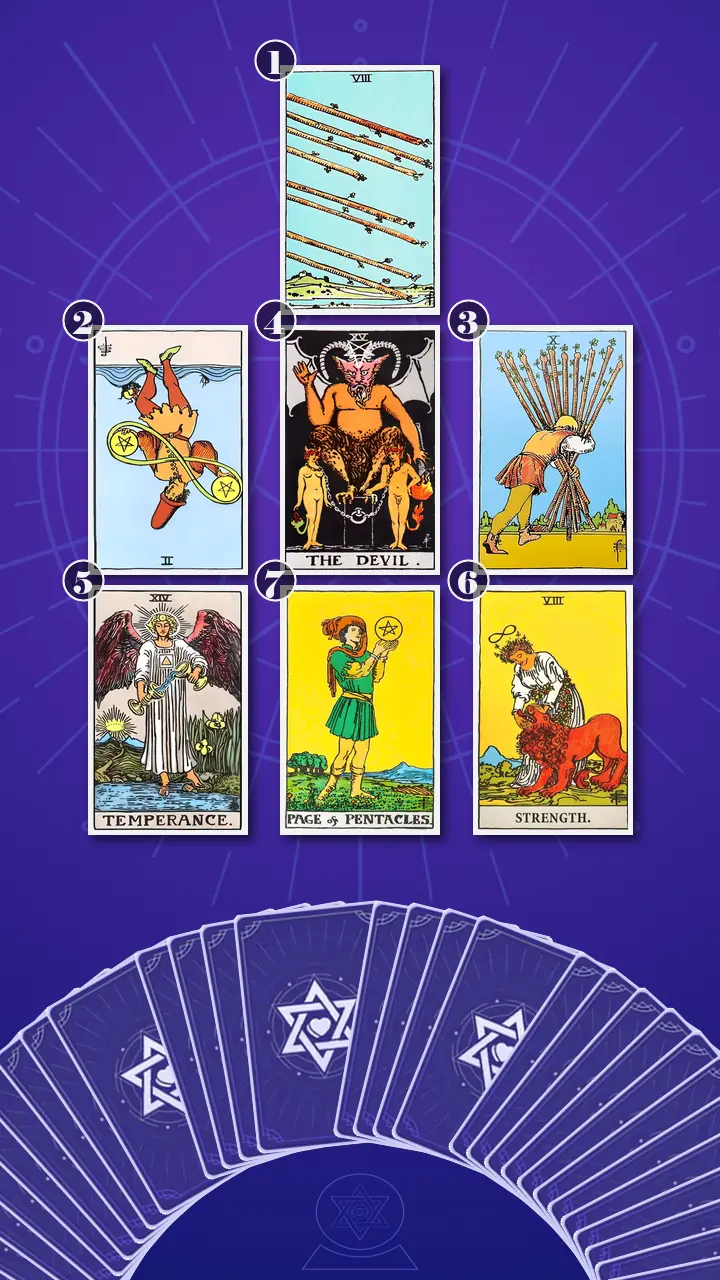
Reading the Map: From Speed to the Chain
Position 1: Surface symptoms — Eight of Wands (upright)
“Now flipped over,” I told her, “is the card representing Surface symptoms: what the notification overload looks like in daily behavior and attention.”
Eight of Wands, upright.
This is the exact vibe of her week: rapid-fire dispatch center energy. Slack pings, email banners, group chat @mentions—velocity running the day. The modern-life version is simple: you sit down to start your assignment, and your phone turns into air-traffic control. You’re not choosing priorities—you’re reacting to speed, like push notifications are driving and you’re just holding the wheel.
Energetically, this is excess acceleration. It’s not “you’re bad at time management.” It’s your attention constantly being pulled into motion with no landing point—wands flying through open sky.
Taylor let out a small laugh that had a bitter edge. “That’s… honestly kind of mean,” she said. “Like, yeah. I don’t even get out of bed first.”
I nodded. “It’s not mean. It’s precise. And precision is good news—because we can work with precise.”
“Also,” I added, “inbox zero can be a comfort habit, not a progress metric. The badge count dropping feels like control, even when the essay doc is still blank.”
Position 2: Inner tug-of-war — Two of Pentacles (reversed)
“Now flipped over is the card representing Inner tug-of-war: the mental/emotional pattern that keeps pulling you back into checking and multitasking.”
Two of Pentacles, reversed.
The modern scene practically narrates itself: your brain keeps school, work, and ‘me’ as three open tabs and flips between them every time a ping hits. You’re trying to be adaptable, but it’s like juggling on a subway platform—one bump and you drop the thread, then waste time re-orienting and rereading.
I walked her through a quick montage, because she’d already lived it: alt-tab, unlock phone, reply, reopen doc, reread the same sentence, open calendar, check Slack “active” dot, back to doc. “Is this adaptability,” I asked, “or is it panic dressed as productivity?”
Energetically, reversed Two of Pentacles is a blockage of stability. The juggling skill is there—but it’s tipped into constant switching, so nothing gets finished. You’re not resting, and you’re not completing. Just… wobbling.
Taylor’s gaze slipped off-camera for a second, like she was watching herself do it in real time. Then she nodded once, slow.
Position 3: External pressure — Ten of Wands (upright)
“Now flipped over is the card representing External pressure: the school/work demands and expectations that intensify the imbalance.”
Ten of Wands, upright.
This card doesn’t blame you. It validates the load. Shifts you can’t easily drop, readings that require actual uninterrupted focus, group project coordination that never stops, last-minute work updates landing in chat. Constant responsiveness becomes one more invisible wand on top of the visible ones.
Energetically, Ten of Wands is excess burden. And the symbol that always gets me is the face blocked by the load: when you’re carrying too much, perspective gets crowded out. Everything becomes “carry it, don’t think about it.”
Taylor swallowed. “That’s literally me on the walk to the TTC,” she said. “Like, physically. Tote bag digging into my shoulder.”
Position 4: Core blockage — The Devil (upright)
“Now flipped over is the card representing Core blockage: the deeper mechanism that makes balance feel unsafe or impossible right now.”
The Devil, upright.
I went very gently here. The modern-life scenario is the most honest one: even when nothing is truly on fire, unread messages feel like danger. You check for reassurance, not just information. The rule underneath it is brutal and quiet: “If I don’t reply now, I’ll look unreliable.” Notifications become a chain you could loosen, but your body treats it like you can’t.
Energetically, The Devil is attachment and compulsion. Not “you love your phone.” More like: your phone has a “terms and conditions” page you never agreed to, but you live by it anyway—reply fast = good person.
Taylor pressed her tongue to the inside of her cheek, like she was holding back something sharper. “I know I could stop,” she said, almost like a confession. “But it feels… unsafe. Like I’m about to get caught being irresponsible.”
I watched her shoulders tighten, then release a fraction when I named it plainly: “Reliability isn’t the same thing as instant availability. The chain is real—but notice how, in the card, the chains are loose.”
Position 5: Available resource — Temperance (upright)
“Now flipped over is the card representing Available resource: what you can lean on to stabilize and rebalance.”
Temperance, upright.
Temperance is where the pace finally changes. The modern scene is not glamorous—it’s doable: you start building a rhythm instead of chasing control. Two reply windows. One focus block. Small transitions between tasks: water, breathe, write the next step. Not rigid scheduling. Intentional mixing so work, school, and you each get a measured pour.
Energetically, Temperance is balance through integration. A DJ transition, not a random song barging in. You switch because you decide to, not because a banner demands it.
Taylor’s mouth softened into the first expression that wasn’t clenched. “That sounds… weirdly possible,” she said. “Like, not a whole Notion template makeover.”
“Exactly,” I said. “Notion templates are cute until the week gets messy. Temperance is built for messy weeks.”
When Strength Held the Lion: The Moment Willpower Stops Working
Position 6 (Key Transformation) — Strength (upright)
Before I turned this card, the little hum in my planetarium office shifted—someone in the hallway clicked off a light, and for a second the space felt like the moment after a show ends, when the stars fade and people are still blinking back into the real world.
“Now flipped over,” I said, “is the card representing Key transformation: the specific inner shift that unlocks a healthier relationship with responsiveness and rest.”
Strength, upright.
Setup: I brought Taylor back to her own pattern at night: 11:27 PM, lights off, refreshing her inbox even though she’s tired—because the silence of unread messages feels louder than the messages themselves. She was stuck between two thoughts: I need stricter rules versus I need to be able to tolerate this discomfort without panicking.
Delivery:
Stop trying to defeat your phone with willpower alone; start leading your attention with quiet Strength, like holding the lion with a steady hand.
I let the sentence sit in the air for a beat. Then I added the heart of it, the part people miss when they search “how do I stop checking notifications while studying?” and expect a hack: “You don’t need harsher rules; you need steady, compassionate self-control that makes focus and rest feel safe again.”
Reinforcement: Taylor’s reaction came in layers. First, a tiny freeze—her breath caught and her hand stopped mid-fidget above her desk, as if her body had been caught reaching for the phone without permission. Then her eyes unfocused, like she’d rewound a dozen moments: thumb hovering over Slack, the “just one quick reply” lie, the blank doc. Finally, her jaw unclenched with an exhale so quiet I almost missed it, and her shoulders dropped one notch, not like relief-as-a-miracle, but relief-as-a-muscle finally letting go.
This is where my astronomy brain always shows up. In the planetarium, I teach people how gravity doesn’t need drama to be powerful—it just quietly shapes everything. My Black Hole Focus lens works the same way: an event horizon is a boundary you don’t argue with. Inside it, attention falls in. Outside it, things can orbit without consuming you. Strength isn’t “be stronger.” It’s “choose an event horizon for 10 minutes.” A boundary so clear your nervous system stops negotiating every second.
I watched Taylor absorb that, and she surprised me with a flash of irritation—real, human. “But if it’s ‘training,’” she said, “doesn’t that mean I’ve been doing it wrong this whole time?”
“It means you’ve been doing what works in the short-term,” I said. “Clearing badges gives relief. That’s not failure. That’s your system trying to survive. Strength just gives you a different kind of relief—one that doesn’t cost you your assignments or your sleep.”
“Now,” I asked her, “using this new perspective, can you think back to last week—was there a moment when this insight could’ve changed how you felt? Like a single time you could’ve finished the paragraph first, just once?”
She nodded, slow again. “Tuesday. Library. I kept restarting my Spotify Deep Focus playlist like that would fix my brain.”
“That’s the rep,” I said. “One moment. One breath. One paragraph.”
And I anchored it: “This isn’t only about productivity. It’s a shift from urgency-driven hyper-availability to grounded self-led focus.”
Position 7: Next step — Page of Pentacles (upright)
“Now flipped over is the card representing Next step: one concrete, realistic action for the next 7 days to restore balance across school, work, and you.”
Page of Pentacles, upright.
The Page doesn’t ask for a personality transplant. It asks for a beginner plan: simple, measurable, kind. The modern-life scenario is literally a one-note system: two message windows, one school focus block, one recovery anchor—treat it like learning, track what works, adjust, repeat.
Energetically, Page of Pentacles is grounded consistency. One thing at a time. Not as a vibe— as a practice.
The Window-Not-Reflex System: Next Steps You Can Actually Do
I tied the whole map together for Taylor the way I’d explain a constellation to a school group: not as scattered dots, but as a pattern you can finally see.
“Here’s your story,” I said. “Your week starts in Eight of Wands weather—speed everywhere. Your nervous system tries to juggle it (Two of Pentacles reversed), while your real workload is heavy (Ten of Wands). Then The Devil sits at the center: the invisible rule that says ‘fast replies = safety and worth.’ Temperance shows you have access to rhythm. Strength is the bridge—gentle discipline that makes unread messages tolerable. And Page of Pentacles makes it real with a small, repeatable plan.”
Her blind spot was clear: she was treating responsiveness like a moral identity test instead of a boundary she could design. The transformation direction was equally clear: from reflexive instant replies to intentional response windows and protected focus blocks—without shaming herself.
She hesitated, then hit me with the practical obstacle that always matters: “But I can’t be unreachable. My work does last-minute shift stuff.”
“Agreed,” I said. “So we’re not doing ‘no phone.’ We’re doing one-channel emergency and everything else can wait. You can care without being on-call.”
- Two Reply Windows (7-day experiment)Pick two daily message windows for the next 7 days (example: 12:30 PM and 7:30 PM). Put them in Google Calendar as real appointments titled “Reply Window.” During the window, you can answer Slack/email/group chats without guilt.If it feels scary, start with one low-stakes thread first. Remind yourself: reliable with delayed replies is still reliable.
- One Focus Block With an Event HorizonCreate one school Focus Block per day: 25 minutes (or 10 if that’s all you can do). Put your phone physically out of reach—zipped in a backpack pocket or in another room. If you must be reachable for a shift emergency, allow calls/SMS only and mute everything else.Expect the “itch” at minute 3–5. That itch is the practice, not proof you’re failing.
- Temperance Transition + Shooting Star NotesBetween contexts (class → work, work → studying), do a 3-minute reset: stand up, refill water, take 6 slow breaths, then write: “Next 1 thing: ____.” If a thought or message urge flashes up, use my Shooting Star Notes trick: capture it in 30 seconds on one note (“reply to X at 7:30”) and go back to the task.The note is a container. It tells your brain, “We won’t forget,” without reopening Slack like it’s a slot machine.

A Week Later: Quiet Proof, Not a Perfect Life
Six days after our call, Taylor messaged me a screenshot: her calendar with two tiny blocks labeled “Reply Window,” and a single sticky note on her desk that said, “Next 1 thing: finish the intro paragraph.”
She wrote, “I did two 25-minute blocks this week. I didn’t become a new person. But I finished an outline before checking Slack. Also I ate lunch sitting down, which sounds ridiculous but felt… like I got my body back.”
Her bittersweet proof was simple: she submitted an assignment, then celebrated by sitting alone in a café for an hour—no big victory speech, just a quieter nervous system and the unfamiliar feeling of not having to earn rest by clearing badges first.
When I think about a real Journey to Clarity, it rarely looks like dramatic transformation. It looks like one boundary holding. One breath taken. One paragraph finished before the ping.
When your phone buzzes and your body goes tight, it’s not because you’re lazy—it’s because a part of you believes that one delayed reply could prove you’re not in control, so you keep reaching for the only quick relief you can see.
If being responsive is something you can manage—not something you have to obey—what’s one tiny response window or focus block you’d be willing to try for the next seven days, just as an experiment?