From Golden Handcuffs to Self-Trust: Making a Values-Led Career Call

Finding Clarity in the 11:41 p.m. Spreadsheet Spiral
If you’re a mid-level tech PM who keeps a resignation message saved as a draft while calculating your retention bonus after tax, you’re not “indecisive”—you’re caught in golden handcuffs and choice paralysis.
Jordan (name changed for privacy) said that to me with a tiny, exhausted shrug, like they’d been waiting for someone to say it out loud without judging them for it.
They were calling from Toronto, perched at their condo kitchen counter—same place they keep ending up on weeknights. The only light was that blue MacBook glow plus a slightly-too-bright under-cabinet LED that buzzed if you listened closely. Their phone sat face-up, still warm, as if LinkedIn had been a literal heating pad.
“It’s like… I’m being responsible,” they said, but the word sounded thin. “I’ve got a spreadsheet called Stay vs Leave (FINAL v7). I keep opening ‘after tax retention bonus Ontario’ calculators like it’s my job. I rewrite the same ‘can we talk about my future here?’ message to my manager, save it as a draft, then… I don’t send it.”
As they spoke, their jaw kept tightening in little pulses, like they were chewing on the decision instead of breathing. Their leg bounced against the barstool rung with that wired-but-tired energy you get when your body wants sleep but your brain is still running simulations.
Jordan glanced off-screen, probably at yet another tab. “I can stay a year,” they said. “But I don’t know what it costs me emotionally. And if I leave without a perfect plan, it feels irresponsible.”
The pressure in them wasn’t abstract; it had a physical texture. It was like trying to read fine print while standing on a subway platform with a train screaming in—everything loud, everything urgent, and your mind insisting you should still make the optimal choice.
I let a quiet beat pass, the way I used to before a big trade on the floor—long enough for the nervous system to notice it’s safe to be here. “You’re not indecisive—you’re trying to buy certainty with thinking,” I told them. “And honestly? In a retention bonus dilemma, that’s a very normal response.”
I leaned in a little, warm and direct. “Let’s make this practical. We’re going to turn the fog into a map. Not so you can force a perfect outcome—so you can find clarity and take one real next step.”

Choosing the Compass: The Decision Cross Tarot Spread
I asked Jordan to put both feet on the floor and take one slow breath—nothing mystical, just a nervous-system reset. “Unclench your jaw if you can,” I said. “Not forever. Just for this one inhale.”
While they did that, I shuffled. I always describe it the same way: this part isn’t a ritual to summon answers from the sky; it’s a way to stop the mind from sprinting ahead and let the question land in the body. A clean handoff from looping to listening.
“For this,” I said, “I want to use a classic spread called the Decision Cross.”
And if you’re reading this because you’re Googling something like Should I stay for a retention bonus or quit?—here’s why this spread works. It’s built for a two-path career choice with a strong money-and-security hook. It compares ‘stay’ versus ‘resign’ without turning your life into a ten-card novel. Most importantly, it has a dedicated obstacle position, which is essential when the real problem isn’t information—it’s the psychological bind that keeps you spinning.
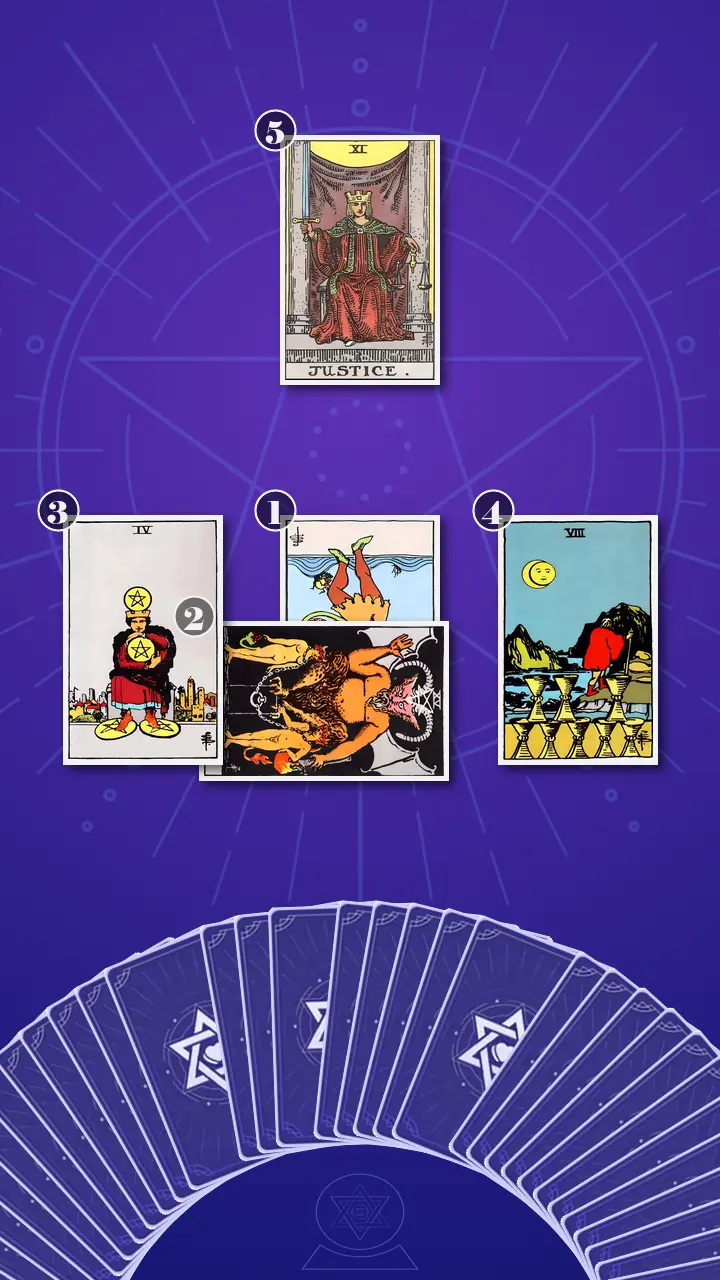
I previewed the map for Jordan: “Card one shows the day-to-day decision climate—what your week actually looks like inside this choice. Card two names the real obstacle, the thing that distorts the decision beyond pros and cons. Then we lay out staying on one side, resigning on the other. And the final card gives guidance: not a prediction, but the principle that restores agency and the next move that creates traction.”
Reading the Cross: Money, Attachment, and the Two Futures
Position 1: The current decision climate
“Now flipped,” I said, “is the card representing the current decision climate: what you’re doing and feeling day-to-day while weighing ‘stay one year’ vs ‘resign.’”
Two of Pentacles, reversed.
I didn’t need to dramatize it. The card practically narrated their week for me. “It’s after work in Toronto,” I said, keeping my voice plain on purpose. “You’ve got a retention-bonus spreadsheet open, a CRA tax estimator in another tab, LinkedIn job posts in a third, and a resignation message saved as a draft. You keep switching between them like you’re ‘managing options,’ but the switching is the problem—every new number or job post resets the debate.”
Jordan let out a short laugh that had a bitter edge to it. “That’s… brutal,” they said. “Like—yeah. That’s literally my Tuesday.”
“Reversed,” I continued, “this card is an energy of blockage—juggling that used to be adaptive turning into overload. The infinity loop on the card reads like having 27 tabs open and calling it progress because your hands are busy. Or like a Jira board where everything is ‘In Progress’ and nothing ever ships.”
I nodded toward what I could see in their posture. “Your calendar and your body are paying the tax: late dinners, missed workouts, tight jaw, restless legs, that midnight wired-but-tired feeling. You’re doing a lot… but it’s not moving you forward.”
Jordan’s fingers tapped once against their mug, then stopped—like they’d been caught. Their eyes softened in that specific way people look when a pattern gets named without shame.
Position 2: The real obstacle
“Now,” I said, “we turn over the card representing the real obstacle: what subtly binds or distorts the decision—not the obvious pros and cons.”
The Devil, upright.
Jordan’s mouth went a little tight before I even spoke. Like their body recognized the theme before their brain wanted to.
“Here’s the thing,” I said gently. “A bonus can be real money and still be a leash.”
I translated it into the exact modern loop: “The retention bonus starts acting like a psychological contract. You tell yourself staying is the only ‘adult’ option, even as your body reacts to another year with dread. You treat the bonus date like a countdown timer that owns you.”
And then I did what this card always asks of me: I made it specific, not moral. “This isn’t weakness. This is attachment. The Devil’s chains look fixed, but they’re loose. Which is another way of asking: what part of this is truly non-negotiable—and what only feels non-negotiable because it scares you?”
Jordan swallowed hard. Their breathing did a tiny hitch—freeze first—then their gaze unfocused, like they were replaying that HR email moment: subject line with the word Retention, the stomach drop, the internal split.
They spoke in two voices, just like the card. “The loud voice is like, ‘Only an idiot would walk away.’” Their jaw flexed. “And then there’s the other voice that doesn’t even use words. It’s just… chest tightness. Dread.”
“Yeah,” I said. “That’s the bind. Your mind is trying to optimize the choice to avoid being exposed—financially, professionally, identity-wise. And your body is trying to tell the truth about the cost.”
Position 3: Path A — Staying for the year
“Now flipped,” I said, “is the card representing Path A—staying: what staying for the year and bonus tends to build internally and practically, beyond the headline benefits.”
Four of Pentacles, upright.
“This is the ‘hold on’ card,” I said. “Staying could build savings and reduce immediate chaos. It could be the part of you that wants a clean runway and doesn’t want to gamble with rent in a high cost-of-living city.”
Then I named the trade-off without demonizing it. “But this card is also an energy of excess—security turning into emotional bracing. Like you’re conserving joy the way you’d conserve cash. The coin is held at the chest: what you’re protecting starts to sit right on your heart.”
I pulled in the sensory reality this tends to create. “It’s Sunday night, stale takeout smell in the room, laptop heat on your thighs, your calendar full of blocks you didn’t choose. You tell yourself, ‘I’ll just power through one year for the payout,’ and without noticing, your life shrinks to work plus recovery. Fewer plans. More isolation. More scope creep you accept because you don’t want to look ‘difficult’ while a bonus is on the table.”
Jordan exhaled slowly, like their ribcage had been holding a secret. “I can see how it turns into lockdown,” they said, quietly. “Not because staying is evil. Just because… I’d stop being a person for a year.”
“Exactly,” I said. “If you stay, the question becomes: what boundary would make staying feel like a choice instead of a sentence?”
Position 4: Path B — Resigning with intention
“Now flipped,” I said, “is the card representing Path B—resigning: what leaving tends to create internally and practically, beyond the headline fears.”
Eight of Cups, upright.
I watched Jordan’s shoulders drop a fraction—almost involuntary.
“This isn’t a rage-quit card,” I told them. “This is a deliberate walk-away. It’s the quiet moment you admit the role doesn’t fit your values or your energy anymore.”
I gave them the modern scene the card wants: “It’s Wednesday night. You’re walking alone along Queen West. Cold enough that your breath shows. No spreadsheet, no tabs. Your phone is in your pocket, and your body loosens a little. And the sentence lands: ‘This doesn’t fit anymore.’ Not dramatic. Just clear.”
“The missing cup in the stack,” I added, “is the thing you can’t unsee: the gap between what this job gives you and what it quietly takes.”
Jordan blinked fast once. Then they gave me a small, startled smile that didn’t fully become happiness—but it did become honesty. “It’s not that I hate everything,” they said. “It’s that I’ve outgrown it.”
“That’s exactly Eight of Cups,” I said. “Resigning creates space. Not guaranteed comfort. But space to choose a direction—skills, culture, autonomy, health—without requiring perfect certainty as the entry fee.”
When Justice Lifted the Sword
Position 5: Next move guidance
I slowed down before turning the final card. “This next one,” I said, “is the north star: the decision principle to use, and the most empowering immediate step to regain agency.”
For a moment, the room felt quieter—like even the buzzing LED in Jordan’s kitchen had taken a step back.
Justice, upright.
“Okay,” I said, and my voice naturally shifted into a cleaner, more structured cadence. “Justice is ethical clarity. It’s values-based decision-making. It’s weighing the consequences honestly—and then ending the case instead of reopening it every night.”
Setup. I pictured the exact loop Jordan had described because I’ve seen it a hundred times, and because I used to live a version of it myself in finance. “It’s 11:40 PM,” I said. “Your spreadsheet is open, LinkedIn is open, your resignation draft is sitting there like a loaded tab. You’re exhausted, but you keep toggling because it feels safer than choosing.”
Delivery.
Don’t let the bonus chain you to a choice; let Justice’s scales weigh your values and the real cost, then act with a clean, honest next step.
I let the sentence hang for a beat. No rescuing it with extra words. Just air.
Reinforcement. Jordan’s reaction came in layers, like a wave breaking and then pulling back.
First: a physical freeze—breath paused mid-inhale, their hand hovering near the trackpad as if it had been caught trying to open another tab. Second: cognitive seep-in—their eyes went slightly unfocused, not vacant, but inward, like they were replaying every night they’d tried to spreadsheet their way into emotional safety. Third: the release—an exhale that sounded almost like laughter, except it wasn’t funny. It was relief mixed with grief.
“But if I choose,” they said, and their voice cracked just a little, “it becomes real. And then if it goes badly… it’s on me.”
“Yes,” I said, softly. “That’s the honest fear. Not the money math. It’s control. It’s the terror that the ‘wrong’ choice will expose you as someone who doesn’t actually have control.”
I felt my own inner flashback—Wall Street, bonus season, contracts that looked like certainty but were really just structured risk. I kept it brief, the way I do. “Back then, the biggest lie I watched smart people buy into was that more modeling equals more safety,” I said. “It doesn’t. It just postpones the moment you take responsibility for a trade-off.”
Justice’s gift is that it doesn’t demand you be fearless. It asks you to be clean. “Weigh honestly. Then cut cleanly,” I told Jordan.
“Let’s make it concrete,” I continued, matching the card’s sword-with-scales energy. “Set a 10-minute timer. Write three lines: (1) ‘My top 3 values are ___.’ (2) ‘My 3 non-negotiables are ___.’ (3) ‘The one action I’ll take in 48 hours is ___ (book the manager chat / send one application / message one contact).’ If your body spikes with panic, you can pause, breathe, and stop—this is an experiment, not a contract.”
Then I asked the question that turns insight into lived memory: “Now, with this new lens—can you think back to last week? Was there a moment when this would’ve changed how you felt?”
Jordan stared at the card, then nodded once, slowly. “Monday morning,” they said. “On Line 1. I was rereading the retention email and my shoulders were basically in my ears. I could’ve just… named the chain instead of pretending I needed one more spreadsheet.”
“That,” I said, “is the pivot from pressure-filled indecision to calm resolve. Not because the future is guaranteed—because you stop outsourcing your life to a number and start choosing with self-respect plus risk management.”
The “Weigh-Then-Cut” Plan: Actionable Next Steps
I pulled the whole spread together for Jordan the way I’d summarize a business case—except this time, the KPI wasn’t “maximum payout.” It was “a life you can actually inhabit.”
“Here’s the story these cards tell,” I said. “Right now you’re in an overloaded juggling loop (Two of Pentacles reversed). The true blocker isn’t lack of intelligence—it’s the golden-handcuffs attachment that makes the bonus feel like a contract you can’t renegotiate (The Devil). Staying builds tangible safety but risks emotional contraction unless you add boundaries (Four of Pentacles). Leaving builds alignment and self-respect, but it requires tolerating uncertainty long enough to create options (Eight of Cups). Justice says the win isn’t perfect foresight—it’s a values-led choice with a plan that reduces risk.”
Then I named the cognitive blind spot plainly: “You’ve been treating this like there is one correct move you must optimize perfectly. That belief turns your brain into a 24/7 risk engine. It feels adult—but it keeps you trapped.”
“The transformation direction,” I continued, “is this: shift from ‘optimize for the guaranteed payout’ to ‘choose based on values and trade-offs, then reduce risk with a clear plan and one decisive next action.’”
Jordan frowned, not in disagreement—more like practical resistance. “But I can’t do 30 minutes every day,” they said quickly. “My days are chaos. Standups, fires, Slack, and then I’m just… done.”
“Good,” I said, because this was the moment to keep it real. “Then we don’t do 30. We do 10. Your brain will protest either way. The point is: you practice ending the loop.”
I offered them a set of next steps that were deliberately small—things that create reality without forcing a final decision tonight.
- Decision Cap Week (7 days)Set a timer for 30 minutes (or 10 minutes if you’re maxed out). During the timer, you’re allowed to do decision work (spreadsheet, research, notes). When it ends, you close the laptop and stop “researching,” even if it feels unfinished.Expect the thought “This is irresponsible—I need more data.” That’s the loop talking. Treat the timer as a boundary, not a verdict.
- The One-Page “Justice Sheet” (Notes/Notion)Create a single page titled Justice Sheet. Write: 3 values (ex: health, growth, integrity), 3 non-negotiables (ex: minimum cash buffer, role scope, manager support), and 3 trade-offs you’re willing to accept (ex: slower promotion for sanity, short-term pay dip for autonomy).If you feel yourself turning it into a 12-page Notion system, stop. One page is the point. “You don’t need a perfect plan—you need a plan that reduces risk and respects your life.”
- One Stabilizer That Reduces FearThis week, book one real-world stabilizer: either (a) one informational chat with a PM you trust at another company, or (b) a 15-minute call with a financial advisor / a simple runway calculator to set your baseline buffer.Lower the bar: one message to one person counts. You’re not announcing anything—you’re widening the door.
I added one more layer, because it’s where my background actually helps. “Jordan, think of this like IPO prep,” I said—my Transition Roadmapping instinct kicking in. “You don’t wait until everything is perfect to go public. You tighten the narrative, get the numbers honest, reduce the biggest risks, and then you choose a timeline.”
“Your Justice Sheet is your prospectus,” I continued. “And if you decide to quietly job search while employed, we can treat your LinkedIn like a prospectus too—clean positioning, competency-based pricing, no frantic overhauls at midnight.”
Jordan’s expression shifted—still serious, but less clenched. “So I’m not choosing tonight,” they said, “I’m choosing the rule. And one move.”
“Exactly,” I said. “Pick a trade-off you can live with—then stop reopening the case every night.”

A Week Later: Ownership, Not Certainty
Six days later, I got a message from Jordan. Just a screenshot: a calendar invite titled “20-min: Sustainable next year chat”—sent to their manager. Under it they’d typed, “Timer went off. I still wanted to rewrite it. I hit send anyway.”
They added one more line: “I slept a full night. I still woke up and thought, ‘What if I’m wrong?’—but this time I laughed a little. Not because it’s fine. Because I’m not trapped.”
That’s the quiet proof of a Journey to Clarity. Not a perfect outcome—an owned next step. Ethical clarity turning into motion.
When you’re holding a calculator in one hand and a resignation draft in the other, it’s not that you don’t know what to do—it’s that you’re terrified the ‘wrong’ choice will expose you as someone who doesn’t actually have control.
If you let this be a values choice—messy but honest—what’s one clean next action you’d be willing to take this week to prove to yourself you’re not trapped?