From 30 Open Tabs to One Finished Task: A Weeknight Reset Plan

The 9:06 p.m. Tab Triage in a Zone 2 Flat
If you’re a late-20s London PM who opens LinkedIn, Rightmove, your banking app, and Hinge in the same sitting—and still goes to bed feeling behind—this is your kind of overwhelm.
Taylor (name changed for privacy) joined my call from their sofa at 9:06 p.m. on a Wednesday, laptop heat warming their thighs like a stubborn space heater. I could hear the small domestic soundtrack through their mic: the radiator clicking on and off, a kitchen light humming, the faint whir of a laptop fan working overtime.
On their screen, the reality was louder than the room. A Rightmove search. LinkedIn jobs. Monzo opened to the “spendable” number. Hinge with a half-written reply. Their cursor kept darting like it was trying to perform CPR on four different futures at once.
“I’m not procrastinating,” they said, and the words came out quick, like they’d been rehearsed while brushing their teeth. “I’m just trying to be strategic. But I keep… switching. Job, rent, money, dating. I feel busy all night and still end up with nothing finished.”
I watched their jaw tighten on the rent reminder email, the way their shoulders lifted toward their ears as if bracing for impact. It wasn’t just stress; it was the body preparing to sprint while the mind refused to pick a direction.
Overwhelm, in that moment, looked like trying to read a map in a wind tunnel—paper flapping, street names blurring, your hands full, your breath shallow—while you keep telling yourself the next glance will make the route obvious.
“You want to get on top of life logistics and feel stable,” I said, keeping my voice gentle but un-fuzzy. “And at the same time, you’re scared that picking the ‘wrong’ first step will cost you time, security, or momentum. Let’s not shame the chaos. Let’s map it. We’re here for clarity—and for a next step you can actually do on a London weeknight.”

Choosing the Compass: The Energy Diagnostic Map (7) Tarot Spread
I started the way I do at the planetarium in Tokyo when a crowd walks in carrying a thousand questions: I slow the room down so the sky can appear. “Before we pull cards,” I told Taylor, “we’re going to do a tiny reset. Not mystical—just nervous-system logistics.”
“Okay,” they said, already half-laughing. “I feel like I need that.”
“Three minutes,” I said. “Cosmic breathing. In through the nose, slow exhale like you’re fogging a window. Your exhale is you telling your body: I’m not on-call for every tab.”
As they breathed, I shuffled. Not for drama—for focus. That’s the simplest way to explain how tarot works in real life: it gives us a structured conversation with the part of you that already knows the pattern, but can’t hear itself over the noise.
“For your question—‘job, rent, dating, budgeting: what first?’—I’m using a spread I call the Energy Diagnostic Map (7) · Context Edition,” I said. “This isn’t an either/or decision. It’s a whole system: visible juggling, inner indecision, external pressure, and one hidden loop that keeps you stuck. This spread is the smallest structure that can still hold the whole messy browser window.”
I angled the camera so they could see my layout. “We’ll look at: your surface behavior (what the tab-switching looks like), the inner tug-of-war behind ‘what first,’ the external pressures pushing on you, the core blockage that keeps the cycle running, the resource you can use immediately, the key transformation—your turning point—and then one grounded next step for the week.”
“Like turning my laptop into… a dashboard?” Taylor asked.
“Exactly,” I said. “A clean dashboard. Not because life is simple. Because your attention is finite.”
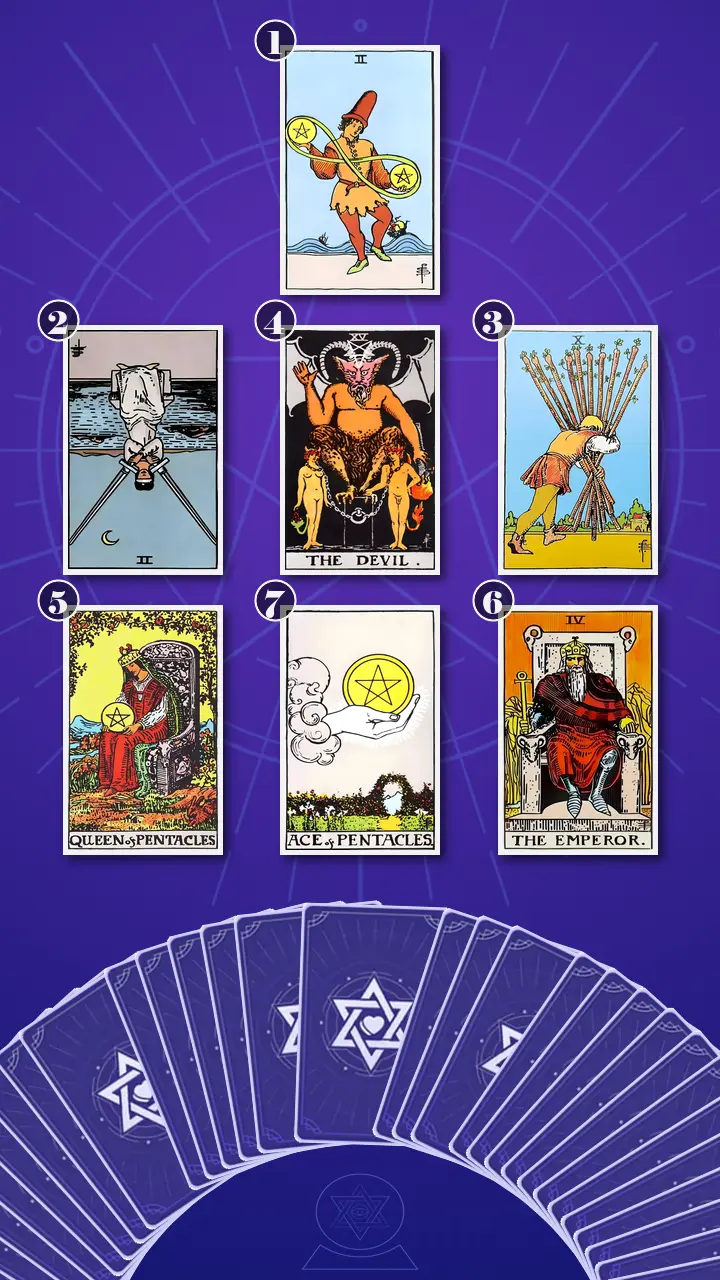
Reading the Map: From Decision Fatigue to a Single Priority
Position 1 — Surface energy: what your day-to-day behavior looks like
“Now flipping over, this is the card representing surface energy: what your day-to-day behavior looks like when the ‘30 tabs’ overwhelm is active,” I said.
Two of Pentacles, upright.
“This one almost makes me smile—because it’s so honest,” I said, turning the card so they could see the figure balancing two coins inside an infinity loop, waves behind him. “Here’s the thing: this card does not say you’re lazy. It says you’re actively juggling. It’s 9 p.m. and you’re toggling between LinkedIn, Rightmove, your banking app, and Hinge like you’re doing triage.”
I leaned in a little. “But your attention is the budget. Every switch is a withdrawal. You feel busy, but nothing gets a finish line.”
Taylor gave a short laugh that landed with a bitter edge. “That’s… rude. Accurate, but rude.” Their fingers tapped the trackpad like they were itching to switch away from being seen.
“Motion isn’t the same as progress—tabs can look like effort and still be avoidance,” I said softly. “And the infinity loop on this card? That’s the ‘never-finished’ cycle. The same four domains keep coming back around unless you deliberately choose what stays in the air today.”
Position 2 — Inner tug-of-war: the indecision pattern behind “what first?”
“Now flipping over, this is the card representing your inner tug-of-war: the specific indecision pattern behind ‘what first?’ and how it stalls action,” I said.
Two of Swords, reversed.
“This is the hover over ‘Submit’ card,” I told them. “You hover over the application, then your brain says, ‘Wait—check rent first.’ You open a new tab. You come back. You reread. You pause again. It’s a stalemate dressed up as responsibility.”
I pointed to the blindfold and crossed swords. “Reversed, it’s the strain of holding this posture. The blindfold maps to: ‘I can’t decide until I have more information,’ even when the missing piece isn’t data—it’s tolerating the discomfort of choosing.”
Taylor stared at the card and then looked away, like they’d been caught reading their own diary in public. “I keep telling myself I’m being… careful.”
“Careful is fine,” I said. “But you’re not choosing forever. You’re choosing first.”
That landed. Their shoulders didn’t drop yet, but their breath stopped hitching at the top of their chest for a second—like the idea offered a small exit route.
Position 3 — External pressure: what your environment is putting on you
“Now flipping over, this is the card representing external pressure: deadlines, money realities, social comparison—what’s pushing on you right now,” I said.
Ten of Wands, upright.
“This is the realness,” I said. “Responsibilities are not imaginary. After a demanding full-time day, you try to do rent admin, job searching, money planning, and dating emotional labor in one evening. Each tab is a wand you feel you should carry alone.”
I traced the image where the bundle blocks the figure’s face. “And it’s making you blind. Too much in your arms means you can’t see the path. Your brain doesn’t know what’s urgent because everything is piled in your head at once.”
Taylor’s mouth tightened again, but this time it looked more like grief than panic. “It’s like… everyone expects you to just be able to do it. Like adult life is supposed to be clean.”
“London will absolutely sell you that story,” I said. “And then charge you rent for believing it.”
Position 4 — Core blockage: the hidden driver keeping you cycling through tabs
“Now flipping over,” I said, and I slowed my hands a fraction, “this is the card representing the core blockage: the hidden driver that keeps you cycling through tabs instead of completing one stabilizing action.”
The Devil, upright.
The card was blunt. Chains. A raised hand. A torch inverted like a warning label.
“This isn’t about you being ‘bad’ or undisciplined,” I said immediately. “This is about a loop. A sticky, fear-driven attachment. The chain is loose—but the relief you get from checking tightens it again.”
I let the scene get specific, like zooming in on a finger on a phone screen. “Your thumb hits refresh: listings, messages, email. For half a second, the new load gives you a tiny dopamine exhale—‘I didn’t miss anything.’ And then the drop hits because it isn’t the magic answer. So you pull the slot machine lever again.”
I watched Taylor’s eyes track the card, then flick to the side as if their own open tabs were being accused.
“Refresh is relief with interest,” I said. “You pay for that tiny sense of safety with your attention. And the interest rate is: you stay reactive. You never finish. You never get the nervous-system receipt of ‘handled.’”
Taylor’s reaction came in a three-beat chain I know well from the planetarium when someone sees Saturn’s rings for the first time—freeze, recognition, release. 1) Their breathing paused, like their body went still. 2) Their gaze unfocused for a moment, as if replaying last night’s refresh spiral. 3) Then a sharp exhale escaped. “Oh… yeah,” they said, quiet.
“And here’s the Devil’s question,” I continued, “because it’s the most useful one: when you click into a new tab ‘just to check,’ what feeling are you trying not to feel for thirty seconds? Uncertainty? Fear? Loneliness? The vulnerability of committing?”
They swallowed. “It’s… the quiet. The ‘what if I choose wrong’ quiet.”
Position 5 — Usable resources: the strength you can access immediately
“Now flipping over, this is the card representing usable resources: the practical strength you can access immediately to regain steadiness,” I said.
Queen of Pentacles, upright.
“This is the antidote that doesn’t require a personality transplant,” I said, and my voice softened without getting vague. “The Queen of Pentacles is grounded care. Containment is care. She’s not asking you to optimize your whole life. She’s asking you to stabilize the platform you make decisions from.”
I described it as a montage—screen-world to body-world. “Kettle click. Mug warmth. Feet on the floor. A cleared corner of the table. One realistic money snapshot. Food, water, sleep. Not glamorous. Not shareable on LinkedIn. But it calms the part of you that thinks everything is an emergency.”
Taylor’s shoulders eased down a few millimeters, almost involuntary. “That feels… doable,” they said, like they were surprised by their own agreement.
“Good,” I said. “Doable beats dramatic.”
When The Emperor Spoke: The Rule That Ends the Negotiation
Position 6 — Key transformation: the structure that breaks the loop
I held my breath for half a beat before turning the next card, the way I do right before I dim the lights in the dome and the first stars appear. The room on Taylor’s end seemed to hush; even the radiator clicks sounded farther away.
“Now flipping over,” I said, “this is the card representing the key transformation: the mindset or structure that breaks the loop and creates a workable priority sequence.”
The Emperor, upright.
“The Emperor is the operating system,” I said. “Not mood management. Not ‘wait until I feel ready.’ It’s self-leadership: a chosen constraint strong enough to hold pressure so you don’t have to renegotiate with yourself every night.”
Setup. I could feel Taylor still clinging to the idea that if they just found the perfect order, the week wouldn’t collapse. It was 9:18 p.m. energy: laptop on thighs, tabs multiplying, their chest buzzing as they chased certainty like it was a deadline.
Delivery.
Stop letting fear keep every tab open; choose your rule of the week and sit on your own throne like The Emperor.
I let that sentence hang for a second, like a planet held steady in orbit.
Reinforcement. Taylor’s face changed in layers. First their eyebrows lifted—offense, almost. Then their mouth twisted into a laugh that said, I hate that this is true. Their shoulders stayed tense for a moment, then dropped as if they’d been holding up a ceiling. One hand—still off-camera—must have unclenched, because their wrist appeared in frame and their fingers were suddenly open, resting on the edge of the laptop instead of gripping it.
They inhaled, and it caught. Their eyes shimmered, not full tears, but that thin watery look you get when you realize you’ve been living in a constant brace. “But if I pick a rule,” they said, voice rougher, “doesn’t that mean I was… doing it wrong?”
“It means you were doing what your nervous system thought would keep you safe,” I said. “And it worked—briefly. It gave relief. But it also trapped you.”
This was where my astronomy brain always steps in. “In spaceflight, we don’t ‘win’ by firing the engine nonstop,” I told them. “We win by using structure—trajectory, timing, and a few intentional burns. I call it a Gravity Assist Simulation: instead of trying to force every outcome tonight, we evaluate what small rule will change your path over time with the least fuel.”
“So it’s not ‘what first’ forever,” Taylor murmured. “It’s… what first this week.”
“Yes,” I said. “Operating System > Mood. And when your body spikes—tight jaw, buzzy chest—that’s not proof the rule is wrong. It’s proof you’re exiting the loop.”
I leaned forward. “Now, with this new lens—structure over perfect sequencing—think back to last week. Was there a moment when you were about to click ‘Submit’ or send the message, and the tab-switch reflex kicked in? How would it have felt to have a rule already chosen, so you didn’t have to negotiate?”
Taylor went quiet, eyes unfocused again. Then they nodded once. Decisive. “Tuesday. I hovered over ‘Submit,’ then went to Rightmove. If I’d had a rule… I would’ve submitted.”
“That nod,” I said, “is a shift from chaotic overwhelm into grounded self-leadership. Not perfect confidence. But a steadier baseline.”
Position 7 — Next grounded step: a concrete action that becomes stability
“Now flipping over,” I said, “this is the card representing your next grounded step: a concrete, realistic action that turns insight into stability within the next week.”
Ace of Pentacles, upright.
“This is the hand offering you something you can actually hold,” I said. “One tab becomes one outcome: a submitted application, a paid bill, a scheduled viewing, a saved budget baseline.”
I watched Taylor’s eyes soften again—not with relief yet, but with something more practical: comprehension. “The Ace of Pentacles doesn’t want a grand reinvention,” I said. “It wants a confirmation screen.”
“One confirmation screen can calm more than ten open tabs,” Taylor repeated, almost testing the sentence in their mouth.
“Exactly,” I said. “Your body will believe a receipt faster than it will believe a Notion template.”
From Insight to Action: The One-Tab-to-One-Outcome Method
I gathered the seven cards into one story, the way I’d summarize a sky tour: not every star, just the constellation that helps you navigate.
“Here’s the system your spread shows,” I said. “On the surface, you’re juggling (Two of Pentacles). Inside, you treat choosing what to do first like a permanent verdict, so you freeze and bargain (Two of Swords reversed). Outside, the pressure is real—work, rent, social comparison, city costs—so you’re carrying too much in your arms to see the path (Ten of Wands). Underneath it all, the real trap is the compulsion loop: checking and refreshing for emotional relief, paying with attention, and then feeling worse when nothing is finished (The Devil).”
“But you have two stabilizers,” I continued. “First, a home base you can build tonight—body-first steadiness (Queen of Pentacles). Second, a structure you’ll follow—a rule that ends the nightly negotiation (The Emperor). Then the Ace of Pentacles asks you to turn it into one tangible win.”
“Your cognitive blind spot,” I said carefully, “is thinking the only safe way to prioritize is to do it perfectly. That makes ‘first’ feel like ‘forever.’ And it makes monitoring feel like control.”
“The transformation direction is the opposite: move from solving everything today to choosing one stabilizing task, time-boxing it, and letting completion—not perfection—set your next priority.”
Taylor exhaled. “I can feel my brain trying to argue with you,” they admitted. “Like, ‘but what if the other thing becomes urgent.’”
“That’s normal,” I said. “That’s the spacecraft reacting to turbulence. We don’t panic—we do a Spacecraft Attitude Adjustment: we prepare for the wobble so it doesn’t knock us off course. The wobble is not a sign you should open all tabs again.”
“So what do I actually do tonight?” they asked, and it came out sharper—an honest practical obstacle. “I don’t have two hours. I barely have… twenty minutes.”
“Perfect,” I said. “We’re not building a new life. We’re building a container.”
- Home Base First (5 minutes)Before opening any tabs, fill a glass of water, make tea, and clear one small surface (a single square foot of table or sofa space). Then open your banking app and write down one number: your current balance or ‘spendable until payday.’ Close the app.If your brain says “too basic,” that’s the loop talking. Make it even smaller: just tea + one number. Stability can start boring.
- Draft Your “Rule of the Week” (10 minutes)Open Notes and write one sentence: “This week, my first stabilizing task is ___.” Add a one-checkbox definition of done (e.g., “Done = submit 1 application” or “Done = set up council tax payment” or “Done = send 1 viewing request”). Put the rule on a sticky note where you open your laptop.Don’t over-engineer it. One rule for one week. No renegotiation during the focus block—you’re collecting data, not proving worth.
- Single-Tab Focus Block (25 minutes)Set a 25-minute timer. Close every tab except the one needed for the next visible step toward your checkbox. When the urge to tab-switch hits, do one slow exhale and return to the next click (submit, send, schedule, pay).Aim for one confirmation screen. If perfection paralysis shows up, lower the bar: “draft saved and clearly named” counts if it’s a real, retrievable step.
“If you want a quick prioritization check,” I added, “we can do a constellation alignment pros/cons in thirty seconds: which single action reduces the biggest real-world consequence this week—late fees, missed application window, housing timeline? That’s usually your stabilizing first.”
And because I’m me—half scientist, half reader of symbols—I named the hidden piece too. “Also,” I said, “your Dark Matter—the overlooked factor—is your body. Your system is trying to run high-stakes decisions on a buzzy chest and a clenched jaw. Ground first, then decide. You’ll be shocked what becomes obvious when your nervous system isn’t braced.”

A Week Later: The Quiet Proof of Finding Clarity
Six days later, Taylor sent me a message: “Did the rule. Didn’t love it. But it worked.”
They’d chosen: Mon = money admin first. One checkbox: “Set up council tax payment + confirm direct debit date.” They did the home base ritual—tea, cleared the corner of the table, wrote down one Monzo number—and then they closed every tab except the council site. Twenty-one minutes later they had a confirmation email.
“It’s weird,” they wrote. “I still have the same life. But my shoulders dropped when I saw the receipt. Then I submitted one job application the next night. Not perfect. Just… sent.”
In my head, I saw the bittersweet version of that win: they didn’t throw a party. They sat alone in the same flat, tea cooling beside them, staring at the confirmation screen for three quiet minutes—half relieved, half stunned that completion could feel safe.
That’s the journey I love watching—especially with modern life admin overwhelm, career crossroads, and decision fatigue: not a dramatic reinvention, but a small, real steadiness returning to the body. From compulsive tab-switching to grounded self-leadership. From “everything is urgent” to “one thing ships.”
And if you’re reading this with your own jaw tight, your own shoulders braced, your own cursor hovering like it’s afraid—hold this close: when you’re trying to protect your future in four directions at once, your shoulders stay braced like you’re about to get hit—because choosing one first step can feel less like prioritising and more like risking your stability.
If you trusted that “first” isn’t “forever,” what’s one tiny rule you’d be willing to try for the next seven days—just long enough to let one tab become one real-world confirmation?