From Wired-But-Tired Scrolling to Steadier Calm: Micro-Commitments

The 10h Alert in the Condo Kitchen
If your iPhone hits you with a 10h Screen Time alert and your first thought is “How did that even happen?”—welcome to the doomscroll procrastination loop.
Jordan (name changed for privacy) showed up looking like they’d been trying to outrun their own nervous system. They were 28, early-career marketing in Toronto, hybrid job, constant pings—life lived in little red badges and half-finished drafts.
They described a Wednesday morning like it was a crime scene: 8:57 AM in their condo kitchen, kettle clicking off, laptop open on the counter. The fluorescent under-cabinet light buzzed like a mosquito you can’t swat. Slack already had that blue dot waiting. Jordan said their hands felt restless—like they needed to be doing something—yet their jaw had been locked all morning.
“I tell myself I’ll just clear messages,” they said, voice flat with tired disbelief. “And then I’m on Instagram Stories before I’ve written a single sentence. It’s like my phone isn’t relaxing me, it’s just deleting my time.”
As they talked, I watched the pattern land in three different places—work, money, love—with the same exact timing. Right before a focused work block: scroll. Right after opening a banking app: scroll. Right before sending a vulnerable text: scroll.
The core tension was painfully clean: Jordan wanted stability and momentum—real progress, calmer money habits, actual closeness with someone—while fearing the discomfort of showing up imperfectly and being judged. Not just by a boss or a date. By themselves.
They rubbed their thumb against their index finger as if the phone was still there. “If I look at the numbers, they feel like a verdict. And if I send a text and it’s weird, I’ll look… needy.” Their laugh was brief and sharp. “I keep optimizing my life instead of living it.”
The restlessness in the room felt like trying to read street signs in a wind tunnel—everything moving too fast to grab. Under it, I could hear the quieter undertow: shame that made them want to disappear, and loneliness that made the screen feel like the safest place to be seen without being evaluated.
“We’re not going to treat this like a character flaw,” I told them. “We’re going to treat it like a pattern with a mechanism. And today, we’re going to find clarity—specifically, what your screen time is protecting you from in work, money, and love, and what the next honest step looks like.”

Choosing the Compass: How Tarot Works When Life Feels Like Ten Tabs
I asked Jordan to take one slow breath—not as a mystical ritual, but as a clean transition. On the trading floor, we called it a reset before the next decision. Your brain can’t renegotiate a pattern if it never leaves the pattern long enough to see it.
I shuffled slowly and invited them to hold one simple question in mind: “What is my avoidance actually doing for me—right before work, money, or connection?”
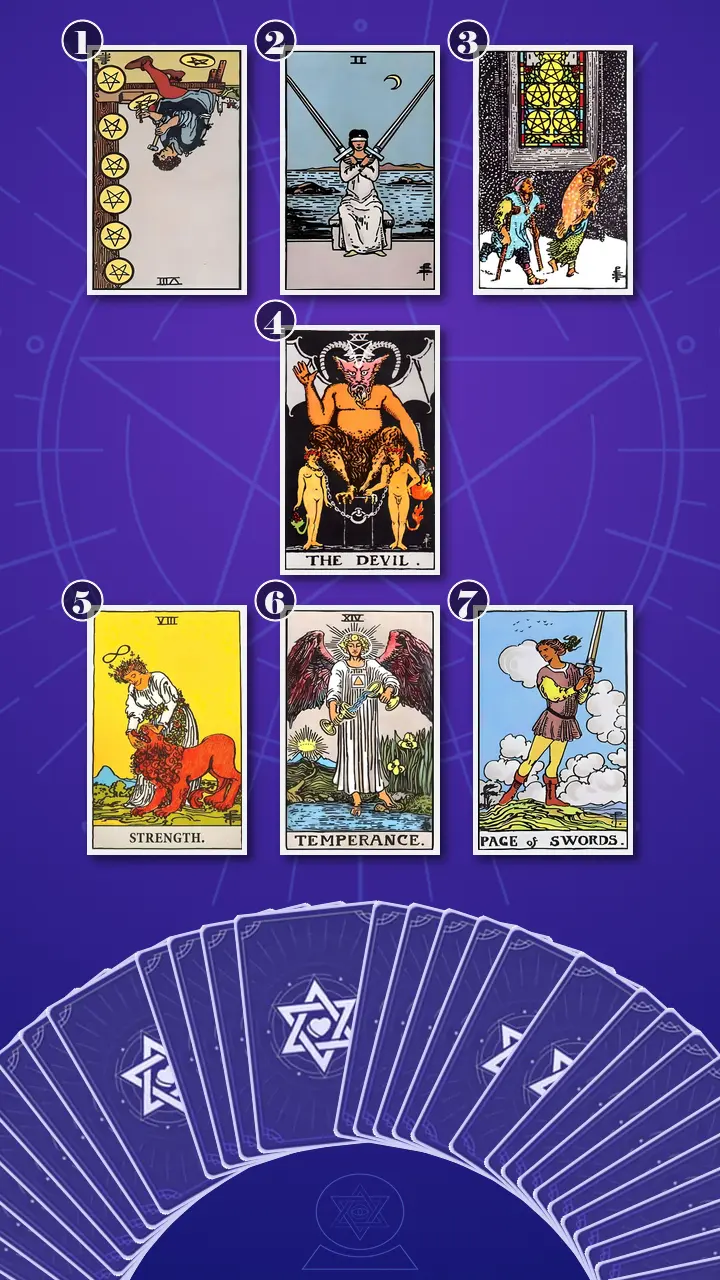
“Today,” I said, “we’re using a spread I designed called the Energy Diagnostic Map (7) · Context Edition.”
For you reading this—this is why that matters. When someone asks a multi-domain question like ‘Why do I scroll for ten hours—and what am I avoiding in work, money, and love?’ a long, general spread can blur the signal. This map keeps it tight: one card for the surface behavior, one for the internal conflict, one for outside pressure, one for the core blockage, then three cards that rebuild a workable path—resource, transformation, and next step. It’s basically a diagnostic: scattered attention → binding loop → regulated integration → actionable advice.
I pointed at the layout as I set it. “Card 1 will show what you’re doing on-screen instead of the next real step. Card 4, dead center, is the root knot—the part that repeats even when you ‘know better.’ And Card 6 is the turning point: the shift that makes follow-through feel safer and more sustainable.”
Reading the Map: Card Meanings in Context
Surface Pattern: The Detour That Looks Like Responsibility
“Now we’re turning over the card that represents Surface pattern: what you’re doing on-screen instead of the next real step in work, money, or love,” I said.
Eight of Pentacles, reversed.
Jordan leaned in, like their body recognized it before their mind did.
“This is the ‘busy but not building’ card,” I told them. “In modern life, it’s: you sit down to do one real thing—a campaign draft, a client email, a budget transfer, a vulnerable text—and your brain instantly offers a detour that feels responsible. Reorganize your task manager. Watch ‘how to focus’ videos. Tweak budget categories. Reread old messages for tone. An hour passes, you’ve been busy the whole time, and there’s still nothing you could point to as done.”
Reversed, the Eight’s energy isn’t absent—it’s scattered. The discipline that builds skill gets diluted into micro-tasks that give you the sensation of effort without the risk of being evaluated.
Jordan gave a short, bitter laugh. “That is… too accurate. Almost rude.” They exhaled hard through their nose, eyes dropping to the table. “I can literally spend forty minutes picking a font for a deck.”
I nodded. “Busy isn’t the same as building. Your attention is doing warm-up laps forever because the actual ‘first rep’—the draft, the number, the message—feels like it could prove something about you.”
Inner Tug-of-War: The Blindfold That Feels Like Safety
“Now we’re turning over the card that represents Inner tug-of-war: the split decision or emotional standoff that makes the phone feel easier than choosing and acting.”
Two of Swords, upright.
“This is protected stalemate,” I said. “The card’s blindfold is the energy of ‘I can’t look at this yet’—closing the bank app, not opening the draft, not sending the text—because looking feels like being judged.”
I described it in a micro-scene, because that’s how this card speaks in real life: two browser windows open in your head. On one side: the decision that would reduce stress—pick the one priority for Monday, send the email with a messy first pass, schedule the transfer, say the honest thing. On the other: your phone offering instant neutrality. No choice. No exposure. Just the soothing hum of content.
“What are you not looking at,” I asked gently, “because it feels like a verdict?”
Jordan’s shoulders lifted, just slightly, like they were bracing. Then they dropped. “It’s… choosing a priority at work,” they admitted. “And with money, it’s admitting I can’t ‘vibe’ my way into saving. With dating—” They stopped, thumb worrying the edge of their sleeve. “It’s admitting I want closeness. I hate feeling like I need anything.”
The Two of Swords isn’t laziness. It’s a defense. The energy is blocked in the chest: don’t move, don’t choose, don’t get seen trying.
External Pressure: The Winter That Makes the Screen Feel Warm
“Now we’re turning over the card that represents External pressure: what in your environment is amplifying the urge to escape into the screen,” I said.
Five of Pentacles, upright.
“This is scarcity winter,” I told them. “Cost-of-living pressure and comparison fatigue tighten your nervous system. Rent notifications, bills, someone else’s ‘just got promoted’ post—it lands like proof you’re behind. Your phone becomes the quickest warmth.”
Five of Pentacles is not just ‘money stress.’ It’s the feeling of being outside looking in—like stability is for other people. And when you feel like an outsider, you don’t take risks. You don’t send the message. You don’t negotiate. You don’t ask for help. You scroll, because scrolling asks nothing from you except your attention.
Jordan’s eyes went distant for a second, like a PATH food court line playing back in their head: checking the bank app, stomach dropping, locking the phone—then unlocking it to numb out.
“Yeah,” they said quietly. “Every notification feels like… you’re failing at adulthood.”
Core Blockage: The Contract You Didn’t Mean to Sign
I let a beat of silence pass before the center card. “Now we’re turning over the card that represents Core blockage: the underlying pattern that keeps repeating across work, money, and love, even when you ‘know better’.”
The Devil, upright.
I kept my voice matter-of-fact. “Your phone isn’t the villain—it’s the fastest exit ramp from discomfort. The Devil is the compulsion contract: short-term soothing that tightens into a loop.”
I watched Jordan’s fingers flex, as if the urge was being named in their muscles.
“Here’s the close-up scene this card is showing me,” I said. “You’re about to do the thing—open Slack and reply with actual progress, open the bank app and look at one real number, send two honest sentences. The discomfort spikes. Your jaw clenches. Your hands go restless. And the phone is in your hand before you even notice you picked it up.”
I mirrored the Devil’s loose chains with modern mechanics: swipe → numb → shame → swipe. “Part of your brain says, ‘I’m just taking a break.’ Another part whispers, ‘I’m avoiding the verdict.’ And then the shame makes you want the next hit of neutrality even more.”
Jordan nodded without looking up—quiet, uncomfortable, but relieved to have it named without being scolded. Their exhale sounded like surrender, not defeat. “Yeah… that’s exactly it.”
On Wall Street, I used to watch people get trapped by invisible agreements: chase the number, prove you’re worth the seat, never look uncertain. The Devil feels like that—except the ‘deal’ is: avoid discomfort now, pay with your future attention later. The good news is in the art itself: the chains are loose. It’s powerful, but interruptible.
Usable Resource: Strength That Doesn’t Require Self-Hate
“Now we’re turning over the card that represents Usable resource: the inner strength you can access without needing a perfect plan first,” I said.
Strength, upright.
“This is calm self-control built from compassion,” I told them. “Not punishment.”
Strength’s energy is balanced—not excess, not deficiency. It’s a steady hand on the lion. In your life, it looks like naming the urge—‘I want to scroll’—and staying present long enough to do five minutes of the real thing. Not because you’re forcing yourself. Because you’re proving to your nervous system that discomfort isn’t danger.
Jordan’s posture changed here. Their shoulders dropped a fraction, and their face softened in a way that told me their body liked this version of “discipline” better than the harsh one.
“I always go extreme,” they admitted. “Block everything, feel deprived, then binge at night.”
“Strength isn’t a cage,” I said. “It’s a steadying hand.”
Key Transformation: When Temperance Poured Between Two Cups
Before I turned this card, the room went noticeably still. Even the street noise outside felt like it pulled back.
“Now we’re turning over the card that represents Key transformation: the most important shift in your relationship to attention and discomfort that unlocks real change,” I said.
Temperance, upright.
Setup. I described the exact moment their pattern usually tightens: it’s 9:18 PM on a Sunday, Jordan is on the couch with their laptop open, Slack half-closed, and their thumb already hovering over TikTok. They tell themselves they’ll scroll for “five minutes,” but what they’re really trying to do is not feel the dread underneath—dread that if they choose one priority, they’ll choose wrong; dread that if they start, they’ll be seen trying imperfectly.
Delivery.
Not an all-or-nothing phone cleanse; build a steady mix of focus and recovery, like Temperance pouring cup to cup, until your attention stops swinging between binge and burnout.
I let it sit. No extra explanation for a second. Just air and honesty.
Reinforcement. Jordan’s reaction came in a chain. First: a tiny freeze—breath caught, eyes widening like the sentence had reached the part of them that was tired of punishment. Second: the mind trying to re-run the old script—But I’m the kind of person who needs a full reset. I always mess it up. Their gaze unfocused, as if they were replaying last week’s late-night scroll in fast-forward. Third: the release—shoulders sinking, jaw unclenching, a slow exhale that sounded almost embarrassed. “That… feels doable,” they said, voice quieter. “Like, I don’t have to become a different person overnight.”
This is where I brought in the toolset that’s made my tarot work different from the start—because in finance, you don’t win by wishing risk away. You win by pricing it honestly. “Let’s use a Risk-Reward Matrix for your attention,” I said. “Three scenarios.”
“Scenario A: extreme detox and blockers. Reward: quick clarity for a day. Risk: rebound binge and shame. Scenario B: current loop. Reward: immediate numbness. Risk: lost time, background dread, and weaker self-trust. Scenario C: Temperance rhythm—focus and recovery mixed on purpose. Reward: consistent follow-through. Risk: it feels ‘too small’ at first, so your brain will call it pointless.”
I watched Jordan’s eyes track as if something inside them finally had a dashboard.
“Now,” I said, “set a 12-minute timer. Write one line at the top of a note: ‘Right now I want to scroll because I don’t want to feel ___.’ Fill in the blank with one word—dread, shame, uncertainty, loneliness. Then do one tiny next step: a two-sentence email draft, open your banking app and check one number, or send one honest text. When the timer ends, you can stop. No punishment. No extra credit. And if you feel your jaw clench or your chest spike, take three slow breaths and choose pause over push.”
Jordan swallowed. Their eyes shone, not with a dramatic breakdown, but with that particular relief of being understood at the mechanism level. Then the vulnerable question arrived—an unexpected reaction, sharp with self-protection.
“But if it’s just a rhythm,” they said, a flash of frustration coloring their voice, “does that mean I’ve been doing it wrong this whole time?”
I shook my head. “It means you’ve been using the best tool you had for regulation. It worked fast. It just got too efficient. Temperance isn’t a moral correction—it’s an upgrade: from accidental recovery to intentional recovery.”
I leaned in slightly. “Now, with this new lens—think back to last week. Was there a moment right before you scrolled where this 12-minute practice could’ve changed how you felt?”
Jordan stared at the card, then nodded once. “Thursday. I opened my bank app, saw the balance, felt that stomach drop… and I locked the screen and went straight to TikTok. If I’d done twelve minutes, I could’ve at least looked at one number without spiraling.”
That was the emotional transformation landing in real time: from restless numbness toward cautious self-trust through one small follow-through.
Next Step: The Page of Swords and the “Field Notes” Mindset
“Now we’re turning over the card that represents Next step: one practical, testable action or mindset experiment that builds self-trust this week,” I said.
Page of Swords, upright.
“This is the truth-seeking beginner,” I told them. “It’s mental speed—like a windy sky—but aimed at observation instead of consumption.”
I shifted into a ‘field notes’ tone on purpose. “Track it like data, not like a moral report card. Once a day, write: ‘I reached for my phone right before ___.’ Fill in the blank. Then add one feeling word: dread, embarrassment, uncertainty, loneliness, annoyance.”
Jordan’s face changed again—less heavy, more curious. Like the part of them that loved analytics finally had a healthier job.
“I can do that,” they said. “That’s… actually kind of interesting.”
A Rhythm Beats a Reset: Actionable Advice for the Next 7 Days
I pulled the whole spread together for them the way I would in a boardroom—clear storyline, no drama, honest causality.
“Here’s what the map says,” I summarized. “On the surface, you’re busy-but-not-building (Eight of Pentacles reversed): systems, scrolling, ‘prep’ that keeps you safe from being evaluated. Underneath, you’re in a protected stalemate (Two of Swords): choosing feels like exposure, so you stay neutral. The environment adds pressure (Five of Pentacles): money stress and comparison fatigue make the world feel cold, so the phone becomes warmth. The core mechanism is The Devil: discomfort hits, you take the fastest exit ramp, then shame tightens the loop. Your resource is Strength: 90 seconds of kind restraint. And the turning point is Temperance: not a detox, but a repeatable mix of focus and recovery that teaches your nervous system a new baseline. Then the Page of Swords makes it practical: simple data, one observation a day.”
The cognitive blind spot was also clear: Jordan had been treating discomfort as danger—so they kept waiting to feel ready. The actual transformation direction was the opposite: Action first. Confidence second. A micro-commitment doesn’t require you to feel brave; it creates the evidence that you can be brave.
I offered them a short plan—small steps, no moralizing, designed for a real hybrid-work week.
- The Anchor Task Rule (25 minutes)Each weekday, pick one “anchor task”: one work deliverable or one money action or one honest message. Set a 25-minute timer and do a single pass—no refining, no reformatting, no researching a better system.If your brain says “25 minutes is pointless,” label it as The Devil’s all-or-nothing pitch. Do it anyway for one week, just as a test.
- The Offline Reset (5 minutes)After the 25 minutes, do a deliberately offline 5-minute reset: stand by a window, stretch your shoulders, rinse a mug, or step into the hallway. No phone.Think of this as Temperance: recovery on purpose, not by accident. You’re training rhythm, not restriction.
- One-Line Screen-Time Audit (Page of Swords)Once a day, write: “I reached for my phone right before ___.” Add one feeling word. Then do the smallest next action that reduces background stress by 5%—within 10 minutes.Keep it private and lightweight. Miss a day? That’s data, not failure.
Before we wrapped, I taught Jordan one of my pre-commitment techniques from the trading floor—simple enough to do in a condo kitchen: decide in advance what you’ll do when the urge hits. “When Slack pings and you feel your jaw lock,” I said, “you don’t negotiate with it. You execute a tiny script: name the urge, three breaths, twelve minutes, done.”

A Week Later: The Quiet Proof
A week later, Jordan messaged me on a rainy Tuesday: “I did the 25/5 thing four days. Not perfect. But I sent the email draft in the first block. And I opened my bank app and checked one number without immediately bailing.”
They added, “I still woke up one morning thinking, ‘What if I mess this up?’—but it didn’t feel like a verdict. More like… a weather report.”
That’s what a real Journey to Clarity looks like most days: not a total transformation, but the first believable evidence that your attention can belong to you again.
When you’re about to face a deadline, a balance, or a vulnerable text—and your hand reaches for your phone before you’ve even decided—what you’re really trying to avoid is the feeling that being imperfect will look like being unworthy.
If you didn’t need to feel ready first, what’s one tiny 10–25 minute “next honest step” you’d be willing to try this week—just as an experiment?