Menu in Hand, Throat Tight, Then One Honest Sentence Toward Mutuality

When ‘You choose’ turns dinner into a belonging test
If you’re a London agency person who can handle a client curveball but still freeze when a friend says, ‘You pick dinner,’ this is probably people-pleasing, not lack of taste.
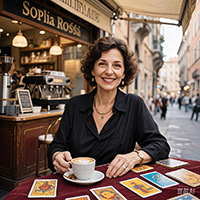
Ava (name changed for privacy) sat across from me with both hands around a cappuccino, the table smelling faintly of espresso and orange peel, and told me about 7:12 p.m. on a Thursday at a small wine bar in Hackney. Glasses were clinking, garlic hit the air from the kitchen, the server had the pad out, and her date smiled and said, ‘You go first.’ She had already checked the menu on the Tube. She knew what looked good. But in the second the attention swung toward her, her throat tightened, her breath went shallow, and her mind stopped scanning her own appetite and started scanning price, tone, and the other person’s face.
‘I heard myself say, “Honestly, anything’s fine,”’ she told me. ‘Then I ordered the safest thing on the menu. It’s so stupid, because I did have a preference. I just… didn’t want to make things harder for him. Or sound high-maintenance. Or be a problem.’
Outwardly, she was polished, funny, low-drama—the kind of woman who could keep a client calm on no notice and still send the follow-up email in perfect tone. Inside, she described something much smaller and more exhausting: wanting to choose honestly while fearing that having a preference would make her inconvenient. Her apprehension had the strange texture of a paper menu turning into a fire alarm in her hands.
I nodded. ‘That makes sense,’ I said. ‘And it’s more common than people admit. “I’m easy” is not always a preference; sometimes it’s a safety strategy. A lot of people are not indecisive—they’re just busy making themselves easier to absorb. So we’re not here to shame the reflex. We’re here to make it visible. Let’s draw a map through the fog and find the clarity that belongs to you, not to the room.’

Choosing the compass: a four-card spread for fear of being a burden
I asked Ava to put both feet on the floor and take two slow breaths before we began. I do this not because tarot needs theatre, but because the body usually arrives in the room a few minutes after the mind does, and a reading works better when both are present.
For her, I chose the Situation-Challenge-Advice-Outcome · Context Edition. When someone is asking, in effect, ‘Why do I freeze when people ask what I want?’ I don’t reach for an oversized spread. This pattern is intimate, specific, and very legible. Four cards are enough to show the visible habit, the deeper obstacle underneath it, the shift that interrupts it, and the more mutual relational pattern that can grow from there.
I told her what I tell readers, too: the strength of this spread is its clean chain. The first card names the symptom in real time—the freeze, the blankness, the reflexive ‘anything is fine.’ The second goes lower, into the fear that ordinary preference creates debt, imbalance, or disapproval. The third is the hinge: the stance that restores self-trust. And the fourth does not predict fate; it shows the direction that opens when honesty and connection are finally allowed to coexist.
The two-second blank behind ‘I’m easy’
Position 1: The card of the freeze
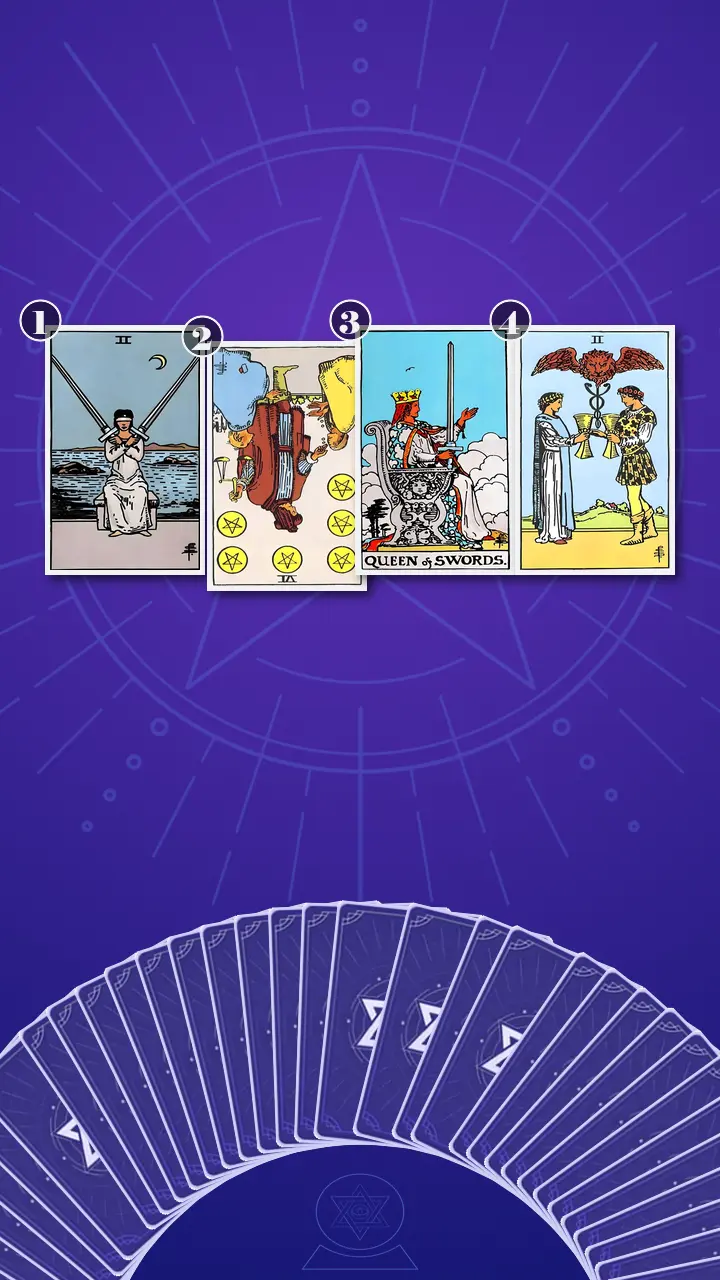
I turned the first card, the one representing the visible pattern that shows up in the moment itself. It was the Two of Swords, upright.
I looked at the blindfold, the crossed swords over the chest, the stillness of the figure, and then back at Ava. ‘This is that exact restaurant moment,’ I said. ‘You’ve already done the prep. You checked the menu on your commute. You thought you were ready. But the second the attention lands on you, your own preference goes offline. Instead of reading yourself, you start reading the room. Who looks price-conscious? Who seems tired? What answer will keep the social temperature smooth? It looks like flexibility from the outside. Inside, it’s self-protection.’
That card carries Air energy, but here it’s blocked Air—thought that has frozen instead of clarified. The problem is not that you have no answer. The problem is that you’ve learned to put a blindfold over your own signal before your answer can fully form. It’s like having ten tabs open in your brain and none of them is your actual appetite. Or, very modernly, staring at a menu the way people stare at Netflix: overloaded, frozen, and weirdly afraid of picking the wrong thing in front of other people.
I asked her, ‘What happens in your body in the two seconds before you speak?’
She gave a short laugh that had a bitter edge to it and rubbed her thumb along the rim of the cup. ‘My throat first,’ she said. ‘Then my stomach. And then the internal voice starts: Don’t be difficult. Don’t be the expensive one. Just pick something normal.’
‘Exactly,’ I said. ‘That’s why this doesn’t feel like simple indecision. The choice is small. The body response isn’t.’
Position 2: The invisible Splitwise ledger
I turned the next card, the one revealing the deeper challenge underneath the behavior: the fear that having needs will create imbalance, debt, or disapproval in relationship. It was the Six of Pentacles, reversed.
I felt my own recognition rise before I spoke. After twenty years of listening to people untangle their lives over coffee, I know this pattern well: the moment hunger gets translated into morality. ‘This,’ I told her, ‘is where a simple plan stops being about dinner and turns into invisible bookkeeping. Cost. Distance. Timing. Who compromised last time. Whether asking for your first choice means you now owe extra gratitude, extra flexibility, extra self-erasure later. It’s like doing emotional Splitwise in your head while everybody else thinks you’re just choosing noodles.’
Reversed, this card shows distorted Earth—practicality pulled out of shape by scarcity logic. In healthy balance, Earth asks, ‘What is workable?’ In blockage, it becomes, ‘How do I cost the least?’ That’s a very different question. It means fairness stops being a visible conversation and becomes a private debt ledger. You don’t just choose the cheaper or easier option because it fits reality. You choose it because it proves you are asking for less.
I watched Ava’s jaw tighten before she answered. First her shoulders lifted. Then her eyes dropped to the table as if she were checking figures only she could see. Then she exhaled through her nose and said quietly, ‘If someone adjusts for me, I immediately feel like I owe them. Even if it was a completely normal request.’
‘Yes,’ I said. ‘And that is the deeper wound. Not “I don’t know what I want,” but “When did ordinary preference start feeling like a social debt?” Pre-compromising feels polite until it makes connection one-sided. You get short-term relief—no friction, no visible disapproval—but the long-term cost is resentment, weak self-trust, and relationships where only one real person is in the room.’
When the Queen of Swords cut through the room’s algorithm
Position 3: The hinge card
When I turned the third card, the grinder behind the counter fell silent for a beat, as if the room itself had made space. This was the advice position—the key shift needed for transformation, the stance that could interrupt automatic people-pleasing and restore self-trust. The card was the Queen of Swords, upright.
I smiled the moment I saw her. ‘Good,’ I said. ‘This is the antidote.’
The raised sword, the open hand, the clear forward gaze—every part of this image answered the first two cards. ‘The Queen of Swords does not confuse clarity with cruelty,’ I told Ava. ‘She names one true thing cleanly. In real life, this is you saying, “My first choice is sushi tonight, but I’m open,” instead of disappearing behind “whatever works.” It’s clean Slack message energy. The ask is visible. The tone is still human. Clarity does not cancel care.’
This is where I brought in a lens I use often, something I privately call Analysis Paralysis Deconstruction. When the mind is spinning, I strip the moment down to grounded realities and immediate constraints. ‘Right now,’ I said, ‘the real data is simple: what you want, what fits your budget, what time or environment works for you, and what the other person actually says in response. Everything else—the eye-roll you haven’t seen, the disappointment that hasn’t happened, the distance you’re forecasting, the debt you think you’ll owe—is projected data. The Queen does not make choices based on projections. She works from evidence.’
Then I reduced it even further, because complexity is often the disguise this pattern wears. ‘In the moment,’ I said, ‘your choice is not between being nice and being selfish. It’s between two things only: answering from reality, or answering from fear of inconvenience. That binary matters.’
Picture that tiny pause when the server is waiting, your phone is face-up on the table, and you are reading everybody else’s mood faster than your own hunger. It looks like a simple choice, but your body treats it like a belonging test.
Stop hiding behind the blindfold of ‘anything is fine’; let the Queen’s raised sword speak one true preference, and her open hand show that clarity can still invite connection.
Your preference is not a disruption. It’s information. Your preference is not what makes connection hard; erasing it before anyone can respond is what keeps the connection one-sided.
Ava went completely still. First, her breathing paused halfway in, so lightly I only noticed because I’ve spent years learning how much people reveal in silence. Then her gaze slipped past my shoulder to the rain-flecked window, unfocused in that unmistakable way people look when they are replaying a scene with new audio over it. Then came the emotional turn: a sharp exhale, a blink too fast, and a flash of anger that surprised even her. ‘But then what have I been doing?’ she said. ‘Just… disappearing before anyone even asks me to?’
‘You’ve been surviving in advance,’ I said gently. ‘That is not the same as failing. It means your nervous system learned to edit you out before the room could. The point is not to judge that. The point is to stop mistaking it for truth.’
Her shoulders dropped so suddenly it looked almost like weakness before it looked like relief. People rarely talk about that part. When a burden lifts, there is often a second of vertigo underneath it—the strange, vulnerable wobble of realizing the old rule may not be law after all. Her eyes reddened a little. She gave a smaller, steadier nod.
I slid a notebook toward her. ‘Now,’ I said, ‘with this new lens, think back to last Thursday. Was there a moment when this sentence would have changed the feeling?’
She didn’t answer immediately. Then: ‘Yes. If I’d just said I wanted the aubergine dish, he might have said fine. He might have suggested something else. But at least he would’ve been responding to me, not to the edited version.’
‘Exactly,’ I said. ‘That is the first real step from hyper-vigilant self-erasure toward grounded self-expression. Not forcing an outcome. Letting yourself stay visible long enough to be met.’
I had her open her Notes app right there and type a sentence stem: ‘My first choice is ____, but I’m open.’ Drafting it counted. Rehearsing it counted. The Queen of Swords is not about becoming louder overnight. She is about becoming legible to yourself first, and then to somebody else.
Position 4: What mutuality actually looks like
I turned the final card, the one showing the integrated direction if the guidance is practiced: a more mutual relational pattern where preference and connection can coexist. It was the Two of Cups, upright.
‘This is important,’ I said. ‘The spread begins with a Two and ends with a Two. The wound and the repair are both relational. The goal is not to stop caring about other people. The goal is to let two real people exist in the same interaction.’
The Two of Cups holds balanced Water. Not no feeling, not total smoothness—just reciprocity. ‘This is the moment after the honest sentence,’ I told her. ‘You say, “My first choice is sushi, but I’m open.” And the other person says, “Yeah, sushi works,” or “I’d rather do pasta—want to pick somewhere in between?” Nothing dramatic. No collapse. No punishment. Just response. Preference becomes the thing that makes mutuality possible, because people can only meet what is actually present.’
I pointed to the mirrored figures exchanging cups. ‘Think of it like a shared playlist. It only gets good when both people actually add songs. If one person keeps pretending they have no preference, the connection stays tidy, but it never gets very real.’
This time Ava’s reaction was quieter. Her mouth softened first. Then her grip on the cup loosened. Then she smiled in a way that had more relief than certainty in it. That was enough. I never ask for more than enough in a first breakthrough.
The first-choice sentence and the Coffee Bean Filter
Once all four cards were on the table, the story they told was clean. Ava had been holding every menu, plan, and date question like a social exam. The Two of Swords showed the visible freeze: blocked self-contact in the moment she was asked to choose. The reversed Six of Pentacles showed the hidden engine: a distorted fairness belief that translated preference into debt. Her blind spot was not that she cared too much. It was that she treated imagined reactions as facts and called self-erasure fairness. The Queen of Swords offered the shift: say one honest first choice before you negotiate yourself out of it. And the Two of Cups showed the direction of growth: mutual adjustment instead of one-sided accommodation.
So I gave her a path that was small enough to use in real life, not just in a reading.
- The First-Choice SentenceBefore one meal, date, or plan this week, send one clean text to one real person: ‘My first choice is sushi tonight, but I’m open if you’d rather do something else nearby.’ Use it before the WhatsApp thread gets crowded or before you’ve read everyone else’s mood into the silence.Keep it short, warm, and factual. You are adding information, not forcing the outcome.
- The Two-Breath Preference CheckWhen someone says, ‘You choose,’ take two slow breaths before you answer. Ask yourself three things: What do I actually want? What fits my budget? What answer would only exist to avoid being inconvenient? If you blank, use a shortlist you wrote in Notes before leaving home.A pause is not a problem. Ten honest seconds counts as progress.
- The Coffee Bean Filter ProtocolTwenty-four hours before one social plan, split a note into two columns: ‘Absolute Must-Haves’ and ‘Emotional Noise.’ Put budget, travel time, noise level, energy, and hunger in the first column. Put imagined eye-rolls, high-maintenance panic, and debts nobody has asked you to pay in the second. Then make one no-disclaimer request if needed, such as ‘Could we do 7 instead of 6:30?’ or ‘I’d actually prefer somewhere quieter.’If the full exercise feels like too much, sort just two items. Must-have or noise. That binary alone can restore decisiveness.

A week later: the quiet proof
A week later, Ava sent me a screenshot from a Hinge chat. Her message was simple: ‘My first choice is sushi, but I’m open if you’d rather do something else nearby.’ His reply was even simpler: ‘Sushi works. There’s a place by Liverpool Street if that suits?’ That was it. No punishment. No subtle distance. Just a normal human response to normal human information.
The next morning, the old thought still showed up—Was that high-maintenance?—but this time she rolled her eyes, made coffee, and let the thought pass unanswered.
That is what a Journey to Clarity usually looks like in real life. Not a personality transplant. Not never feeling awkward again. Just a little less mind-reading, a little more self-trust, and one more honest version of you staying in the room. That was what this four-card Situation-Challenge-Advice-Outcome spread gave her: not certainty, but ownership.
Sometimes the menu is not the hard part—the hard part is that split second when your throat tightens and one honest answer feels like it could cost you closeness. If that moment is familiar, please remember that noticing the reflex already means you are no longer standing at the very beginning of it. If you did not have to pre-compromise before anyone answered, what one small preference would you let stay visible this week?
Every reading at AceTarot is a Journey to connect with inner wisdom and empower next step.
Learn more about our Journey to Clarity.