Rewriting the Sick-Day Slack—Then Letting One Clean Sentence Stand

The 7:12 a.m. Slack Trial
When Maya (name changed for privacy) joined my screen from Toronto, I recognized the pattern before I laid a hand on the deck. I said, “If hybrid-office life has made a green status dot feel weirdly moral, and a plain ‘I’m taking a sick day’ feels too exposed, you’re in the exact loop this reading names.” She gave me a tired half-smile and said, “Yes. That’s exactly it.”
Then she handed me the scene that so many late-20s knowledge workers know in their bones. At 7:12 a.m. she was wrapped in a duvet on the sofa of her condo, winter-blue light flattening the room, laptop fan whirring, tea gone metallic and cold. She had typed, ‘I’m unwell and taking a sick day today,’ deleted it, added ‘I barely slept,’ then added, ‘I can check anything urgent if needed,’ while her jaw locked hard enough to throb. Her calendar beside it looked like a Tetris wall before 9 a.m.
What she brought me was overexplaining a sick-day Slack to prove legitimacy before taking basic rest at work. She wasn’t deciding whether she was sick. She was deciding how much evidence would make her sound responsible enough to be sick. The guilt in her sat like a courtroom clerk in her chest, riffling through papers and looking for one more exhibit before allowing the case to proceed.
“I know it should be a simple message,” she told me. “But I keep hearing how it might sound.” I told her that made complete sense in a text-heavy job where tone feels easy to misread and impossible to fully control. “The extra wording is usually smoke, not the fire,” I said. “So let’s not shame the coping strategy. Let’s draw a map through it, and see if we can get you to something that feels more like clarity than self-defense.”

Choosing the Compass: A Situation-Obstacle-Advice-Outcome Spread for Work Guilt
I asked her to set the imaginary Slack draft aside for a moment, put both feet on the floor, and take one slow breath while I shuffled. I do this not for theater, but for focus. A reading works best when the mind stops arguing long enough for the real pattern to show itself.
For her question, I chose a Situation-Obstacle-Advice-Outcome spread. When people ask me how tarot works with something as specific as sick-day anxiety or boundary-setting at work, this is exactly the kind of structure I trust: small, proportionate, and honest. Her problem was not which grand life decision to make. It was why one tiny workplace boundary had become mentally loaded enough to feel like a moral event. A minimal spread was the better instrument.
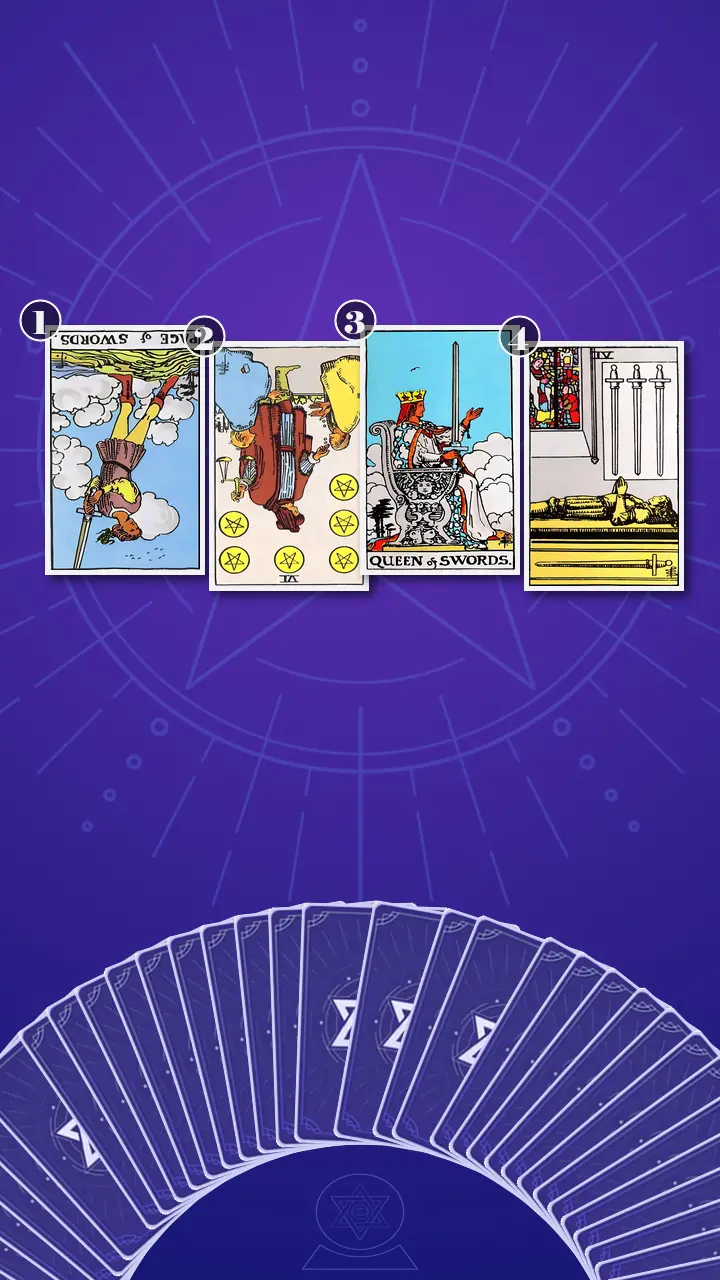
I told her I wanted the cards to move in a straight line, almost like watching one Slack draft travel from spiral to clarity to rest. The first position would show the symptom as it appears in real life. The second would reveal the hidden blockage underneath it. The third would offer the cleanest corrective stance. The fourth would show what integration looks like after the clearer message is sent.
That left-to-right sequence mattered to me. As an archaeologist, I have spent years reading a site by layers and transitions rather than by isolated fragments. This spread lets me do the same with a modern nervous system: first the visible debris, then the buried rule, then the tool that still works, then the structure that can stand.
Reading the Draft Box
Position 1: The Loop That Calls Itself Care
I turned over the first card and said, “This is the position that shows the concrete symptom behavior from your question: over-editing the sick-day message to pre-empt judgment.” The card was the Page of Swords, reversed.
The modern scene on the card was almost painfully exact: a half-finished Slack message sitting in the compose box while Maya keeps swapping direct language for softer wording, adding detail, then rereading the whole thing from an imagined manager’s point of view. It had the energy of typing as if every reply might be screenshotted to a group-chat jury. The real action was not communication. It was defensive editing.
In reversed form, the Page’s energy is both excess and blockage. There is too much anticipatory thought and not enough clean movement. The raised sword is already on alert before any real attack exists. The windswept sky is the nervous system when wording becomes a shield. In practical terms, the apology, the symptom list, the extra ‘happy to monitor anything urgent’ line are all trying to buy safety from a verdict that has not actually arrived.
“What is the extra wording trying to protect you from?” I asked. “Lazy?”
She let out a short laugh with real bitterness in it. “Okay,” she said, rubbing her forehead, “that is so accurate it’s a little rude.” Her fingers tapped her mug once, then stilled. That was the recognition I wanted: the moment the pattern stopped looking like personality and started looking like a loop.
Position 2: The Inner Performance Ledger
I moved to the second card. “This is the position that reveals the underlying obstacle and the fear that make a basic boundary feel unsafe to say plainly.” The card was the Six of Pentacles, reversed.
Here the whole problem dropped beneath the draft box. Before she even decided whether to take the day, Maya was running an invisible balance sheet: what she finished yesterday, what meetings she would miss, how inconvenient her absence might be, whether she had enough goodwill banked, whether high rent and fast-moving office culture meant she needed to look especially committed. Her body had a limit, but her mind kept acting as if rest needed approval before it counted.
The scales in the card make that almost embarrassingly visible. Seeing them, I had one of those quick professional flashbacks that still happen to me after years in archaeology: bronze trade weights in a museum drawer, precise to the gram, each one made to settle an argument about value. That is what her nervous system was doing. It was weighing her need as though care were a transaction and rest had to be earned. In this reversed earth energy, support comes with strings, and even one genuine sick day starts to feel like it has surge pricing.
“You don’t need better evidence,” I told her. “You need less internal litigation.”
She froze in three small stages. First her breath caught. Then her eyes drifted off-screen as if replaying half a dozen mornings at once. Then her shoulders lowered by a fraction. “Yes,” she said quietly. “I do an internal performance review before I even decide.”
When the Queen Lifted the Sword
Position 3: The Sentence That Did Not Beg
When I turned the third card toward the camera, even through a laptop screen the silence changed temperature. “This,” I said, “is the position that offers the antidote to the blind spot: the mindset and communication stance that interrupt the loop.” The card was the Queen of Swords, upright.
The modern life scenario was immediately clear. Maya copies a saved two-sentence script into Slack, removes the extra explanation, does not add ‘I can monitor anything urgent,’ and presses send anyway. The power here is not coldness. It is the adult voice that can state a limit clearly without turning it into a plea for approval. The sword is the fact. The open hand is the part that stays human without bargaining.
This is where I used a framework I call Skill Archaeology. In a dig, I do not manufacture an artifact; I uncover what has been there all along under later layers of dust and collapse. Maya did not need a new personality installed by noon. She already spends her workdays writing concise copy, organizing campaigns, and making information legible for other people. The overlooked talent was not clarity. It was self-authorization. The Queen was not teaching her how to write. She was unearthing her right to use her existing clarity on her own behalf.
You know that exact moment: blue morning light, Slack open, one truthful sentence typed out, and your body already asking for rest while your mind starts assembling evidence like you’re about to be cross-examined for needing a day off.
You do not need to turn your boundary into a courtroom argument; the Queen's upright sword asks for one clean truth and the self-respect to let it stand.
For a beat, she did not nod. Her mouth tightened first. Then she leaned back, almost angry, and said, “But if I do that, then I’ve been making a whole case for something basic.” I let that land. Outside my study window, rain tapped once against the glass and stopped, and the room suddenly felt sharper. “Yes,” I said. “And that does not make you foolish. It makes you adapted to a work culture that trains people to confuse constant availability with virtue. But adaptation is not identity.”
I watched the reaction move through her in layers. Her grip loosened from the mug. Her eyes brightened, not quite tears but close. Then a long breath left her chest as if it had been waiting several years for permission. After that exhale came the strange, honest part I often see at real breakthroughs: a split second of blankness, almost dizziness, because clarity also hands responsibility back to the self. “That shorter version scares me,” she said, softer now. “Not because it’s wrong. Because I can’t hide in it.”
“Exactly,” I replied. “A sick day is a boundary, not a closing argument. Brevity is not carelessness when the truth is already clear.” I told her that within ten minutes of our call, she could save one clean two-sentence script in Notes, label it ‘use as-is,’ and make the next hard moment easier than this one. Then I asked, “Now, with this new lens, think back to last week. Was there a moment when one clean sentence would have changed the whole temperature of your day?” She nodded slowly. “Thursday,” she said. “I would have rested instead of hovering.” That was the hinge: a move from guilt-laced hypervigilance and internal litigation toward self-authorized calm around work boundaries.
Position 4: The Offline Window
I turned to the final card. “This is the position that translates the shift into embodied follow-through: what integration looks like after the clearer message is sent.” The card was the Four of Swords, upright.
I told her this is where many people lose the plot. They send the sick-day message, but keep Slack on the phone, leave notifications on, and refresh for tone, reaction, or silence. The modern version of this card is simple: close Slack on both devices, turn off previews, put the phone out of reach, and let recovery be the actual task. Think less ‘working from bed’ montage, more real Do Not Disturb.
Here the energy is balanced and still. The resting figure matters because the body only believes a boundary when the environment agrees with it. If you stay half-available, your body still hears ‘not yet.’ Before she ever typed ‘reachable if urgent’ again, I asked her to use one of my practical filters, Relic Authentication: is there a genuine emergency process in this workplace, or is anxiety dressing itself up as urgency? If there is one real channel, choose it. If there isn’t, do not invent one out of guilt.
Maya gave the smallest, cleanest nod of the session. Even on screen I could see her jaw unclench. The card was not promising a perfect new self. It was offering a protected offline window long enough for her nervous system to believe the boundary she had already spoken.
From Finding Clarity to Actionable Advice
When I laid the whole line of cards together, the story became very clear. The Page of Swords reversed showed the visible symptom: overexplaining a sick-day Slack to pre-empt judgment. The Six of Pentacles reversed named the hidden engine beneath it: an inner worth ledger that makes rest feel earned, measured, and morally loaded. The Queen of Swords cut through that ledger with factual boundary-setting. The Four of Swords turned the insight into actual rest after sending. What looked like a wording problem was really a permission problem wearing polished message drafts as camouflage.
I told Maya that her main blind spot was assuming clear communication had to prevent anyone from ever forming a negative opinion. That is far too much labor to ask from one sentence. The transformation direction was simpler and harder at once: shift from proving you deserve time off to stating your limit clearly and letting that be enough. That is how tarot becomes useful here. It does not mystify the problem. It shows why a plain boundary feels dangerous, and then gives you the next steps.
Because I am an archaeologist by training, I rarely prescribe one heroic leap. Ancient builders moved impossible stones by leverage, sequencing, and repetition. I call this Megalith Transport. We do not need a whole new personality by Monday. We need three smaller stones moved in the right order.
- The No-Closing-Argument Script Save one two-sentence sick-day script in Notes this week: ‘I’m unwell and taking a sick day today. I’ll be offline and will follow up tomorrow.’ The next time you need it, paste it into Slack before opening other chats or rereading your calendar. If your first thought is ‘This sounds too blunt,’ treat that as the old loop asking for extra evidence. Use it unchanged once, just as an experiment.
- The Worth-Ledger Interrupt The next time you feel yourself tallying whether you have earned rest, open Notes and write two quick labels: ‘Actual limit’ and ‘Story I’m adding.’ Fill them with one factual line each. Example: ‘Actual limit: I’m sick and can’t work well today. Story I’m adding: I need to sound impressive enough to deserve rest.’ Keep it under twenty seconds. This is Tool Evolution, not homework. You are identifying a habit, not putting yourself on trial again.
- The Send-and-Step-Away Boundary After you send the message, log out of Slack on either desktop or mobile for one protected block of 45 to 90 minutes. Turn off banner previews or move the app off your home screen. If your workplace has a real emergency path, choose one channel only rather than staying vaguely reachable everywhere. If a full hour feels impossible, start with twenty minutes. Authenticate ‘urgent’ before you offer access; ambient anxiety is not an emergency process.
She looked at the list and then asked the kind of grounded question I always trust. “But what if I really can’t do ninety minutes offline because campaign stuff does blow up sometimes?” I appreciated that. Real boundaries live or die on logistics. So I cut the goal smaller. “Then do twenty first,” I told her. “One channel, one window, one experiment. We are not testing whether you can become a different person by lunchtime. We are testing whether your body can learn that ‘offline’ means something measurable.”

A Week Later: The Quiet Proof
A week later, I received a message from her that I could almost hear in her voice: “Used the script this morning. It felt like I’d forgotten a sentence. I wanted so badly to add ‘happy to check anything urgent,’ but I didn’t. Muted Slack for 45. Slept.”
That was the proof I had hoped for. Not a cinematic transformation. Not some radiant final state where work guilt never returned. Just a clean message, a wobble, an offline block, and a body finally allowed to cash the check the boundary had written. Later she admitted that when she woke up, her first thought was still, What if that sounded cold? Then she laughed, turned the phone face down again, and slid back under the duvet.
That is what this Journey to Clarity looked like in a Situation-Obstacle-Advice-Outcome reading: not certainty, but ownership; not perfection, but the first real evidence that one factual sentence can hold. It was a quiet movement from proving legitimacy to trusting a limit.
Sometimes the hardest part of taking a sick day is not being sick; it’s feeling your body ask for rest while your worth rushes in to cross-examine it.
If that tiny courtroom feels familiar, and one clean sentence were allowed to be enough, what boundary might you want to hear in your own voice this week?