My Dad Called My Job a 'Hobby'—So I Stopped Building Receipts

Finding Clarity in the 2 a.m. Scroll
Jordan (name changed for privacy) arrived with the kind of politeness that looks like control. The kind you wear when you’ve been told, directly or indirectly, that your feelings are “too much” and your work is “not real.”
“My dad called my job a hobby,” they said, voice flat on purpose. “And now I can’t tell what I’m doing at work anymore. Like… what am I proving?”
Outside my little reading room in East London, the evening rain kept tapping the window like a persistent notification. Jordan had come straight from a Zone 1–2 commute—Oyster tap, escalator rush, that stale Tube heat that clings to your coat. Their laptop bag was still on their shoulder like a sandbag they couldn’t put down.
They pulled out their phone without meaning to, thumb hovering where Slack lives. Their jaw tightened in that automatic way—like a reflex you don’t notice until it hurts.
“It’s Sunday night,” they added, almost laughing at themselves. “I pre-plan my week like it’s a performance review. I’m rewriting emails, tightening subject lines… even when they were approved. If I slow down, it means I’m not serious.”
I watched their hand come up to their face—index finger pressing into the hinge of the jaw as if they could physically hold the anxiety in place. Shame has a particular texture. In Jordan, it looked like a tight chest under a neatly zipped jacket, like their whole body bracing for cross-examination the second a screen lights up.
“That makes sense,” I said, letting my voice stay warm and plain. “When someone you want respect from dismisses your work, your nervous system can start treating every task like evidence.”
I paused, making sure they could feel the invitation in the silence. “Let’s try to map this. Not to decide whether your work is ‘legit’—but to find clarity about what you’re actually proving, and what you want to be guided by instead.”

Choosing the Compass: How the Celtic Cross Works for Career Validation
I asked Jordan to take one slow breath—nothing mystical, just a gear shift out of the week’s momentum. I shuffled while they held the question in mind: After my dad called my job a hobby, what am I proving at work?
“Today I’m using the Celtic Cross,” I said. “It’s a classic spread, and it’s especially good when the issue isn’t ‘which option should I pick?’ but why a single comment turned into a whole internal system.”
For anyone reading who’s ever wondered how tarot works in a practical way: the Celtic Cross is basically a psychological map. It separates the visible behavior (what you’re doing) from the hidden driver (what you’re afraid will happen if you stop), then shows the external pressure and the next pivot point. It gives you card meanings in context—not fortune-telling, but pattern recognition with a structure you can actually use.
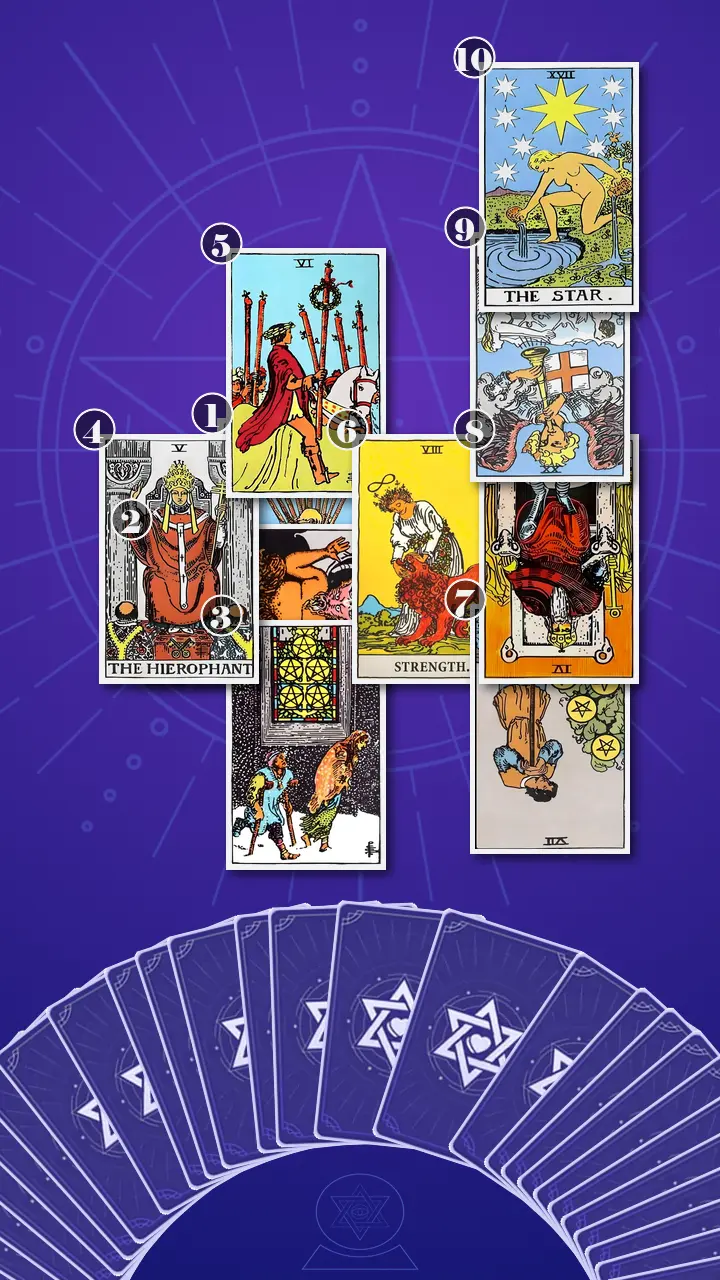
I pointed to the center. “The first card will show the observable work pattern you’re in. The second card crosses it—your main tension, what keeps the cycle locked. And the sixth card is the near-future pivot: the next psychological move that helps you step out of the proving loop.”
Jordan nodded once, small and sharp, like: Okay. Show me.
Reading the Map: A Career Crossroads Hidden Inside “One More Edit”
Position 1: The observable work pattern you’re in right now
“Now we turn over the card representing the observable work pattern you’re in right now: what you’re doing at work to cope with the ‘hobby’ comment,” I said.
Ten of Wands, upright.
I didn’t need to dramatize it; the image does that by itself—someone bent forward, carrying a bundle so big it blocks the view.
“This is almost word-for-word your week,” I said, and used the life translation I’d been given because it matched Jordan’s reality too perfectly: ‘It’s a normal agency morning in London: coffee in hand, Slack open, and you’re already doing an extra 45 minutes of tightening subject lines that were approved yesterday.’
“You’re not doing it because the work needs it,” I continued. “You’re doing it because being visibly overloaded feels like armour. If you’re carrying enough, no one can call it a hobby.”
In energy terms, the Ten of Wands is excess: effort turned up past usefulness. Work becomes a weight you haul to be believed.
Jordan let out a short laugh that had no joy in it. “That’s… too accurate,” they said, then quieter: “Honestly it’s kind of cruel.”
The laugh was the first crack in the control. It said: Yes, I see myself. And I hate that I see myself.
Position 2: The main tension or block
“Now we turn over the card representing the main tension or block: what keeps the proving cycle locked in place,” I said.
The Devil, upright.
Jordan’s eyes flicked to the card, then away—like looking at it directly might make it truer.
“Here’s the modern version,” I said, grounding it in their actual habits: ‘You act like there’s an invisible contract: if you’re not constantly impressive, you’re in danger. So you stay online after hours, refresh for feedback, rewrite messages until they sound “serious,” and volunteer for extra tasks without scoping.’
“That’s the chain,” I said. “And the classic detail in this deck is the chains are loose. Which tells me this isn’t a prison you can’t leave. It’s a compulsion your body believes you can’t leave.”
Energetically, The Devil is blockage: attachment to external validation, to the feeling of being un-criticizable. It’s the late-night fluorescent hum, ten open tabs, and a brain that thinks: If I stop, I get exposed.
I asked the question that matters without shaming: “Where are you acting like you have no choice?”
Jordan’s mouth tightened, then softened. “Slack after hours,” they admitted. “Even when nobody asked. I just… need to be there.”
Position 3: The hidden driver underneath the work behavior
“Now we turn over the card representing the hidden driver underneath the work behavior: the fear or need you don’t say out loud,” I said.
Five of Pentacles, upright.
“Under the proving is a colder fear,” I said, and anchored it in the real-life scenario: ‘Being shut out of respect, stability, and support. One “hobby” comment becomes “I’m outside the warm room.”’
The Five of Pentacles is deficiency energy—scarcity, exclusion, the nervous system expecting the door to close. Not because it’s happening now, but because your body remembers what it felt like to be dismissed.
Jordan swallowed. Their throat bobbed hard, like they were forcing something down. “It’s embarrassing,” they said, “but I started checking my bank app more. Like… if I can see the number, I can breathe.”
“That’s not embarrassing,” I said. “That’s a body trying to find safety through certainty.”
Position 4: The conditioning story you learned about what counts as ‘real’ work
“Now we turn over the card representing the conditioning story you learned about what counts as ‘real’ work and who gets respect,” I said.
The Hierophant, upright.
“This is the inherited rulebook,” I said. “The one that says legitimacy is granted by the approved path.”
Then I made it modern and specific: ‘You inherited a rulebook where “real work” is easy to explain at a family dinner: stable title, clear ladder, respectable salary. So when you say “copywriter at a creative agency,” you feel a pressure to translate it into something that sounds approved—like you need the right vocabulary to earn respect.’
The Hierophant is balance when it offers guidance. But here it’s become overreach: a gatekeeper in your head holding the keys.
Jordan nodded, almost angry. “He respects accountants,” they said. “He respects anyone who can say their job in one sentence without someone asking follow-ups.”
“Exactly,” I said. “And you’re in a creative field where the value is real but not always legible to an old-school rubric.”
Position 5: What you’re consciously trying to achieve through over-performance
“Now we turn over the card representing what you’re consciously trying to achieve through over-performance: the outcome you’re chasing,” I said.
Six of Wands, upright.
“This is the part of you that wants the ‘receipt,’” I said, and used the scenario that matches the craving: ‘You want one undeniable win: a campaign everyone talks about, a promotion title, a client name-drop—something you can hold up as a receipt that ends the argument.’
Six of Wands is healthy fire when it’s pride and recognition that nourishes. But paired with Ten of Wands plus The Devil, it becomes performance as survival—victory as defence.
Jordan’s voice turned small. “I just want him to stop looking at me like I’m… playing.”
“I hear you,” I said. “And I’m going to say something that’s both kind and blunt, because it’s the turning point of this reading: You’re not lazy—you’re litigating your worth.”
When Strength Spoke: The Gentle Hand on the Lion
Position 6: The next psychological pivot
The room got quieter in that specific way it does when the most relevant card is about to be seen—not dramatic, just focused. Even the rain sounded farther away.
“Now we turn over the card representing the next psychological pivot: what helps you shift from proving to grounded self-respect in the near term,” I said.
Strength, upright.
I let Jordan look first. Their eyes softened, confused by how gentle the image was compared to how hard they’d been living.
Setup (30–50 words): It’s 9:18pm, you’re still in the same Google Doc, adjusting a headline that was approved hours ago. Your jaw is clenched, Slack is open on the side, and your brain is running a silent closing argument: ‘See? This is real work.’
Delivery:
You don’t have to overpower the ‘hobby’ label with more work; you have to hold your worth steady—like Strength, where the gentle hand stays on the lion instead of letting the roar drive the day.
I let the sentence sit between us like a clean bell tone.
Reinforcement (100–200 words): Jordan’s body reacted before their face did. First: a tiny freeze—breath held, shoulders lifted, as if their muscles were waiting to be told they’d failed. Second: their eyes went unfocused for a beat, like they were replaying every late-night edit spiral in fast-forward. Third: a slow exhale, not relief exactly—more like the first time you realize you’ve been gripping a railing you didn’t need to hold.
“Try a 10-minute ‘Strength check’ once this week,” I said, keeping it practical. “Pick one deliverable, set a timer, make only the highest-impact edits, then hit send when the timer ends. If your body spikes—tight chest, urge to keep fixing—pause for one breath and remind yourself: stopping is not failing. If this feels too activating, you can scale it down to 3 minutes—or skip it entirely.”
Jordan blinked hard, eyes shiny but not falling apart. “But if I stop,” they whispered, “it feels like I’m confirming he was right.”
“That’s the lion,” I said. “And Strength doesn’t kill it. Strength doesn’t argue with it. Strength holds it.”
I leaned in slightly. “Now, with this new lens—can you think of one moment last week when the urge to ‘just do one more tweak’ hit, and this could’ve changed how it felt in your body?”
Jordan swallowed again. “Thursday,” they said. “Manager wrote ‘could this be punchier?’ and I went straight into… panic. I could’ve asked one question. Or done one round. Instead I stayed up and rewrote everything.”
“That’s the shift,” I said. “This isn’t just about one deliverable. It’s a step from shame-driven proving toward grounded self-respect that doesn’t need permission.”
And here’s where my old life flashed in—quick, controlled, like a memory you don’t indulge. On a trading floor, you can’t trade your way out of fear. You can only manage risk with structure. Strength is that structure: not louder effort, but steadier standards.
“Stop building receipts for a trial you didn’t choose,” I added, gently. “That’s what Strength is asking.”
Position 7: How you’re showing up internally
“Now we turn over the card representing how you’re showing up internally: your self-image and personal stance at work right now,” I said.
Seven of Pentacles, reversed.
“Inside, you’re impatient with the timeline,” I said, using the modern translation: ‘You check for results constantly—opens, clicks, feedback threads, whether someone “liked” the line you wrote—then feel a wave of frustration when growth looks normal and slow.’
Seven of Pentacles reversed is deficiency of patience—progress interpreted as failure because it isn’t instant.
“A career isn’t a webpage,” I said. “It buffers. And right now your brain treats buffering as a verdict.”
Position 8: External voices and structures shaping your mindset
“Now we turn over the card representing external voices and structures shaping your mindset: authority, workplace norms, and family pressure in the background,” I said.
The Emperor, reversed.
“This is authority energy distorted,” I said. “Control, rigid expectations, and approval that feels conditional.”
I grounded it in the scenario: ‘There’s an authority vibe around you—family expectations, workplace norms, the unspoken “be tougher, be more certain” culture—and it seeps into your self-talk. Your dad’s comment becomes an invisible manager hovering over your shoulder.’
“Sometimes the loudest boss in the room isn’t on payroll,” I said, letting that land.
The Emperor reversed is blockage: structure used as a weapon rather than support. It can make you micromanage yourself into exhaustion.
Position 9: The hope-fear knot
“Now we turn over the card representing the hope-fear knot: what you long to hear and what you’re terrified will be confirmed,” I said.
Judgement, reversed.
“This one is brutal in the most familiar way,” I said. “It’s verdict energy.”
I translated it into the everyday social moment: ‘Every time someone asks about your job, it feels like a verdict day. You want someone to say, “That counts, you’re legit,” but you’re terrified they’ll confirm your worst fear.’
Jordan’s hand went to their throat without thinking—fingers pressing lightly as if to stop the words that always want to over-explain.
Judgement reversed is blockage of self-recognition. Waiting for a stamp of approval that never comes, because the committee in your head keeps changing the criteria.
Position 10: Outcome / likely direction
“Now we turn over the card representing the integrated direction you can grow into,” I said.
The Star, upright.
The Star always changes the temperature in a reading. Less heat. More breath.
“Here’s what it looks like in real life,” I said, and used the scenario as-is because it’s exactly the point: ‘The integrated direction is a quieter life rhythm: you make work that feels honest, you pace it, and you replenish after. You stop trying to convince anyone and start building a portfolio—and a life—that you can actually live inside.’
The Star is balance returning—restoration after strain, authenticity without armour.
“Your life can be bigger than the argument,” I said, and Jordan’s shoulders dropped like they’d been waiting all week for permission to unclench.
From Proving to Self-Trust: Actionable Next Steps (Without Toxic Positivity)
I pulled the whole story together for them, the way I used to do when a business decision was messy and emotional but still needed a plan.
“Here’s the narrative your cards are telling,” I said. “A dismissive comment hit an old rulebook (Hierophant): ‘Real work is traditional, legible, and approved.’ That woke up a fear of being shut out (Five of Pentacles), so you started carrying more than you need (Ten of Wands). The Devil locks it in by making your overwork feel like the only option: if you’re not constantly impressive, you’re in danger. But Strength is your bridge—quiet authority that refuses to escalate. And The Star is where you’re headed: a work life paced by truth and restoration, not a courtroom.”
“Your cognitive blind spot,” I continued, “is that you’re treating output as proof of legitimacy. But output isn’t proof—output is a tool. When you make it evidence, you never get to stop.”
“The direction of change is clear,” I said, echoing the heart of the spread: “Stop using work output as evidence in a trial you didn’t choose, and start choosing one concrete, self-defined metric of ‘good work’ to guide your week.”
This is where I brought in my own framework—one I call Human Capital Valuation. “In finance, value isn’t a vibe. It’s a model,” I said. “Not to reduce you to a number, but to stop letting other people’s numbers run your life. This week, we’re going to price one competency you actually want to grow—like clarity, persuasion, or speed-to-clean-draft—and use that as your metric. Not your dad’s approval. Not Slack’s green dot. Not LinkedIn applause.”
Jordan flinched slightly at “this week.” “But I literally don’t have time,” they said, and it came out sharper than they meant. “I’m slammed. I can’t add another thing.”
I nodded. “Good. That’s real. Let’s make the plan smaller.”
- The 10-Minute Strength CheckOnce this week, pick one deliverable (a subject line set, a headline draft, one client email). Set a timer for 10 minutes. Only make the highest-impact edits. When the timer ends, send it.If your chest spikes and your jaw locks, take one breath and say: “Enough is a boundary, not a personality flaw.” If 10 minutes is too much, do the 3-minute version.
- One Self-Defined “Good Work” MetricChoose one competency to value this week (e.g., “clear first draft by 11:30,” “one clean clarifying question after feedback,” or “one-round revisions rule”). Write it on a sticky note where you can see it before you open Slack.Make it repeatable, not impressive. If you can’t repeat it on a Wednesday when you’re tired, it’s not a metric—it’s another trial exhibit.
- Profile-as-Prospectus (LinkedIn, 20 minutes)Open your LinkedIn “About” section and rewrite it like a one-page prospectus: one sentence on what you do, one sentence on the value you create, one sentence on what you’re building next. No apology, no translating for the family committee.If this triggers the urge to over-polish, set a hard stop at 20 minutes. You can iterate later. The goal is ownership, not perfection.
“These are small,” I said. “On purpose. We’re not fixing your whole relationship with authority in a week. We’re giving your nervous system one new data point: you can stop escalating and nothing collapses.”

A Week Later: The Quiet Proof
Six days later, Jordan messaged me a screenshot of a sent email. No dramatic caption. Just: “Did the 10-minute Strength check. Sent it. Didn’t reopen it.”
They added, almost as an afterthought: “Slept through the night. Woke up and still thought ‘what if I’m wrong?’—but I didn’t spiral. I made coffee. Then I started work.”
That’s what I mean by a Journey to Clarity. Not certainty. Not a perfect immune system against criticism. Just a small, steady loosening—jaw unclenched, shoulders down, work no longer treated like a courtroom exhibit.
And if you needed the line that anchors all of this, it’s still the same: When one offhand “hobby” comment makes your jaw lock the second you open your laptop, it can feel like every email and every headline is evidence you have to submit just to be taken seriously.
If you picked one self-defined metric of “good work” for this week—something simple and repeatable—what would you choose, just as an experiment?