Always Busy, Still Dropping Things: A Path to Steadier Follow-Through

Finding Clarity in the 7:14 a.m. Scroll
If you’re in your late 20s, work a coordination-heavy city job, and check Slack before your feet touch the floor, this might be high-functioning overwhelm—not a personality flaw. That was the first thought I had when Jordan (name changed for privacy) signed onto my session from Toronto and said, “I skipped breakfast, blew a deadline, and forgot a friend’s birthday. I’m not even doing that much, so why does everything feel like too much?”
As they talked, I could see the whole Tuesday in the way only an overworked nervous system can describe it: 7:14 a.m. in a small downtown bedroom, blue phone light on their face, radiator hissing, sheets still warm around their legs. Slack, then email, then texts before they had even sat up. Mouth dry. Stomach empty before the day had officially started. By 12:22 p.m., the radiator hiss had turned into fluorescent buzz near the office kitchen, the air smelled faintly of reheated tomato sauce and garlic, and Jordan was still telling themself lunch could wait until after one more file.
The contradiction was painfully ordinary. They wanted to stay on top of work, friendship, and everyday life, but the pace they were moving at kept making those exact things skip, slide, and leak. The feeling in their body wasn’t just stress. It was like trying to tap through a TTC gate with a coffee, tote, phone, and laptop, and realizing there isn’t one free hand left for the actual thing that opens the door. A buzzy head. A hollow stomach. Shoulders that never fully unclenched. And under all of it, the private fear: “What if this makes me look careless?”
I answered the way I often do when someone has already started cross-examining their own character. “This is a pace problem before it’s a character problem,” I told them. “One missed birthday and one late file are data, not a verdict. Let’s make a map and see what’s actually off.”
Choosing the Compass: The Five-Card Cross for Overwhelm
I asked Jordan to put both feet on the floor and take one slow breath before I touched the deck. Then I shuffled in silence for a few seconds—not as mystic theater, but as a clean transition. When the day begins with notifications as the first voice in the room, even a small pause can feel like getting your own mind back.
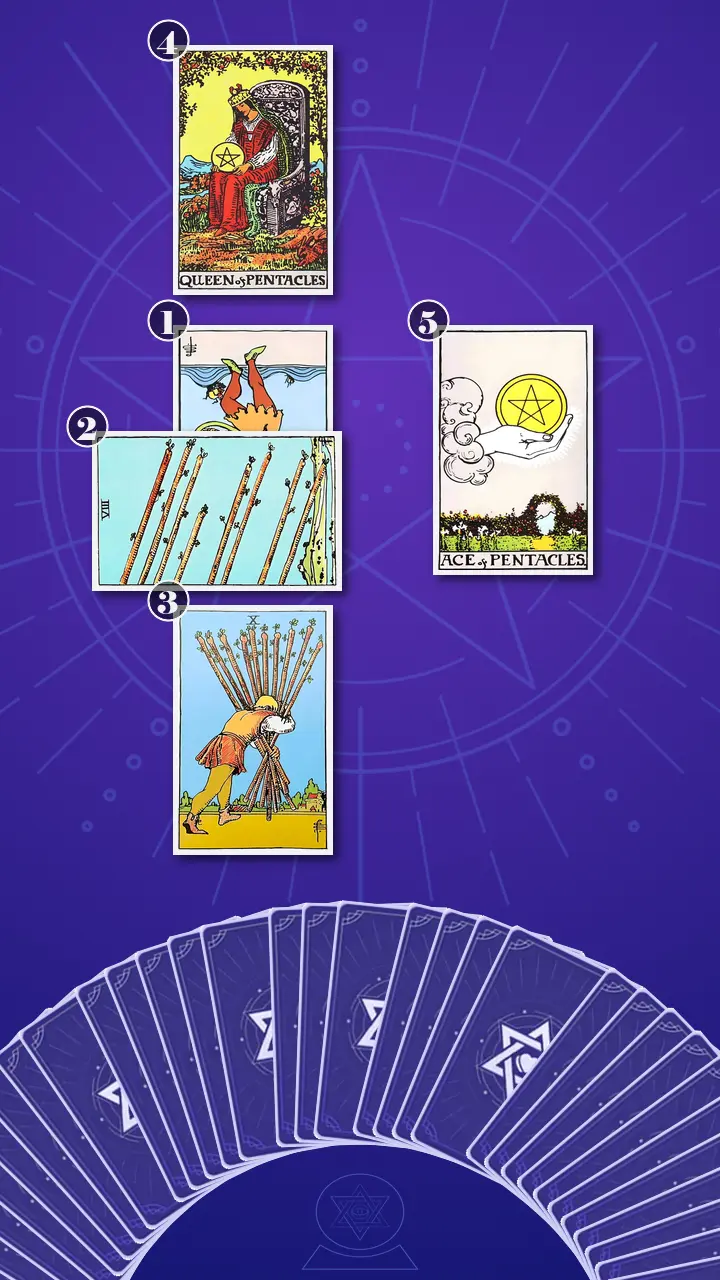
For this question, I chose a Five-Card Cross. People often ask me how tarot works when the problem is not dramatic enough to look like a crisis, yet still disruptive enough to make daily life feel chaotic. This is exactly where a classic cross spread is useful. It gives the minimum structure needed to diagnose high-functioning overwhelm without inflating it into melodrama. The center card shows the visible symptom cluster. The card crossing it shows the pressure intensifying it. The lower card reveals the root burden. The higher card offers the corrective lens. The card to the right becomes the practical next step.
I explained it to Jordan the way I would explain it to any reader trying to understand card meanings in context: the shape works like a road sign at an intersection. The center shows where you’re stuck, the vertical axis tells me why and how to rise, and the right-hand card opens a usable exit. For this reading, I was especially watching the center, the root, and the higher guidance—because if you want to know why you’re always busy but still missing deadlines, you have to look at the visible slips, the deeper load, and the reframe that actually restores steadiness.
The Tabs, the Pings, and the Weight Underneath
Position 1: The Loop That Looks Like Responsibility
“Now I’m turning over the card that shows the present situation as it’s appearing in everyday life,” I said. “Two of Pentacles, reversed.”
In real life, this looked exactly like the week Jordan had just described: Slack, email, calendar alerts, personal texts, and a half-finished document all active at once. Breakfast gets pushed to after one more reply. Lunch turns into coffee. The actual priority still slips while the feeling of being busy keeps passing for progress. Two of Pentacles reversed is earth energy in blockage—practical life out of balance, constant motion without stable holding. Everything Everywhere All at Once, but in your task bar.
I pointed to the juggler in the card, the infinity-loop ribbon linking the coins while rough water churned behind him. “This is what happens when your brain becomes the project dashboard,” I told Jordan. “And your brain was never built to be one.”
Jordan gave a short laugh that had a little bitterness in it. “Wow,” they said. “That’s accurate enough to be rude.” Their fingers tapped once against the mug, then stopped. Recognition had landed, even if it stung.
“That sting matters,” I said. “Because this isn’t you being bad at adulting. It’s the moment juggling stops looking efficient and starts dropping the basics.”
Position 2: Urgent Is Loud
I turned the crossing card. “This position reveals the immediate pressure pattern making the symptom cluster worse. Eight of Wands, reversed.”
Here the problem was not laziness or lack of care. It was action energy getting scattered. Jordan’s day was being run by incoming pings rather than chosen sequence: a Slack dot lighting up, a calendar alert, a text, a quick email, another “quick question” that was never actually quick. This card is reactive attention in tarot form—TikTok pacing with spreadsheet consequences.
“Urgent is loud,” I said. “Important needs somewhere to land.” I watched that sentence hit. The card shows eight wands flying through open sky with nobody grounded enough to receive them. That is what it feels like when every app is on push and your attention is being run by default settings instead of choice. You stay in motion. You do not stay with anything long enough to complete the thing that matters most.
Jordan looked off-screen for a second, the way people do when a reading has just found the sentence their inner OS has been repeating. “I keep thinking, if I answer these three things, then I’ll finally focus,” they said. “And then somehow the whole day is gone.”
Position 3: The Human Forklift
I moved to the card below the center. “This one points to the deeper foundation underneath the present issue—the pattern that has been carrying all of this for longer than the last bad week. Ten of Wands, upright.”
The emotional texture shifted immediately. We moved from screen imagery to body imagery. Under the skipped breakfast, late deliverable, and forgotten birthday was an older burden: Jordan had become the person who carried the extra admin, the quick edit, the social follow-up, the life logistics, and the emotional labor of not wanting to disappoint anyone. Ten of Wands is fire in excess—willpower turned into overcarrying. Each item looks manageable alone. Together, they make simple follow-through feel physically heavy.
I told them what I saw in the image: a figure bent under an oversized bundle, walking toward a town they could barely see because the load itself blocked the view. “This is what happens when competence turns you into a human forklift,” I said. “On paper, none of it sounds huge. In the body, it’s four heavy tote bags cutting into your hands at once.”
I asked, “What have you kept saying yes to because renegotiating it would feel more awkward, selfish, or exposing than just carrying it?”
Jordan gave me a tired smile. “Honestly? Half my inbox. And half my friendships.”
The reaction came in three quiet stages. First, their breath paused. Then their gaze unfocused, as if some recent commute replayed itself—laptop bag, grocery bag, one more quick edit, one unpaid bill, one birthday they meant to remember. Finally, they exhaled through their nose and said, very softly, “None of it feels huge alone. That’s the part that makes me feel ridiculous.”
“You’re not ridiculous,” I said. “You’ve just been accumulating weight in units too small to earn sympathy, but not too small for a body to feel.” I also pointed out something subtle in the spread: there wasn’t a single Cup on the table. The feelings were not absent. They were delayed. Which is why one late reminder could suddenly come back as guilt, irritability, or that hot-faced panic of ‘what kind of person forgets this?’”
When the Queen of Pentacles Sat Down
Position 4: The Antidote Above the Noise
When I turned the fourth card, the whole reading seemed to gather itself. Even through the screen, I felt the atmosphere change. “This is the position of higher guidance,” I said. “And it’s the key card in your spread. Queen of Pentacles, upright.”
This was the antidote to everything below it. Not more stamina. Not a stricter app. Not a prettier Notion second brain. Mature earth. Embodied steadiness. Practical self-respect. The part of Jordan that could stop building a day around urgency and start asking what meals, buffers, reminders, and boundaries would make the day sustainable. One pentacle held securely, not two spinning in a storm.
Whenever a reading turns like this, my artist brain reaches for structure before speed. Looking at the Queen, I flashed back to the first time I stood in front of a Mondrian in New York and realized the painting was not powerful because it held more. It was powerful because every block had a boundary, and the white space counted. That is what I call my Mondrian Grid Method. When life becomes a smear of obligations, I stop asking how to move faster and ask where the lines belong. For Jordan, the Queen was asking for three clean panels, not thirty: body, work, personal. Structure. Air. Somewhere for importance to land.
I could see the exact trap this card was answering. When your phone is the first voice in the room and by mid-afternoon your stomach is empty but your brain still won’t land, it can genuinely feel like you are failing at ordinary life. Usually, what is happening is less moral and more structural: you are trying to hold the whole day with no foundation under it.
I said it slowly. “What’s off is not that you care too little. It’s that you’ve been treating care for yourself as optional, and that’s exactly when reliability starts cracking at the edges.”
You do not fix this by juggling harder; you fix it by tending the garden beneath your feet, one practical need at a time.
I let the sentence sit in the silence. Outside my studio window, a siren passed and faded, and the room felt even quieter after it—the kind of silence that makes a true thing ring a little louder.
Jordan froze with their hand halfway to the mug. Then came the reaction in layers. First, the tiny stillness of someone forgetting to perform agreement. Then the eyes widening, not with melodrama, but with recognition so clean it almost hurt. Then the shoulders dropping so suddenly it looked disorienting, like setting down four grocery bags at once and feeling your hands buzz afterward. When they finally spoke, there was relief in it, but also resistance. “But if I do that,” they said, voice thinner now, “doesn’t that mean I’ve been getting this wrong?”
“No,” I said. “It means you built a strategy around fear—fear of looking unreliable, fear of slowing down, fear of admitting your hands were already full. That strategy made sense. It just isn’t the same thing as steadiness.”
I leaned in. “Now, with this new perspective, think back to last week. Was there a moment when this insight would have changed how you felt?”
They took a breath. Their eyes dropped, then lifted. “Tuesday,” they said. “If I’d treated lunch like part of the job instead of something I had to earn, I probably wouldn’t have crashed at three and blown the deadline. And I might have remembered the birthday before the guilt version of me showed up.”
That was the real shift. Not instant mastery. The first meaningful step from frazzled guilt toward grounded self-trust. Reliability cracks where care gets treated like an optional add-on. The Queen was teaching them the reverse.
Position 5: The First Brick
I turned the final card to the right. “This position translates the reframe into an actionable path. Ace of Pentacles, upright.”
I love this card in readings about burnout and everyday follow-through because it refuses the fantasy of a total life overhaul. The Ace offers one tangible support, one first brick, one doorway you can actually walk through this week. For Jordan, that looked like a recurring lunch block, a note called Tomorrow 3, an early birthday reminder, or one protected focus window with notifications off. Not a personality transplant. Just one visible system that makes follow-through easier than forgetting.
“This is balanced earth,” I said. “Not a dramatic reset. One structure your nervous system doesn’t have to remember alone.” The hand in the card emerges from a cloud and offers a coin; the path beyond it is simple enough to enter now. Jordan’s mouth softened into the first real almost-smile of the reading. Small change had started to feel believable.
From Insight to Action: The Three-Anchor Day
Once all five cards were down, the story was clear. Two of Pentacles reversed showed the visible symptom cluster: too many tabs, too much mental juggling, basics falling through. Eight of Wands reversed showed the immediate pressure pattern: speed, pings, and incoming demands choosing the day. Ten of Wands showed the deeper engine underneath: a life made heavy by too many small yeses and too much self-trust outsourced to endurance. Then Queen of Pentacles corrected the whole frame by restoring grounded care, and Ace of Pentacles turned that reframe into a practical doorway.
The blind spot was not lack of effort. It was treating food, buffer time, reminders, and realistic pacing like optional decor—nice if there was time, disposable if there wasn’t. But those things were not extras. They were load-bearing beams. The transformation direction was simple, even if it felt unfamiliar: stop proving competence by carrying everything at once, and start protecting attention and basic care with a smaller set of daily commitments and one visible support system. The solution was not more adrenaline or more analysis. It was body-first reliability.
I told Jordan I wanted the next step to feel less like a life renovation and more like jazz. In my Jazz Solo Planning approach, you do not improvise by chasing every sound in the room. You keep returning to the melody. For the next week, their melody was body, work, personal.
Jordan made a face. “I get it,” they said, “but I honestly don’t know where I’m supposed to find twenty extra minutes. That’s the whole problem.”
“Then we don’t start with twenty,” I said. “We start with visible and almost annoyingly small. Clarity has to be livable.”
- Make a Tomorrow 3 note.Tonight, open Notes and create exactly three lines: Body, Work, Personal. Put one item under each—something like ‘grab breakfast on the commute,’ ‘finish the client deck before checking Slack threads,’ and ‘send the birthday text at lunch.’ Keep the note on the first screen of your phone so you see it before the app pile starts choosing for you.If three feels weirdly exposed, start with two. The win is visibility, not elegance.
- Protect one lunch window like a real meeting.Choose one day this week and block twenty minutes on your calendar between noon and 2 p.m. Name it something you would not casually ignore, like ‘Lunch / reset,’ and put one grab-and-go item where your hand will hit it first tomorrow—next to your keys, in your bag, or on the front fridge shelf.If twenty minutes is fantasy right now, do the seven-minute version with a snack. Care still counts in miniature.
- Build a visible support for follow-through.Before bed, set one reminder forty-eight hours early for the next personal date you actually care about, and move your reminder tool—Calendar, Reminders, Todoist, whatever you already use—to your phone’s first screen. When a new task comes in tomorrow, put it on a later list before deciding whether it belongs to today.A visible later list is kinder than a heroic memory. One tool is enough; you do not need to optimize your whole existence.
“Do less on purpose,” I told Jordan, “so the right things stop leaking.” That was the practical heart of the whole Five-Card Cross reading: not becoming superhuman, but becoming easier to support.

A Week Later: The Quiet Proof
A week later, Jordan sent me a message. It was short, almost casual, which is often how real change looks at first. “I made the Tomorrow 3 note,” they wrote. “Blocked lunch twice. Sent the birthday message early for once. I still wanted to open Slack in bed this morning, but I put both feet on the floor first.”
That is the kind of proof I trust. Not a cinematic montage. Not a new personality by Monday. Just a slightly steadier morning, one promise kept without adrenaline, one small system doing the remembering their nervous system had been trying and failing to do alone. Clearer, but still human. Safer, but not magically fearless.
When I think back on Jordan’s reading, I do not remember someone who needed more discipline. I remember someone moving from chaotic overfunctioning to steadier follow-through by finally giving care a seat at the table. That is what this Five-Card Cross tarot spread for high-functioning overwhelm had really mapped: a path from frazzled guilt to grounded self-trust, one practical choice at a time.
There is a very specific kind of panic in feeling your stomach go empty, your shoulders lock up, and a late reminder suddenly make you feel careless when you have actually been trying too hard the whole time. If that panic feels familiar tonight, please remember this: noticing the pace is already a break in the pattern.
If you let one small, visible support—one square in the grid, one lunch block, one reminder set early—hold part of tomorrow with you, what would you want it to be?