My 10-Minute Two-Cup Reset: From Late-Night Slack to Real Rest

The 8:42 p.m. Couch Vigil
You keep your laptop open on the couch “just in case,” toggling between Slack and your banking app like both are urgent—because burnout has you doing cost–benefit math on basic rest.
Jordan (name changed for privacy) said that line to me almost word-for-word, and for a second I felt that familiar, ugly click of recognition—the moment when a person realizes their private struggle has a name.
It was 8:42 PM on a Tuesday in their Toronto condo living room. Their camera showed the soft rectangle of a laptop glow on the couch, Slack blinking beside a half-finished cup of cold tea. I could almost hear the HVAC hum through the screen. Their phone looked warm in their hand, like it had been there all night. Their shoulders were inching up toward their ears. Their jaw kept tightening and releasing, tightening and releasing—like a metronome nobody asked for.
“My PTO got denied,” they said. “And I didn’t even ask for a trip. I’m asking for air.”
The thing with denied PTO is that it doesn’t just block a few days on a calendar—it turns into a leak. Jordan described how, since the denial, they kept taking on tasks anyway, staying online late to “catch up,” and then spending money to make life easier because they didn’t have the energy to be a person. The leak had hit their friendships too: plans cancelled, group chats reacted-to instead of answered, that quiet isolation that settles in when you’re too depleted to show up—and too ashamed to admit it.
Exhaustion, in Jordan’s body, wasn’t an abstract “tired.” It was like carrying a backpack that gets heavier each day while insisting it’s “temporary”—and then feeling your stomach roll, slightly nauseous, the moment you picture Monday.
I kept my voice gentle, practical. “I’m really glad you didn’t try to solve this alone. We’re not going to treat this like a character flaw. We’re going to treat it like a system that’s giving you data. Let’s make a map of where the burnout is leaking—work, money, body, friends—and find the one place we can change the pressure first. That’s our journey to clarity tonight.”

Choosing the Compass: The Energy Diagnostic Map
I asked Jordan to take one slow breath in, and a longer breath out—nothing mystical, just a nervous-system handshake. While they exhaled, I shuffled my deck on my desk in Tokyo, the way I do between planetarium shows: steady, quiet, like aligning a lens.
“Today,” I said, “we’ll use a spread I call the Energy Diagnostic Map (7) · Context Edition.”
For readers who wonder how tarot works in a situation like this: I’m not using the cards to predict whether Jordan will magically get a vacation approved. I’m using them as a structured diagnostic. Burnout after PTO denial is rarely a single-issue problem—it’s multi-domain. Work pressure spills into money decisions. Money anxiety tightens the body. A tight body makes sleep shallow. Shallow sleep makes friendships feel like one more obligation. A 7-position map keeps it minimal while still scanning: (1) the visible symptom, (2) the inner juggling, (3) the external pressure point, (4) the core blockage, (5) an accessible resource, (6) the key transformation, and (7) one grounded next step.
I told Jordan what mattered most about the layout: “We’ll place the Core Blockage right in the center so we don’t drift into a vague ‘you’re tired’ reading. Then we’ll move down into the Key Transformation and the Next Grounded Step—so you leave with actionable advice, not just insight.”
In my head, I pictured orbital mechanics—the way a small perturbation, applied consistently, changes a trajectory over time. You don’t shove a planet into a new path with one dramatic push. You adjust the rhythm. Tarot is good at finding the rhythm point.
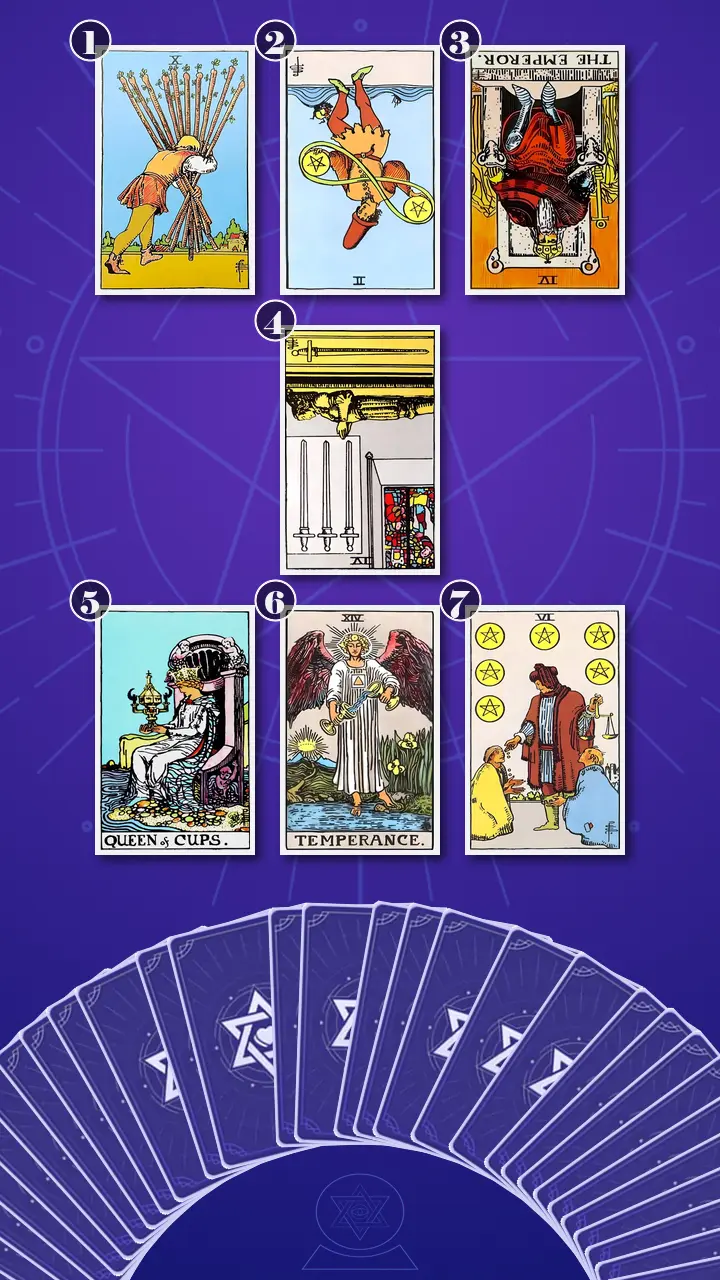
Reading the Map: Where Burnout Leaks
Position 1 — Surface burnout signal: what’s most visible in your day-to-day output
“Now we turn over the card that represents your surface burnout signal: the most visible way burnout is showing up in day-to-day work output and capacity,” I said.
Ten of Wands, upright.
The image is almost too on-the-nose: a person bent under a bundle they can barely see around. “This is overload as a lifestyle,” I told Jordan. “It’s not just ‘a busy week.’ It’s carrying responsibilities for so long that your posture, mood, and bandwidth start paying the bill.”
And the modern-life translation landed immediately: the week after PTO is denied, you become the safety net by default. You track everyone’s deadlines, catch mistakes before they happen, stay online late so nothing slips. Then you get home with nothing left for cooking, budgeting calmly, or being present with friends—yet putting something down still feels like the risky choice.
In energy terms, this is excess—too much fire, too much output, too much “I’ll handle it.” It looks competent from the outside. Inside, it’s a slow collapse.
Jordan let out a small laugh that had no humor in it. Then they looked away from the screen, like the card was being slightly rude. “That’s… yeah,” they said. “That’s exactly me. It’s almost mean.”
I nodded. “You’re not tired because you’re weak. You’re tired because you’re carrying it like it’s all yours.”
Position 2 — Inner tug-of-war: the unstable juggling across work, money, body, and friends
“Now we turn over the card that represents your inner tug-of-war: where competing priorities are creating instability and spillover,” I said.
Two of Pentacles, reversed.
Reversed, that playful juggling energy turns into a glitch. The infinity loop becomes the alt-tab life: Slack → Google Calendar → bank dashboard → Instagram Stories of someone’s weekend trip → back to Slack, with nothing ever fully closing.
“This,” I said, “is a system with zero buffer. Your calendar and budget can look ‘fine’ until one urgent request hits at 3:45 PM. Then meals, sleep, and friendships become the first dominoes.”
In energy terms, this is blockage—not because Jordan lacks skill, but because the system can’t self-correct. When the plan breaks, the mind reaches for control: tighter rules, stricter routines, harsher self-talk. And then, when one late meeting breaks the tighter plan, the pendulum swings into a ‘screw it’ spiral.
Jordan’s mouth pulled into a wince-smile. Their fingers tapped the edge of their phone—one, two, three—like counting receipts. “Convenience spending is sometimes just a bill for missing recovery,” they murmured, almost to themselves. “I hate how true that is.”
“No moralizing,” I said quickly. “This card isn’t calling you irresponsible. It’s showing you the hidden transaction: when recovery gets denied, you end up paying for it somewhere.”
Position 3 — External pressure point: the workplace dynamics tightening the loop
“Now we turn over the card that represents the external pressure point: how workplace dynamics—including the PTO denial—are shaping your options,” I said.
The Emperor, reversed.
“Okay,” I said softly, “this is the ‘permission denied’ card in this context.”
The Emperor is structure, rules, leadership. Reversed, that structure becomes gatekeeping—stone-throne energy. There was even a little Succession vibe to it: policies and leverage dressed up as ‘just business.’
“This card externalizes something important,” I told Jordan. “Not all burnout is personal weakness. Some burnout is a system that blocks recovery, and then quietly trains you to internalize the block. The PTO ‘no’ becomes an internal rule you enforce on yourself.”
Jordan’s eyes sharpened. Their posture changed—still tired, but more upright. “So when I keep refreshing my inbox,” they said, “it’s like I’m waiting for a verdict on whether I’m allowed to slow down.”
“Exactly,” I said. “And here’s where I bring in one of my astro-metaphors. I call it the Solar Sail Principle: you can’t always change the wind—an org chart, a policy, a manager’s timing—but you can angle your sail. Environmental resistance can become steering, not just punishment.”
That’s the nuance: we acknowledge the constraint without surrendering agency. We don’t romanticize endurance. We get strategic.
Position 4 — Core blockage: why recovery isn’t completing
“Now we turn over the card that represents the core blockage: the deepest mechanism that keeps recovery from actually happening and makes burnout leak across life areas,” I said.
Four of Swords, reversed.
The room went quieter in that specific way it does when someone hears themselves described too accurately.
“Rest that still includes Slack isn’t rest—it’s standby mode,” I said.
And I mirrored the exact loop, because this card demands specificity: 10:34 PM in bed, room dark except the blue phone glow. Rereading a Slack thread like it’s a podcast you can’t pause. Thumbs hovering, then setting the phone down, then picking it up again. Body horizontal. Nervous system upright.
Inside, the operating system runs one line of code: If I don’t stay a little bit alert, I’ll get ambushed tomorrow.
In energy terms, this is deficiency of true recovery—not a lack of time in bed, but a lack of “all clear” in the body. When recovery doesn’t complete, the system collects interest: more headaches, more jaw tension, more wired-but-tired nights, more impulse spending to buy back energy, more social withdrawal because you have nothing left to give.
Jordan exhaled—long, heavy, like letting a weight down without knowing where it would land. Their eyes went slightly unfocused for a moment, as if replaying last night’s scroll in real time. Then they nodded once. “I’m not even resting when I’m ‘resting,’” they said.
“Yes,” I said. “And that’s not a discipline problem. It’s a safety signal problem.”
Position 5 — Usable resource: support you can access without perfect circumstances
“Now we turn over the card that represents your usable resource: what support can be accessed without needing a perfect external circumstance,” I said.
Queen of Cups, upright.
The Queen doesn’t rush. She witnesses. She holds a lidded cup—feelings that are complex and worth opening slowly, in a safe container.
“This is the antidote to spreadsheet-brained burnout,” I told Jordan. “Not more optimization. Emotional attunement. One honest conversation. One page of journaling that doesn’t become a productivity plan. A friend who can handle the unpolished version of how you’re doing.”
Jordan swallowed. Their hand went to their sternum, briefly—an unconscious check-in with their own body. “I keep giving ‘I’m fine’ updates,” they admitted. “Even to people who would… actually show up.”
“That’s the Queen’s invitation,” I said. “Who can handle the honest version—without you minimizing it?”
In my own language, I call this Orbital Resonance at the human level: some connections stabilize you. Some amplify your stress. The Queen of Cups is asking you to choose the supportive orbit—one that doesn’t require you to perform competence while you’re running on empty.
When Temperance Poured Between Two Cups
Position 6 — Key transformation: the practice that turns crisis into a sustainable system shift
I held the next card face-down for a beat longer than usual. “We’re turning over the key transformation now,” I said, and I meant it. “This is the turning point—the alchemy.”
Temperance, upright.
There’s an angel pouring liquid between two cups, one foot on land and one foot in water, a path leading toward a soft sun. Measured. Repeatable. Not dramatic.
Setup. I described the trap the way Jordan had lived it: 10:46 PM on a weeknight, laptop still open on the couch “just in case,” Slack pings in the background while you check your bank app and debate ordering delivery again. Exhausted—but your brain still drafting explanations for tomorrow, as if you’re preparing for cross-examination instead of a morning standup.
Delivery.
Not “all or nothing” burnout survival—choose measured mixing, like Temperance pouring cup to cup, and let small boundaries and small rest rebuild your capacity.
I let it hang there for a second, the way I let a planetarium audience sit in the dark before I turn on the night sky. Because sometimes the pause is where the meaning lands.
Reinforcement. Jordan’s reaction came in a three-part wave. First, a physical freeze: their breath caught, and their shoulders held as if bracing for a bigger demand—like I was about to tell them to overhaul their whole life by Friday. Then the cognitive shift: their eyes moved off-screen, unfocused, as if scanning a memory—every time they’d told themselves, If I can just survive until Friday… and then “Friday” arrived with no relief. Then, a release: their jaw unclenched slightly, and they exhaled again, smaller this time. “That’s… doable,” they said, and there was a flicker of grief inside it. Grief for how long they’d been waiting for permission to collapse.
“Temperance isn’t ‘do less forever,’” I said. “It’s ‘mix it better, daily.’ And here’s where my astronomy brain gets stubborn: sustainable change is about rhythm. Like orbit. You don’t escape gravity by fighting it at 2 a.m. You change the pattern by adjusting the cadence.”
I offered a micro-practice right there—the 10-minute Two-Cup Reset (with the permission to stop anytime if it spiked anxiety): phone in another room or Focus mode; draw two columns—OUTPUT and RECOVERY; name one deliverable for tonight (not ‘catch up’); choose one five-minute restoration right after; and write one boundary sentence: “I can pick this up tomorrow at 9:30.”
Then I asked the question that makes a reading real: “Now, with this new lens—measured mixing—can you think of a moment last week when this would have changed how you felt?”
Jordan didn’t answer immediately. Their gaze dropped, and their thumb stopped scrolling. “Last Thursday,” they said finally. “I had this urge to keep working in bed because… if I didn’t, it would prove something. Like I’m replaceable.” They looked back up. “But if I’d done the Two-Cup thing, even for two minutes, I would’ve at least ended the night on my terms.”
That was the shift: from numb over-functioning toward cautious boundary testing. From “prove I can endure” to “protect capacity like a resource.” This wasn’t just about denied PTO. It was the beginning of self-trust.
Position 7 — Next grounded step: rebalance exchange in real life this week
“Now we turn over the card that represents your next grounded step: a practical action that rebalances work-money exchange and protects recovery this week,” I said.
Six of Pentacles, upright.
Coins. Scales. Giving and receiving with measurable fairness. I love this card after Temperance because it refuses to let “balance” stay emotional. It turns it into terms.
“This is your reminder,” I told Jordan, “that burnout isn’t only a willpower problem—it’s often an exchange problem. If you keep paying for work with your sleep, your body, and your friendships, the interest rate eventually becomes brutal.”
The Six of Pentacles asks for a clean trade: if scope increases, something else moves. If responsiveness is required, it gets acknowledged—through rotation, comp time, clearer priorities, or compensation. Not silently absorbed.
I offered a script because this card likes scripts: “Given X, I can deliver A by Friday or B by Tuesday—what do you prefer?” Constraint. Two options. Decision in writing. No novel-length justification.
Jordan’s face did that thing I see all the time with exhausted high-performers: relief, then immediate doubt. “But if I send that,” they said, “won’t I sound… difficult?”
“You’ll sound like a project coordinator who’s managing scope,” I said. “And if your workplace treats basic clarity as ‘difficult,’ that’s data too.”
From Insight to Action: A Repeatable Rhythm, Not a Miracle Weekend
I summarized the story the spread had told us, because integration is where clarity becomes usable: the Ten of Wands showed the visible overload—Jordan carrying everything like the human Jira board. The Two of Pentacles reversed showed the spillover—alt-tabbing between work and life admin until money, meals, sleep, and friendships became patch jobs. The Emperor reversed named the context—an external “permission denied” system that Jordan had started enforcing internally. The Four of Swords reversed pinpointed the bottleneck—rest that never restores, because the nervous system stays on-call. The Queen of Cups returned the missing ingredient—safe emotional witnessing and connection. Temperance offered the method—measured mixing, one boundary plus one restoration, repeated. And the Six of Pentacles grounded it—fair exchange, clear terms, real-world trade-offs.
The cognitive blind spot was subtle but powerful: Jordan had been treating rest as something to earn by being endlessly reliable. The transformation direction was the opposite: protect capacity like a resource—because capacity is what makes reliability possible in the first place.
“Let’s keep your next steps small,” I said. “The point is repeatability, not perfection.”
- Standby-Mode Shutdown (30 minutes)Tonight, choose one notifications-off window before bed: set Slack/email to Focus mode for 30 minutes, and put your phone in another room if you can. If that feels impossible, do 10 minutes. Your only job is to let your nervous system receive ‘all clear.’Expect the thought “I don’t have time.” Shrink the window instead of abandoning it. Two minutes counts if it’s real.
- Two-Cup Reset (10 minutes)Once per workday this week, draw two columns—OUTPUT and RECOVERY. Write one deliverable you’ll complete, then one 5-minute restoration you’ll do right after (tea, shower, balcony air, slow walk to the end of the block). Add one boundary line: “I can pick this up tomorrow at 9:30.”If guilt spikes, don’t “make up” for it with discipline. Just pour smaller amounts—Temperance style.
- Boundary-in-Writing (Two Options)In your next check-in or Slack thread, use the Six of Pentacles script: “Given X, I can deliver A by Friday or B by Tuesday—what do you prefer?” If a new task arrives, ask for a scope-for-scope trade: “If we add this, what should move?”Send the short version first. The urge to over-explain is just fear wearing a productivity costume.
I also offered one of my simplest “planetarium-to-boardroom” tools for the morning dread—my Earth-rotation perspective before morning meetings. “Before you open Slack,” I said, “put both feet on the floor and imagine the Earth rotating under you. Meetings pass. Pings pass. You’re not trapped in a single moment. Give yourself ten seconds of ‘I’m on a spinning planet’ before you’re on a spinning thread.”
And for the digital side of it—the constant background buzzing—I named it plainly as Space Debris Clearing: “Mute the channels that aren’t actually yours to monitor. Clear the orbit. Your attention is not infinite.”

A Week Later: The Quiet Proof
Six days later, Jordan messaged me: “I did the Two-Cup Reset for two minutes on Thursday. Two. I sent the ‘A by Friday or B by Tuesday’ line. My manager picked B. I closed my laptop and plugged it in across the room. I still woke up with the first thought ‘What if I’m wrong?’—but this time I noticed my jaw wasn’t clenched, and I actually laughed.”
It wasn’t a dramatic makeover. It was a small loosening—the quiet proof that clarity can be a practice, not a lightning strike.
That’s the thing I wish more burnt-out people could borrow from the night sky: the most reliable changes are rhythmic. You don’t need a perfect break to start recovering. You need a repeatable pattern that tells your body, again and again, “I’m allowed to come back online tomorrow.”
When your time off gets denied, it’s not just the calendar that tightens—your whole body starts acting like you have to earn rest by being endlessly reliable, even when you’re already running on empty.
If you treated your capacity like a resource you’re allowed to protect, what’s one tiny boundary + one tiny recovery move you’d be willing to try for the next 24 hours—just as an experiment?