Offer-Reneging Guilt—and How to Choose by Fit, Not Image

Finding Clarity in the 11:40 p.m. Two-Offer Spiral
If you are early in your career, paying big-city rent, and stuck between a secure yes and a better late-arriving offer while your jaw turns to stone every time a recruiter emails, this is that moment.
When Maya (name changed for privacy) sat down with me from her Toronto condo, I could already feel the shape of the spiral before she finished her first sentence. She described 11:40 p.m. on the couch with both offer PDFs open side by side on a warm laptop, the fan whirring, blue light needling her eyes, and street noise leaking through the window. She kept highlighting salary, title, and PTO lines, then flipping to Notes to rewrite the same pros-and-cons list. She had signed one job offer and then gotten a stronger one later, and now every follow-up email felt like a verdict.
She told herself she needed more information, but her body was reacting to something else entirely: the sick drop in her stomach whenever a recruiter preview appeared, the jaw locked so hard it almost clicked, the feeling of standing with one foot in each room and calling it strategy. This was post-acceptance career choice paralysis in its most modern form.
“I know which offer looks better,” she said, rubbing the hinge of her jaw, “but I hate how messy it makes me look.”
The feeling in her words was not vague anxiety. It was like trying to swim through gray syrup while a notification kept buzzing somewhere just above the surface. A hard choice is not the same thing as a wrong one.
I nodded and kept my voice soft. “We’re not here to make you flawless,” I told her. “We’re here to make the fog legible. Let’s draw a map for this crossroads and see what this decision is actually asking of you.”

Choosing the Decision Cross for a Job Offer Dilemma
I asked her to take one slow breath with both feet on the floor, not as some theatrical ritual, but as a nervous-system reset. Then I shuffled until the question had a clean edge between us: I signed one offer, then got a better one—switch or stay?
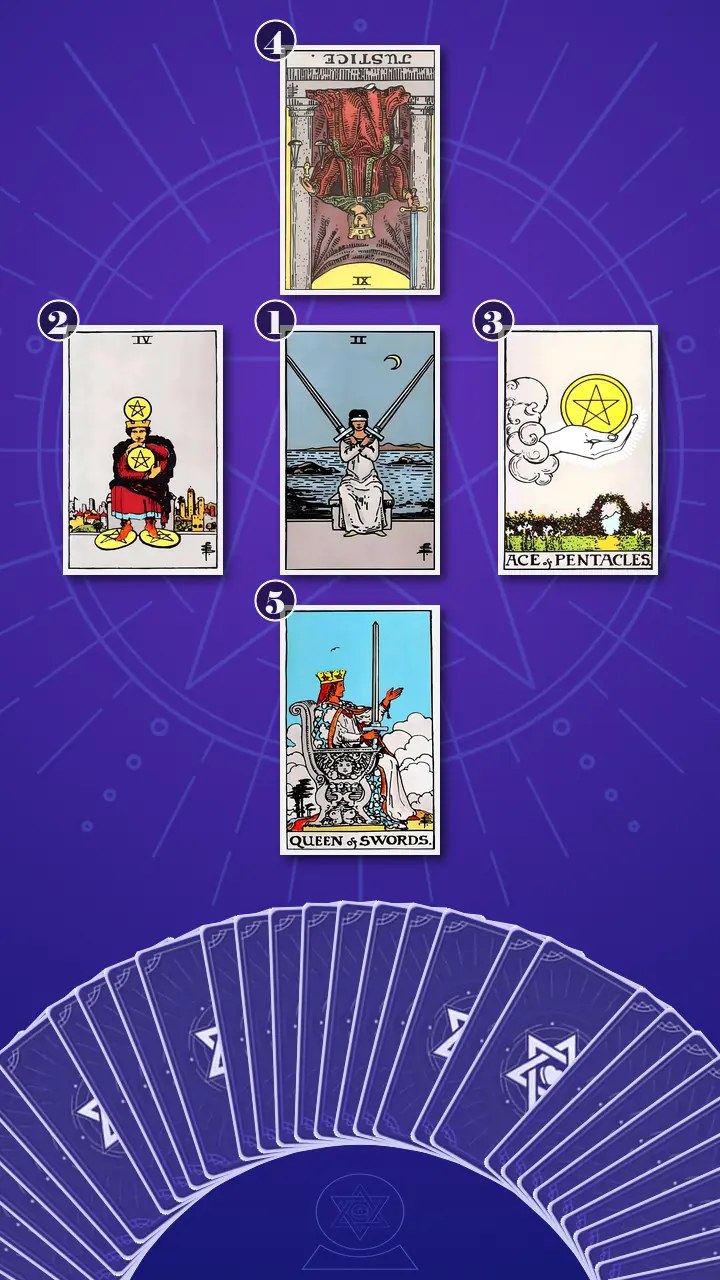
For this kind of career decision paralysis, I use a five-card spread called the Decision Cross · Context Edition. When someone is stuck between two viable offers, prediction usually is not the missing ingredient. Weighting is. This spread is small enough to keep the story clear and strong enough to hold the full knot: the present paralysis at the center, the stay path on the left, the switch path on the right, the hidden pressure above, and the decision compass below.
I explained it the same way I explain constellations at the planetarium: a pattern only becomes useful when you know which points matter and how they connect. That is how tarot works best for a job offer dilemma after signing—not by handing down a cosmic yes or no, but by separating signal from noise. The first card would show the stall itself. Two side cards would compare what staying and switching were really serving. The fourth would expose the fairness story distorting everything. The fifth, our key card, would show how to find clarity and communicate it cleanly.
Reading the Crossroads Like a Transit Map
The Tabs That Pretend to Be Research
I turned over the card representing the immediate decision knot: the observable paralysis between the signed offer and the later better one. It was the Two of Swords, upright.
In modern life, this card is painfully literal. Two browser tabs. Two PDFs. The same comparison list rewritten three times. It looks like analytical productivity on the surface, but underneath it is emotional gridlock. The blindfold and the crossed swords over the chest show blocked Air: thought working overtime while the body braces against conflict.
I asked her, “When you say you’re still deciding, what are you actually doing in real life—reopening the PDFs, rewriting the list, or avoiding the one message you don’t want to send?”
Her mouth twisted before she smiled. “All three,” she said.
“Exactly. This is the loop,” I said. “One more comparison, one more clause, one more hour. More data is not helping if the real cost is one honest sentence.”
She let out a short, almost offended laugh. “Okay, wow. That’s accurate enough to be rude.” Her fingers tapped once against her mug and then went still. That bitter little laugh told me the card had landed where it needed to.
The Offer That Feels Safe Because It Is Already Yours
Next I read the card representing what staying with the signed offer was really serving—stability, loyalty, or fear of disruption. It was the Four of Pentacles, upright.
This card always feels to me like someone clutching the first boarding pass just because it is already in their Apple Wallet. Staying keeps the story neat: I accepted, I followed through, I was dependable. In Maya’s life, it translated into keeping the first offer because it was already secured, already explainable, already easier to post and defend. That is Earth energy tipping into excess—security becoming a grip.
“Notice your body when you imagine staying,” I said. “Does it feel steady, or does it feel braced?”
She looked down immediately, as if her body had answered before her mind could edit it. “Relieved,” she said first, then caught herself. “No. Not relieved. More like... clenched.”
That was the card’s whole point. The stay path was not false, but it was serving certainty and reputation more than fit. It was the clean story, not necessarily the aligned one.
The Better Route That Arrived Late
The card on the right showed what switching to the later offer was really serving—growth, fit, and willingness to tolerate short-term discomfort. It was the Ace of Pentacles, upright.
Here the message was refreshingly concrete. This was not shiny-object syndrome. This was the career version of Google Maps surfacing a materially better route after you had already started walking: inconvenient, yes, but still real. Better pay. Stronger scope. A role that matched the kind of foundation she said she wanted to build. This was balanced Earth—an offered opportunity, not fantasy.
At the planetarium, I spend my evenings showing visitors that an orbit only makes sense when you watch its full path instead of freezing one frame and panicking about where the planet seems to be. In career readings, I use something I call Orbital Resonance. I do not ask only, “Which offer looks better on paper?” I ask, “Which workplace will your energy actually synchronize with over time—your growth pace, your manager rhythm, your need for scope, your financial reality in this city?” When I laid the Ace beside the Four, the contrast became clean: one option preserved certainty, the other matched her longer arc.
She inhaled sharply and stared at the Ace for a beat too long to fake. “That’s the annoying part,” she said. “If the later offer had arrived first, I wouldn’t even be calling this confusing.”
There it was. Wanting it stopped sounding selfish and started sounding factual.
The Courtroom Hanging Over the Table
Then I turned over the card representing the hidden influence distorting the whole decision—the guilt, professional-image fear, or fairness story she had not fully named. It was Justice, reversed.
The room went quieter when this card appeared. In modern life, Justice reversed looks like drafting a withdrawal email, deleting it because it sounds “too blunt,” rewriting it softer, then scrolling Fishbowl or Reddit threads about reneging an offer like they are case law. It is the LinkedIn-age version of becoming your own prosecutor, jury, and defendant. Air is still present here, but distorted—discernment mutating into self-punishment.
“You are not just weighing two jobs,” I told her. “You are cross-examining your own worth. You keep asking, ‘If I do this, what does it prove about me?’”
Her chest dropped on the exhale so visibly that even the camera caught it. Outside her window, a streetcar bell rang at exactly that moment, small and metallic, like a gavel in the distance.
“I wasn’t deciding,” she said finally. “I was putting myself on trial.”
“Yes,” I said. “And you do not owe a courtroom defense for a career decision. Prompt notice matters. Respect matters. Clarity matters. Self-punishment does not. Since when did professionalism become never causing anyone a difficult email?”
When the Queen Lifted Her Sword
The Clean Sentence at the Bottom of the Cross
Finally, I turned over the card below the center—the guidance card, the decision compass that could turn overthinking into a clean next step. It was the Queen of Swords, upright.
The light changed when she appeared. The late silver from Maya’s window caught the edge of the card, and for a second the blade looked like a line drawn straight through static. This Queen is mature Air: discernment, self-respect, and direct communication. In modern life, she is the version of you who mutes the group chat, closes the extra tabs, writes down three non-negotiables, and sends the respectful but unambiguous email.
At that moment Maya was still caught in the old trap. She wanted a choice that matched her priorities, yes—but she also wanted a choice that left nobody disappointed, no recruiter awkward, no trace of mess, no moral aftertaste at all. That is how offer reneging guilt keeps a person frozen long after the facts are clear.
Stop mistaking a spotless image for integrity; choose by your real standards and cut through the fog with the Queen's clear sword.
I let the sentence stay in the air between us.
First came the physical freeze: even her breathing paused, her thumb hovering above the rim of her mug. Then came the cognitive shift: her eyes drifted slightly out of focus, like she was replaying every draft-delete-draft cycle and suddenly seeing the algorithm underneath it. Then the emotion landed. Her shoulders dropped. Her jaw unclenched. She breathed out in a shaky stream that sounded half relief, half grief, the strange dizziness that comes when a burden lifts and responsibility rushes in to take its place.
“But doesn’t that mean I already handled this badly?” she asked. There was a flash of anger in it, not at me, but at the version of herself she had been dragging through this. “Like, if I were really this clear, I would’ve done it sooner.”
I shook my head. “No. It means you got caught between being liked and being honest. That’s human, not disqualifying. Integrity is not a spotless image; it is a clear choice said plainly. And you do not need a guilt-free decision; you need a well-defined one.”
I leaned forward. “Now, with this lens, think about last week. Was there a moment when you were not really comparing jobs at all, but trying to protect your image from one awkward email?”
She gave a softer laugh this time. “Yesterday on the TTC. I wasn’t reading the contract. I was reading myself like I was evidence.”
“That’s the turn,” I told her. “Not from uncertainty to perfect certainty. From courtroom thinking to compass thinking. From guilt-soaked image management to grounded discernment and clean communication.”
Then I gave her the practical version the Queen was asking for. “Open Notes. Three standards only. Compensation floor, role scope, and team fit if those are the real ones. No bonus points for sounding nice enough. Decide from those. Then send the clean message.”
She picked up her phone immediately. The movement was small, but I know that kind of movement. In the dome, when a child finally spots Saturn after staring at the wrong patch of sky, there is always a brief stunned pause before recognition takes hold. This felt like the adult version of that—less wonder, more ownership.
From Courtroom to Compass
When I looked at the spread as a whole, the story was elegant in the way hard truths sometimes are. At the center, the Two of Swords showed blocked Air: Maya had turned two browser tabs into a holding pattern because movement meant friction. On the left, the Four of Pentacles showed the signed offer as security already in hand—stability, yes, but also a guarded grip on the cleanest professional storyline. On the right, the Ace of Pentacles showed that the later offer was not merely tempting; it was materially stronger and more aligned with the career foundation she actually wanted. Above them, Justice reversed revealed the main distortion: she had turned a professional situation into a character trial. And below, the Queen of Swords restored Air to its healthy form—less looping, more language; less image management, more clear standards.
There was almost no Fire or Water in the spread, which told me something important too: her desire and her emotional truth had both been pushed offstage. The blind spot was simple once it was named. She had been acting as if professionalism meant never creating a moment of friction. It does not. The transformation direction was just as clear: move from preserving a flawless image to choosing by real priorities and communicating directly. That is the whole shift.
I gave her a framework that was deliberately small and practical. Clarity usually arrives through structure, not drama.
- Run the Three-Standard Decision FilterOpen a blank note and write exactly three non-negotiables for this decision—for Maya, that meant compensation floor, role scope, and manager or team fit. Set a 20-minute timer and score each offer only against those three standards, not against how polite, loyal, or low-maintenance each option makes you look.When the urge to add a fourth or fifth criterion shows up, that is the loop trying to reopen. Keep it to three. If 20 minutes feels like too much, do the 5-minute version on your phone while you are on your commute or sitting in a café.
- Use the Clean Reply ProtocolMake a two-column note titled “What I owe them” and “What I do not owe them.” Under the first, write: prompt notice, respect, clarity. Under the second, write: my whole internal debate, a courtroom defense, emotional self-punishment. Then draft one two-sentence message to the employer you are declining: a thank-you, then a clear withdrawal.Read it aloud once, remove the extra apology lines, and send it within 24 hours of deciding. Clear and respectful beats overworked and delayed every time.
- Borrow the Earth’s Rotation Before You Hit SendThe next morning, before your first meeting and before you reopen the PDFs, stand by a window for thirty seconds and do what I call the Earth-rotation perspective. Feel that the planet is already moving; your career is not a frozen screenshot. Then send the email from your laptop, not your phone, so you are less likely to keep editing.This is not about calming yourself into passivity. It is about getting your nervous system out of emergency mode so your clarity can act.

A Week Later, the Quiet Proof
Three days later, Maya messaged me: “Picked the later offer. Sent the withdrawal email in two sentences. I hated it for seven minutes, then my body stopped acting like I was being chased.”
A week after that, she told me she had celebrated by sitting alone in a café with a flat white after work, phone face down, looking a little stunned and a little lighter. The decision was firm; the nerves had not vanished. That is what finding clarity usually looks like in real life—clearer, not airbrushed.
I thought about how the spread had moved from blindfolded stalemate to the Queen’s raised sword. This Journey to Clarity was never really about which company would look best from the outside. It was about helping her become someone who could choose by fit instead of appearances, speak plainly, and trust herself a little more afterward.
If tonight you are sitting with a locked jaw and a half-written email, trying to prove that wanting the better fit does not make you unreliable, please know this: noticing that struggle already means you are no longer entirely inside it.
If you let yourself be a clear person instead of a spotless one for one moment, what would your decision need to line up with to feel honest in your own body?