At 6:47 p.m., the Laptop Reopened; by Friday, Ownership Was Named

The 6:47 p.m. Green Dot
If you are a late-20s client-facing professional in Toronto whose laptop is still open at 6:47 p.m. because a teammate left a thread half-finished, and your first thought is not tomorrow but do not look difficult, I know exactly the pattern we are talking about. This is the people-pleasing at work story that often hides inside after-hours Slack anxiety, performance-based self-worth, and the question so many clients ask me in one form or another: why does being dependable at work feel like being available 24/7?
Jordan (name changed for privacy) joined me from her condo downtown, still sitting at a small dining table that clearly doubled as a workstation. Her coat hung off the chair behind her, her laptop was half-closed like she had tried to end the day and failed, and every few minutes a soft Slack pop slipped through under the steady fridge hum. Blue screen light flattened her face. She rubbed the back of her neck and said, 'I told myself I was done, and then I saw a teammate's unfinished client thread. I reopened everything. Again.'
She worked in Client Success on a lean hybrid team where responsiveness was quietly rewarded and nobody ever wrote down the real emotional cost of that. On paper, she was trusted and valued. In her body, it looked like tight shoulders, shallow breathing, and a wired-tired buzz that made logging off feel oddly unsafe, like trying to fall asleep in a server room. 'I know I do too much,' she told me. 'But if I stop, everything gets messier. And if I say no, I feel difficult immediately.'
I could hear the real contradiction underneath it: she wanted to be respected for judgment, but she was still trying to earn safety by being the easiest person to ask. I leaned a little closer to the camera and said it as gently as I could. 'The green dot is not your job description.' Then I added, 'We do not need to shame the pattern to change it. Let me help you map it. Tonight is about finding clarity - where reliability ends, where self-erasure begins, and what your next step can actually look like.'

Choosing the Corridor: The Five-Card Shadow Spread
I asked Jordan to plant both feet on the floor, take one slower breath, and hold a single sentence in mind: Why am I still the responsible one at work? Then I shuffled. For me, that opening is not a mystical performance. It is a psychological handoff. It helps the body come out of reactive mode long enough for the truth to become legible.
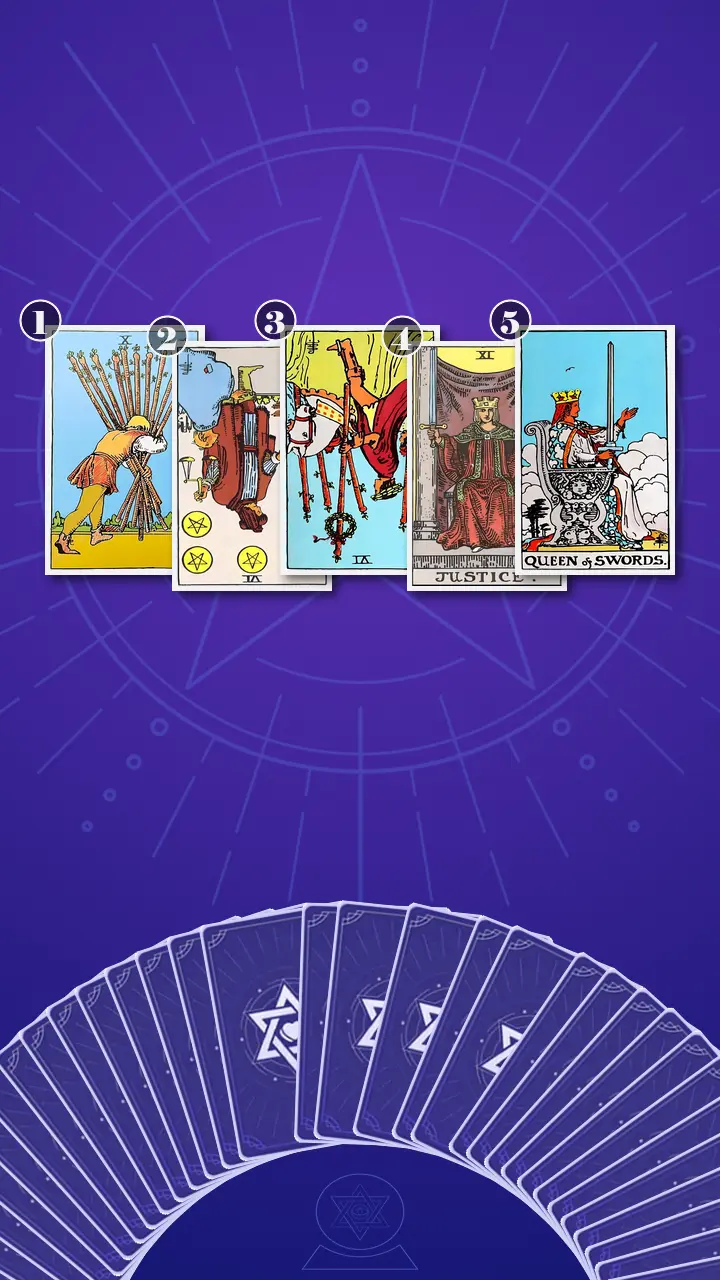
I chose The Shadow Spread - a five-card workplace boundaries spread I use when the surface complaint is a habit, but the real knot is identity. If you have ever wondered how tarot works for workplace over-responsibility, this is one of the clearest examples: I am not using fortune-cookie card meanings. I am reading card meanings in context. This spread is ideal for a tarot reading for workplace boundaries and overwork because it moves with clean logic: visible symptom, hidden bargain, underlying fear, integrating truth, and immediate practice.
I told her what each position would do before I laid the cards from left to right. The first card would show the conscious pattern she kept calling professionalism. The second would reveal the hidden exchange underneath that pattern. The third would uncover the fear that kept the whole structure alive. The fourth card - the key card in this reading - would show the truth capable of rebalancing it. And the fifth would turn that truth into a real sentence, a real timeline, a real next move.
Reading the Heat Before the Air Cleared
Position 1: The Last Laptop Glowing
I turned over the card representing the visible work pattern in the diagnosis: staying online late, scooping up leftover tasks, and treating availability as proof of value. It was the Ten of Wands, upright.
I held the image up to the camera. 'This is you at 6:47 p.m.,' I said. 'You see one loose client thread, reopen the laptop, write the follow-up yourself, and keep Slack green just in case, even though nobody explicitly asked you to stay.' The bundle of wands blocks the figure's view, and that detail mattered. Once everything is in your arms, everything feels equally urgent. It is like having twenty-seven browser tabs open and deciding each one is a moral emergency until your brain loses depth perception.
Energetically, I read this as excess Fire - effort that has gone past usefulness and turned into burden. The card did not tell me Jordan was incapable. It told me she was so overloaded that perspective had narrowed into a tunnel. Her nervous system had started confusing unfinished work with real threat. I said the line I knew she needed to hear: 'Being reachable is not the same as being reliable.'
Jordan gave a short laugh that had more bruise than humor in it. 'Okay,' she said, 'that is uncomfortably specific.' Her fingers tapped once against her mug and then went still. I recognized the reaction immediately - the wince of instant self-recognition, the moment someone sees that the disappearing evening was not random at all.
Position 2: When Helping Auto-Renews Into Obligation
I turned to the next card. 'Now I am reading the position that reveals the hidden exchange pattern in the psychological mechanics - how overgiving and one-sided helpfulness quietly maintain the problem.' The card was the Six of Pentacles, reversed.
'This is the hidden workplace economy,' I told her. 'You say yes before checking capacity. You patch the missing context in handoffs. You fix the formatting, the follow-up, the emotional tone, the little things nobody officially owns. You are not only helping. You are underwriting the gaps.' It reminded me of walking through the PATH at 5:31 p.m., getting a ping that says 'quick question,' stopping against a wall near Union, and doing ten minutes of unpaid cleanup because ignoring it until tomorrow feels riskier than missing your train.
Here the energy was distorted Earth - support without reciprocity, labor without clear ownership. The scales on the card are the whole story. In their reversed state, generosity stops being a free choice and becomes an unspoken contract. From my business background, I often explain this with Corporate Game Theory: once one person keeps absorbing the cost, the office equilibrium quietly rearranges around that behavior. Other people do not always mean to exploit it; they simply stop planning for the cost you always cover. 'Extra helpful can become extra available before you even notice the deal you are making,' I said.
Her chest dropped on the exhale. One hand lifted to her collarbone and stayed there. 'I never realized how much of my job is unofficial cleanup,' she said, more to herself than to me. I nodded. 'And because you do it well, the cleanup disappears. The labor becomes invisible at the exact moment it becomes expected.'
Position 3: The Crowd Inside the Notification Bar
I turned over the third card. 'This position uncovers the core fear sustaining the pattern - the fear that reduced availability will lead to reduced worth, belonging, or professional regard.' The card was the Six of Wands, reversed.
I felt the room quiet a notch. 'This is the face-up phone on the couch at 9:18 p.m.,' I said. 'You have already sent the late-night fix. Netflix is on. But your body is still waiting for the thumbs-up, the thank-you, the reaction emoji, because part of you needs proof that the extra effort registered somewhere.' In the Rider-Waite-Smith image, victory is public. Reversed, that public validation folds inward and becomes a private wobble. The crowd turns into Slack reactions. The laurel becomes praise in a 1:1. Silence starts to feel personal.'
Energetically, this was deficient Fire and blocked confidence. The work can be solid, yet the body still asks, Did it even count if nobody noticed? That is why after-hours availability can feel addictive. It is not only about the task. It is about the quick hit of reassurance that follows the task. 'What kind of contribution would you still respect in yourself if no one answered right away?' I asked her.
She stopped moving completely for a beat. Then her gaze drifted off-screen, as if replaying half a dozen evenings at once. 'I hate how true that is,' she said quietly. That was the real ache in the spread - not laziness, not time management, but the shame underneath the pattern of needing the room to mirror her value back before she could feel settled.
When Justice Spoke and the Air Changed
Position 4: The Scales, the Sword, and the Better Metric
By the time I turned the fourth card, even through a laptop screen the visual temperature of the reading changed. The first three cards had all the hot, crowded feel of after-hours work - strain, social pressure, too much motion. Then came a frontal figure, still and exact. 'This position identifies the key integrating truth,' I said, 'the move from guilt-driven overfunctioning to fairness, reciprocity, and self-respect.' The card was Justice, upright.
'This is the moment you stop treating every late message as a character test,' I told her, 'and start asking cleaner questions: Is this actually urgent? Who owns it? What timeline is fair? What standard would I use if I were not trying to prove anything right now?' Justice is balanced Air. Not coldness. Not punishment. Just discernment with a spine. It is the difference between running your time on vibes and having an actual policy for your attention.
Justice always takes me back to my years on Wall Street. I spent a long time in rooms where people confused noisy reaction with real value, and I learned something there that never left me: if your metric is wrong, your decisions will be wrong. So when this card appears, I instinctively reach for what I call Human Capital Valuation. I ask: what is this person actually worth to the system when priced by skill, judgment, and sustainable contribution - not by panic coverage? In Jordan's case, the answer was obvious. Her value was in client discernment, relationship steadiness, and clean follow-through. Not in being an unpaid after-hours smoothing service for every loose end the team forgot to assign.
The Sentence at the Center
It starts in that tiny after-hours moment: coat half on, Slack still open, one unfinished thread glowing like a personal obligation while the room gets quieter around you.
You are not here to keep proving your worth through extra weight; you are here to rebalance the scales and let clarity cut away automatic yeses.
If the work was never fairly yours, carrying it perfectly does not prove your worth; it only hides the imbalance.
First, her breath stopped. Not dramatically - just a clean little freeze, like buffering. Her fingers hovered over the rim of her mug. Then her eyes unfocused and slid to the side, the way they do when someone is replaying old Slack threads with a completely different subtitle running underneath them. When she looked back at me, there was a flash of anger in it. 'But if that is true,' she said, voice tighter now, 'doesn't that mean I trained people to expect this? Doesn't that mean I have been doing it wrong?'
I answered immediately, because this is the moment when people often try to turn Justice into self-punishment. 'No,' I said. 'It means you adapted intelligently to a culture that rewards responsiveness and leaves ownership blurry. Justice is not blame. Justice is accurate accounting.' I watched the line land in layers. Her jaw unclenched. Her shoulders lowered a full inch. Then came the strange second wave I have seen so many times in breakthrough readings: not just relief, but that slight light-headed vulnerability that shows up when the old emergency story goes quiet and the self has to stand there without it. I let the silence breathe before I asked, 'Now, with this lens, can you remember one moment from last week when naming fairness instead of worth would have changed how that message felt?'
She nodded slowly. 'Friday. My manager asked how things were going, and I almost said manageable because I did not want to become the difficult one.' I nodded back. 'That is it,' I told her. 'Fairness is a better metric than guilt.' In that moment, the reading stopped being about one late reply and became what it really was: the first move from guilt-driven overfunctioning toward steady self-trust and sustainable reliability.
Before we moved on, I gave her a tiny immediate exercise. I asked her to open a note and write three lines: 'Mine,' 'Shared,' and 'Not tonight.' I had her place one live task under each. Then I had her draft one sentence for the 'Not tonight' line, even if she never sent it. I told her that if guilt spiked, it would not mean the boundary was wrong. It would mean the old pattern had been interrupted.
Position 5: The Reply That Sounds Like Self-Respect
I turned the final card. 'This position translates the transformation into a grounded next step - a practical communication style, boundary, or prioritization move you can test immediately.' It was the Queen of Swords, upright.
'This is you writing one concise message that names capacity, gives a realistic timeline, and stays collaborative without volunteering extra labor to ease everyone else's discomfort,' I said. The Queen of Swords is balanced Air in motion. Her raised sword and open hand create the exact formula this case needed: firm edge, open channel, no self-erasure. She is like an out-of-office reply in human form - clear, polite, and not available for emotional reinterpretation.
'Clear is kinder than silently resentful,' I told Jordan. Then I gave her a sentence in her own voice: 'I do not have capacity to take this tonight. I can look tomorrow by 11 a.m.; if it needs action sooner, it will need another owner.' She read it back under her breath, and I watched her bracing for it to sound harsh. It did not. It sounded adult.
That card mattered because it did not ask her to become colder. It asked her to become legible. No disappearing. No snapping. No over-explaining. Just clear boundary language and realistic timelines - the exact shift from constant reachability to self-respecting limits.
From Green-Dot Guilt to Fair Workload
When I stepped back and looked at the whole spread, the story was clean. The Ten of Wands showed the visible overload: Jordan carrying so much that the day lost shape. The reversed Six of Pentacles showed the hidden bargain: helpfulness had become a one-way labor contract. The reversed Six of Wands revealed the vulnerable engine beneath it: silence from other people had started to feel like evidence about her worth. Then Justice and the Queen of Swords changed the axis. The problem was never that she was too kind. It was that she had been using guilt as a management tool and approval as a metric.
I told her the blind spot plainly: 'You have been treating discomfort as proof the extra work is yours. It is not. Most of the time, discomfort is just the feeling of no longer rescuing the system before the system has to show its gaps.' Her transformation direction was equally plain: define reliability through clear priorities, fair workload, reciprocity, and self-respecting limits - not through constant after-hours availability. In other words, stop auditioning for worth and start naming ownership.
- The Mine / Shared / Not Tonight FilterFor the next five workdays, before every non-urgent after-hours reply, open a note and sort the ask into three lines: 'Mine,' 'Shared,' and 'Not tonight.' Do it on the actual Slack thread or email that hooks you. Give it two minutes, not twenty. The goal is to interrupt the automatic yes before it leaves your fingers.If this feels too formal, start with one low-stakes thread. Naming ownership is not refusing to help; it is making the work visible.
- The Boundary-First Reply ScriptSave one copy-paste line in your Notes app and use it once this week in a medium-stakes situation: 'I do not have capacity to take this tonight. I can look tomorrow by 11 a.m.; if it needs action sooner, it will need another owner.' If replying instantly is part of the compulsion, use schedule send once instead of immediate reassurance.Before you send it, I had her use my old trading-floor drill - the Morning Routine: Trading Floor Opening Simulation. Feet flat. Shoulders down. Read the line out loud once in a steady voice, as if you are reporting facts, not pleading a case.
- The Ownership Reset in Your Next 1:1Bring one concrete example of invisible clean-up work to your next manager check-in and ask, 'Can we clarify who owns this kind of follow-up going forward?' Keep it specific: one thread, one handoff type, one recurring gap. You are not presenting a personality problem; you are clarifying workflow.Expect a guilt spike afterward. That does not mean you were difficult. It means the old pattern did not get to speak for you unchallenged.

A Week Later, the Screen Went Quiet
Four days later, I got a message from Jordan with a screenshot attached. She had changed her Slack status to 'Offline for the evening - back at 9 a.m.,' used schedule send on a reply she would normally have fired off at night, and in her 1:1 she had asked who actually owned a recurring follow-up thread. Her manager had not recoiled. He had said, 'Good call. We should assign that more clearly.' The catastrophe her nervous system had predicted never arrived.
That night she slept straight through. In the morning the old thought still showed up - what if that sounded difficult? - but she smiled at it, left the phone face-down by the kettle, and let the water boil first.
That is usually how a real Journey to Clarity looks in my work. Not a cinematic life overhaul. One fairer sentence. One cleaner handoff. One evening where the body learns that respect can survive an unanswered ping. This is why I trust a five-card Shadow Spread tarot reading for workplace boundary guilt and over-responsibility: it makes the hidden contract visible, and once you can see it, you can renegotiate it.
There is a very specific loneliness in being the last laptop still glowing, trying to earn safety by being the easiest person to ask. If that is where you are tonight, I want you to know that simply noticing the pattern means you are already no longer at the beginning.
If your value did not need one more after-hours yes to prove itself, what might a fairer reply sound like the next time guilt reaches for your keyboard?