From Slack Auto-Yes to Contract-First Ownership: Jordan's Shift

Finding Clarity in the 8:47 p.m. Slack Buzz
If you’re the kind of mid-level tech PM who replies “Sure, I can take it” to a Slack “Can you own this?” before you’ve even checked your calendar—because silence feels risky in a always-on culture—then you already know the exact flavor of fear Jordan (name changed for privacy) brought into my reading.
She called me from Toronto, but I could picture her without trying: 8:47 PM on a Tuesday, on the Line 1 subway heading south from Bloor-Yonge. Phone buzzing against her palm. Fluorescent carriage lights flickering like they couldn’t commit to a mood. Someone’s winter coat brushing her elbow. Earbuds in, a podcast playing—except she wasn’t hearing it anymore.
“It’s always the same,” she said, voice low like she didn’t want her own sentence to hear itself. “The message pops up—‘Can you own this?’—and my body… it’s like it snaps to attention. Tight chest. Shoulders up. I type ‘Sure’ before I even open my calendar. And then I’m… on the hook.”
I watched her on video: the tiny lift of her shoulders as if a notification had just gone off in the room with us. Her jaw set like she was holding something in place with her teeth. Pressure didn’t show up as an abstract emotion on her face—it showed up as a posture, a brace. Like she was carrying a stack of heavy boxes up a stairwell while pretending it was easy.
“What fear makes me do that?” she asked. “I don’t even want to say it out loud because it sounds dramatic, but… it feels like if I hesitate, it’ll look like I’m not on top of things. Like I’m replaceable.”
I let that land. “Overfunctioning is what you do when you’re trying to buy safety with effort,” I said, gently, because shame loves a harsh tone and I wasn’t going to give it one. “We’re not here to judge the reflex. We’re here to understand it—so you can choose a different rhythm. Tonight, let’s turn the fog into a map. This is a Journey to Clarity, not a performance review.”

Choosing the Compass: The Four-Layer Insight Ladder
I was sitting in a quiet staff office at the Tokyo planetarium, long after the last school group had filed out. The star projector had finally gone silent; only the building’s ventilation hummed, steady as a far-off tide. I asked Jordan to put both feet on the floor and take one slow inhale, one slow exhale—not as a mystical ritual, just a nervous-system handrail. Then I shuffled.
“For this,” I told her, “I’m using a spread I built for modern work pressure: the Four-Layer Insight Ladder · Context Edition.”
And to you, reading this: here’s how tarot works in moments like Jordan’s. This isn’t about predicting whether her manager will be nice next week. It’s about tracing a pattern from the obvious behavior to the deeper belief underneath it—and then translating insight into a concrete, testable change. Six cards is enough to stay tight and practical: symptom → trigger → root → resource → reframe → action.
I described the ladder to Jordan as I laid the cards in a vertical line, like steps descending from noise into truth. “The first card shows what ‘owning it’ looks like in your real day. The second shows what the ping activates. The third is what you’re afraid will be proven about you if you don’t overfunction. The fifth is the turning point—the lesson that changes the whole definition of ownership. And the last card is your grounded next step for this week.”
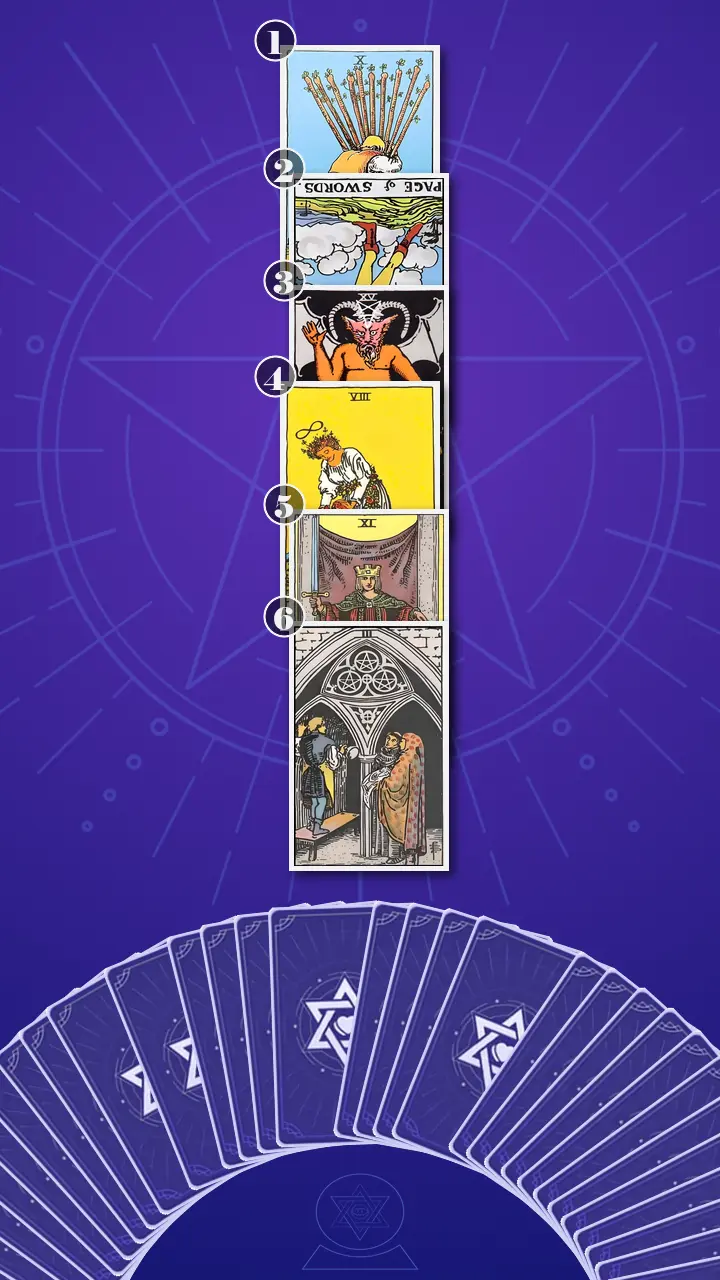
Reading the Map: Card Meanings in Context, Not in Theory
Position 1 — The observable overfunctioning pattern
“Now we flip the card that represents the observable overfunctioning pattern: what ‘owning it’ looks like in your day-to-day behavior,” I said.
Ten of Wands, upright.
In the card, the figure’s arms are full. Their head is lowered. The wands block their view. Even the town ahead—relief, completion, arrival—looks far because the load has become the whole world.
“This,” I told her, “is like your normal week: back-to-back meetings, Slack open across devices, and every vague request becoming something you quietly own end-to-end. Status updates, stakeholder nudges, risk logs, last-minute edits—while acting like it’s fine. And by the time you sit down to do strategic work, it’s after dinner and your brain’s fried.”
Ten of Wands isn’t a moral failing. It’s fire-energy in excess—effort that’s too concentrated in one person. The card doesn’t say, “Stop caring.” It says, “Your care has become a private burden.”
Jordan gave a small, sharp laugh that didn’t reach her eyes. “That’s… too accurate,” she said. “Honestly, it’s a little cruel.”
“It’s not cruel,” I said. “It’s specific. And specific means workable.” I paused. “In the last two weeks, what did you say you’d ‘own’ that wasn’t actually defined—what did it turn into once you were alone with it?”
She stared down and rubbed her thumb against her index finger like she was trying to erase a sensation. “A ‘quick’ request turned into coordinating three teams. And then I wrote the update. And then I rewrote it. At 11:38 PM.”
“If your ‘yes’ requires secret overtime, it wasn’t an honest yes,” I said—not to scold her, but to give her a clean line to hold onto when things got blurry again.
Position 2 — The immediate trigger and blocker
“Now we open the card that represents the immediate trigger and blocker: what the Slack ping activates and how it narrows your choices in the moment,” I said.
Page of Swords, reversed.
“Messages,” I said, tapping the card lightly, “and what messages do to a nervous system.”
I used her exact modern-life scenario, because it mattered that she recognized it: “A short Slack ping hits and your mind starts sprinting: reread, assume urgency, draft a reply, delete it, then send an instant yes to stop the discomfort. Five minutes later you’re overexplaining in a long message or spinning up extra documentation to prevent being misunderstood—creating more work in the name of ‘clarity,’ but without actually asking the one clean question that would define the request.”
Then I offered her the split-screen, because Page of Swords reversed is the difference between two realities:
Accurate response: “What do you mean by ‘own’? What’s the deadline? What does done look like?”
Adrenaline response: “Sure. On it.” (Plus a paragraph you didn’t need to write. Plus a plan nobody asked for. Plus the night you lose.)
Reversed, the Page is air-energy in blockage—not lack of intelligence, but attention whipped around like wind-tossed branches. “Fast replies aren’t the same as clear agreements,” I said. “Sometimes fast is just louder.”
Jordan’s eyes flicked to the side of her screen—toward, I could tell, where Slack lived. Her mouth tightened. She didn’t nod; she went still, like she was replaying a familiar scene: cursor blinking, phone warm in hand, heart deciding the sentence before her mind got a vote.
Position 3 — The underlying fear and belief
“Now we turn over the card that represents the underlying fear and belief: what you think will be proven about you if you don’t overfunction,” I said.
The Devil, upright.
In my planetarium work, I spend a lot of time teaching people the difference between what’s massive and what’s merely close. The Moon looks huge on the horizon not because it’s suddenly closer, but because our brain uses context to interpret it. The Devil works like that: fear looks like law when it’s pressed up against your face.
“Here’s the modern translation,” I told her. “You don’t feel like you can negotiate. In your head, saying no—or even asking for scope—equals being exposed as not valuable. So you accept ambiguous ownership, absorb other people’s urgency, and then try to earn safety by working harder. The chain is the belief that your security comes from overdelivering—not necessarily anything your manager explicitly said this week.”
The Devil is earth-energy in a twisted form: attachment. A coping strategy that started as protection becomes a subscription you forgot you signed up for—charging you monthly until you actually cancel it.
“I want you to notice something,” I said, pointing at the image. “The chains are loose. That matters. This fear is powerful, but it’s not all-powerful.”
Jordan swallowed. “It’s the sentence,” she admitted. “The sentence in my head is… ‘We don’t really need her.’”
“Whose eyes are you afraid of, specifically?” I asked. “If you didn’t overdeliver this time, who do you imagine deciding your worth?”
“A senior teammate,” she said immediately. Then, quieter: “And… me.”
Position 4 — The stabilizing inner resource
“Now we open the card that represents the stabilizing inner resource: what capacity you can lean on to stay present and respond rather than react,” I said.
Strength, upright.
Strength is one of my favorite cards to read for anyone living in Slack culture, because it’s not about becoming fearless. It’s about becoming steady. The woman doesn’t fight the lion. She doesn’t pretend the lion isn’t there. She holds it—gently, firmly—like a hand on a restless dog’s collar at a busy intersection.
“Here’s your modern-life scenario,” I said. “You feel the spike when a ping lands—but instead of letting it drive your fingers, you take a breath and choose a slower, cleaner response. You don’t fight the workplace; you guide your own reflex. You let the urge to prove yourself exist without obeying it.”
This is regulated fire: courage without sprinting. Power without force.
Jordan exhaled—a small sound, but I heard it. Her shoulders lowered maybe a millimeter. Her hands, which had been clasped tight, loosened and re-laced. That was the first crack in the pattern: not a grand boundary speech, just a micro-pause.
“I can be steady and still be good at my job,” I offered as an inner script. “Not fast. Not perfect. Steady.”
When Justice Spoke: Ownership as a Contract, Not a Verdict
Position 5 — The key reframe about ownership (Key Card)
I told Jordan, “We’re turning over the card that represents the key reframe about ownership: how to redefine ‘own this’ as a clear agreement instead of a personal worth-test.”
As I flipped it, the room felt quieter—not because anything changed in Tokyo, but because she changed. Attention gathered. Even the hum of the ventilation sounded like it had stepped back.
Justice, upright.
“This is the turning point,” I said. “Someone pings, ‘Can you own this?’ and you respond like it’s a contract negotiation, not a personality test: you ask what ‘own’ means, state one constraint, and propose a timeline. You’re fair to them and fair to your real capacity. You make trade-offs explicit—if this becomes priority, something else moves.”
Justice is air-energy in balance: clear-eyed, factual, not cold—just clean. The scales are scope, timeline, trade-offs. The sword is the one sentence you’re willing to send.
And here’s where my own lens—my research brain—always kicks in. In astronomy we talk about resonance: when two bodies keep meeting at the same points in their orbits, the interaction amplifies. It can stabilize a system… or it can trap it.
“Jordan,” I said, “this is what I call Orbital Resonance. Right now, your system is resonating with other people’s urgency. Their ping hits, and you match their frequency instantly. That’s why it feels like you have no choice: your body has already synced. Justice breaks resonance. It introduces a different rhythm—your rhythm—by forcing a pause where facts can exist.”
She blinked hard. “So I’m not reacting to the task,” she whispered. “I’m reacting to… gravity.”
“Exactly,” I said. “And gravity can be negotiated with structure.”
She was right on the edge of it then—still in the old story: My value is measured by immediate compliance. You could almost hear the laptop half-closing in her mind, and the ping landing right before logging off.
That’s the setup, the familiar moment: the late-day Slack message, the tight chest, the shoulders lifting, the word “Sure” rising like a reflex because it’s easier than the discomfort of clarifying.
Stop treating every request as a verdict on you; start weighing it like a scale—name the facts, name your limits, and let “owning it” mean a fair agreement.
I let silence do its job for a beat.
Her reaction came in a chain, not a single emotion.
First: the physical freeze. Her breath caught. Her eyes widened a fraction—pupils like they were adjusting to sudden light. Her hands stopped moving entirely, hovering mid-gesture near her mug.
Second: the cognition sinking in. Her gaze went slightly unfocused, like she was replaying a specific Slack thread. The corners of her mouth tightened as if she’d just found the hidden terms and conditions she’d agreed to years ago.
Third: the emotional release—and it surprised her. She let out a sharp exhale that sounded like a laugh trying not to become a cry. Then her brow furrowed, anger flashing up fast.
“But… if that’s true,” she said, voice suddenly brighter with heat, “doesn’t that mean I’ve been doing it wrong? Like I’ve been… making myself smaller?”
I didn’t rush to soothe it away. “That anger makes sense,” I said. “It’s the part of you that knows you’ve been paying a high price for safety. But Justice isn’t here to put you on trial. Justice is here to renegotiate the agreement.”
Her shoulders dropped—this time not a millimeter, but noticeably. She blinked again, slower. Her voice softened. “So I’m allowed to… weigh it.”
“Yes,” I said. “And I want you to test it, not just believe it.”
Then I gave her the reinforcement—because insights don’t stick in an always-on culture unless they’re anchored to a behavior.
“Try a 10-minute contract-first experiment the next time someone says ‘Can you own this?’ Before you commit, type one clarifying question plus one proposed timeline, then stop. Don’t add extra explaining unless they answer your question. If your body feels panicky, put a hand on your chest for one breath and remind yourself: ‘I’m allowed to clarify.’ If it feels too much, start with delaying your reply three minutes—set a timer—then send the same two lines.”
I leaned in slightly. “Now, use this new lens and look back: last week, was there a moment where you said yes fast—when this could have made you feel different?”
Jordan didn’t answer immediately. She pressed her lips together, then nodded once. “Thursday. 4:58 PM. I had my hand on the laptop to close it. And a senior teammate pinged. I said yes in under a minute.”
“That’s the bridge,” I said. “This is you moving from notification-driven proving to calm, boundaried accountability—without losing your competence.”
The Craft Guild Plan: Actionable Advice for the Next Slack Ping
Position 6 — A practical next-step behavior
“Now we flip the final card,” I said, “the one that represents a practical next-step behavior: the most realistic way to practice healthier ownership this week at work.”
Three of Pentacles, upright.
“This card is your antidote to secret hero sprints,” I told her. “You turn ownership into a shared structure: who provides inputs, who reviews, what the deliverable is, and what ‘done’ looks like. You work in the open—shared doc, clear checkpoints—instead of doing invisible overtime. Your competence shows up as coordination and craft, not martyrdom.”
Three of Pentacles is earth-energy in balance: systems. Process. Collaboration. It’s the opposite of DM chaos.
Putting the whole ladder together
I summarized the story the cards had told, because cohesion is where clarity lives: “Ten of Wands says you’re carrying ambiguous work alone and calling it integrity. Page of Swords reversed shows the moment the ping hijacks you—speed as safety. The Devil names the deeper bind: worth equals availability, so saying yes feels mandatory. Strength gives you a micro-pause—soft power—to regulate the adrenaline. Justice reframes ownership as a fair agreement. And Three of Pentacles grounds it into visible work and shared roles.”
“Your blind spot,” I said, “is that you’ve been treating clarifying like a social risk—when it’s actually project management. You’ve been interpreting a request as a verdict, not an intake.”
“And the direction of change is exactly what your cards are begging for,” I added. “From auto-yes to clarifying and contracting: define what ‘owning’ means, name constraints, and propose a realistic timeline before you commit.”
The scripts (small enough to actually use)
I offered Jordan concrete next steps—small, copy-pasteable, designed for the real world where your nervous system is already lit up.
- The 2-line “Justice Reply”The next time someone Slacks “Can you own this?”, send two lines only: (1) one clarifying question (“When you say ‘own,’ do you mean driving end-to-end or just the first draft?”) + (2) one proposed timeline (“I can send a first pass by Thursday 3 PM—does that work?”).Save it as a Slack snippet. If you feel panicky, do a 10-second pause—feet on the floor, one inhale, one exhale—then paste.
- Say the trade-off out loudIn the same thread, make capacity visible: “I can take this today if we deprioritize X—what should move?” You’re not refusing; you’re turning an emotional IOU into an explicit schedule decision.If guilt spikes, repeat a neutral line: “Totally—just want to make sure I’m owning the right piece so we hit the deadline.”
- Build one “Definition of Done” mini-docFor one recurring request type, create a shared Google Doc/Notion page with 5 bullets: deliverables, who provides inputs, who reviews, what ‘approved’ means, and the deadline. Share it in the thread and pin it.Keep it ugly on purpose—5 minutes, not a masterpiece. Three of Pentacles rewards visible drafts, not secret perfection.
Jordan nodded, but her eyes narrowed slightly. “Okay, but… I can’t even find five minutes sometimes,” she said. “My calendar is chaos. And if I don’t answer right away, it feels like I’m being judged.”
“That’s real,” I said. “So we lower the bar.”
“Here’s one of my planetarium-grounding tools,” I added—my Earth-rotation perspective before morning meetings. “Before standup, take eight seconds and imagine the Earth turning under you. Nothing dramatic—just that steady rotation. It reminds your body: urgency is not the only tempo that exists. Then you choose one sentence you’ll use today: A clean question is not pushback—it’s professionalism.”
She smiled, small and reluctant, like she didn’t want to admit she liked it. “That’s… weirdly helpful,” she said. “Like it gives me a bigger sky.”

A Week Later: The Quiet Proof
Five days later, I got a message from Jordan while I was prepping a new planetarium show about orbital periods. Outside the staff window, Tokyo’s morning light had that pale, winter clarity—the kind that makes everything look honest.
Jordan wrote: “Got the ping. Didn’t auto-yes. Sent the two lines. My hands were shaking a little, not gonna lie. They answered my question. Deadline moved to Friday. And I didn’t work late.”
It wasn’t a perfect transformation montage. It was a single Slack thread where she stayed human. She still felt the spike. She just didn’t obey it.
That’s what clarity often looks like in real life: not certainty, but a small sense of looseness. A jaw unclenching. A calendar block surviving. Ownership becoming a clear agreement instead of a reflexive self-sacrifice.
When a vague “Can you own this?” hits and your chest tightens, it can feel like your entire worth is riding on a single fast yes—even if your body is already telling you you’re at capacity.
If you didn’t have to earn safety through speed this week, what’s one clarifying question you’d allow yourself to ask before you commit?