My 'Ambitious Targets' Were a Self-Worth Test: How I Planned for Capacity

Finding Clarity in the 9:41 p.m. Notion Rewrite
If quarterly OKR planning hits your calendar and your shoulders tense up before you even open the doc, you’re not “dramatic”—you’re running on Sunday Scaries energy in spreadsheet form.
Taylor (name changed for privacy) appeared on my screen from a Toronto condo living room—9:41 PM their time, Monday morning light already softening the edges of Tokyo behind me. The CN Tower was a faint glow through their window, like a quiet witness. Their laptop was balanced on their knees, Notion on one side and a Google Doc on the other, and their trackpad hand kept doing that tiny, restless micro-scroll as if the right wording might appear if they just rubbed the page hard enough.
They didn’t say “I’m burnt out.” They said, “Quarterly goals are due. I need targets that look legit. But if I write something realistic, I feel… replaceable.”
I watched their shoulders inch toward their ears, jaw set like a clamp. The pressure in them wasn’t loud; it was dense—like trying to breathe with a winter coat zipped up to your nose, indoors, because some part of you thinks the cold is proof you’re working hard enough.
“Okay,” I said, soft and direct. “We’re not here to make you aim lower. We’re here to make a plan your life can actually carry. Let’s find clarity—real clarity, not the kind you get from reformatting a deck at 10:47 PM.”

Choosing the Compass: The Celtic Cross · Context Edition
I asked Taylor to take one slow breath—not as a mystical ritual, just a nervous-system gear shift. While they exhaled, I shuffled. In my day job, I guide people under a planetarium dome and watch their faces change when they realize the “fixed” stars are actually moving in long, patient arcs. Tarot feels similar to me: not fate, but motion you can finally see.
“We’re going to use a spread called the Celtic Cross · Context Edition,” I told them. “Because your issue isn’t just what goals to pick. It’s the whole system around the goals—the overload, the pressure point, the deeper rule you’re following, the workplace conditioning, and then the pivot into a sustainable quarter.”
To you reading this: that’s why the Celtic Cross works so well for career burnout and quarterly planning. It doesn’t reduce the problem to productivity tips. It shows the architecture: what’s happening now, what’s crossing it, what’s underneath it, and what the next workable move actually is.
“The center card will name your present reality,” I said, “the crossing card will show the pressure point that turns planning into a self-worth test, and the near-future card will show the next pivot—what you can do differently soon, not in some perfect future version of you.”
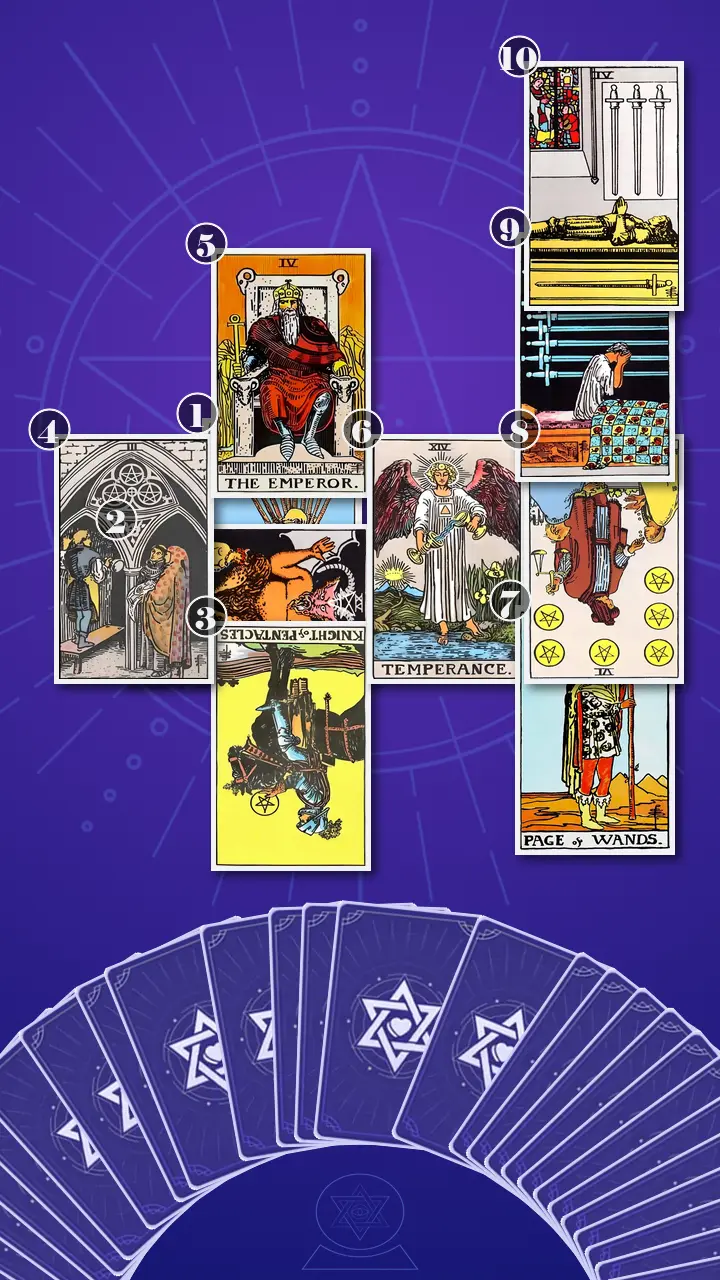
Reading the Map: Card Meanings in Context for Quarterly Goals
Position 1 — The current burnout-relevant reality
“Now flipping over, we have the card that represents the current burnout-relevant reality: what your goal-setting looks and feels like right now in day-to-day behavior.”
Ten of Wands, upright.
In the image, a person is bent forward under a bundle of wands—so many they can’t even see the road ahead. And the modern translation hit immediately: this is like having fifteen tabs open—Notion, a dashboard, a QBR deck—and calling it “clarity,” when it’s actually just obstruction. Too many targets block strategy the way those wands block vision.
“This is the ‘burden posture,’” I said. “The hunched laptop angle. The jaw clench. The late-night second wind that feels productive, but it’s your body running on emergency juice.”
Taylor let out a small, bitter laugh—unexpected, but so human. “That’s… accurate,” they said. “Like, kind of rude.”
I nodded. “I know. And I’m not saying you’re doing anything wrong on purpose. I’m saying the plan already has weight baked in. If the plan needs you to be superhuman, it’s not a plan—it’s a dare.”
I asked the question the Ten of Wands always asks in workplace readings: “Which two responsibilities are you carrying that were never truly yours to begin with?” Taylor’s eyes flicked away from the camera, as if scanning their week like a mental calendar grid.
Position 2 — The main pressure point (the crossing energy)
“Now we flip the card that represents the main pressure point: what makes goal-setting spiral into overcommitment or self-worth tests.”
The Devil, upright.
I didn’t go mystical with it. I went modern. “This is the Slack green dot as a leash,” I said. “You’re technically free. No one is literally making you rewrite the same OKR line at midnight. But you keep coming back because it feels safer to be seen trying.”
I gave Taylor a scene they didn’t have to invent: the OKR review invite landing; the LinkedIn ‘big win’ post; the impulse to add just one more KPI so nobody can question effort. “The chains in this card are loose,” I said. “That’s the point. The pressure is real—Toronto rent is real, performance culture is real—but part of the binding is an internal rule that says, ‘If I don’t add it, they’ll think I’m coasting.’”
Taylor exhaled sharply, then did another half-laugh that sounded like relief and annoyance at the same time. “It’s my director,” they said. “Not even what they say. It’s… the version of them in my head.”
“That’s exactly Devil energy,” I said gently. “Approval becomes safety. And then goals stop being a map and start being a courtroom.”
I paused and added a line I’ve learned to repeat like a safety rail: “A polished goal doc can’t substitute for capacity.” Taylor’s shoulders didn’t drop yet, but their eyes softened. Something in them recognized the trap without feeling shamed for it.
Position 3 — The hidden driver beneath the plan
“Now we open the card that represents the hidden driver beneath the plan: the unconscious rule you follow when choosing targets and estimating capacity.”
Knight of Pentacles, reversed.
Upright, this Knight is steady. Reversed, the steadiness becomes rigidity: grind without adaptation. The modern version is treating a quarterly plan like a legally binding contract with your past self—even after reality changes. It’s the habit tracker that turns into a punishment device.
“Under the hood,” I said, “there’s a rule that consistency means never renegotiating. Like, ‘If I change course, it means I wasn’t serious.’ But that’s not maturity—that’s stubbornness wearing a productivity hoodie.”
Taylor’s fingers tightened around their mug, then loosened. “I do that,” they admitted. “I lock it in early, then… I suffer through it. Like suffering is evidence.”
“That’s the reversal,” I said. “Earth energy gone inflexible. The risk isn’t that you don’t work hard. It’s that you don’t update the plan when new information arrives—like your actual capacity.”
Position 4 — The conditioning behind the pattern
“Now we flip the card that represents the conditioning behind the pattern: past workplace/team dynamics that taught you how goals ‘should’ be.”
Three of Pentacles, upright.
In the card, a craftsperson works while others observe with plans in their hands. It’s not sinister. It’s standards. It’s evaluation culture. It’s learning what counts as “good work” by what gets reviewed and praised.
“Somewhere along the way,” I said, “goal-setting became a performance. Something you do to be endorsed. And that makes vagueness feel risky—even when honesty would be healthier.”
Taylor nodded once, slow. “My first PM job was… intense,” they said. “Everything was a metric. Everything was a slide.”
I let that sit. In my mind, a quick flashback surfaced: a group of middle-schoolers in the Tokyo planetarium, whispering “It’s not moving” about a star map—until I dimmed the dome and sped up time, and suddenly the whole sky shifted. Standards aren’t evil. But time reveals whether they’re sustainable.
Position 5 — Your conscious ideal of a ‘good quarter’ (the crown)
“Now we open the card that represents your conscious ideal of a ‘good quarter’: the standard you think you must meet.”
The Emperor, upright.
“This is interesting,” I said, and Taylor leaned in slightly, like they could feel the pivot coming. “Your mind doesn’t want chaos. You want something solid, defensible, structured.”
I kept it practical: “At his best, the Emperor is supportive structure. A container. A clean one-page ‘rules of engagement.’ Calendar blocks. Clear definitions of done. The authority to say, ‘Here’s what I’m available for.’”
And this was where their body changed: not dramatically, but noticeably. Their shoulders lowered a fraction. Their breath got less clipped.
“Trade-offs aren’t negativity,” I said. “They’re leadership. Being ‘reliable’ isn’t the same thing as being endlessly ‘available.’”
Taylor tested a sentence out loud, almost like trying on a jacket: “If we add this… what comes off?” They looked embarrassed for a second—like the words were too bold.
“That,” I said, “is Emperor medicine.”
When Temperance Spoke: The Pour That Changed the Quarter
I turned the next card over more slowly. The room got quieter—the kind of quiet where you can suddenly hear your own laptop fan.
“Now we’re looking at the card that represents the next pivot in how you set targets: the near-term energy that can move you toward sustainability.”
Temperance, upright.
Temperance is an angel pouring water between two cups: not choosing ambition or rest, but blending them until the mixture is drinkable. One foot on land, one in water—stability and feeling, both included. A winding path toward a bright horizon that doesn’t require sprinting the whole way.
In modern work terms, this is calibration. It’s setting OKRs that include how you’ll do them—meeting load, deep work time, recovery—so the quarter is executable, not just impressive.
Setup: You know that moment when the quarterly goals doc is open, your shoulders creep up, and you keep tweaking metrics at 10:47pm—because a ‘real’ plan is supposed to feel slightly impossible, even before the quarter starts.
Delivery:
Not ‘prove your worth by carrying more’—choose the Temperance pour: mix ambition with recovery until the plan feels livable.
And I let it hang there for a beat.
Reinforcement: Taylor’s reaction came in a chain—three small movements that told me more than any speech could. First, a physical freeze: their fingers stopped fidgeting, mug suspended halfway to their mouth. Then the cognitive part landed: their gaze unfocused for a second, like they were replaying ten different late nights at once—Notion open, Slack checked “just in case,” rewriting a goal to sound more “serious.” Finally, the emotion surfaced: their shoulders dropped, and a breath came out with a slight tremor, half laugh and half grief.
“But if it’s livable,” they said, and the sentence wobbled, “does that mean it’s… not ambitious?”
There it was—the surprise resistance. Not relief, but a flicker of anger on their own behalf, as if moderation had been marketed to them as failure.
“No,” I said. “It means you’re designing for orbit, not for explosion.”
This is where my own framework clicked into place—my signature lens from astronomy, used as a practical diagnostic tool. “I call this Orbital Resonance,” I told them. “When you set goals, you’re setting a rhythm: weekly check-ins, deliverables, stakeholder pings, your own internal pressure. If the rhythm of your goals matches the rhythm of your fear, you get destructive resonance—everything amplifies, and your system shakes itself apart. Temperance is the recalibration: changing the frequency. Adding recovery so the system stabilizes.”
I leaned forward. “Right now your quarter is tuned to ‘prove it.’ Temperance tunes it to ‘sustain it.’ And that’s how you get repeatable momentum.”
“Now,” I continued, “with this new lens—Temperance, not the Devil—look back at last week. Was there a moment when your shoulders tightened and you added ‘one more’ metric? If you’d treated your capacity like data, what would you have done instead?”
Taylor swallowed. “Thursday,” they said. “Someone asked for a ‘quick initiative.’ I said yes. Then I stayed up rewriting the plan so it looked intentional.”
“That’s it,” I said. “This isn’t a personality flaw. It’s a system you’ve been running. And this moment is the shift—from pressure and self-comparison toward cautious relief as boundaries take shape.”
Climbing the Right-Hand Staff: Self, Environment, and the Mind at 3 a.m.
Position 7 — Your role in the system
“Now flipping over, we have the card that represents your role in the system: the self-image and strengths you can lean on while reworking goals.”
Page of Wands, upright.
“This is good news,” I said. “You have curiosity. You can treat one goal like a prototype instead of a referendum.”
The Page is the part of you that can say: What are we learning? not just Did we win? In PM language, it’s writing goals like hypotheses—“If we do X, we expect Y”—so the quarter rewards iteration, not self-punishment.
Taylor smiled, small but real. “I miss that version of me,” they said. “The one who liked experimenting.”
Position 8 — External dynamics affecting capacity
“Now we flip the card that represents external dynamics affecting capacity: workload distribution, expectations, reciprocity in your environment.”
Six of Pentacles, reversed.
Reversed, the exchange is uneven. The scales don’t reflect reality. “This is the ‘default fixer’ problem,” I said. “You take on more because you can. And the system quietly counts on it.”
I made it concrete: “This is the meeting where someone casually says, ‘Can we also add a quick pass on X?’ and you hear yourself say ‘Sure’ before your brain catches up.”
Taylor winced. “Yep.”
“Temperance isn’t just internal,” I added. “It has to show up as visible trade-offs. Otherwise you’re building a sustainable plan inside a machine that runs on invisible labor.”
Position 9 — The inner tug-of-war (hopes and fears)
“Now we flip the card that represents the inner tug-of-war: what you secretly hope goal-setting will fix, and what you’re afraid it will prove.”
Nine of Swords, upright.
“This is the 3:12 AM loop,” I said. “Phone glow, Slack check ‘just in case,’ re-reading the goals doc like it’s going to hand you safety.”
I didn’t dramatize it; I named the cost without catastrophizing. “Your mind runs scenarios like a CI pipeline that never stops building.”
Then I asked for specificity. “Write the fear sentence exactly as it appears,” I said. “No fixing it yet. Just capture it: ‘If I set fewer goals, they’ll think ____.’”
Taylor stared at their desk for a beat. “They’ll think I’m not… leadership material,” they said quietly.
“Thank you,” I said. “That sentence is data. Not destiny.”
Position 10 — Integration guidance (not a fixed prediction)
“Now we flip the card that represents integration guidance: what sustainable success looks like when you apply the lesson of this reading.”
Four of Swords, upright.
The image is protected stillness—a sanctuary-like pause. “This isn’t quitting,” I said. “This is strategic recovery as part of execution.”
I met Taylor’s eyes through the screen. “Rest isn’t a reward for finishing. It’s part of the system that lets you finish.”
Four of Swords asks for a recovery KPI the same way you’d ask for a delivery KPI. Protected focus blocks. No-meeting windows. A hard Slack cutoff. Not as luxury—as infrastructure.
From Insight to Action: Capacity-First OKRs for the Next 7 Days
I pulled the story together for them, the way I’d summarize a star map after showing someone the constellations.
“Here’s what I see,” I said. “The Ten of Wands shows you’re carrying too much before the quarter even begins. The Devil explains why you keep picking it up—because goals have become a self-worth test. The reversed Knight shows the hidden rule: you treat the plan like a contract you’re not allowed to renegotiate. The Three of Pentacles shows how you learned this in a culture of being watched and evaluated. Then the Emperor offers a healthier authority: a container you choose. Temperance is the bridge—calibration, pacing, mixing ambition with recovery. And the Four of Swords completes it: recovery isn’t optional; it’s a built-in success condition.”
“Your cognitive blind spot,” I continued, “is thinking the only way to look competent is to increase scope. But competence can also look like designing constraints, naming trade-offs, and delivering consistently without self-erasing.”
“The transformation direction is clear,” I said, echoing what Temperance taught: “Shift from ‘maximize ambition’ to ‘design targets around real capacity, with recovery and constraints treated as non-negotiable inputs.’”
Then I gave Taylor next steps—small, testable, and specific. Not a complete life overhaul. A week of proof.
- Draft a “Capacity Container” before you touch OKR numbersOpen a blank doc (not your polished QBR deck). In 5 bullets: (1) realistic weekly hours you can sustainably give this quarter, (2) max number of active goals, (3) meeting load you can tolerate, (4) one recovery rule (e.g., “No Slack after 8:30 PM”), (5) one trade-off rule: “If we add X, Y moves.” Do it tonight in 10 minutes.If your body tightens or shame spikes (“this is weak”), label it “Devil voice” and go back to the container—no arguing required. Stop at 5 minutes if you need to; partial counts.
- Run a “Two-Speed Quarter” draft (Temperance pacing)On Monday lunchtime, list (A) 1–2 things that must be steady weekly and (B) 1 thing that can be sprinted seasonally. Then take ONE existing goal and rewrite it as: Output + Definition of Done + a pacing note (“weekly steady looks like ___”).Set a timer for 15 minutes. When it ends, stop—even mid-sentence. This is how you teach your nervous system that calibration beats intensity—especially in week three.
- Use the Trade-Off Question once (to fix the Six of Pentacles imbalance)In your next planning conversation, say one sentence and one question: “I can commit to A and B. If we add this, what gets removed from my plate this week?” Then wait for an answer before agreeing.Keep it collaborative, not combative. If you feel your throat tighten, slow down and repeat the question calmly. Trade-offs aren’t negativity. They’re leadership.
Before we ended, I offered one of my personal grounding tools—simple enough to actually use in a real PM calendar.
“Tomorrow before your first morning meeting,” I said, “try my Earth-rotation perspective. For ten seconds, imagine the Earth turning under you—time moving whether you hustle or not. It sounds tiny, but it pulls you out of the panic that says everything has to be solved tonight. Then open your calendar and place your recovery KPI like it’s a deliverable.”

A Week Later: The Quiet Proof
Six days later, Taylor messaged me. No long paragraph. Just: “Did the Capacity Container. Put a hard Slack cutoff on my calendar. Used the trade-off question once. It was awkward, but my manager actually answered.”
They added, almost as an afterthought: “I slept through the night—then woke up and my first thought was still, ‘What if I’m aiming too low?’ But this time I laughed and opened the container doc instead of Notion.”
That’s what a Journey to Clarity often looks like in real life: not instant certainty, but ownership. A plan that’s a map, not a verdict. Ambition that doesn’t require self-sacrifice as proof.
And if you’re carrying your quarter like it’s fragile glass—if quarterly targets start feeling like a verdict on your worth, your body tightens, your plan gets heavier, and even rest starts to feel like something you have to earn—please hear this: that tightness is information, not failure.
If you treated your capacity like a non-negotiable input—not a weakness—what’s the smallest boundary or pacing rule you’d be curious to test for just one week?