The Timesheets-Due-by-EOD Ping—and the Case File I Quit Writing

Timesheet Shame at Work, and the Slack Ping That Feels Personal
You’re a junior consultant in a hybrid job, and the moment Slack says “Timesheets due by EOD,” your stomach drops like you just got called to the principal’s office—classic timesheet anxiety.
Jordan (name changed for privacy) said it almost word-for-word as they settled onto their couch in Toronto, laptop balanced on their knees. It was late afternoon, that in-between light where the condo windows reflect you back at yourself. The overhead bulb had that sterile brightness that makes every screen glare feel sharper. Their fingers kept tapping the trackpad like they were trying to scrub something off it.
“It’s not the timesheet,” they told me, eyes flicking between our video call and the tab already open behind it. “It’s what it says about me.”
I watched their shoulders creep upward, the way they were holding their breath without noticing. Shame doesn’t always look dramatic. Sometimes it’s just a tight stomach, a jaw locked like you’re bracing for impact, and a restless urge to fix the story before anyone can see it.
“So when the reminder hits,” I asked, “what do you do first—like, the first ten seconds?”
Jordan gave a small, annoyed laugh. “Calendar. Then emails. Then Slack search. Like I’m… building a case.”
They worked in client services, where everything gets categorized: billable, non-billable, internal, admin, learning. The work itself was fine—sometimes even satisfying. But measurement turned their week into a moral scorecard. Capable versus exposed. Reliable versus ‘caught.’
“Okay,” I said, keeping my voice low and practical. “Let’s give this fog a map. We’re not here to make your week look perfect. We’re here to understand why logging hours feels like a character test—and how to get you back to something calmer and more usable. Finding clarity, not a new way to punish yourself.”

Choosing the Compass: The Four-Layer Insight Ladder Tarot Spread
I asked Jordan to take one slow breath—not as a mystical ritual, but as a gear shift. Then I shuffled while they held the question in their mind: Timesheet due—why does time tracking trigger shame at work?
“Today,” I said, “I’m going to use a spread I built for this exact kind of loop. It’s called the Four-Layer Insight Ladder · Context Edition.”
And for you reading this: this spread is useful when the problem isn’t predicting the future or choosing between two options. It’s when a workplace trigger—billable hours, utilization, performance metrics—hooks into an internal shame spiral. The ladder separates what you can see (your behavior) from what’s driving it (beliefs, fear) and then points to one grounded next step.
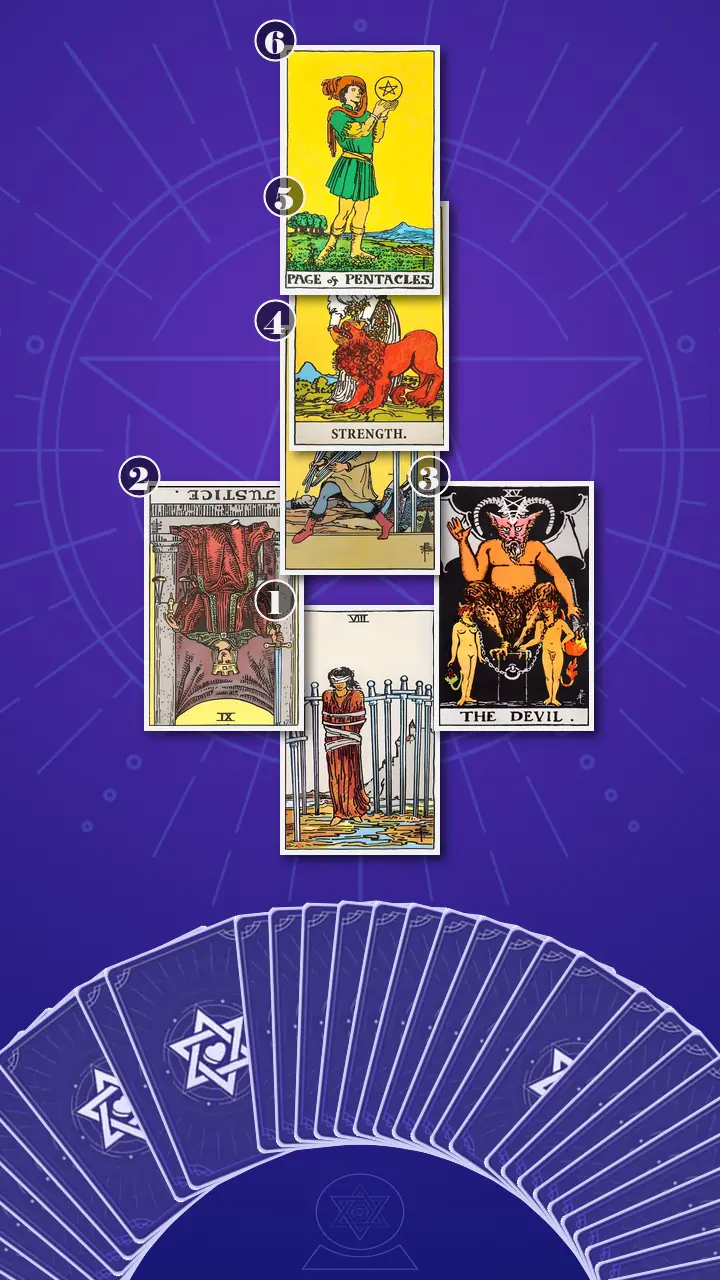
In this ladder, the first card shows the concrete moment: what happens right before you submit (or don’t). Cards two and three climb deeper—your conscious story about the numbers, and the core fear underneath. Card four reveals the protective strategy you default to. Card five is the turning point: the inner stance that dissolves shame-based measurement. Card six is integration: the practical habit that makes time tracking feel less dramatic, this week.
“Think of it like climbing out of a tight stairwell,” I told Jordan. “We’re going upward—out of the panic, into air.”
Reading the Stairwell: When “Just Admin” Turns Into a Trial
Position 1 — The Observable Timesheet Moment
“Now we turn over the card representing the concrete, observable timesheet moment—what you do right before submitting,” I said.
Eight of Swords, upright.
I didn’t need to reach for anything abstract. This card has a modern script already: it’s 6:42 p.m. in your Toronto apartment, laptop still open after dinner. You open the timesheet tool, see two half-empty days, and instantly start mind-reading your manager. You bounce between Google Calendar, sent emails, and Slack search like you’re trying to prove you weren’t idle—then freeze because every option feels like the wrong move.
“This,” I said, “is the stuck-in-the-app feeling. Cursor blinking. Drop-down categories. You’re hovering like one wrong label will set off an alarm.”
In energy terms: this is blockage. Not because you can’t do the task, but because your nervous system treats the task as unsafe. The blindfold in the Eight of Swords is imagined scrutiny; the bindings are loose—meaning, there is actually a small step available. But fear makes it feel impossible.
Jordan let out a tight laugh that sounded like it got caught in their throat. “That’s… so accurate it’s kind of rude,” they said, half-smiling, half-wincing.
I nodded. “Yeah. And the rude part is also good news. If the trap is partly made of assumptions, we can work with that.”
Position 2 — The Story You Tell Yourself About What It ‘Means’
“Now we turn over the card representing the explicit story you tell yourself about what the timesheet means about your competence,” I said.
Justice, reversed.
Jordan’s eyes flicked down immediately, like they’d been expecting a judge to show up.
Justice reversed takes a normal accountability tool and turns it into a fairness trial. The modern translation is painfully specific: you rewrite “project work” into something like “stakeholder synthesis + deliverable refinement” so it sounds defensible, like wording can stop judgment. You’re not tracking time—you’re trying to control the verdict.
“I want to give you a sentence to hold onto,” I said, because sometimes one sentence is an exit sign.
A timesheet is information, not a verdict.
Justice reversed is excess in the evaluation system—too much inner court, not enough neutral standard. Accountability turns into punishment in your head before anyone has asked anything. The scales aren’t weighing hours; they’re weighing worth, legitimacy, ‘being good.’ And that’s too heavy for any spreadsheet to carry.
Jordan exhaled—one of those breaths you don’t realize you’ve been withholding. Their shoulders dropped a fraction. “Wait,” they said quietly. “I’m not scared of time tracking. I’m scared of judgment.”
“Exactly,” I said. “That’s the real job of this spread: naming what’s actually happening.”
Position 3 — The Deeper Root Fear Underneath the Story
“Now we turn over the card representing the core fear that turns neutral tracking into shame,” I said.
The Devil, upright.
On paper, the Devil can sound dramatic. In consulting, it’s not dramatic. It’s quiet. It’s utilization becoming a chain: you feel like you have to earn your right to rest by producing ‘acceptable’ hours. If your day had messy, invisible work—thinking, learning, reworking, clarifying—it feels suspicious. Even after work, you scroll productivity hacks and promotion posts with a knot in your stomach, like the number on the spreadsheet is the real truth about you.
In energy terms, this is attachment. Your identity gets tethered to an external metric. The loose chains in the card matter: the system is real, yes. But the meaning you assign to it is where the lock clicks shut.
Jordan stared at the card and swallowed. Their voice went flatter, like they were trying not to feel it. “If I’m not visibly useful,” they said, “I’m disposable.”
“That fear makes sense,” I replied. “Not because it’s true, but because you’re in an environment where numbers are treated like ‘proof.’ The problem is: the Devil will always demand more proof.”
Position 4 — The Protective Move That Backfires
“Now we turn over the card representing the coping move you use when you feel evaluated—the strategy that keeps the cycle running,” I said.
Seven of Swords, upright.
This is perception management as self-protection. The modern-life scene is you editing your own week: shaving time off messy tasks, inflating clean-sounding categories, waiting until 9:58 p.m. to submit so there’s no time for questions. It’s not fraud—it’s fear-driven impression management. And it keeps you stuck because you never get to experience being safe while being honest.
I said it plainly, because the Seven of Swords responds to plain language: If you’re rewriting your hours to feel safe, you’re not tracking time—you’re managing fear.
In energy terms, this is over-control. The irony is brutal: control is supposed to reduce anxiety, but here it increases it. You spend more energy sounding defensible than staying supported.
Jordan’s mouth twisted, like the truth stung but also relieved them. “I don’t want to lie,” they said. “But I definitely try to make it… un-questionable.”
“That’s a protection strategy,” I said. “It’s your brain trying to find the safest move in a system it doesn’t fully trust.”
And—because I’m me, and my past life still shows up sometimes—I had a quick flash of the trading floor: how everyone talks about risk like it’s a number, while their bodies are doing something else entirely. “On Wall Street,” I told Jordan, “people would swear they were ‘being rational’ while their whole nervous system was in fight-or-flight. This is similar. Your spreadsheet isn’t the danger. Your body thinks the judgment is.”
When Strength Rewrote the Verdict: From Moral Scorecard to Neutral Information
Position 5 — The Antidote: The Inner Stance That Changes Everything
I slowed my hands before turning the next card. The air in my studio felt quieter, the way it does right before a market opens—nothing happening yet, but everything about to matter.
“Now we turn over the card representing the key inner stance that dissolves shame-based measurement and rebuilds self-trust,” I said. “This is the turning point.”
Strength, upright.
Strength in modern life is simple and hard at the same time: opening the timesheet, feeling the flush of shame, and not negotiating with it. Naming what’s happening—“I’m scared this will make me look incompetent”—and still logging what’s true. No panic-polishing. No essay-length defense notes. Accuracy over performance. Respect for reality over trying to dominate your feelings.
Jordan was back at their laptop around 6:30 p.m. in their mind, I could see it—the Slack quiet, the “Timesheets due by EOD” ping sitting in their chest, the toggling between Google Calendar and the timesheet app, rewriting the same entry like the wording could make them feel safe.
Stop treating your timesheet like a courtroom verdict; start treating it like Strength—gentle hands on a loud inner critic, steadying the week without trying to dominate it.
Jordan’s reaction came in a chain. First: a physical freeze—breath paused, fingers hovering over the trackpad like they didn’t want to touch anything. Second: their eyes unfocused for a second, like they were replaying every Friday scramble, every “stakeholder synthesis + deliverable refinement” rewrite, every moment they tried to earn the right to rest. Third: the release—an exhale that actually moved their shoulders down, followed by a blink that turned their eyes a little glassy.
“But if I stop treating it like a verdict,” they said, and there was a flash of anger in it, “doesn’t that mean I’ve been doing it wrong this whole time?”
I held that with them. “It means you’ve been trying to survive evaluation,” I said. “That’s not ‘wrong.’ It’s human.”
Then I brought in my own diagnostic lens—the one I use when clients are trapped in a single metric. “In finance, we do valuations all the time. Here’s the thing: no serious analyst values a company off one line in one spreadsheet. Your timesheet is one data source—cost allocation—not your market value. If we did a human capital valuation of you using a competency-based model—client communication, problem solving, learning speed, stakeholder management—your worth doesn’t collapse because Tuesday has a fuzzy block called ‘research.’”
“Now,” I asked them, “with this new lens, can you think of one moment last week—right before you hit submit—where this would have changed how you felt?”
Jordan’s voice got softer. “Wednesday. I had to rethink the whole approach after a call. I kept trying to hide that time because it sounded… messy. But it was necessary.”
“That’s the shift,” I said. “From shame-driven self-protection to steady self-trust under evaluation. And here’s the breakthrough sentence that goes with it: time tracking becomes neutral information you use to manage reality—not a moral scorecard deciding who you are.”
Position 6 — Integration: The Practical Habit for This Week
“Now we turn over the card representing how to embody this in daily life—simple, repeatable, low-drama,” I said.
Page of Pentacles, upright.
The Page of Pentacles is the apprentice: humble, consistent, practical. In modern terms: you treat time tracking like boring bookkeeping, not branding. A 5-minute daily timer, same time each day. Simple labels. No narrative. On Friday, you review patterns as workload feedback—“this project always eats context-switch time”—and you use that to advocate for scope and protect your energy.
I leaned in a bit. “And I’m going to say this with love,” I told Jordan, “because it’s the Page of Pentacles talking: Stop doing calendar forensics on Friday night.”
Jordan actually smiled at that, a real one. “Okay,” they said. “That… hits.”
From Insight to Action: The Neutral Log Protocol (That Doesn’t Ask You to Become a Robot)
I pulled the whole ladder together for them in one clean story:
“When the reminder hits, you freeze (Eight of Swords) because you’re not just logging time—you’re stepping into an inner performance review (Justice reversed). Under that is a fear that metrics decide your worth and your right to rest (The Devil), so you protect yourself by curating the story of the week instead of recording it (Seven of Swords). The way out isn’t perfect data. It’s Strength: steady self-respect while being seen. And the way Strength becomes real is Page of Pentacles consistency—small, boring repetition.”
“Your cognitive blind spot,” I added gently, “is that you’ve been treating ‘messy’ as ‘unsafe.’ But a messy week in client work is often just… a normal week.”
Jordan nodded, then immediately hit me with the real-life constraint—because of course they did. “But I can’t do some elaborate daily routine,” they said. “I’m in back-to-back calls. I barely have five minutes.”
“Perfect,” I said. “Then we don’t build an elaborate routine. We build a five-minute one that behaves like an emergency exit.”
Here are the next steps I gave them—actionable advice, not a vibe:
- The Page-of-Pentacles 5-Minute LogPick a daily time you can actually keep for seven days (e.g., 4:55 p.m. or right after your last client call). Set a timer titled “Page of Pentacles Log.” During the timer, log only what you clearly remember from today using plain labels (Client Delivery / Meetings / Research / Internal/Admin / Comms). No defense notes.If your brain says “too simple,” label it: “inner courtroom.” Start with logging just ONE day, not the whole week.
- The 15-Minute Accuracy Rule (Pre-Decided)Before you open the timesheet, write your “good enough” standard on a sticky note: “Accurate within ~15 minutes.” Use the same 3–5 labels all week so you’re not renegotiating reality while anxious.This only works if the standard is chosen when you’re calm. If you choose it mid-spiral, you’ll move the goalposts.
- The Strength Submit Moment (My ‘Opening Bell’ Reset)Right before you click submit, pause for 3 slow breaths and label what’s present: “Shame is here” / “Fear is here.” Then ask: “Am I acting from fear of judgment, or respect for reality?” Click submit as an act of steadiness, not proof.If you’re activated, stand up for 20 seconds first—feet grounded, shoulders back—like a trading-floor opening. Your body leads your brain back to calm.
“Consistency beats the reconstruction spiral,” I told them. “Not because you’ll suddenly love timesheets—but because your nervous system will stop associating them with emergency.”

A Week Later: The Quiet Proof
Six days later, I got a message from Jordan. Just one line: “Logged four days this week with the 5-minute timer. Friday didn’t feel like a trial.”
They added, almost as an afterthought: “I still had the stomach drop. But I didn’t negotiate with it. I just… did the boring labels and stopped.”
That’s what a real Journey to Clarity looks like in a high-metric job. Not a personality transplant. A small, repeatable shift: from self-defense to steadier self-trust under evaluation—using the Four-Layer Insight Ladder tarot spread to name the loop, then building a system that doesn’t require perfection to function.
When a simple admin task makes your stomach clench, it’s rarely about the hours—it’s about the fear that if the numbers look human, you’ll be treated like you’re not enough.
If your timesheet could be one small act of self-respect instead of self-defense this week, what would you do differently in the next five minutes?
Every reading at AceTarot is a Journey to connect with inner wisdom and empower next step.
Learn more about our Journey to Clarity.