From Project Dread to Steady Leadership: Shipping v0.3 in Public

Finding Clarity at Bloor–Yonge
You’re a mid-level tech person in Toronto who can handle hard work—until the work comes with a leadership audience and your chest tightens (classic high-visibility project dread).
Jordan said that to me without meaning to. It slipped out the way a truth does when your body is already bracing.
She described 8:52 a.m. on a Monday, standing on the TTC platform at Bloor–Yonge. The platform screen flickered like it was about to give up. Someone’s coffee smelled sharp and a little burnt. She opened her calendar and saw the invite: “Leadership Review,” with VP names in the attendee list. Her shoulders crept up before her brain even formed the sentence.
“Cool,” she muttered, half to herself. “So this is a public exam now.”
When she told me she’d been assigned a high-visibility project she dreads, I watched her do the thing I’ve seen a hundred times in ambitious, capable people: her gaze went a fraction distant, like she’d opened ten browser tabs in her head and all of them were screaming risk.
She didn’t call it anxiety. She called it “being thorough.” But her body called it something else: a tight chest and tense shoulders every time she opened the project doc or a calendar invite. Dread that felt like carrying a glass sculpture through a crowded subway—any bump could be catastrophic, so you move slower, and then you’re late, and now everyone’s watching.
“I don’t mind hard work,” she said. “I mind being wrong in public.”
I nodded. “That makes complete sense. And it’s not a character flaw. It’s a nervous system strategy.” I kept my voice calm on purpose. “Let’s try to map this—so you can stop fighting the fog and start finding clarity. Not a perfect feeling. A usable next move.”
Choosing the Compass: The Celtic Cross Spread for a Career Spotlight
I asked Jordan to take one slow breath in, and a longer breath out—nothing mystical, just a clean transition from bracing to observing. While I shuffled, I had her hold the question in plain language: “Assigned a high-visibility project I dread—what’s my next move?”
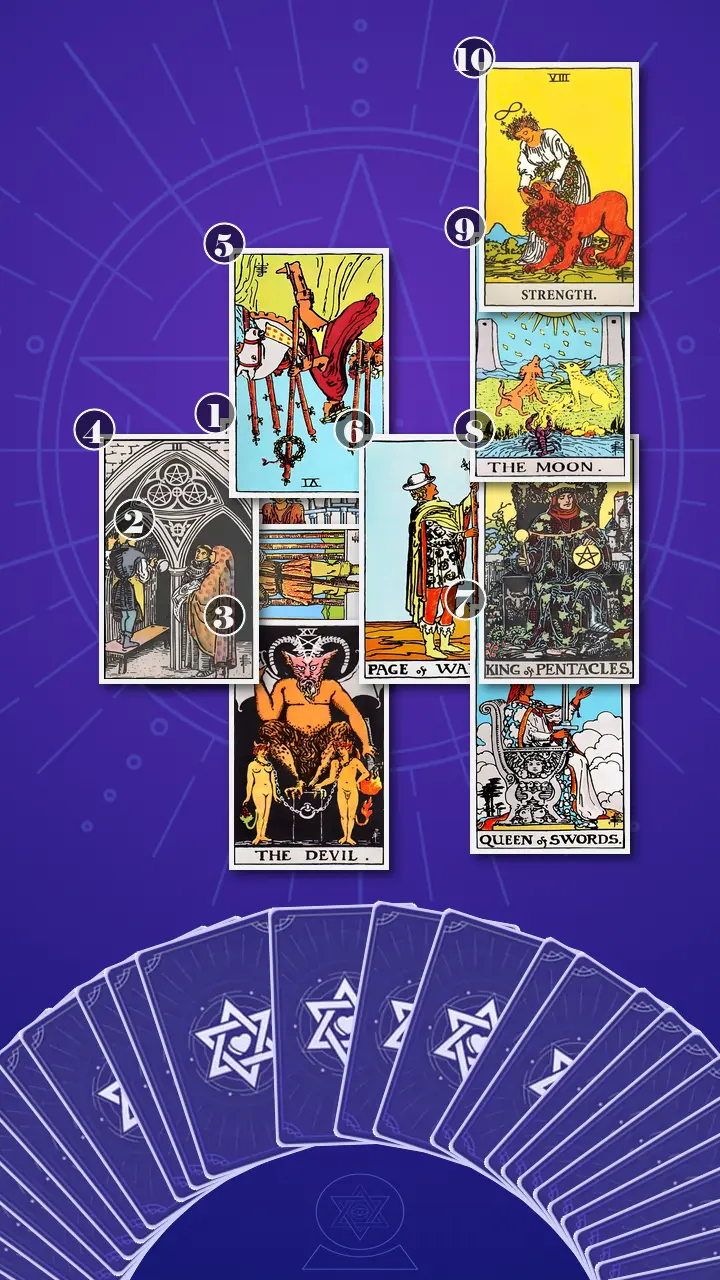
“Today we’ll use a classic Celtic Cross spread,” I said. “It’s one of the best ways to see how a situation behaves over time—present symptoms, the immediate block, the root driver, and then an integration path. It’s how tarot works at its most practical: not fortune-telling, but pattern recognition that turns decision fatigue into a sequence of next steps.”
For you reading this: Jordan’s issue wasn’t a simple yes/no choice. It was a visibility-triggered internal bind that needed the full chain—present → obstacle → foundation → context → conscious pressure → near-term momentum → self stance → environment → hopes/fears → integrated direction. The Celtic Cross gives that structure without pretending life is deterministic.
I pointed to three positions I knew would matter most for her: the current snapshot (how dread shows up day-to-day), the root cause (what’s really driving the hesitation), and the integration outcome (the most empowering direction forward, not a fixed prediction).
Reading the Map: Card Meanings in Context (and Why “Trying Harder” Isn’t Working)
Position 1 — Current snapshot: how the dread shows up day-to-day
“Now we’re turning over the card that represents your current snapshot: how the dread shows up in day-to-day behavior on this project.”
Eight of Swords, upright.
I didn’t need to dramatize it. This card is already the montage: the project doc open, but you’re functionally trapped—circling the same first slide or first paragraph because every version feels like it could be criticized by someone senior. Not blocked by skill. Blocked by the feeling that being seen mid-process is unsafe.
In energy terms, this is Air in excess: analysis running so hot it becomes a perimeter. The blindfold and loose bindings matter here. They’re not tight. It’s not a real prison. It’s a psychological one—made of imagined scrutiny and self-judgment.
Jordan gave a tight little laugh that had a bitter edge. “That’s… so accurate it’s kind of mean.”
I met her eyes. “Good. That means we’re looking at the mechanism, not your identity. Over-preparing can be a form of hiding—especially when visibility feels like a verdict.”
Position 2 — Immediate challenge: what’s actively blocking momentum right now
“Now we’re turning over the card that represents your immediate challenge: what’s actively blocking momentum right now.”
Nine of Wands, reversed.
This is the armor card—except reversed, the armor is heavy and cracked. The modern-life translation is painfully specific: you show up to stakeholder touchpoints like you’re walking into an ambush—over-prepped, tense, ready to defend. The cost is your energy goes into backup slides, over-explaining, late-night pre-emption… instead of forward motion like shipping drafts and asking for decisions.
In energy terms, this is Fire blocked: willpower turned into bracing, not movement. And paired with the Eight of Swords, it creates the exact trap Jordan described—Google Slides where the first slide looks perfect and the rest is skeleton text; a Notion doc that’s basically “vFinal_FINAL2”; Slack threads reread like evidence instead of answered like collaboration.
“So,” I said gently, “it’s not that you’re not trying. It’s that your effort is getting spent on defending rather than coordinating.”
Position 3 — Root cause: the deeper driver underneath the dread and hesitation
“Now we’re turning over the card that represents your root cause: the deeper driver underneath the dread and hesitation.”
The Devil, upright.
Jordan’s face changed in a way people don’t fake—her mouth went still, like she’d just recognized her own reflection somewhere she didn’t expect.
This isn’t about you being “bad” or “toxic.” In a career context, The Devil is the attachment loop: one reaction becomes a verdict. It’s the belief underneath the behavior—“If I make a visible mistake, they’ll see I don’t belong, and that means I’m not worth what I thought I was.”
That’s why control tactics start to look like safety: polish, rehearsals, strategic silence, collecting more inputs before you commit. The key symbol is the loose chain. The pressure is real. The bondage is maintained by the belief that worth depends on performance.
I said it plainly: “Your dread makes sense if your brain thinks this deck is secretly trying to control other people’s emotions.”
Position 4 — Recent past: what pattern or context led to this visibility
“Now we’re turning over the card that represents your recent past: what pattern or context led to being assigned this kind of visibility.”
Three of Pentacles, upright.
Relief moved through the table like warmth returning to hands. This card is earned trust. It’s the workshop, the blueprint, the people building something real together.
Modern translation: you’ve actually earned this assignment through solid work. Your best work historically came from clear roles, feedback loops, and iteration—but this new visibility makes you forget that review is part of craft, not humiliation.
In energy terms, this is Earth in balance: competency that already exists, and a process that’s meant to be shared.
Position 5 — Conscious aim: what you think you need to prove to feel safe
“Now we’re turning over the card that represents your conscious aim: what you think you need to prove or accomplish to feel safe.”
Six of Wands, reversed.
Jordan exhaled through her nose like she’d been caught. “Yep. That’s the pedestal.”
This card is recognition—flipped into pressure. Consciously, you think you need to prove yourself in public, so attention stops feeling like momentum and starts feeling like risk. Praise doesn’t land as support; it lands as stakes for the next moment.
In energy terms, this is Fire distorted: visibility becomes a “public test” narrative instead of a leadership tool.
Position 6 — Near-term development: what’s coming next if you keep engaging as-is
“Now we’re turning over the card that represents your near-term development: what’s coming next if you keep engaging the situation as-is.”
Page of Wands, upright.
Here’s the pivot toward oxygen. The Page doesn’t promise comfort. It promises movement through experimentation: prototype mode, learning reps, a willingness to be seen mid-build.
This isn’t a performance. It’s an iteration cycle.
In energy terms, this is Fire returning—not as defense, but as curiosity. The question it asks Jordan is simple: “What would you do next if this were a prototype, not a verdict?”
Position 7 — Self-position: the part of you you can lead with
“Now we’re turning over the card that represents your self-position: the part of you you can lead with (and how to use it effectively).”
Queen of Swords, upright.
This is where the fog gets clean edges. The raised sword is a boundary line. The open hand is an invitation for specific input.
Modern translation: your best lever is clean communication—a crisp update that states what’s decided, what’s unknown, and exactly what you need from stakeholders, without hedging or over-justifying.
Jordan whispered, almost like she was testing the feel of it: “Decided. Open. Ask.”
“Exactly,” I said. “Clarity beats charisma when stakes are real.”
I even gave her a tiny template, because this is what I do when someone is stuck: I turn insight into a draftable artifact.
“No ‘just.’ No ‘sorry.’ No ‘maybe.’ You don’t have to pre-defend your thinking. You have to lead the feedback loop.”
Position 8 — Environment: the social/work context you’re reacting to
“Now we’re turning over the card that represents your environment: the social/work context and expectations you’re reacting to.”
King of Pentacles, upright.
This is one of my favorite reality-check cards for high-visibility project dread. The King doesn’t want theatrics. He wants stewardship.
Modern translation: your environment is more pragmatic than your fear assumes. Leadership likely wants a steady plan, sensible trade-offs, and reliability—not constant brilliance. You build trust faster with cadence and deliverables than with perfect performances.
In energy terms, this is Earth stabilizing: the room is not a lion-pit. It’s a boardroom. They want something they can hold.
Position 9 — Hopes and fears: what you secretly want, and what you fear it might confirm
“Now we’re turning over the card that represents your hopes and fears: what you secretly want from this spotlight, and what you fear it might confirm.”
The Moon, upright.
I watched Jordan’s eyes flick to her phone—pure muscle memory. The Moon is the read-receipt spiral: a stakeholder views your message and doesn’t reply, and your brain treats silence like a verdict.
So I split it for her, right there, like a two-column note:
Facts: they saw it. They haven’t responded yet.
Story: they hate it. I’m in trouble. I don’t belong.
“Silence isn’t feedback. It’s just silence,” I said. “The Moon doesn’t mean danger. It means partial visibility. You move forward with a flashlight, not a full-mile view.”
In energy terms, this is uncertainty amplifying projection. The antidote is a concrete question—one clean ask that turns fog back into data.
When Strength Spoke: Soft Grip, Steady Leadership Under Scrutiny
Position 10 — Integration outcome: the most empowering direction to move in
When I turned the final card, the room felt quieter—like even the laptop fan decided to listen.
“Now we’re turning over the card that represents your integration outcome: the most empowering direction to move in (not a fixed prediction).”
Strength, upright.
Setup: You know that moment on the TTC when you see the leadership invite and your shoulders go up before you’ve even opened the deck? That’s the real start of the project—your body bracing for a verdict. Jordan’s been trying to eliminate that feeling before she’s willing to be seen.
Delivery:
Stop treating the spotlight like a lion that will devour you; start meeting it with Strength—steady hands, soft voice, and firm boundaries.
I let that sit. No rushing. No filling the silence with advice.
Reinforcement: Jordan’s breath caught—just for a beat. Her fingers, which had been gripping the edge of her mug, loosened without her noticing. Then her eyes unfocused, the way they do when a memory replays: the Zoom room, cameras half-off, the senior leader joining, her voice tightening, the post-game analysis she didn’t consent to. Finally she exhaled—long and shaky—and her shoulders dropped like she’d been holding a backpack of rocks.
She blinked hard and gave me this look that was half relieved, half offended at how true it was. “But if I’m not aiming for flawless… doesn’t that mean I’ve been doing it wrong?”
I didn’t argue with her. I reframed the economics. This is where my old life on Wall Street always flashes in: on a trading desk, you don’t get to wait for certainty. You price risk, you place the trade, and you manage the position. Perfection isn’t the goal—risk-adjusted execution is.
“You weren’t wrong,” I said. “You were protecting yourself with the tools you had. The shift is: you’re not building a masterpiece in secret. You’re leading an iteration cycle in public.”
Then I brought in one of my signature frameworks—because Strength isn’t just a feeling; it’s an operating plan. I call it Transition Roadmapping: treat high-stakes visibility like an IPO prep cycle. You don’t unveil the company with one perfect slide deck. You draft the S-1. You run internal reviews. You do controlled ‘roadshow’ reps. The point is cadence, clarity, and boundaries—not pretending you’re fearless.
I leaned in. “Now, with this new lens: think back to last week. Was there a moment—right before you hit send, right before a check-in—where a soft grip would’ve changed your next step?”
She nodded slowly. “Wednesday. I rewrote the intro for an hour because one stakeholder saw my message and didn’t reply.”
“That’s The Moon,” I said. “And Strength answers it with one calm action: a draft, a boundary, an ask.”
In that moment, the journey was visible: from dread and tightening toward cautious confidence—because this wasn’t about becoming fearless. It was about moving from self-doubt to grounded courage through structure.
From Dread to Next Steps: Actionable Advice for the Next 48 Hours
I summarized what the Celtic Cross had told us in one coherent story—because clarity isn’t “more thoughts.” It’s fewer, truer sentences.
“Here’s the chain,” I said. “You’re acting like you’re trapped (Eight of Swords) and bracing like every touchpoint is a cross-examination (Nine of Wands reversed) because, underneath, one reaction has been getting treated like a verdict on worth (The Devil). But you were given this because you’ve already proven competence through craft and collaboration (Three of Pentacles). Your conscious pressure is to ‘prove yourself’ to the crowd (Six of Wands reversed), and that turns leadership into performance. The near future wants prototype energy (Page of Wands). Your leverage is precision and boundaries (Queen of Swords). Your environment rewards steady deliverables (King of Pentacles). Your fear spikes in uncertainty (The Moon). And your way through is Strength: soft grip, steady cadence, clean asks.”
The cognitive blind spot was clear: Jordan had been treating clarity as something you’re allowed to have only after you eliminate uncertainty. But in real work—especially at a career crossroads where visibility increases—clarity is something you build by running the feedback loop.
So I gave her next steps that were deliberately small, specific, and hard to overthink.
- Send the “Draft v0.3” updateToday or tomorrow, send a 6-sentence message titled: “Draft v0.3 — what’s decided / what’s open / what I need.” Include: Decided (2 bullets), Open (2 bullets), Ask (1 decision needed + 1 timeline confirmation). Send it to one trusted stakeholder or your manager first—call it a working version.If 6 sentences feels impossible, do 3: Decided / Open / Ask. Your brain will demand context—that’s the old armor. Don’t negotiate with it; hit send.
- Use the Queen of Swords opener in the meetingBefore your next stakeholder touchpoint, write one single-sentence opener on a sticky note and read it out loud: “Here’s what’s true, here’s what’s next, and here’s the decision I need today.” Then stop talking and let the room respond.If your voice tightens, pause for one breath. Don’t fill silence with extra defense slides. Coordinate, don’t defend.
- Run a 90-second “opening bell” resetRight before any high-visibility moment (send, standup, leadership check-in), do my Trading Floor Opening Simulation: feet flat, shoulders down, exhale longer than inhale for 3 cycles, then say (quietly): “What is the calmest next step that moves this into the room?” Take that step immediately—one message, one question, one draft section.Make it humane: set a 10-minute timer for the smallest version. You can stop when the timer ends. This is practice, not punishment.
A Week Later: The Quiet Proof
Five days later, Jordan texted me a screenshot: a Slack message titled “Draft v0.3” with three sections—Decided, Open, Ask. Under it, a stakeholder reply: “This is super clear. Let’s choose Option B and revisit scope next sprint.”
Her follow-up message to me was small and honest: “My chest still did the thing. But I sent it anyway. And… nothing exploded.”
Her bittersweet proof came the next morning: she slept through the night, but her first thought was still, “What if I’m wrong?” Then she paused, exhaled, and smiled a little—because now she had a process for being seen without being consumed by it.
That’s what this Journey to Clarity looked like in real life: not a personality transplant, but a shift from “I must look flawless” to “I will lead through clear drafts, clear asks, and steady follow-through.”
When a project gets a spotlight, it can feel like your whole worth is standing up there with the slides—so you grip tighter, rewrite more, and still feel your chest tighten every time you’re about to be seen.
If you didn’t have to feel fearless to lead, what’s one small ‘v0.3’ move you’d be willing to put into the room this week—just to see what happens?