From Chest-Tight Dread to Grounded Self-Trust After "Hang Soon" Texts
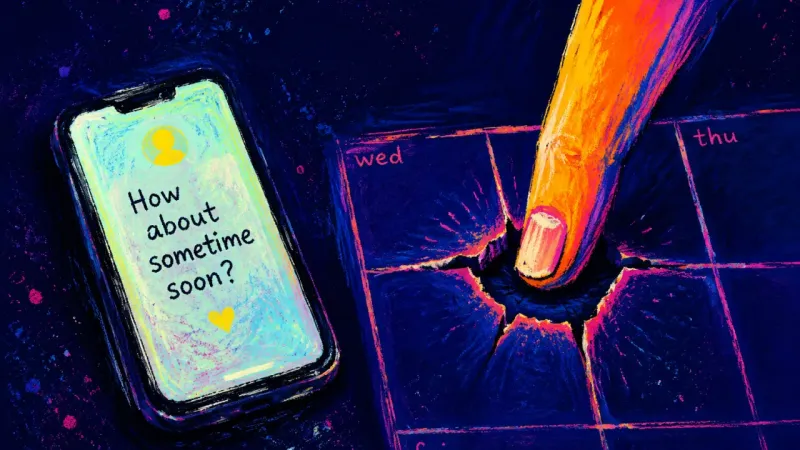
The 10:42 p.m. Text That Triggers Rejection Sensitivity
You read “We should hang soon” and immediately feel that chest-tight drop—then you start drafting replies like you’re writing ad copy for your own likeability.
Jordan (name changed for privacy) sat across from me on a video call from her Toronto condo bedroom, duvet half-kicked off like she’d been fighting with it. The phone glow had been on her ceiling earlier—she told me that part with a small, embarrassed laugh—because at 10:42 p.m. she’d opened the iMessage thread, scrolled up, scrolled up again, then opened her calendar like it could prove she was “busy anyway.” The blue light stung her eyes. The room was too warm. And the city noise outside was the kind that makes silence feel louder.
“It’s one sentence,” she said, palms pressed together in front of her, “and it ruins my whole mood. Like… is it breadcrumbing or am I anxious? I can’t tell if I’m being intuitive or just triggered.”
I watched her shoulders creep up toward her ears as she quoted the message again: “We should hang soon :).”
The dread in her wasn’t abstract. It was physical—like a tight chest wrapped in shrink wrap, and a stomach-drop that made her want to fold inward, even while she kept her voice casual. Wanting to take it as genuine interest versus fearing it’s a polite brush-off. Warmth versus pride. Connection versus the urge to disappear first.
“I get it,” I said, keeping my voice low and steady. “We’re not going to predict what they ‘really mean.’ We’re going to map what happens in you—so you can stop living inside decoding mode and start choosing clarity. Think of this as a Journey to Clarity: we’ll turn that one sentence from a verdict into information.”

Choosing the Compass: The Four-Layer Insight Ladder Tarot Spread
I asked Jordan to take one slow breath—not as a mystical ritual, just a nervous-system gear shift—and to hold the exact question in mind: “What past taught me to read ‘We should hang soon’ as rejection?”
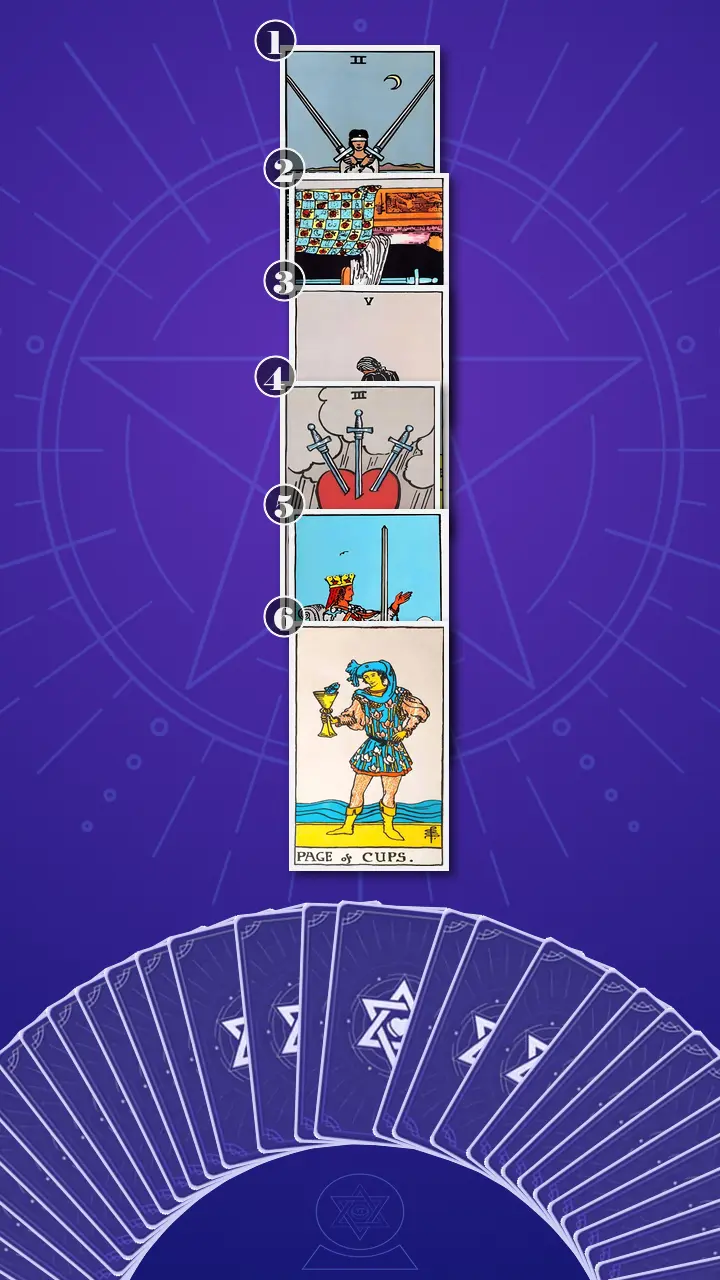
As she exhaled, I shuffled and laid out the Four-Layer Insight Ladder · Context Edition. I like this spread when the real issue isn’t “Which option should I choose?” but “Why does this one tiny cue hit like a threat?”
For anyone reading who’s ever Googled “is ‘we should hang soon’ a brush-off”: this is how tarot works best in texting confusion. We move from the surface stimulus → your automatic meaning → the old template it’s echoing → the deeper wound underneath → the reframe → one grounded next step. Minimal cards, maximum clarity.
“We’ll read straight down,” I told her, “like descending from the notification banner into the body’s memory—then climbing back out with a cleaner script.”
Reading the Map: What Your Nervous System Does With ‘Soon’
Position 1 — The immediate trigger (the text + the pause)
“Now turning over is the card representing the immediate trigger and what is actually happening in the moment,” I said.
Two of Swords, upright.
In modern life terms, it’s painfully literal: You’re on your couch after work, Slack finally quiet, and the text comes in: “We should hang soon.” You stare at it like it’s a trick question. You want to reply warmly, but your body goes rigid—so you do nothing, because doing nothing feels like you can’t be rejected for trying.
This card is freeze as self-protection. The energy isn’t “wrong”—it’s blocked. The blindfold and crossed arms show a nervous system hitting airplane mode right when you need a single, clear sentence. Nothing is decided yet, but your body acts like it already is.
I mirrored what I saw in her story, slow and specific: “Thumb hovering. Message left on read. Calendar opened like a shield. And the loop is: ‘If I suggest a day and they dodge it, I’ll feel stupid… so I won’t suggest a day.’”
Jordan let out a small laugh that had no joy in it. “That’s… brutal,” she said, still smiling like she wanted to pretend it didn’t sting. “But yeah. That’s exactly it.”
Position 2 — Your automatic translation (the instant story your mind assigns)
“Now turning over is the card representing your automatic translation: the instant story your mind assigns to the ambiguity,” I said.
Nine of Swords, reversed.
The scenario is the one Jordan had practically memorized: It’s late, lights off, and you’re replaying the chat like it’s CCTV footage. You check timestamps, look for the typing bubble, and convince yourself their vagueness is a quiet no. To stop feeling exposed, you consider waiting hours to respond—then you feel sick with anxiety anyway.
Reversed here, the energy is internalized—a private courtroom you run at 1 a.m. where you’re both prosecutor and defendant. This is the draft-and-delete loop that feels like “research,” but functions like self-harm.
I said, “Let’s do what I used to do on a trading desk when the screen was screaming: separate signal from noise. In your Notes app, it’s Facts vs. Stories.”
“Facts: they said ‘We should hang soon.’ There’s a smiley. That’s it. Stories: ‘They’re fading me.’ ‘I’m embarrassing.’ ‘If they wanted to, they would.’”
Her eyes dropped to the lower left of her screen, like she was watching herself do it. “And then I go ‘cold mode’ to feel in control,” she admitted. “I’ll delay for hours like it’s a power move. But I’m just… spiraling.”
“One rewrite max—then send,” I said, not as a command, but as a handrail.
Position 3 — The past pattern being echoed (the learned template behind ‘soon’)
“Now turning over is the card representing the past pattern being echoed: the learned template that taught you what ‘soon’ supposedly means,” I said.
Five of Cups, upright.
Here’s the translation: A new person says “soon,” and your brain immediately pulls up that one situationship who sounded enthusiastic but never locked anything in. The past disappointment overlays the present like a filter, so you start reacting to an old person in a new conversation.
This is grief as a preset. The energy is sticky: your attention keeps returning to the spilled cups—the letdowns you can name instantly—while the two standing cups (the times people did show up) become harder to feel when you’re triggered.
I kept my voice gentle. “You’re not dramatic—you’re interpreting with an old template. One person didn’t follow through… and your nervous system turns that into: therefore no one will.”
Jordan swallowed, throat moving like she was pushing down a memory. “There was someone,” she said quietly. “So many ‘soon’s. So many ‘next week’s. And then… nothing.”
Position 4 — The core wound underneath (what rejection would ‘prove’ about you)
“Now turning over is the card representing the core belief/wound underneath: what rejection would ‘prove’ about you,” I said.
Three of Swords, upright.
The modern-life scenario hits fast: You feel the sting before you even think: the phrase “hang soon” hits the part of you that expects to be the one waiting. Your fear isn’t just ‘they’re busy’—it’s ‘if I show interest and nothing happens, it proves I’m not wanted.’
This card’s energy is raw clarity. Not because it says “you will be rejected,” but because it names what the body is protecting: a heartbreak-shaped bruise that ambiguity keeps pressing on.
I slowed down. “That sting isn’t you being ‘too much.’ It’s your brain trying to prevent a rerun of being left hanging.”
Jordan blinked hard, jaw clenching then releasing in a tiny tremor. “It’s so dumb,” she whispered.
“It’s not dumb,” I said. “It’s learned.”
Position 5 — The key reframe (the antidote that restores self-trust)
I glanced at the next card and felt the room shift—like the air got cleaner. “We’re turning over the most pivotal card in this reading,” I told her.
Queen of Swords, upright.
The scenario is simple and almost boring—which is exactly why it’s medicine: You stop trying to decode tone and you ask for a real plan in one line. Not as a test, not as a chase—just clean communication: “I’d love to. Thu after 7 or Sat afternoon?” If they’re into it, it moves forward. If they aren’t, you learn quickly without spiraling.
Jordan’s typical loop was right there between pride and longing: she wanted to look chill to protect herself, but the “chill” was costing her sleep and self-respect.
Stop treating vagueness as a verdict, start asking for clarity—and let the Queen of Swords cut cleanly through the fog with one respectful, direct line.
There was a beat of silence where even the hum of her condo felt far away.
The shift isn’t “be fearless.” It’s this: clarity is not neediness—it’s self-respect and emotional hygiene.
I watched the three-step reaction move through her in real time: first a tiny freeze—her breath caught, like her body didn’t want to let the idea in. Then her eyes unfocused for a second, as if replaying every time she’d tried to “act indifferent” and called it boundaries. Then the exhale came—slow, shaky, shoulders dropping like someone had unhooked a weight from her collarbones.
“But if I say that,” she pushed back, heat rising into her cheeks, “doesn’t it make me… the one who cares more?”
That flash of anger was protective, not petty. I nodded. “That’s the Three of Swords talking—trying to prevent the old pain.”
Then I brought in the lens I’m known for: on Wall Street, we didn’t survive by guessing. We survived by setting clean terms. “Think of this as Negotiation Alchemy,” I said. “Not manipulation—structure. You’re not asking for reassurance. You’re asking for logistics. Your BATNA—your best alternative to a negotiated agreement—is your own Friday night peace. When you send one clear option, you’re not chasing; you’re collecting data.”
“And here’s my other framework,” I added, “Influence Credit Scoring. If someone responds to clear invitations with clear follow-through, they’re higher credit. If they dodge specifics twice, the credit is low. That’s not a verdict on your worth—it’s a rating on the reliability of the connection.”
I leaned forward. “Now, use this new angle and look back at last week. Was there a moment when you treated ‘soon’ like a closed door—when it was really just missing information?”
Jordan’s eyes widened, then softened. “Yeah,” she said. “I… I basically punished them for not being specific by going quiet. And then I told myself the silence proved they didn’t care.”
“That’s the old script,” I said. “The Queen offers a new one.”
Position 6 — A grounded next step (warm action that creates clarity)
“Now turning over is the card representing a grounded next step: one small action that creates clarity without overexposing you,” I said.
Page of Cups, upright.
The scenario is warmth with training wheels: You send a message that sounds like you (not like a strategy): light, warm, and specific. You offer one concrete option and let the response be information, not a referendum on your worth.
This card’s energy is balanced: open-hearted, but not over-invested. It’s the shoreline—your edge of comfort. You’re not diving into the deep end. You’re taking one step closer to honest connection.
“Warm + specific beats chill + vague,” I said. “The Page is the part of you that can be sincere without making it a performance.”
Jordan nodded, slower this time. The tension in her forehead eased. “That… actually feels doable,” she said. “Like I can send one sentence and not make it mean my whole life.”
The One-Question Clarity Rule: Turning Tarot Insight Into a Text You Can Send
Here’s the story your spread told, in plain language. The Two of Swords showed the freeze: you protect your heart by pausing, rereading, and refusing to move the conversation forward. The Nine of Swords reversed showed what happens next: your mind does the conversation for you at 2 a.m., gathering “evidence” from timestamps and Instagram like it’s a stock ticker. The Five of Cups named why it’s so charged: an old follow-through failure became your default lens. The Three of Swords named the tender core: you fear ambiguity will prove you’re not wanted. Then the Queen of Swords offered the turning point: treat vagueness as missing information, not a verdict. And the Page of Cups brought it back to human scale: one warm, schedule-able invitation.
The cognitive blind spot is this: you keep trying to think your way into safety, but the thing that actually creates safety is clean information. Silence feels like boundaries, but in this pattern it often functions like a test—one that starves you of clarity.
The transformation direction is simple and brave: shift from interpreting vagueness as rejection to treating it as missing information and asking for one concrete plan. Vague isn’t rejection. Vague is missing information.
Here are your next steps—small, practical, and designed for the exact moment your nervous system wants to go into airplane mode:
- Send the Two-Options Invite (10-minute window)Within 10 minutes of seeing “We should hang soon,” copy/paste: “I’d love to. Are you free Thu after 7 or Sat afternoon?” (If you want warmth, add one human detail: “I’ve been craving a low-key catch-up.”)One rewrite max—then send. Save two go-to options in Notes (weekday evening + weekend daytime) so you don’t have to invent language while activated.
- Do a 30-second Facts vs. Stories SplitOpen Notes and write 3 facts (what they literally said/did) and 3 stories (what you fear it means). Then choose one action: send the clear ask, or pause intentionally.If your brain insists you need more evidence, label it “mind-reading,” and return to the one-question script.
- Use my “Cocktail Party Algorithm” to keep it warm and cleanPhase 1: Warm opener (“I’d like that.”). Phase 2: Specific offer (two options). Phase 3: Easy out (“If neither works, tell me what does.”). It’s friendly, not performative—and it invites reality.After you hit send, put your phone face-down and do a 2-minute reset (water, stretch, balcony). Your job is to regulate, not refresh.

A Week Later: Clarity, Not Certainty
A week later, Jordan messaged me a screenshot. One sentence she’d sent—no essays, no “haha totally!” placeholder. Just: “I’d love to. Thu after 7 or Sat afternoon?” Under it, her follow-up: “My hands were shaking a little, but I did it. I put my phone down and walked to Loblaws like a normal person.”
She didn’t tell me it led to a rom-com ending. She told me something better: she slept through the night. In the morning, the first thought still flickered—What if I’m wrong?—but this time she noticed it, exhaled, and didn’t obey it.
That’s the real Journey to Clarity: not forcing certainty, but building enough self-trust to ask one clean question and tolerate the answer—whatever it is.
That chest-tight moment isn’t just about the text—it’s the part of you that learned ambiguity can turn into being left behind, so you try to stay safe by caring quietly.
If you let “soon” be missing information instead of a personal verdict, what’s one small, self-respecting question you’d feel okay sending—just to find out what’s real?