From Post-PTO Exhaustion to Calmer Consistency: A Daily Rebuild

Finding Clarity in the 9:12 p.m. Laptop Glow
You get back from PTO in London and the first Monday hits like a wall—full inbox, full calendar, and a body that still feels heavy (hello, post-holiday crash).
Nina (name changed for privacy) joined my session from her flat with the kind of lighting that only happens when you’ve promised yourself an early night and then… didn’t. It was 9:12 p.m. on her clock. Her laptop was open “just to clear a couple emails,” and the blue light made everything look a little harsher than it needed to. A mug of tea sat beside her, already gone cold, and her phone kept buzzing with the tiny insistence of unread texts and a dating app notification she couldn’t bring herself to open.
Even through a video call, I could see it in her body: heavy limbs like wet laundry, shoulders pulled up as if her neck was trying to hide inside her hoodie, a tightness around the jaw that said she’d been “being professional” all day. She stared at the camera and said, almost laughing at herself, “I’m back, but my body didn’t get the memo.”
She told me the surface problem—work, health routines, dating, all of it feeling off. But the engine underneath was sharper: she wanted to return to normal productivity and a lively dating life, while fearing that slowing down or asking for support would expose her as not capable enough. Exhaustion wasn’t just tiredness for her; it felt like trying to walk through London with a suitcase strapped to her ribs—every step doable, but somehow costing triple.
“We’re not here to diagnose you,” I told her gently. “We’re here to find clarity about what’s misaligned—so you get actionable next steps that don’t require a brand-new personality by Friday. Let’s draw you a map through this fog.”

Choosing the Compass: The Energy Diagnostic Map (7)
I asked Nina to take one slow breath—not as a ritual, just as a way to stop the nervous system from sprinting ahead of the conversation. While I shuffled, I did what I’ve done for a decade at the Tokyo planetarium: I slowed the pace enough for a pattern to become visible. In astronomy, you don’t understand an orbit by staring harder. You understand it by tracking a cycle.
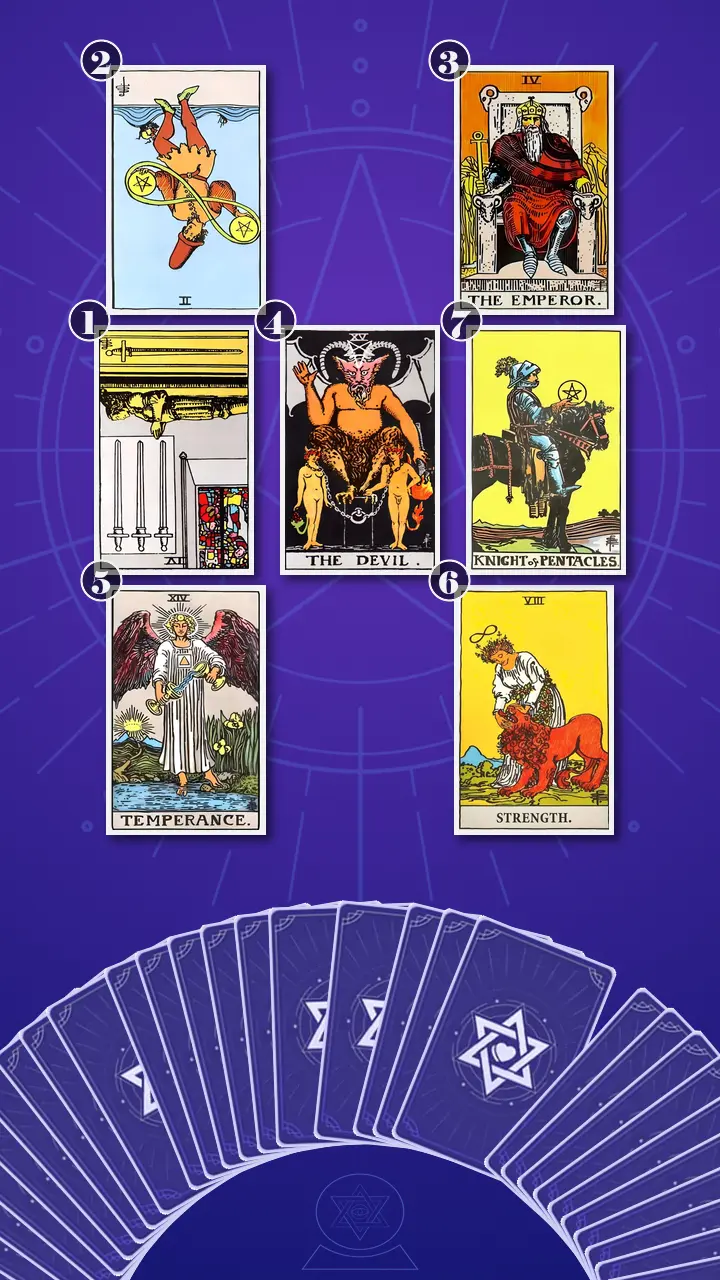
“Today, we’ll use a spread called the Energy Diagnostic Map (7) · Context Edition,” I said.
For anyone reading along: this spread is built for multi-domain questions—when you’re at a career crossroads, feeling stuck, and the exhaustion touches work, body routines, and dating energy all at once. It’s not a single timeline and it’s not a yes/no. It’s a diagnostic layout: we identify what’s showing up now, what’s pulling you internally, what your environment is rewarding, and—most importantly—the core loop that keeps the depletion running. Then we move straight into resource, inner transformation, and a grounded next step. That’s how tarot works at its best: card meanings in context, turned into practical guidance.
I previewed the key points for Nina: “The first card is your surface energy—what’s been obvious since you got back. The center card is the core blockage—the mechanism that keeps you depleted. And the sixth card is the turning point: the inner shift that unlocks steadier boundaries and self-trust.”
Reading the Map: Why PTO Didn’t Become Recovery
Position 1 — Surface energy after PTO
“Now flipped over,” I said, “is the card that represents surface energy: what shows up immediately after returning from PTO.”
Four of Swords, reversed.
In modern life, this is the exact feeling Nina had already named: you took time off, but you never truly went offline. You “rested” while half-monitoring Slack, thinking about deliverables, planning your comeback, or bracing for the backlog. Then you return to work and your body feels heavy while your brain stays wired—so nights become low-quality rest (scrolling, replaying meetings) that doesn’t restore you.
Energetically, I read this as a blockage: rest exists in theory, but the nervous system never receives a clean “off” signal. The card’s image is almost rude about it—the resting figure, and above them, the swords still hanging like thoughts you can’t put down.
Nina let out a small, bitter laugh. “That’s… accurate. Like, too accurate,” she said, rubbing the side of her neck. “I literally took PTO and still checked messages. Not even for work reasons—more like… I didn’t want to come back and look behind.”
“That laugh matters,” I told her. “It’s not a personal flaw. It’s a pattern.”
Position 2 — The inner tug-of-war
“Now flipped over,” I said, “is the card that represents the inner tug-of-war: the competing priorities pulling your attention across work, body routines, and dating.”
Two of Pentacles, reversed.
This is the wobble. You’re trying to rebuild three things at once after PTO: be sharp at work, ‘get healthy,’ and have a lively dating life. So you bounce between tabs—calendar, wellness content, Hinge messages—without giving any one area a stable baseline. The result is feeling busy and behind at the same time, and basics like food, sleep, and real downtime get dropped.
Energetically, this is deficiency—not of effort, but of rhythm. The energy it asks for is pacing. Reversed, it shows constant switching without true prioritization.
“If everything is urgent, nothing is nourishing,” I said, and I watched her eyes soften like she’d been waiting for permission to stop pretending it was all equally important.
Position 3 — External pressure
“Now flipped over,” I said, “is the card that represents external pressure: what your environment rewards or punishes right now.”
The Emperor, upright.
This is structure—useful, stabilizing, but not always humane. Nina’s work culture (and the internalised version of ‘professional’ she carries) expects steadiness immediately after PTO: meetings restart, timelines didn’t pause, responsiveness is rewarded. So she overrides hunger, fatigue, and the need to decompress because she’s trying to look dependable. Even dating starts to feel like a performance metric: “I should be going on dates,” like it’s another KPI dashboard.
Energetically, The Emperor is balance when it’s supportive structure, but it can tip into excess—rigidity—when the “rules” become armour you forget you’re wearing.
I had a quick professional flashback—standing in the planetarium control room, watching a school group in Tokyo. The show runs on timing: if you speed it up too much, the stars blur and nobody learns anything. The Emperor can be that: a schedule so tight it stops being a guide and becomes a grindstone.
“You’re not making this up,” I said. “Your environment is training your nervous system to stay on call.”
Position 4 — Core blockage (the loop that keeps you depleted)
“Now flipped over,” I said, “is the card that represents the core blockage: the sticky loop that keeps you depleted even after time away.”
The Devil, upright.
I always say this carefully: The Devil isn’t about you being ‘bad.’ It’s about an attachment that feels like safety.
In modern terms, this is the compulsion loop: proving (over-responding, over-scheduling), then escaping (doomscrolling, inbox refreshing, late-night swiping) for a quick hit of relief. Not because it’s fun—but because stopping feels weirdly unsafe. Underneath it is the fear: “If I can’t keep up, I’m not worth as much.”
And the detail in the card that matters most to me is the loose chain. The trap persists not because you can’t leave, but because you’ve normalised staying.
I described it the way Nina had lived it: a thumb refreshing Slack like pulling a lever on a slot machine. One more check. One more swipe. “I don’t even want this,” the inner monologue says, “I just can’t stop.” Control feels like safety—and still be the thing that drains you.
Nina’s reaction was a three-step wave: first her breath caught, almost a freeze; then her gaze went unfocused, like she was replaying last night in her head; then she exhaled sharply through her nose. “Oh,” she said quietly. “That’s exactly what I do.”
Position 5 — Usable resource (what actually supports recovery)
“Now flipped over,” I said, “is the card that represents your usable resource: what supports real recovery and alignment without extremes.”
Temperance, upright.
Temperance is the opposite of the dramatic reset. It’s the steady pour between two cups. It’s the thermostat, not the light switch.
In Nina’s actual life, it looks like a middle path: instead of ‘back on the grind’ or total shutdown, you create a gentle rhythm. A real transition after work. Regular simple meals. Fewer but better plans. Your energy stops being borrowed from tomorrow.
I could almost hear the Central line in the background of her week—stepping off the Tube and going straight into the next demand. “Think about it like making a sustainable lunch,” I said. “Not a full meal prep overhaul you’ll abandon by Thursday. Mix the inputs. Portion the day.”
Her shoulders dropped a fraction. Not a miracle—just the smallest softening. “That sounds… possible,” she said, like she hated that it did.
When Strength Held the Lion: Calm Boundaries for Post-PTO Exhaustion
Position 6 — Key transformation (the turning point)
I let the silence stretch for half a beat before turning the next card. The room felt quieter, even through a screen—as if her phone buzzed less loudly just because we’d noticed it.
“Now flipped over,” I said, “is the card that represents the key transformation: the inner shift that loosens the blockage and rebuilds self-trust around energy and boundaries.”
Strength, upright.
Strength is nervous-system leadership. Not domination. Not punishment. It’s the calm hand on the lion—desire, ambition, anxiety, attention—held with steadiness.
Setup: Nina was stuck in that 9:12 p.m. moment: opening the laptop “just to clear two emails,” blinking an hour later with cold tea, and feeling like even a simple dating notification was too much. She wasn’t missing energy. Her energy was being run like a system she had to dominate.
Delivery:
Not ‘push harder to prove you’re fine’—choose gentle self-leadership, like the woman who calms the lion without force.
Reinforcement: Nina’s face changed in layers. First her eyes widened, a tiny pupil-flare of recognition. Then she pressed her lips together, as if holding back the reflex to argue with me—or with herself. Her shoulders, which had been perched up near her ears, lowered slowly, like a backpack strap finally sliding off bone. Her hands, clenched around her mug, loosened until her fingers lay flat against the ceramic. She exhaled, long and shaky, and for a second she looked almost… dizzy. That vulnerable kind of clarity where you realise the path is simpler than you expected—and therefore, you can’t hide behind complexity anymore.
“But if I stop proving it,” she said, voice tight, “doesn’t that mean I’ve been doing it wrong? Like… for years?”
“It means you were using the tools you had,” I replied. “The cost just got too high.”
This is where my astronomy brain always jumps in. I told her about my Solar Sail Principle—one of my favourite ways to read boundaries. A solar sail doesn’t fight the solar wind. It uses pressure—what would normally feel like resistance—to choose direction. In Nina’s world, the ‘solar wind’ is the environment: the full calendar, the Slack culture, the unspoken reward for fast replies. Strength isn’t pretending that pressure doesn’t exist. Strength is angling yourself so the pressure doesn’t knock you off course.
“A calm boundary isn’t a wall,” I said. “It’s a sail. You’re not trying to win against work. You’re trying to steer your energy so you still have a life after 7 p.m.”
Then I asked her, exactly as I always do at this turning point: “Now, with this new lens—what would have felt different last week if, at 9:12 p.m., you’d asked: ‘What would be strong if I didn’t have to prove anything?’”
She stared at the card on her side of the screen for a beat, then whispered, “I would’ve shut the laptop. And I would’ve gone to bed without negotiating with myself.”
That’s the shift: from numb, post-PTO depletion and self-judgment toward calm, consistent self-trust. It’s not about becoming effortlessly refreshed. It’s about becoming off-call on purpose.
Position 7 — Next step (minimum viable consistency)
“Now flipped over,” I said, “is the card that represents the next step: one grounded action pattern to try this week.”
Knight of Pentacles, upright.
This is the antidote to the dramatic reset fantasy. The Knight of Pentacles is boring in the best way: steady enough to be sustainable, slow enough for your body to believe you.
In modern terms, it’s a minimum viable consistency week: one realistic bedtime window, one simple meal default, one protected transition after work, and one intentional low-stakes social/dating move. Not 40 new habits. Not a Notion dashboard you’ll stop updating and then hate yourself for.
Energetically, this is balance that becomes trust over time. The still horse matters: you don’t fix depletion by sprinting.
Nina nodded once. “Relief,” she admitted, and then—honestly—she looked slightly annoyed at how relieving it felt.
The Protected Recovery System: Actionable Advice for the Next 7 Days
I pulled the whole map together for her in plain language.
“Here’s the storyline the spread is telling,” I said. “You came back from PTO with interrupted rest (Four of Swords reversed) and tried to juggle work, health, and dating all at once (Two of Pentacles reversed). Your environment rewards control and constant availability (The Emperor), which feeds a compulsion loop—prove all day, numb out at night (The Devil). The way out isn’t another overhaul. It’s integration and pacing (Temperance), plus calm self-leadership (Strength). And the way you make it real is minimum viable consistency (Knight of Pentacles).”
The cognitive blind spot was clear: Nina had been treating rest like a one-time event—PTO as the fix—while keeping the same “always-on” rules running in the background. The transformation direction is simpler and harder: shift from chasing recovery through willpower to building recovery as a daily system with boundaries you actively protect.
Then we made it practical—small steps, not speeches.
- The 20-Minute Off-Call TransitionThree times this week, the moment you get home (or the moment you close your laptop if you’re WFH), put your phone in another room for 20 minutes. Change clothes, drink water, then sit or walk with zero input—no podcasts, no scrolling.If 20 minutes feels impossible, do the 7-minute version. This isn’t a productivity hack; it’s a nervous-system signal. If anxiety spikes without your phone, treat it as information—not failure.
- Strength Boundary: One Rule for 4 DaysPick one calm boundary that you can hold without drama: “No work messages after 7:30 p.m.” Try it for 4 days. If a message comes in, save a draft reply: “I’ve seen this—will pick it up tomorrow morning.” Use it once this week.Expect the inner critic to say, “This is lazy.” Let it be background noise. Strength isn’t pushing harder. It’s holding a boundary without hating yourself for needing it.
- The Dopamine-to-Connection Check (Dating Apps)Before you open Hinge/Bumble at night, do a 10-second check: “Am I looking for connection or dopamine?” If it’s dopamine, close the app with no shame and do something sensory for 2 minutes (tea, shower, stretching). If it’s connection, send one message—or one voice note—then log off.Make it a Knight of Pentacles move: one intentional action beats 45 minutes of swiping. Minimum viable consistency beats a dramatic reset you can’t repeat.
Before we ended, I added one tiny technique from my own toolkit—something I call the Earth-rotation perspective. “Tomorrow before your first morning meeting,” I said, “look out a window for ten seconds and remember: the Earth is rotating at about a thousand miles an hour. Your ‘urgent’ Slack thread is not the axis of existence. Let your shoulders drop. Then join the call.”

A Week Later: The Quiet Proof
Six days later, Nina messaged me. Not a long update—just the kind of text you send when you’re testing whether a new reality is allowed to be real.
“Did the 20-minute thing three times,” she wrote. “Moved my charger across the room. Didn’t reply to a 9 p.m. message once. Woke up and my first thought was still ‘what if I’m slipping’… but I didn’t spiral. Also I said yes to a 45-minute coffee. It was nice. I left before I crashed.”
That’s the journey to clarity I’m always hoping for: not a perfect life, but a steadier one. When you stop treating recovery like a single event and start protecting it as a daily system, work and dating stop being worth-tests. They become choices you can engage with—intentionally.
When you’re exhausted after PTO, it’s not just tiredness—it's the tight-chested fear that if you stop managing everything, someone will finally notice you’re not as capable as you pretend to be.
If you didn’t have to prove you’re ‘back to normal’ this week, what’s one calm boundary your body would quietly ask you to hold—just as an experiment?