From 'Quick Favor?' Guilt to a 24-Hour Pause: A Boundary Reset

The 9:07 a.m. Slack Ping That Steals Your Lunch
If you’re the junior PM in NYC who replies “Sure—happy to help!” to a Slack “Quick favor?” before you’ve even looked at your calendar (hello, calendar Tetris).
Alex (name changed for privacy) showed up to our session with that exact look I’ve seen a thousand times on planetarium field trips—people staring up at a ceiling full of stars, trying to pretend they aren’t overwhelmed by scale. Except her “ceiling” was Google Calendar.
She described her morning like a clip on loop: 9:07 a.m. in a Midtown office kitchen, balancing an iced coffee while her phone screen warmed under her thumb. Fluorescent lights buzzed. Slack chimed. Her calendar loaded into a wall of back-to-back blocks that looked like a barcode.
“And I still type, ‘I can hop on!’” she said, like the words were already halfway out of her body before her brain could catch them. “I don’t even check what it costs me. Then I spend the next hour dragging meetings around like puzzle pieces that never fit.”
I watched her jaw tighten as she talked, the way it does right before someone hits Send on a message they already resent. “It’s stupid,” she added, fast. “I’m booked, but I can probably squeeze you in. That’s basically my brand now.”
The guilt she carried wasn’t abstract—it sat in her like a too-tight seatbelt: chest snug, breath shallow, stomach dropping the second a request arrived. Wanting to be seen as dependable and liked… versus fearing that saying no would make her seem selfish, replaceable, or “difficult.”
I let the silence be gentle for a beat. “That loop makes sense,” I said. “In a fast-moving office, responsiveness gets rewarded. But your nervous system is paying the bill at midnight.”
I leaned in the way I do when a constellation tour shifts from pretty facts to actual navigation. “We’re here to do one thing: trade the fog for a map. Not a perfect schedule—clarity. A way to stop the automatic yes before it commandeers your whole week.”

Choosing the Compass: The Transformation Path Grid (6) for People-Pleasing and Boundaries
I asked Alex to take one slow breath—not as a mystical ritual, but as a reset. The body is where the “yes” happens first. Then I shuffled, steady and unshowy, until the cards felt like they’d stopped arguing with each other.
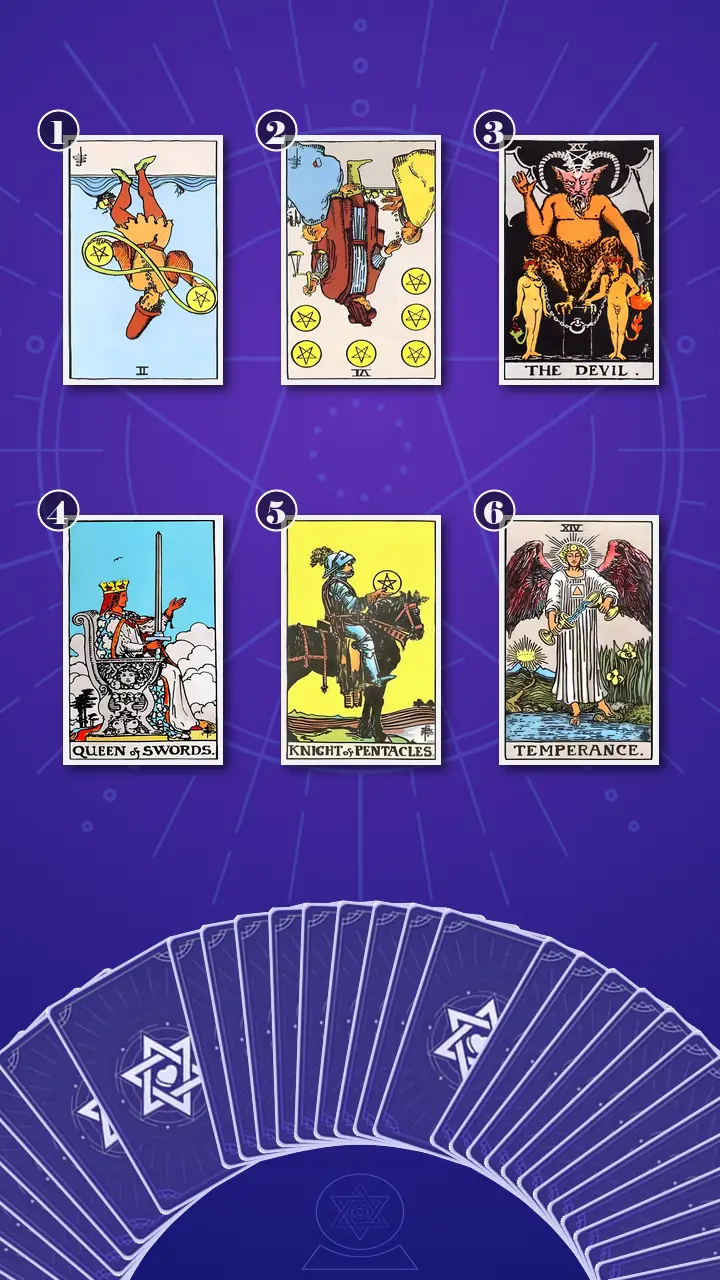
“Today I’m using a spread called the Transformation Path Grid (6) · Context Edition,” I told her. “It’s built for a loop like yours—people-pleasing overbooking—because it doesn’t just label the problem. It shows the mechanics: pattern, pressure, root fear, the interrupt, the practice, the integration.”
For readers who wonder how tarot works in real life: I don’t use it like a fortune machine. I use it like a systems diagram with emotion included. A Celtic Cross would be too many angles for a question this specific, and a quick three-card pull often misses the part that matters most—why you keep doing it even when you “know better.” This grid is the smallest structure that holds the full arc from feeling stuck to finding clarity and next steps.
I pointed to the layout: “Top row is diagnosis—what’s happening on camera, what keeps it running, and the hidden driver underneath. Then we ‘step down’ to the bottom row: the catalyst, the practical approach this week, and what a sustainable rhythm can look like.”
Reading the Map: Card Meanings in Context (Not in a Vacuum)
Position 1 — The observable overbooking pattern right now
“Now we’re flipping the card that represents the observable overbooking pattern right now—what’s happening on camera.”
Two of Pentacles, reversed.
The image alone is a mood: a juggler straining, an infinity-like ribbon looping, choppy waves behind him like life refusing to calm down.
“This is like,” I said, keeping my voice plain, “you’re staring at a packed Google Calendar and still typing ‘I can hop on!’ to a Slack quick sync. Five minutes later you’re dragging meetings around like a game of Tetris, deleting your own lunch, and calling it ‘time management’—even while your chest is buzzing.”
Reversed here, the energy isn’t adaptable. It’s overloaded. Too many commitments competing for the same finite hours. The loop ribbon becomes the week that never settles—motion replacing choice.
I added one line I’ve learned people recognize instantly: “A fast yes is sometimes just guilt in a friendly font.”
Alex let out a small laugh that turned into a wince halfway through. “That’s… brutal,” she said. “Like, accurate, but brutal.” Her fingers tapped once against her mug and stopped—as if her body had been caught doing something it thought it was hiding.
Position 2 — What keeps the people-pleasing loop running
“Now we’re flipping the card that represents what specifically keeps the loop running—the immediate relational pressure.”
Six of Pentacles, reversed.
I nodded at the scales in the card. “Time as currency,” I said. “Approval as the receipt.”
“This is like you say yes without asking what ‘quick’ means,” I continued, “and then the ask quietly expands. You do extra work no one requested, hoping someone notices. It’s not generosity—it’s an unspoken deal: you’ll overgive to avoid being seen as difficult, and you’ll call it teamwork.”
Reversed, this is an imbalance problem—giving faster than you can replenish, without a clear agreement. Not because you’re bad at scheduling, but because the exchange is blurry and social pressure fills the gap.
Alex’s eyes narrowed in that specific way people get when they realize they’ve been paying a fee they never agreed to. “I literally… do the ‘just in case’ work,” she admitted. “Like, no one asked for the extra slide. But I add it anyway. Because I want it to be… impressive.”
“Because impressive feels safer than clear,” I said softly. She swallowed, once, like her throat was trying to decide whether to argue or accept it.
Position 3 — The deeper attachment under the automatic yes
“Now we’re flipping the card that represents the root—what’s underneath the automatic yes.”
The Devil, upright.
I felt the temperature of the room change the way it does right before a planetarium show shifts from ‘fun facts’ to the quiet, existential part. “This card isn’t about being bad,” I told her. “It’s about attachment. The thing you’re bound to.”
“Here’s the modern version,” I said, and I made it concrete: “A request hits your phone and your body reacts before your mind does—stomach drop, jaw tight, instant urge to fix it by saying yes. The real bind isn’t the task. It’s the fear that if you set a boundary, you’ll be less included, less valued, quietly edged out. So you trade your evening for a quick hit of safety.”
I used the echo technique I’d been holding back—the micro-scene that makes the hidden driver visible without shaming it. “Picture this: it’s 6:42 p.m. on the subway. Damp coats, metal smell, a podcast leaking low through your headphones. Your thumb hovers over ‘Sure!’ while your chest tightens. And in the background there’s this invisible rule—like a character sitting on your shoulder—saying: Be easy to work with at all costs. Belonging vs availability. Connection vs compliance.”
Alex nodded, but not like agreement—like recognition she didn’t want to own. Her breath held for a second. Her gaze unfocused as if she was replaying a recent message thread. Then she exhaled long, shoulders dropping a fraction. That three-step shift—freeze, replay, release—told me we’d hit the real engine.
“Belonging that requires self-erasure isn’t belonging,” I said.
“Okay,” she whispered. “But it feels like… if I’m not instantly helpful, I’m not safe. Socially. Professionally.”
My mind flicked to astronomy—the way a body can get captured by gravity without realizing it. You don’t notice the pull until you try to change direction.
When the Queen of Swords Spoke: The Boundary That Changes the Orbit
Position 4 — The interrupt skill that breaks the loop in real time (Key Card)
I paused before turning the next card. Even through a screen, I could feel her bracing—like she was about to see a performance review written in cardboard and ink.
“This,” I said, “is the catalyst. The interrupt.”
Queen of Swords, upright.
“Now we’re flipping the card that represents the mindset or boundary skill that breaks the loop in real time.” The Queen looked straight back at us—raised sword, open hand. Clear sky. Clean edges.
“This is like you pause before replying,” I said, “and instead of an instant yes or a long apology, you send one clean line: ‘I can’t take that on today. I can look Thursday.’ Then you stop. No paragraph. No negotiation. And the weird part is how much your nervous system calms when you don’t audition for approval in the message.”
Here’s where I brought in my signature lens—what I privately call Orbital Resonance. “In the planetarium,” I told her, “we talk about resonance as two bodies syncing their rhythm. Right now, your orbit is resonating with other people’s urgency. Every ping pulls you into their frequency. The Queen of Swords is you choosing your period—your cadence—so you don’t keep having collisions.”
And I watched Alex’s face shift: relief first, then fear. Like she’d just been offered a life raft and realized she’d have to let go of the familiar wreckage to grab it.
Setup: I named the exact moment she kept living inside. “You know that 9:07 a.m. moment,” I said. “Coffee in hand, calendar already stacked—and then a ‘Quick favor?’ pings. Your stomach drops, your fingers start typing ‘Sure!’ before you’ve even checked what it costs you.”
Stop negotiating your availability and start speaking one clean truth—like the Queen of Swords’ raised blade, your boundary is the cut that frees your time.
I let it hang, just long enough for the words to become physical.
Reinforcement: Alex’s reaction came in layers. First, she went still—like her body had hit a quiet wall. Her lips parted, but no sound came out. Then her eyes softened and slid down toward the edge of her desk, as if she’d suddenly remembered every single time she’d typed an apology paragraph while her chest screamed. Her right hand lifted without thinking and pressed flat to the center of her sternum—checking, almost, that she was still allowed to breathe.
Her shoulders dropped an inch. Then another half inch. She blinked hard once, not crying, but close to it. “It’s… one sentence,” she said, voice thinner than before. “Why does one sentence feel scarier than the work?”
“Because the sentence changes the contract,” I said. “Not the workload. The contract.”
She drew a longer breath, and this time it reached her belly. “Okay,” she whispered, and there was a tremor in it—relief tangled with grief, like she was realizing how long she’d been paying for belonging with her evenings.
I asked the question that turns insight into lived memory: “Now—with this perspective—can you think of one moment from last week when this could have changed how you felt?”
Alex closed her eyes for two beats. “Thursday,” she said. “My manager asked for a ‘quick’ check-in at 4:30. I had a therapy appointment. I moved therapy.” She opened her eyes again, and they were steadier. “I could’ve just… said the truth.”
That was the pivot: from notification-triggered guilt and chaotic overbooking to the first spark of calm self-trust—the beginning of capacity-protected boundaries.
Position 5 — A concrete way to practice a new pattern this week
“Now we’re flipping the card that represents a practical approach—how you commit differently this week.”
Knight of Pentacles, upright.
“This is the slow yes,” I said. “Reliability as consistency, not speed.”
“The modern version is: you check your actual capacity, choose fewer commitments, and finish them without late-night scramble energy. You become the person who delivers calmly—not the person who replies fastest and suffers later.”
The energy here is grounded—balance through pace. One pentacle. One real deliverable. It’s the antidote to the frantic toggling of the Two of Pentacles reversed.
Alex nodded, but her mouth twisted a little. “But I can’t do the slow yes thing. People expect fast,” she said. “If I don’t answer right away, I look like I’m slacking.”
This was her practical obstacle, and it deserved respect—not a motivational speech. I reached for my other diagnostic tool: Solar Sail Principle. “In space,” I said, “a sail doesn’t fight resistance. It uses pressure to move. The ‘awkwardness’ you feel when you pause? That’s pressure. We’re going to harness it as propulsion—proof that you’re breaking the old reflex. The discomfort isn’t a sign you’re doing it wrong. It’s the sail catching wind.”
Her expression eased, just slightly. “So the weird feeling is… part of it.”
“Exactly,” I said. “It’s not a PR crisis. It’s friction that creates direction.”
Position 6 — Integration: what balance looks like when your calendar reflects self-respect
“Now we’re flipping the card that represents integration—what your life looks like when this becomes a rhythm.”
Temperance, upright.
The angel poured between two cups—controlled flow, not frantic juggling. One foot on land, one in water. A path toward the horizon that didn’t look like a sprint.
“This is the after,” I said. “Not a perfect week. A regulated week.”
“The modern version is: your week has buffers, recovery, and plans you actually want. You can still say yes—but it’s a chosen yes, with a container. You stop patching life at 10 p.m. because your calendar isn’t built on self-sacrifice anymore; it’s built on a sustainable blend of work, connection, and rest.”
Alex stared at the card for a long moment. Then she said, quietly, “I want that. I want my calendar to support my nervous system, not just other people’s urgency.”
From Calendar Tetris to a Capacity-Protected Week: Actionable Advice
I pulled the thread through all six cards so it became one story instead of six separate meanings.
“Here’s the arc,” I said. “Right now, Two of Pentacles reversed is the visible symptom: a calendar that never settles because you keep adding blocks. Six of Pentacles reversed is the social mechanic: time as currency, approval as the receipt—so you overgive without a clear agreement. The Devil is the hidden driver: the belief that belonging must be earned through instant availability. Then the Queen of Swords is the interrupt: one clean truth, spoken without negotiation. The Knight of Pentacles is the practice: slow yes, fewer promises, kept consistently. And Temperance is the outcome: flow you can live inside.”
“Your cognitive blind spot,” I added gently, “is thinking this is a time-management problem. It’s not. It’s a belonging-management problem. You keep trying to optimize the schedule, not the capacity.”
“So the transformation direction,” I continued, “is exactly this: from automatic yes to a deliberate pause-and-check practice, where you confirm capacity first and offer a clear alternative when it’s a no.”
I gave Alex a small, workable plan—things she could do even in a chaotic NYC week, even with decision fatigue.
- The 24-Hour Pause + One-Line ReplyCreate a canned Slack/Teams reply: “I might be able to help—what’s the deadline and what does ‘quick’ mean in minutes? I’ll confirm by tomorrow at 3.” Use it the next time a “quick favor?” lands.Expect discomfort. If guilt spikes, name it: “approval alarm.” Put a hand on your sternum and take three slow breaths before you add any extra words.
- Decision Buffer BlockWhen a request comes in, don’t accept a meeting. Put a tentative calendar hold called “Decision Buffer” for 24 hours, then decide with your schedule open.Minimum viable version: even a 2-hour buffer is better than instant yes. You’re buying time, not deciding forever.
- 15-Minute Post-Meeting Buffers (Temperance Training)For one week, add a labeled 15-minute buffer after every meeting (e.g., “Transition / Notes / Water”). Treat it as non-negotiable capacity maintenance.If you’re tempted to steal the buffer for “one more thing,” remind yourself: buffers aren’t free time. They’re the system staying stable—like an API limit.
Then I offered one of my personal strategies—the kind that sounds simple until you actually try it.
“Before your morning meetings,” I said, “do an Earth-rotation perspective. Thirty seconds. Look out a window if you can. The planet is turning whether your manager approves of you or not. Let that be your anchor. It helps your body remember: urgency is not authority.”

A Week Later: The Quiet Proof of Finding Clarity
Eight days later, Alex messaged me a screenshot: a Slack thread with a request that started, of course, with “Quick favor?”
Her reply was one line. No apology paragraph. No smiley face to soften the edge. Just: “Can you share scope + deadline? I’ll confirm by tomorrow at 3.”
“I didn’t die,” she wrote underneath. “My chest still did the thing, but it passed. Also… they said it could wait. Which is kind of wild.”
And the bittersweet part—the part that made it real—came in her next message: “I slept through the night. But when I woke up, my first thought was still, ‘What if they think I’m difficult?’ I just… laughed a little this time. Like, okay, brain. We’re learning.”
That’s the Journey to Clarity I trust most: not instant perfection, but the first clean boundary that proves you can be both supportive and self-respecting. The first moment your calendar stops being a constantly refreshing inbox and starts becoming a life you can actually inhabit.
When your calendar is packed wall-to-wall, it’s not always because you’re bad at time—it’s because some part of you is trying to prove you belong by never being the person who says no.
If you didn’t have to earn belonging with instant availability, what’s one small ask you’d let sit for 24 hours before answering?