From Rent-Hike Panic to Middle-Gear Days: Rebuilding Bandwidth

The 9:13 p.m. Spreadsheet Emergency
You’re a NYC tech worker who gets a rent hike email and immediately opens a spreadsheet like it’s an emergency room—because if you don’t outwork it, it feels unsafe.
Jordan (name changed for privacy) sat across from me in my studio space in Brooklyn, the kind of room that always smells faintly like paper and coffee no matter how many candles you light. They had that specific NYC look of “I’m fine” layered over “I haven’t unclenched my jaw since Tuesday.”
They described Monday at 9:13 p.m. in their tiny kitchen: harsh overhead light, the fridge humming like it was annoyed to be involved, and their thumb reflexively waking their phone every time Slack buzzed. They re-read the rent increase email, then opened a budget spreadsheet—wanting calm, choosing control.
“I can’t afford to fall behind right now,” they said, like it was a law of physics. “If I take my foot off the gas, everything slips. I’ll rest after I fix the money problem.”
The stress wasn’t an abstract feeling. It lived in their body like a zip tie: tight jaw, shallow breathing, and that wired-but-tired heaviness where even deciding what to eat feels like a meeting you didn’t RSVP to. And underneath it all was the core contradiction: wanting financial stability and a full life—health, dating, actual joy—while fearing that slowing down would cost safety and self-worth in the city.
I nodded, letting that land without arguing with it. “We’re not here to romanticize burnout,” I said softly. “We’re here to figure out why it’s hijacking work, health, and dating—and what your next, doable move is. Let’s try to draw a map through the fog. A real journey to clarity.”
Choosing the Compass: The Energy Diagnostic Map (7)
I invited Jordan to take one slow inhale, not to “calm down,” but to mark a transition: from spinning in the problem to observing the pattern. While they breathed, I shuffled—slow enough that the sound of the cards had space to be a metronome.
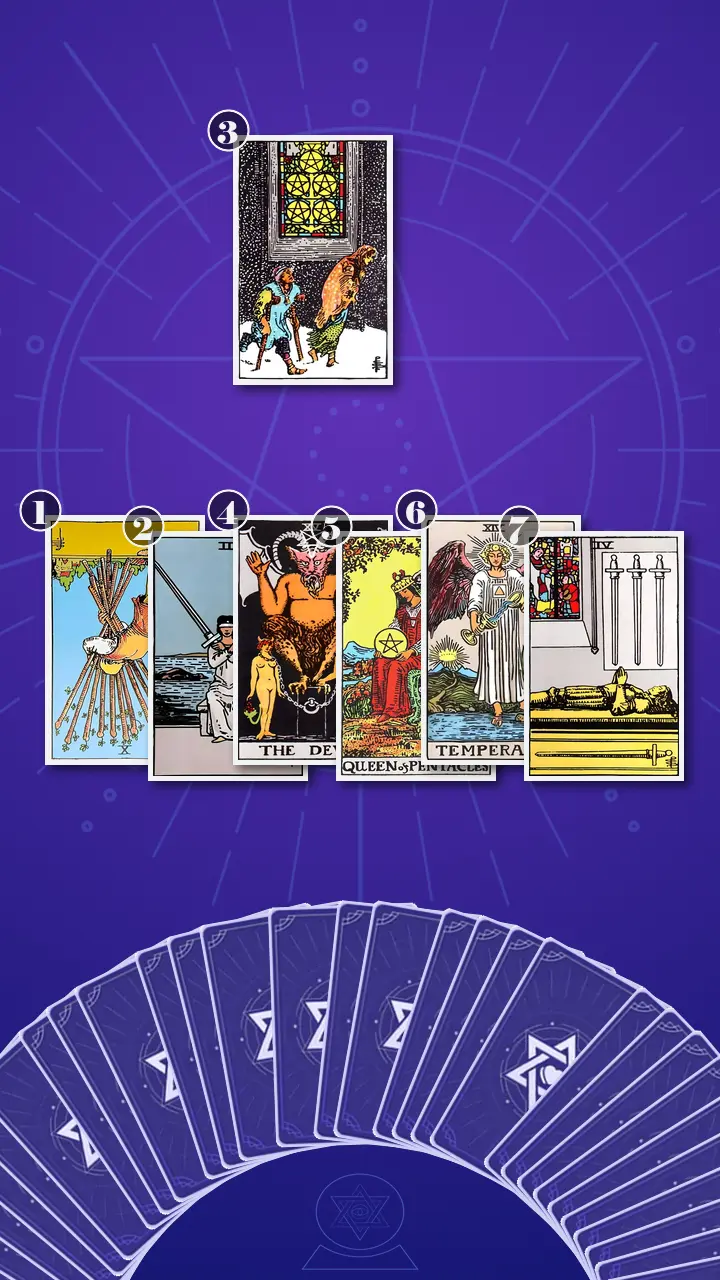
“Today, we’ll use a spread I call the Energy Diagnostic Map (7) · Context Edition,” I told them.
For you reading this: I chose it because a rent hike isn’t a single-issue problem. It’s an external trigger that cascades—work intensity ramps up, meals disappear, dating becomes another tab you can’t keep open. This spread creates a logic chain: surface burnout symptoms → inner tug-of-war → external financial pressure → core blockage → resources → the turning point → a grounded next step. It keeps the reading self-empowering rather than predictive, and it respects the real-world constraint of NYC housing costs.
Here’s what mattered most in this layout: the first card would show the burnout “receipts” you can actually point to; the center card would reveal the root pattern—what’s keeping the loop alive; and the turning-point card would show the single adjustment that changes the whole system across work, health, and dating.
Reading the Map: Burdens, Blindfolds, and Cold Streets
Position 1 — Burnout in Plain Sight
“Now we turn over the card that represents the burnout symptom-cluster as observable behavior and how it’s currently spilling into work, health habits, and dating bandwidth,” I said.
Ten of Wands, reversed.
I didn’t need to dramatize it. The image did that on its own: a figure bent forward, arms full, horizon blocked by the very things they’re carrying.
“This is the ‘rent hike as a personal emergency drill’ card,” I said, keeping it grounded. “You stay online later, say yes to extra tickets, answer Slack from bed, and just handle things so nobody questions your value. Then your body taps out—workout canceled, dinner skipped, dating replies stalled—because you’ve spent all your bandwidth proving you can carry it.”
Reversed, the energy isn’t heroic effort. It’s overload tipping into collapse—fire that’s forced, not fueled. It’s also the risk of an overcorrection: dropping everything at once, ghosting everyone, then feeling guilty and piling it all back on.
I used a quick montage—because this card loves a montage. “The ‘quick’ Slack favor. The late-night ‘just one more’ design tweak. The ‘I’ll cook after I finish this.’ The spreadsheet at midnight like it’s a slot machine.”
Jordan let out a short laugh that had zero joy in it—more like a bruise being pressed. “That’s… so accurate it’s kind of rude,” they said, then rubbed their temple like it was a button to shut the week off.
Position 2 — The Inner Tug-of-War
“Now we turn over the card that represents the internal tug-of-war that keeps you stuck—stability versus rest/connection, including the specific choice points you freeze at,” I said.
Two of Swords, upright.
“This is the draft-and-delete card,” I told them. “You keep key decisions in limbo because choosing feels risky: ask for a raise, push back on workload, look for roommates, schedule a date. Instead, you postpone—and the postponing becomes the decision.”
The Two of Swords energy is blocked air: not a lack of intelligence, but a protective shutdown. The blindfold isn’t ignorance; it’s self-defense. The crossed swords say, “Don’t come closer.”
I watched their hands as I spoke. Their fingers hovered like they were holding an invisible phone over an invisible ‘send’ button.
“What decision are you postponing that your body is paying for daily?” I asked.
Their eyes flicked away from the cards for a second, that micro-flash of yeah, that one. “A message to my manager,” they admitted. “Just… asking to move one deadline. And I keep telling myself I’ll do it after the next meeting.”
Position 3 — The City Pressing Down
“Now we turn over the card that represents how the rent hike and NYC cost-of-living pressure are shaping your decisions and stress responses,” I said.
Five of Pentacles, upright.
“This is the weather change,” I said. “The rent hike hits, and suddenly everything feels scarce. Your brain jumps to worst-case outcomes—moving, debt, losing your place in the city. Even if support exists—negotiation, tenant info, friends who’ve done this—stress makes it feel out of reach, like you’re outside the warm room looking in.”
The energy here is heavy earth pressure. Real numbers, real dates, real fear. I made sure to say it plainly: “Rent pressure doesn’t just raise your costs—it narrows your options until overwork feels like the only move.”
Jordan’s shoulders dropped a fraction, like their nervous system appreciated not being told they were “overreacting.” “Okay,” they said quietly. “So I’m not dramatic. This is a real trigger.”
Position 4 — The Root Mechanism
“Now we turn over the card that represents the underlying fear-driven mechanism that maintains burnout—what you believe you must do to stay safe and valuable,” I said, and I placed it at the center like the eye of a storm.
The Devil, upright.
Whenever The Devil shows up in a reading like this, I can almost hear the soundtrack shift—like a scene in Severance where the office lights hum a little louder and you realize the building is designed to keep you inside. The chains in the card are loose. That detail matters. It means the trap is partly habit, partly belief—an internal rule.
“Your rule is simple and brutal,” I said. “‘Safety = output.’ When money fear spikes, you don’t just problem-solve—you self-bind. You keep working, researching, optimizing, because the feeling of doing becomes your short-term relief.”
The Devil’s energy is compulsion: a loop that rewards panic productivity. Like keeping every browser tab open to feel in control until your laptop overheats and everything crashes anyway.
I named the voice directly, because it loses power when it’s visible. “Listen for the phrase I have to. ‘I have to answer Slack in bed.’ ‘I have to take the extra task.’ ‘I have to keep looking at StreetEasy.’ And then ask: is that a law… or a habit?”
Jordan went through a three-beat reaction chain I’ve seen a hundred times in people who over-function to survive: their breathing paused; their eyes unfocused like they were replaying a week in fast-forward; then their jaw unclenched on a long exhale, almost surprised by its own permission.
I kept my voice gentle but firm. “If your only safety plan is ‘push harder,’ your body becomes the bill that’s always overdue.”
Position 5 — The Resource You Forgot Counts
“Now we turn over the card that represents practical and emotional resources you can access now to stabilize without self-abandoning,” I said.
Queen of Pentacles, upright.
“This isn’t a ‘new you’ card,” I told them. “It’s a ‘stabilize the baseline’ card. Your resource isn’t a heroic hustle—it’s care infrastructure. A boring dinner. A consistent bedtime. A weekly money check-in. Keys in a bowl. A stocked fridge shelf. Things that make your nervous system stop acting like every day is a crisis response.”
The Queen’s energy is balanced earth: stewardship, not scarcity panic. “This is the part of you that can hold money reality without sacrificing your body and your ability to be present with other people,” I said.
Jordan’s face softened into the smallest expression of relief. The kind that says, I can do basics. Basics I can do.
When Temperance Poured Between Two Cups
I let the room go quiet for a beat. Even the street noise outside seemed to tuck itself a little further away.
“We’re turning over the most important card in this spread,” I said. “The one that defines the adjustment that changes everything.”
Position 6 — The Turning Point
“Now we turn over the card that represents the specific balancing shift that transforms the burnout loop into a sustainable rhythm across work, health, and dating,” I said.
Temperance, upright.
They stared at the image: water poured steadily between two cups, one foot on land, one foot in water—the middle gear made visible.
Setup. I spoke to the exact moment I could feel in their week: Sunday night, in bed, rent email open, spreadsheet half-filled, StreetEasy tabs multiplying. Their body tightens and their brain says, “Just push through this week and I’ll feel normal again.” The promise is always one more week away.
Delivery.
Stop treating burnout as the price of safety, and start blending effort with recovery like Temperance pouring two cups into one workable life.
I let it hang there. No extra commentary. Just air and meaning.
Reinforcement. Jordan’s reaction came in layers. First: a blink that didn’t finish, like their nervous system briefly froze. Then: their eyebrows pulled together—not sadness yet, but resistance. “But if that’s true,” they said, voice sharper for a second, “doesn’t that mean I’ve been doing it wrong?” Their hands tightened on the edge of their sleeve, then released. Their shoulders dropped, and with that drop came something like grief—quiet, private—followed by relief so physical it changed the shape of their face. I watched their breath deepen on its own, not because I told them to, but because their body recognized an exit.
“Not wrong,” I said. “Adaptive. Your system found a method that worked once. But it’s expired.”
Then I brought in my own tool—my Mondrian Grid Method, the way I deconstruct goals as if they’re abstract art instead of moral failure. “Temperance is a grid,” I told them, tapping the table lightly like it was a canvas. “Not a vibe. We stop painting your week in one color—work-red, panic-red—and we make blocks: focus, recovery, connection. Not huge. Just clean edges.”
“Set a 15-minute timer tomorrow after work. Phone on Do Not Disturb. Do nothing productive—just sit, walk one block, or stare out the window. If it feels uncomfortable, you can stop at any time; the only goal is to notice whether replying to one text or making dinner feels even 5% easier afterward.”
I leaned in slightly. “Now, with this perspective—Temperance as the method—think back to last week. Was there a moment where a 15-minute ‘middle gear’ would’ve changed what you did next?”
Jordan swallowed. “Friday,” they said. “I went straight from a stressful meeting to trying to reply on a dating app, and I… I just couldn’t. I could’ve taken fifteen minutes. I didn’t even consider it.”
“That,” I said, “is the shift from panic and urgency toward regained agency. This isn’t about predicting whether you’ll ‘make it’ in New York. It’s about moving from proving safety through overwork to creating safety through boundaries, stewardship, and planned recovery.”
And I added the line I wanted them to keep: “Balance isn’t the prize for surviving. It’s the method.”
Position 7 — The Grounded Next Step
“Now we turn over the card that represents a one-week, concrete recovery-and-boundaries action that protects your energy so you can function and relate, not just endure,” I said.
Four of Swords, upright.
“Protected rest,” I said simply. “Not collapse. Not scrolling until your eyes burn. A real recovery container—phone off, no Slack, no listings, no ‘catch-up.’ This is how your mind gets clarity back so you can make one money decision and one relationship decision without your nervous system yelling the whole time.”
The Four of Swords energy is intentional pause—air that clears, not air that spirals. In a city that treats rest like a luxury brand, this card treats it like infrastructure.
The One-Week Middle Gear Plan (Actionable Advice, Not a Life Lecture)
I looked at the whole map with Jordan and told the story it was trying to tell: The rent hike (Five of Pentacles) pressed down on their system, and The Devil at the center translated that pressure into an internal law: “Safety = output.” That law created the Ten of Wands reversal—carrying too much until collapse—and the Two of Swords freeze—drafting, deleting, stalling. The way out wasn’t a single dramatic leap. It was Queen of Pentacles stewardship blended through Temperance’s middle gear, then protected by Four of Swords rest.
The cognitive blind spot was painfully common in career crossroads moments: Jordan treated recovery as something you earn after you fix the money problem. But the cards were clear about the transformation direction: shift from proving safety through overwork to creating safety through boundaries, stewardship, and planned recovery.
I offered three next steps—small enough to do while still living in NYC reality, specific enough to stop decision fatigue from eating the week.
- One Deadline, RenegotiatedPick one recurring work obligation this week. Reply in one Slack thread or email: “I can do X by Friday, not today—does that still work?” Send it to your manager or the stakeholder once (no follow-up essays).A boundary isn’t a personality change—it’s a delivery date. If anxiety spikes after you hit send, set a 3-minute timer and do nothing but breathe until the discomfort crests.
- The 10-Minute Rent-Spiral ContainerOnce per day, set a 10-minute timer. Do exactly one money action: list fixed expenses, draft a landlord email, or skim an NYC tenant-rights resource. When the timer ends, you stop—no extra tabs.This is how you separate “budget anxiety vs actual budget steps.” You’re training your brain that action has edges.
- The Two-Cups Transition Buffer + Minimum Viable Date ReplySchedule one 15-minute decompression buffer after work (phone on Do Not Disturb; shoes off; sit, walk, or stare out the window). After that, send one “minimum viable date reply”: “Long week—can I reply properly after dinner?”You don’t have to be sparkling to be honest. Start with 7 minutes if 15 feels impossible—your only job is to test whether you feel even 5% more present afterward.

A Week Later: The Quiet Proof
Six days later, Jordan texted me a screenshot: the Slack message they’d sent—simple, calm, and terrifying in the way healthy things can be at first. Under it, they wrote: “They said Friday works. That’s it. That’s the whole response.”
They also told me they’d done the 15-minute buffer twice. Once they hated it. Once they stared out their window and noticed, for the first time in weeks, that their shoulders weren’t glued to their ears. They didn’t suddenly become a new person. But they made dinner before opening dating apps. They sent one honest line instead of slow-fading.
Clear but still tender: they slept a full night, then woke up with the first thought—what if I’m wrong?—and this time they just breathed and got out of bed anyway.
That’s the journey to clarity I trust the most: not certainty, but ownership. Not “never stressed again,” but a system that can hold real pressure without turning your whole life into collateral.
When rent fear hits, it’s not just your budget that tightens—your jaw, your breathing, and your whole life start acting like rest and connection are risks you can’t afford.
If you stopped treating balance like something you earn later, what’s one small ‘middle gear’ you’d be willing to test this week—just enough to feel 5% more present in your own life?