Stuck in the 3pm Crash Loop—And How to Treat Recovery as Performance

The 2:53 p.m. Slack Pings in Midtown
If you’re an early-career product/ops person in NYC and Slack responsiveness is basically treated like your personality, the 3pm crash can feel less like tiredness and more like your credibility slipping in real time.
Taylor met me on Zoom from a Midtown office phone booth—the kind with a smudged glass door and a tiny ledge that’s always faintly sticky from someone else’s iced coffee. It was 2:53 p.m. on a Tuesday. They’d just come back from grabbing a sad desk salad, and the fluorescent lights above them had that peculiar hum that makes your skin feel too close to your bones.
On their screen, Slack pings were stacking like a Jenga tower no one wanted to touch. They opened a doc, stared at one sentence, flipped to three tabs and back, and their eyelids went heavy like someone had taped coins to them. Their shoulders inched up—almost to their ears—while their mouth kept saying, “I’m fine, I’m fine,” in that way people say it when they’re not even sure who they’re convincing.
“Every weekday,” they told me. “Around 3 p.m. I just… drop. And then I do the whole thing—coffee I don’t even want, rewriting my to-do list like it’s going to save me, and then later I’m doomscrolling in bed because I’m tired-but-wired.”
What they didn’t say, but what I could hear anyway, was the private terror under the logistics: If I slow down, it’ll show.
The exhaustion in Taylor didn’t look like a dramatic collapse. It looked like a browser with 37 tabs open, all playing autoplay video at low volume—enough sound to keep the nervous system braced, not enough clarity to focus. A foggy forehead. Tight shoulders. A drained-but-wired pulse that wouldn’t settle.
“I’m not lazy,” they added quickly, like they were in court. “I’m just running on fumes.”
“I believe you,” I said. “And we’re not going to treat this like a character flaw. Let’s treat it like a signal. Our goal today is simple: to find clarity about what your 3pm crash is actually made of—work, sleep, social life—and what the next doable adjustment is.”

Choosing the Compass: A Celtic Cross for Burnout Across Work, Sleep, and Social Life
I asked Taylor to take one slow breath—not as theatre, not as mysticism, just as a clean mental transition. “Hold your question in mind,” I told them, “like you’re holding a problem statement at the top of a doc.”
I shuffled slowly, the way I used to brush soil from a mosaic fragment: patient enough to reveal the pattern, careful enough not to force it.
“Today we’ll use something I call the Celtic Cross · Context Edition,” I said. “It’s based on the classic Celtic Cross, but tuned for real life: your present symptoms, the main blockage, the deeper driver, then the domains that feed the loop—sleep and social pressure—before we move into balance and next steps.”
For a question like ‘Why do I crash at 3pm every day even with coffee?’ the strength of this spread is that it doesn’t moralize. It maps the system: symptom → friction → root attachment → contributing inputs → practical adjustment → integration direction. Tarot, at its best, is a way of seeing the shape of the pattern you’re already living inside.
“A few positions to watch,” I added, partly for Taylor and partly for the reader who’s ever Googled how tarot works at 1 a.m.: “The center shows what the crash looks like day-to-day. The crossing card shows what blocks real recovery. And the card above the center—your conscious aim—often reveals what you think balance should look like.”
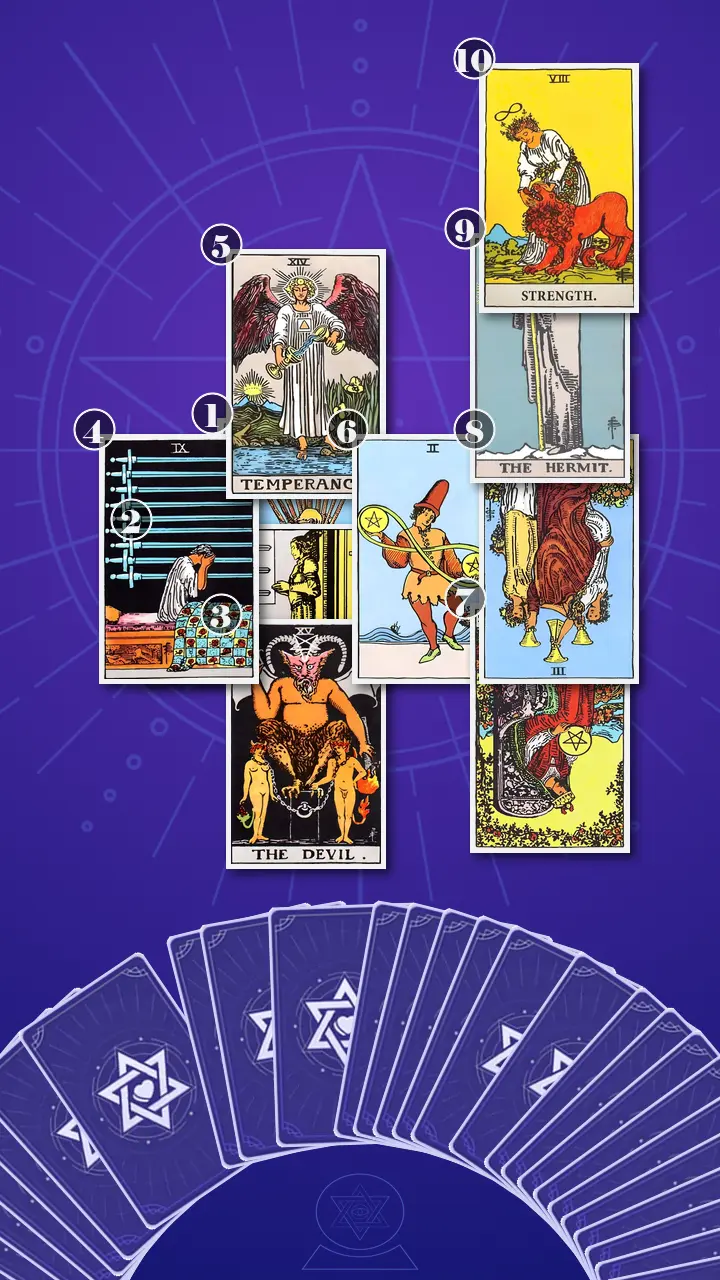
Reading the Map: The First Cards of the Celtic Cross
Position 1: The 3pm crash snapshot
“Now flipped over,” I said, “is the card that represents the 3pm crash snapshot—what burnout looks like in your day-to-day right now.”
Ten of Wands, upright.
I turned the card so Taylor could see the figure bent under the bundle. “This,” I said, “is the purest image of responsibility pile-up. Not one hard thing—ten small, relentless demands. And you’re carrying them in a way that blocks your line of sight.”
Then I used the translation that matters in 2026 more than any medieval symbol: “This is like when your calendar is stacked with meetings and deliverables, and by mid-afternoon you’re carrying invisible wands of expectations—being responsive, being helpful, being impressive—until your body forces a shutdown.”
The energy here isn’t a lack of discipline. It’s excess—too much load, too little margin. Your 3pm crash isn’t a character flaw—it’s a system signal.
Taylor let out a short laugh that had a bitter edge. “Okay,” they said, shaking their head. “That’s… too accurate. Also kind of rude.”
“It can feel brutal,” I replied, “but it’s also merciful. If we can name the bundle, we can decide what stops being yours to carry at 3 p.m.”
Position 2: The main friction blocking genuine recovery
“Now,” I said, “we’re looking at the main friction—what blocks genuine recovery even when you try to rest.”
Four of Swords, reversed.
“In the traditional image,” I said, “rest is available. Sanctuary exists. Reversed, it’s like the door to the sanctuary is there, but you can’t quite step through it.”
I leaned into the modern scenario exactly as it shows up in Taylor’s life: “This is like when you get a moment between meetings but fill it with notifications and ‘quick checks,’ so the nervous system never gets a clean pause and the afternoon slump becomes inevitable.”
This is blockage energy—rest that doesn’t land. Or, in the blunt phrase that people tend to save and re-read: Rest that’s still input isn’t rest.
To anchor it, I painted the contrast the card demanded: “You sit back and tell yourself you’re taking a break. Then your thumb finds your phone ‘just for a second.’ Screen glow. Tiny buzz. Your shoulders stay up by your ears. And your inner monologue goes, ‘I’m technically resting, so why do I feel worse?’”
Taylor nodded, slow. The kind of nod that isn’t agreement—it’s recognition. “Yeah,” they said quietly. “My ‘break’ is just… more stuff coming in.”
Position 3: The underlying driver—the internal contract
“Now we go underneath,” I said. “This card represents the underlying driver—the deeper belief or attachment that keeps you overriding your limits.”
The Devil, upright.
I’ve excavated Roman roads where the grooves of cart wheels still run like fingerprints through stone. This card always reminds me of that: ruts you didn’t choose, but you keep riding because they feel like the only safe track.
“This is the binder,” I told Taylor. “The part of you that mistakes pressure for safety.” Then I used the lived translation: “This is like when you feel you have to answer messages instantly, keep a perfect routine, and still show up socially, because slowing down would feel like losing status or falling out of the loop.”
The energy is compulsion—not because someone is literally holding you hostage, but because an internal rule is. The loose chains in the picture matter: they’re tight enough to hurt, loose enough to remove.
I named the chain as a sentence, because that’s how these contracts survive: “If I slow down, it will show. At work: the active dot anxiety, the typing-indicator identity. Socially: saying yes so you don’t drift in a city where friendships feel schedule-dependent.”
Taylor swallowed. Their throat bobbed once, like their body had reacted before their mind could edit it. “It’s embarrassing,” they said. “But yeah. I’m scared that needing rest proves I’m not competent.”
“That fear makes perfect sense,” I answered. “And it’s also negotiable.”
Position 4: Sleep debt pattern—the bedtime second shift
“Now flipped over,” I said, “is the sleep debt pattern—the recent sleep/recovery history feeding the daily crash.”
Nine of Swords, upright.
I didn’t have to stretch to make it modern. The card already knows what midnight looks like.
“This,” I said, “is the person sitting up in bed because their mind refuses to clock out.” And then, word-for-word in real life: “This is like when you get into bed and immediately start replaying conversations, checking tomorrow’s calendar, and mentally negotiating everything you didn’t finish—so sleep becomes lighter and less restorative.”
I described the scene the way Taylor had lived it: phone warmth in your hand, dim lamp, the calendar app glow like a little stage spotlight. Inner monologue: “If I don’t think about it now, I’ll forget and fail tomorrow.” That’s not rest. That’s overtime.
This card is excess Air—too much mental motion, too little downshift. And it’s why the 3pm crash feels inevitable: your night is quietly setting up tomorrow’s collapse.
Taylor’s eyes flicked away from the camera for a second, as if they were watching last night replay itself on a screen just out of view. “I literally tell myself, ‘I’ll sleep after I solve tomorrow,’” they admitted.
“A common spell,” I said gently. “And a breakable one.”
When Temperance Spoke: Two Cups, One Repeatable Afternoon
Position 5 (Key Card): Your definition of balance
I paused before turning the next card. Not for drama—for accuracy. “We’re about to flip the card that represents your definition of balance,” I said. “This is often where people realize they’ve been aiming at the wrong target.”
Temperance, upright.
The room felt quieter through my headphones, as if even the Slack pings had politely stepped back.
“This is the Integrator,” I told Taylor. “One foot on land, one in water. Not escaping life—standing in it steadily.” Then I gave the translation that belongs to their week: “This is like when you stop trying to ‘fix everything’ with one perfect sleep night or one extreme weekend, and instead build a consistent rhythm—enough rest to function, enough work focus to feel steady, and social time that actually nourishes.”
Temperance is balance energy in its healthiest form: not intensity, not punishment, not a cleanse. A method. A mixing.
Here’s where I brought in my own lens—my Skill Archaeology. “When I excavate a site,” I said, “I don’t look for one miraculous artifact that explains everything. I look for layers—tiny, repeated deposits that tell the truth of daily life. Your energy isn’t a single ‘fix.’ It’s stratigraphy. Temperance is asking: what small, repeatable layer of recovery could you deposit every day so your system stops living in emergency mode?”
And then, to honor the structure of the moment, I slowed down and followed the three-step arc.
Setup
It’s 2:50pm, Slack starts popping again, and you can feel your forehead go foggy. You open a fresh checklist to feel competent, sip coffee you didn’t even want, and tell yourself you’ll rest later—right after you prove you’re still ‘on.’
Delivery
Not a frantic reset or a perfect routine—choose steady mixing, like Temperance’s two cups, and let consistency rebuild your afternoons.
I let the sentence sit between us for a beat, the way you let dust settle before you decide what the outline actually is.
Reinforcement
Taylor’s reaction came in a chain—three small movements that told me the message had landed in the body first. Their breathing froze for half a second, like they’d hit “pause” without meaning to. Then their gaze softened and went slightly unfocused, as if they were replaying every 3 p.m. they’d tried to brute-force their way through. Finally, their shoulders dropped—just a centimeter, but enough to change their whole outline on camera.
“Wait,” they said, and their voice cracked on the word like it had caught on a burr. “So balance isn’t… something I earn when I finally get it together?”
“Exactly,” I said. “Balance isn’t the reward. It’s the method.”
Their mouth tightened briefly—an unexpected flicker of resistance. “But if that’s true,” they pushed back, “doesn’t it mean I’ve been doing it wrong this whole time?”
“It means you’ve been surviving with the tools you had,” I answered. “And now you’re upgrading your tools. That’s not failure. That’s evolution.”
I guided them into the experiment implied by the card—small, specific, real: “Do a 10-minute No-Input Recovery Block today between 2–4pm: set a timer, put your phone face-down (or in another room), and do one low-stimulation thing—eyes closed at your desk, a slow walk to fill your water bottle, or sitting by a window. If you feel anxious or restless, that’s information, not failure—end early if needed. Optional: write one line afterward: ‘My body feels ___, my brain feels ___.’”
Then I asked the question that turns insight into memory: “Now, with this new definition of balance—mixing, not fixing—can you think of a moment last week when this would have changed how you treated the crash?”
Taylor blinked quickly, like someone trying not to make a big deal out of something tender. “Thursday,” they said. “I had a fifteen-minute gap and I filled it with TikTok and email ‘just in case.’ I could’ve… just stood by the window. Like an adult. Like a person.”
“Like a person,” I repeated. “That’s the point.”
And in that moment, I could feel the first step of the deeper transformation: not from tired to energetic, but from self-criticism to grounded stewardship—from treating the body as an obstacle to treating it as the system you’re responsible for protecting.
The Calendar as Weather: The Rest of the Spread
Position 6 (Catalyst): The next stabilizing adjustment within reach
“Now,” I said, “we’re looking at the next stabilizing adjustment within reach—what can change the curve soon.”
Two of Pentacles, upright.
“This is the juggler,” I said, “and it’s not here to shame you. It’s here to teach rhythm.” Then, in modern terms: “This is like when you accept that life stays in motion, and build a flexible afternoon routine—one focused work block plus one real reset—so you’re not depending on willpower alone.”
The energy here is balance under movement. Not stillness. Calibration.
I used the systems analogy Taylor would actually trust: “Think of your calendar like weather. The choppy sea is outside—you can’t stop the waves. But you can choose your anchors.” I pictured an afternoon view: one work deliverable, one recovery action. “Say it out loud,” I coached. “I’m not fixing my life today. I’m stabilizing my 3–5 p.m.”
Taylor’s face changed—not bright, not magically healed—just less cornered. “That feels… doable,” they said. “Like, smaller.”
“You don’t need a perfect routine—you need an afternoon you can repeat,” I reminded them.
Position 7: Your role in the loop
“Now,” I said, “this card represents your role in the loop—the habit or stance that keeps the cycle running.”
Queen of Pentacles, reversed.
“The Queen upright is body stewardship,” I said. “Food, water, sunlight, a home base that actually restores you.” Reversed, it’s the caretaker energy flipped outward.
And the translation was painfully ordinary: “This is like when your apartment and routines could be a recovery nest, but instead you keep running on takeout, screens, and ‘just one more thing,’ then wonder why your body crashes on schedule.”
This isn’t a moral failing. It’s deficiency—basics that don’t happen because you’re busy performing okay. Skipping lunch at your laptop, forgetting water, not seeing daylight, then being annoyed at your body for being inconvenient.
Taylor sighed and rolled their shoulders, as if they’d suddenly noticed how high they’d been holding them. “I treat myself like an afterthought,” they said. Not dramatically—just plainly.
“That’s a clear artifact we’ve just unearthed,” I replied. “And we can work with it.”
Position 8: Social environment—connection vs performance
“Now,” I said, “this card represents your social environment—how expectations and boundaries contribute to depletion or support.”
Three of Cups, reversed.
“This isn’t ‘you have bad friends,’” I said immediately. “It’s about social energy leaks—when connection turns into performance.”
Then the modern scene: “This is like when your social calendar looks full, but the connection doesn’t actually refuel you—either because it’s too late-night, too performative, or quietly shaped by comparison.”
The energy here is imbalance—too much output, not enough nourishment. Group chats that function like attendance tracking. ‘Quick drinks’ that aren’t quick. Saying yes out of anxiety about being left out, then resenting it, then feeling guilty either way.
Taylor gave me a look that was half-smile, half-grimace. “West Village drinks,” they said. “Every time.”
“Then we don’t have to fix your entire social life,” I said. “We just have to authenticate what’s real nourishment and what’s just visibility.”
Position 9: Hopes and fears around slowing down
“Now we’re in the hopes-and-fears position,” I said. “What you want from rest—and what you fear it might cost you.”
The Hermit, upright.
“This is strategic solitude,” I said, tapping the lantern on the card. “Not isolation. Intentional quiet so you can hear yourself again.”
And in Taylor’s life: “This is like when you consider turning down a night out to protect sleep, and the real challenge is tolerating the feeling of being ‘out of the loop’ long enough to recover.”
The energy is balance between belonging and restoration. You want clarity. You fear the temporary loneliness it might require.
Taylor’s voice went small. “I hate how much I care about being seen,” they said.
“Most people do,” I answered. “The difference is whether you let it run the whole system.”
Position 10: Integration direction—Strength
“Last,” I said, “is integration direction—what becomes possible if you work with these patterns.”
Strength, upright.
“Look at how she holds the lion,” I said. “Not with force. With steadiness.”
In modern life: “This is like when you stop treating fatigue as an enemy and instead use calm boundaries—ending work at a set time, limiting late-night input—as the way to rebuild capacity.”
The energy is balanced restraint. Gentle discipline plus compassion. And yes—this is the part where it can feel uncomfortable before it feels good. Boundaries feel like guilt before they feel like relief.
I named the method the way I’d describe fieldwork: “Discomfort is training data, not a verdict. When guilt flares after you protect your 10 minutes, that’s your nervous system learning the new rule.”
Taylor nodded once—firmer this time. Not excited. Ready.
From Insight to Action: Actionable Advice for a 3pm Crash You Can Actually Change
I leaned back and summarized what the spread had shown in one coherent chain—because clarity is often just a pattern told plainly.
“Here’s the story these cards are telling,” I said. “Your afternoons aren’t failing because you’re weak. You’re overloaded (Ten of Wands), and when you try to recover you accidentally keep stimulating yourself (Four of Swords reversed), because underneath it all is an internal contract that says rest is dangerous (The Devil). That contract follows you into bed as rumination (Nine of Swords). What you’ve been reaching for is not a dramatic reset, but an integrated rhythm (Temperance), made real by two simple anchors in your schedule (Two of Pentacles). Your blind spot is that you’ve been treating your body basics and your home base as optional (Queen of Pentacles reversed), and treating social visibility as proof of worth (Three of Cups reversed). The path forward is gentle steadiness—training your system to trust boundaries (Strength).”
The cognitive blind spot was clear: Taylor had been trying to optimize their way out of burnout while still obeying the same rule—prove you deserve rest. That’s why every “break” turned into more input, and why every crash sparked self-auditing instead of recovery.
“The key shift,” I said, “is this: move from powering through the crash to treating recovery as part of performance. One non-negotiable daily recovery block, protected by a simple boundary. Not forever. Just as an experiment.”
Then I offered next steps using my own field strategy—what I call Megalith Transport. “When ancient builders moved stones that should’ve been impossible to move,” I said, “they didn’t become superheroes. They broke the task into levers, rollers, and teams. We’re going to do the same with your 3 p.m.”
- The No-Input Recovery Block (10–15 minutes)Between 2–4 p.m., put a meeting on your calendar titled “No-Input.” Phone face-down (or in another room). Do one low-stimulation thing: eyes closed at your desk, a slow walk to refill water, or sitting by a window. No content. No productivity.If your brain screams “this is unrealistic,” do the 3-minute version. The goal is “less input,” not “perfect calm.”
- The Two Anchors Afternoon PlanBefore noon, choose two anchors for 3–5 p.m.: (1) one work priority you will finish, (2) one recovery action you will do even if you’re behind (water + two deep breaths counts). If a new request hits after 2 p.m., use one neutral line: “I can take a look tomorrow morning.”Treat your calendar like weather: you can’t stop the waves, but you can choose anchors. Keep it absurdly small for the first week.
- The 60-Second Bedtime Brain DumpRight before sleep, write 3 unfinished items + 1 realistic first step for tomorrow morning (in Notes is fine). Then tell yourself, “The rest can wait.”Cap it at 60 seconds. If it turns into spiral journaling, stop—this is an off-ramp, not a deep dive.
For the social piece, I added one more tool—my Relic Authentication approach. “Before you say yes to a plan,” I said, “authenticate it. Is it a real artifact of connection—or a convincing replica made of FOMO?”
Taylor laughed, but it was warmer this time. “Okay,” they said. “One yes that nourishes. One no that protects sleep.”

A Week Later: The Quiet Proof of Finding Clarity
Six days later, Taylor emailed me two lines—no preamble, no apology for existing.
“Did the No-Input Block three times. First time I felt twitchy and guilty. Third time I came back and actually finished the doc without the tab-hopping. Also: I said no to West Village drinks and did a 9:45 p.m. shower instead. I woke up still nervous, but not wrecked.”
It wasn’t a life makeover. It was a micro-proof—an afternoon they could repeat.
In my mind, I saw the bittersweet version of that win, the honest kind: they’d slept a full night, woke up, and for a second their first thought was still, What if I fall behind? Then they exhaled, put a hand on their chest, and didn’t reach for the phone. Not certainty—ownership.
This is what a Journey to Clarity often looks like in the real world: not a dramatic before-and-after, but a new agreement with your own nervous system. A shift from self-auditing to self-stewardship. From compulsion to integration. From “earning rest” to “using rest as method.”
When 3pm hits and your brain goes foggy, it can feel like your body is betraying you—when really you’re terrified that needing rest will prove you’re not as competent (or as worth keeping around) as you’ve been trying to look.
If you treated one small recovery block today as part of your performance—no earning, no proving—what would you want that 10 minutes to look like for you?