From LinkedIn Envy to Private Metrics: A Two-Week Reset in Toronto
Finding Clarity on Line 1, Before the Coffee Even Hits
“You see a coworker’s promotion post before you’ve even had coffee, and suddenly you’re doing ‘timeline math’ in your head like it’s your second job.”
Jordan said that to me like it was a joke. But their laugh didn’t land as a laugh—more like the sound you make when your phone has already decided how your morning is going to feel.
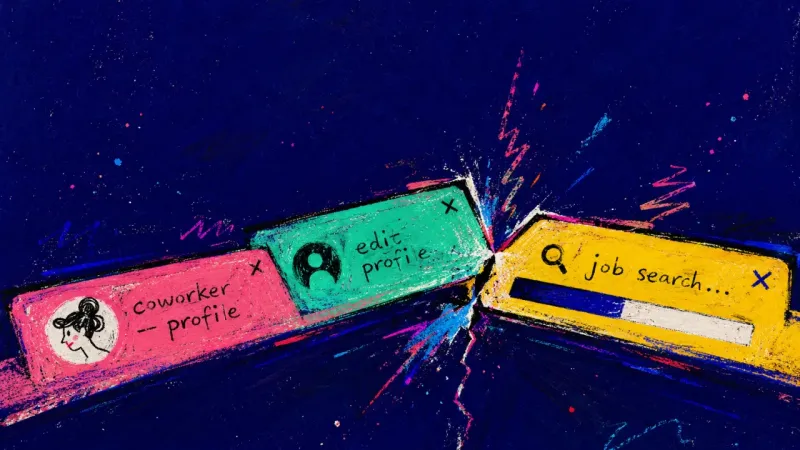
They were calling from Toronto. I could hear the TTC in the background—metal-on-metal, that familiar screech as the train pulled into Bloor-Yonge. Fluorescent light turned their screen into a harsh little mirror. Jordan’s thumb hovered, already mid-ritual: click the promotion post, click the coworker’s profile, click their own profile, and start recalculating their life like a spreadsheet with missing columns.
“I’m happy for them,” Jordan told me, voice careful. “But it also feels like a spotlight on what I haven’t done yet.”
I watched their jaw tighten on camera, the way it does when a thought is trying to become a verdict. Their chest looked held—like they’d taken a breath and forgot to give it back. Envy isn’t just a feeling; in Jordan’s body, it showed up as a tight chest and a clenched jaw, with that stomach-drop you get when congratulations roll in and your brain quietly translates it into: you’re behind.
And underneath it, the contradiction was loud: wanting career recognition and momentum… while fearing that their current pace meant they weren’t truly valuable or competitive.
I said, gently, “We’re not going to shame you for having a nervous system. We’re going to map the pattern. Let’s figure out: is this networking, or is this scorekeeping?”
Jordan’s eyes flicked down to their phone, then back up to me. “I can’t tell whether I want a promotion,” they admitted, “or I just want the panic to stop.”
“Okay,” I said. “That’s a real starting point. Let’s do a Journey to Clarity—not by forcing certainty, but by getting honest about what’s actually happening in the first sixty seconds after a post like that.”

Choosing the Compass: The Celtic Cross · Context Edition
I guided Jordan through a simple reset—nothing mystical, just functional. “One slow inhale,” I said, “and on the exhale, let your shoulders drop one millimeter. We’re telling your body it doesn’t have to sprint.” While they breathed, I shuffled.
“Today,” I told them, “we’re using the Celtic Cross · Context Edition. It’s the classic spread, but aimed directly at a pattern question—because LinkedIn envy isn’t one moment. It’s a chain: trigger, hook, root need, reaction, environment, and then a way out.”
If you’ve ever wondered how tarot works in a practical, non-floaty way, this is it: the Celtic Cross gives me a structure to follow the whole system, not just the loudest emotion. We’re not asking the cards to “predict.” We’re using them to see what your mind keeps doing automatically—so you can choose something else on purpose.
“We’ll start with the center,” I explained, “because that’s the immediate LinkedIn envy snapshot—what happens right after the promotion post. Then we cross it with what keeps the loop running. Later, the staff on the side climbs like floors in the same building—from your self-talk to your environment to hopes and fears, up to an integration that actually stabilizes you.”
Jordan nodded, like their brain appreciated a map.
Reading the Map: Card Meanings in Context
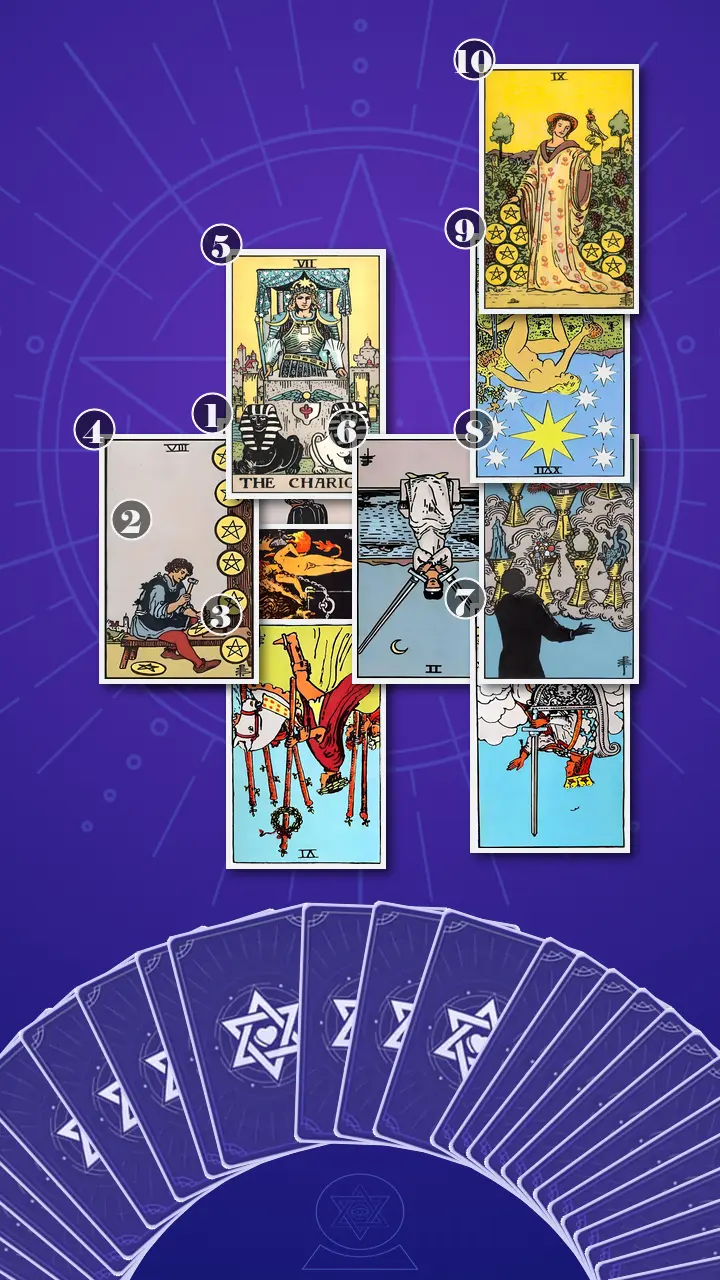
Position 1: The Immediate LinkedIn Envy Snapshot
“Now turning over,” I said, “is the card that represents the immediate LinkedIn envy snapshot: the most visible feelings and behaviors right after the coworker’s promotion post.”
Five of Cups, upright.
I pointed to the image: a cloaked figure staring at spilled cups while two remain standing behind them. “This is an attention bias card,” I said. “It’s the moment your mind locks onto what feels missing—and everything else becomes background noise.”
“Modern translation?” I asked, already knowing the answer from Jordan’s story. “It’s like rereading the promotion post and replaying your timeline, but you can’t mentally turn around to notice the skills, relationships, and steady wins that are already there.”
Jordan let out a small, bitter laugh. “That’s… honestly a little too accurate. Like, damn.”
That laugh mattered. It wasn’t agreement. It was the sound of being seen in a way that’s almost annoying. I kept my voice calm. “This card isn’t saying you’re ungrateful. It’s saying: your brain is grieving something concrete—title, recognition, speed—and instead of naming the loss, it turns LinkedIn into a courtroom exhibit.”
Energy-wise, Five of Cups is contracted—narrow focus, narrowed breath, narrowed future. It makes you scan for evidence you’ve fallen behind, and then it makes your competence feel invisible.
Position 2: What Keeps the Envy Loop Running
I rested my hand on the next card. “Now we flip the one that represents what keeps the envy loop running: the sticky habit or psychological hook that intensifies comparison.”
The Devil, reversed.
The room on my end—my little reading space that still smells faintly of paper star charts from the planetarium—went quiet in that particular way it does when something central shows up. I’ve narrated thousands of nights under artificial constellations, and I’ve learned: the moment you name the true mechanism, people stop fighting the symptom.
“This isn’t a moral card,” I said immediately, because I could see Jordan brace. “It’s a habit-loop card. In reverse, it’s the moment you realize the chain is loose.”
Jordan’s expression tightened. “I mean… I need LinkedIn. Everyone at work uses it. It’s literally part of the job.”
There it was—the defense strategy. The rational voice that tries to make compulsive checking sound like professionalism. I nodded. “Totally. And here’s the nuance: you can use LinkedIn as a tool and still have it hijack your nervous system. Both can be true.”
Then I brought in my signature lens—the one I learned not from tarot books, but from watching orbital mechanics for a decade while explaining them to teenagers on field trips.
“I call this Orbital Resonance,” I said. “In astronomy, resonance is when two bodies sync in a way that amplifies motion. In workplaces, it’s when your internal worth-meter syncs to an external signal—like a coworker’s post—and suddenly your whole emotional system starts orbiting their timeline.”
“The Devil reversed says: the resonance can be broken. Not by deleting the planet—by changing your distance and your rhythm.”
The Aha Moment (Setup → Delivery → Reinforcement)
Setup: I watched Jordan’s eyes dart the way they do when a thought tries to sprint ahead of a feeling. They knew that midnight moment: swearing it’s only two minutes, chest tightening as likes climb, rewriting the headline like it’s an emergency—like optics could produce safety faster than reality can.
Delivery:
Not ‘I have to keep up’—choose to loosen the chain and let your next move be value-led, not feed-led.
I let the sentence sit between us. Even through a screen, you can feel when words land heavy—like a coin dropped into still water.
Reinforcement: Jordan went through a three-step reaction that I’ve seen in so many smart, ambitious people. First: a micro-freeze—breath paused, shoulders held, eyes fixed like they were reading fine print. Second: cognitive seep—their gaze unfocused for a second, like their mind replayed their own behavior: the “market research” tab that turns into profile-hunting; the third headline rewrite; the “Resume_FINAL_final_reallyFINAL.docx” they never actually send. Third: release—an exhale that sounded half like relief, half like grief.
“But if it’s a chain,” Jordan said, voice sharper than before, “doesn’t that mean I’ve been doing this to myself? Like… I’m the problem?”
I kept my tone steady. “It means you’ve been responding to discomfort the way a lot of people do: by reaching for certainty. LinkedIn offers certainty-shaped signals—titles, timestamps, applause. The Devil reversed says you can stop treating that certainty as oxygen.”
“Here’s the practical part,” I added. “Set a 10-minute timer. Open LinkedIn once. Write the very first sentence your mind says—verbatim. Then close the app when the timer ends, even if you feel unfinished. That unfinished feeling? That’s the loose chain tugging. Not a truth.”
Jordan swallowed, then nodded—small, but real.
I asked, softly, “Now, with this new perspective, can you think back to last week—was there a moment when this insight would’ve changed how the night went? A moment when you could’ve gone from ‘I can’t not check’ to ‘I want to check’ to ‘I’m choosing whether I check’?”
Position 3: The Hidden Root Beneath the Envy
“Now we turn over the card representing the hidden root beneath the envy: the deeper need or insecurity that the promotion post touches.”
Six of Wands, reversed.
I tapped the victory wreath and the crowd. “This is the hunger for recognition,” I said. “Not vanity—visibility. The feeling that progress only counts if it’s witnessed.”
Jordan’s face softened in a way that told me they’d been trying not to need that. “Yeah,” they said quietly. “If my career story isn’t impressive in one glance, I feel like I’m already losing.”
Six of Wands reversed is a deficiency of felt acknowledgment. The work may be solid, but without applause, the nervous system marks it as “not real.” And in a LinkedIn culture, the crowd never stops cheering—so your brain keeps waiting for your turn.
Position 4: What You’ve Been Doing That’s Real (and Unseen)
“Now,” I said, “this card represents what you’ve been doing that’s real (and often unseen): the recent effort or work context that makes the comparison feel sharper.”
Eight of Pentacles, upright.
“This is your leverage,” I told them. “This is craft. Reps. Tangible proof. The kind of progress LinkedIn rarely shows but careers are built on.”
I used the before/after cut the way I’ve learned to do when someone needs a reality anchor: “I see the 11:45 p.m. phone glow. Now I want you to picture a desk lamp, laptop open, forty-five minutes of building something that exists: a campaign teardown doc, a one-slide case study, a metrics summary, a draft brief. Something you can save in a folder called ‘Proof.’”
Jordan’s shoulders dropped a fraction. “That feels… less dramatic,” they said.
“Exactly,” I replied. “And doable. That’s the point.” Eight of Pentacles is balanced Earth energy: steady, trackable, quietly powerful. It doesn’t argue with the feed. It simply builds a reality the feed can’t take away.
I said the mantra that always works because it’s simple enough to survive a spiral: “Trade one refresh for one rep.”
Position 5: Your Conscious Intention
“Now we look at your conscious intention: what you want to feel or achieve in your career when you’re not spiraling.”
The Chariot, upright.
“You want momentum,” I said. “Not a perfect story—agency. Direction that feels self-chosen.”
I pointed out the two sphinxes, black and white. “This is the tension you named: ambition versus self-judgment. Real goals versus social comparison. The Chariot is willpower, but it’s also alignment. The question is: are you driving toward your values, or away from discomfort?”
Jordan looked away, like they were actually imagining it. “If nobody could see my career online for a month…” they started.
“Yes,” I said. “What would a win be then?”
Position 6: The Next Likely Reaction Pattern
“Now we flip the next likely reaction pattern: how envy may push you toward rushed decisions or scattered next steps.”
Two of Swords, reversed.
“This is the panic move,” I said. “Too much input, not enough inner clarity.”
I gave them the internal monologue triad because it’s painfully accurate for decision fatigue: “(1) Apply to everything. (2) Nothing fits. (3) I’m behind.”
Jordan winced. “That’s literally me with fourteen tabs open.”
Two of Swords reversed is blockage breaking into urgency. It’s movement without direction—frantic toggling between job listings, salary sites, headline edits—trying to end discomfort with a cognitive sprint. But it doesn’t end it. It multiplies it.
“Tonight isn’t for drastic moves,” I told them. “Tonight is for one next step under thirty minutes.”
Position 7: Self-Worth Script Under Pressure
“Now,” I said, “this card represents your self-worth script under pressure: the inner voice and self-image that activate when you feel ‘behind’.”
Queen of Swords, reversed.
I didn’t need to dramatize this one. Jordan already knew the voice.
“This is discernment turning into a blade,” I said. “Your intelligence gets recruited as a prosecutor.”
Jordan’s mouth tightened. “I’ll read my own resume and think, ‘This sounds weak.’ And then I delete actual accomplishments because they feel… not impressive enough.”
Queen of Swords reversed is excess Air in the harsh direction—precision without kindness, critique without coaching. It keeps the Devil loop sticky because the inner critic creates discomfort, and then the feed offers a momentary sense of control.
“One boundary with your mind,” I suggested. “When you catch a cutting thought, rewrite it into a coach-like observation. Not ‘I’m behind.’ More like: ‘I want clearer promotion criteria, so my next move is to ask for it.’”
Position 8: The Social Media and Workplace Context
“Now we look at the environment: what your workplace and social feed reinforce about success, visibility, and timeline expectations.”
Seven of Cups, upright.
I traced the floating cups in the clouds. “This is LinkedIn as an algorithmic highlight reel,” I said. “It’s optimized for signals, not context.”
Then I used the line I keep for this exact moment, because it de-escalates comparison without pretending titles don’t matter: “The feed isn’t a scoreboard. It’s a highlight reel with missing context.”
Seven of Cups is excess possibility. It’s the buffet of shiny careers—five different success templates in one scroll—and suddenly you feel like you should want all of them. Even the ones that don’t match your actual values, energy, or life.
When I worked night shifts at the planetarium, I used to watch visitors point at the brightest star and assume it was the most important one. It never is. It’s just the one your eye catches first. Social feeds do that to ambition.
Position 9: The Comparison Trigger Point (Hopes and Fears)
“Now,” I said, “this card represents the comparison trigger point: what you secretly hope the feed will give you, and what you fear it proves about you.”
The Star, reversed.
“This is the hope drain,” I told Jordan, and I watched them go still. “When someone else shines publicly, your own orientation dims.”
I used the conflict-contrast script that always lands here: “You’re not lazy—you’re getting graded by a crowd that doesn’t know your work.”
Jordan exhaled, a quiet, uncomfortable “oh… yeah” pause. Their eyes were wet but not crying. Just that edge of being touched in a place they usually keep armored.
“If your worth needs a public milestone to feel real,” I said, “LinkedIn will always feel like a courtroom.”
The Star reversed is deficiency in inner guidance. It’s not “no hope.” It’s leaky hope—hope that drains through other people’s milestones. And that’s why the Devil loop feels so compelling: you keep scrolling like the feed might finally hand you proof you’re okay.
Position 10: Integration and a Healthier Metric
“Now we turn over integration: what stabilizes you when you choose a self-defined definition of success.”
Nine of Pentacles, upright.
The image softened everything: the walled garden, the vines, the steady figure with the falcon. “This,” I said, “is quiet competence.”
Nine of Pentacles is balance—earned stability that doesn’t require an audience. It’s the feeling of standing inside your own life comfortably. Not because you ‘won,’ but because you built something that holds.
“Quiet progress is still progress—even when nobody can clap for it,” I told Jordan. And I meant it in the most practical sense: skills, savings, relationships, clarity, boundaries. Real assets. Not just optics.
The One-Window Rule and the “Proof” Folder: Next Steps That Actually Stick
I leaned back and let the spread become a story instead of ten separate meanings.
“Here’s what I see,” I summarized. “The trigger hits (Five of Cups): you fixate on what feels missing. The hook grabs (Devil reversed): you reach for the feed and for profile edits to regain control. Underneath, there’s a real need to be witnessed (Six of Wands reversed), and a real wobble in hope when others shine (Star reversed). Your mind tries to solve that wobble with sharp self-judgment (Queen of Swords reversed) and frantic options (Two of Swords reversed), because that feels like ‘doing something.’ But the way out isn’t louder branding. It’s Earth: reps, proof, boundaries, and a private metric (Eight → Nine of Pentacles).”
“Your cognitive blind spot,” I added, “is that you’ve been treating visibility as the only valid measurement. That’s why you keep returning to the feed: you’re trying to measure your worth with someone else’s ruler.”
“The key shift,” I reminded them, “is moving from public scorekeeping to private, trackable progress—choosing one measurable growth lane for the next two weeks and letting that be your primary metric.”
Jordan hesitated, then raised a practical objection—the kind that tells me they’re actually considering change. “But I don’t even have ten minutes,” they said. “My mornings are chaos, and nights are when I finally have quiet.”
“That’s real,” I said. “So we don’t put the boundary where it’s hardest. We place it where it’s most likely to succeed. Think of it like my Solar Sail Principle: you don’t fight resistance head-on—you angle it so it carries you. We’ll schedule the LinkedIn window away from bedtime, because bedtime is where the feed becomes a leash.”
Then I offered concrete, low-drama steps—actionable advice, not a reinvention.
- The 10-Minute Timer Window (7 days)Pick one daily time that is not bedtime (lunch, commute, or right after work). Set a 10-minute timer, open LinkedIn once, and when the timer ends, close the app mid-scroll on purpose.Expect the thought “This won’t be enough.” That’s the hook talking. If you slip, don’t delete the app—restart at the next window.
- First-Thought Capture (One sentence only)During your 10 minutes, write down the very first sentence your mind says when you open LinkedIn (verbatim). Example: “I’m behind,” “I need to fix my profile,” “They’re winning.” Then stop—no arguing with it.Treat it like data, not a verdict. The win is noticing the pattern, not feeling instantly calm.
- The 14-Day Growth Lane + One Quiet RepWrite one line: “For 14 days, I’m building ___.” Choose a skill, a portfolio artifact, or one feedback habit. Then schedule one 45-minute “quiet rep” session this week to build something tangible and save it in a folder titled “Proof.”If 45 minutes is too big, do 15. If your brain asks “Will this get likes?”—that’s exactly why it’s the right lane.
Before we wrapped, I offered one of my planetarium-born micro-tools—something that works because it’s physical, not inspirational.
“Try this before your next morning meeting,” I said. “I call it Earth-rotation perspective. Put both feet on the floor for ten seconds. Imagine the planet turning under you—steady, indifferent to the feed. Your career doesn’t have to lurch every time someone posts. You can move in rhythms.”
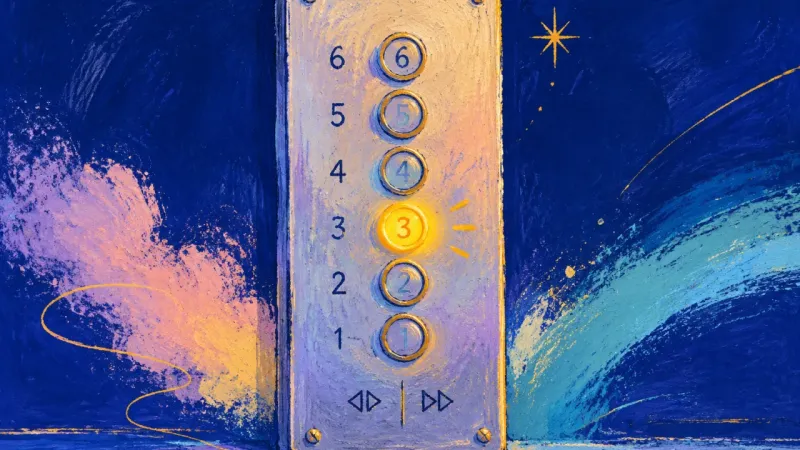
And because Jordan’s spread had that staff section “climbing floors,” I gave them my favorite visualization: “When you feel the urge to spiral, picture an elevator. Floor 1 is the feed. Floor 2 is the chain tug. Floor 3 is your metric. Press the button for the floor you actually want. You don’t have to take the stairs through everyone else’s highlight reel.”
A Week Later: Quiet Proof, Not a Viral Post
Eight days later, Jordan messaged me. No long paragraph—just a screenshot and two lines.
It was a timer screen: 10:00. Under it, a note that said, “First thought: ‘I’m behind.’” And below that, a folder on their laptop titled Proof with one doc inside: “Campaign Teardown – Draft.”
“Closed the app mid-scroll,” they wrote. “Did 15 minutes on the doc instead. Still felt twitchy. Slept anyway.”
That was the proof I care about. Not that envy disappeared. Not that their coworker’s post stopped existing. But that the chain loosened—just enough for Jordan to choose.
In my work, whether I’m guiding people under a dome of stars in Tokyo or reading cards across time zones, clarity almost never arrives as a cinematic breakthrough. It shows up as a small, steady reclaiming of attention—moving from “my worth is public” to “my progress is trackable.”
When someone else’s promotion goes viral in your feed, it can feel like your chest tightens around one brutal thought: if your progress isn’t visible, it must not be real—and that’s a scary place to store your worth.
If you didn’t need LinkedIn to prove you’re on track for the next two weeks, what’s one quiet metric you’d actually trust?
Every reading at AceTarot is a Journey to connect with inner wisdom and empower next step.
Learn more about our Journey to Clarity.