From Career-Story Self-Doubt to Calm Ownership in Your Next 1:1

The Tuesday-Night “Career Story” Spiral
You leave a totally normal 1:1 in Toronto and the second your manager says “What’s your career story?”, your brain starts running like it’s a performance review—hello, Sunday Scaries energy, but on a Tuesday.
Jordan (name changed for privacy) sank into the chair across from me and let out a breath that sounded like it had been held since lunch. They were 28, sharp, put-together in that corporate/tech-adjacent way—clean tote bag, laptop charger wrapped perfectly—but their hands kept doing the same small restless thing: thumb to fingertip, thumb to fingertip, like they were silently rewriting something.
They described the scene before I even asked. “It was 8:41. Monday. Condo living room. Overhead light off. Laptop on my knees. Streetcar noise through the window. Slack pinged twice. I opened a doc literally titled Career Story and rewrote the first sentence again. And again.”
I could hear it: the TTC hum muffled like distant static, the little electronic chirp of Slack, the soft scrape of a trackpad. I could almost smell the faint takeout sweetness that lingers in a room after you’ve stopped tasting your dinner and started tasting your own thoughts.
“My manager isn’t mean,” Jordan said, staring at a spot on my table as if the grain might offer an answer. “But the question feels like a trap. Like… if my timeline isn’t impressive and linear, I’ll look incompetent. So I keep polishing. I keep trying to make it sound intentional. And it just gets… colder.”
Self-doubt, for them, wasn’t a concept. It was a tight throat and chest—like every plain sentence had to squeeze through a narrow doorway while an invisible committee graded the wording. It was restless hands that wanted to reformat a heading because formatting felt safer than choosing a direction.
“I’m Hilary Cromwell,” I told them, keeping my voice steady, more companion than lecturer. “My work—tarot included—isn’t about handing you a verdict. It’s about helping you find clarity in the parts that go foggy when authority shows up. Let’s make a map of this—so your manager’s question stops being a courtroom scene in your head and becomes a real conversation you can steer.”

Choosing the Compass: The Four-Layer Insight Ladder
I asked Jordan to take one slow breath—not as a ritual for the universe, but as a mechanical reset for the nervous system. Then I shuffled, deliberately and quietly, until the click of the cards sounded like something you could count on.
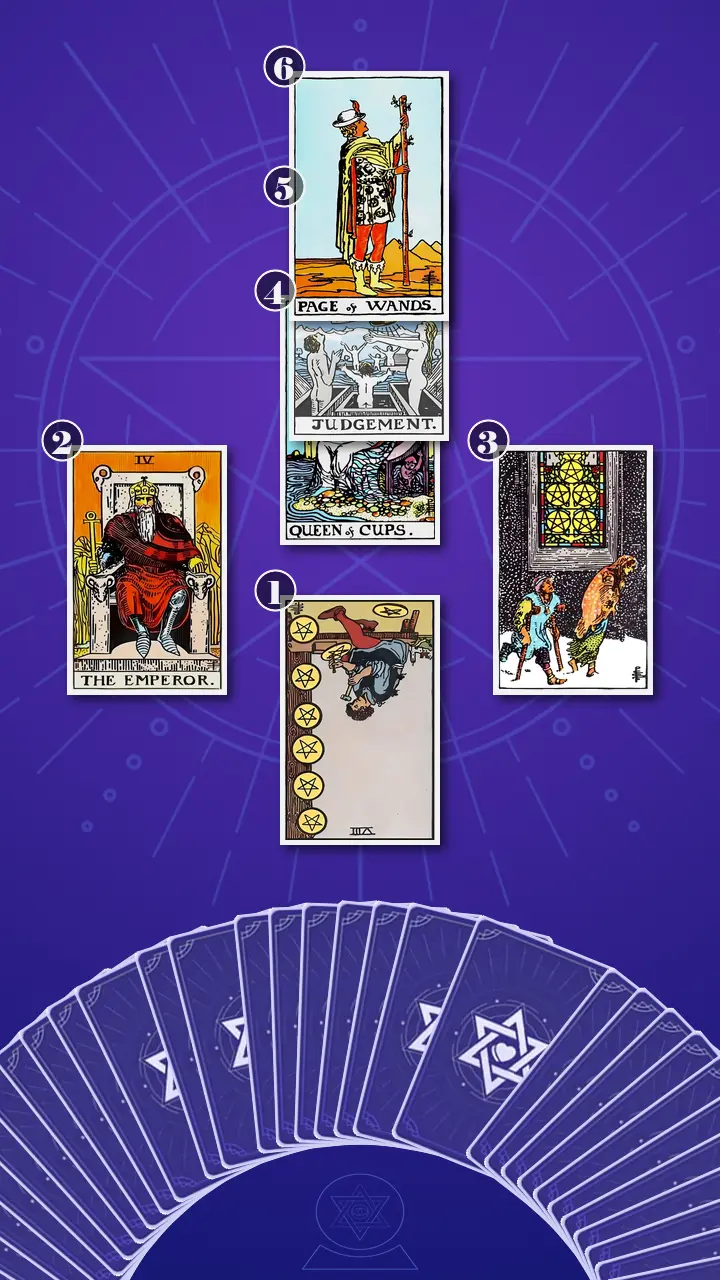
“Today we’ll use a spread I call the Four-Layer Insight Ladder · Context Edition,” I said, laying the idea out plainly. “It’s built for workplace moments that look simple on the surface—like ‘Tell me your career story’—but hit deeper layers: pressure, belonging, self-worth.”
For anyone reading along who’s ever Googled why does ‘tell me your career story’ feel like a test?—this is exactly why the Ladder works. It separates the symptom (the spiral) from the trigger (the authority lens) and the root (the belonging wound), then walks you upward into a usable reframe and next steps. Minimal cards, coherent arc: symptom → pressure → root → resource → transformation → action.
“We’ll climb it,” I added, tapping the table where each position would land. “First: the visible stuck point—what you do in that Google Doc. Second: the authority lens—the internal rubric you think you’re being graded against. Third: the self-worth root—what this question awakens underneath. Fourth: your regulating resource—what helps you stay connected to truth while being seen. Then the turning point. Then a grounded, this-week action.”
Reading the Rungs: Card Meanings in Context
Position 1 — The Visible Stuck Point
“Now we turn over the card that represents the visible stuck point: the specific behavior and mindset that shows up when you try to tell your career story.”
Eight of Pentacles, in reversed position.
In the classic image, a craftsperson bends over a bench, carving pentacles one by one—tools laid out, work nearly obsessive in its repetition. Reversed, that devotion can flip: practice becomes self-worth labor.
“This is that loop,” I said, and I didn’t soften it, because naming it clearly is kindness. “You sit down to write a simple ‘career story’ for your manager, but you end up changing verbs, reformatting headings, tweaking tone to sound more ‘strategic.’ It looks productive. But it’s not progress—it’s a way to feel safe. Like: If I just tighten this one line… then I’ll be allowed to hit send.”
I mirrored the micro-behaviors out loud: the cursor blinking in Google Docs like a tiny metronome of judgment; the trackpad smear; the brief dopamine hit when you swap “transitioned” for “strategically shifted”; and then the sinking feeling when the sentence still doesn’t feel survivable.
Jordan let out a quick, uncomfortable laugh—sharp at the edges, a little bitter. “Yeah,” they said. “That’s exactly what I do. Which is… kind of brutal to hear.”
“Brutal,” I agreed, “and also precise. Precision gives us leverage. Reversed Eight of Pentacles doesn’t say you lack skill. It says your skill is being used to sand down your own humanity.”
I caught myself thinking—an academic flashback, brief and uninvited—of grant applications at Cambridge: brilliant people rewriting one paragraph until it became unreadable, trying to appease an imagined reviewer. The tragedy wasn’t a lack of merit. It was the belief that merit only counts if it’s formatted perfectly.
Position 2 — The Authority Lens
“Now we turn over the card that represents the authority lens: what you believe you must project to be taken seriously—the internalized manager, the standard-setter.”
The Emperor, upright.
The Emperor sits on a stone throne. There’s armor under the robe. Everything about him says: rules, structure, evaluation.
“This is the tab you don’t realize is always open,” I said. “Your inner Emperor. The invisible performance rubric.”
Then I did the translation the way I’d do it for any modern workplace: leveling frameworks, promotion packets, competency matrices—those bullet-point ghosts that haunt a 1:1 even when the manager’s tone is kind.
“Here’s the two-column truth,” I told Jordan. “What was asked: ‘Where do you see yourself going?’ What your nervous system heard: ‘Demonstrate certainty, leadership potential, and a ten-year plan. Prove you’re strategic. Prove you belong.’”
Jordan nodded, tense, like the nod came from their jaw rather than their neck. “Exactly. I hear ‘strategic’ and I start performing. I over-explain. I add context no one asked for.”
“Polish isn’t the same thing as clarity,” I said, letting the sentence land with the weight of a gavel—except in this room, it wasn’t a condemnation. It was a release.
Position 3 — The Self-Worth Root
“Now we turn over the card that represents the self-worth root: the deeper belief about belonging and value that the question activates.”
Five of Pentacles, upright.
Two figures in snow. A lit window. Warmth visible, but not entered.
“We’re in a Toronto winter metaphor whether we like it or not,” I said softly. “This card is that feeling of being outside the ‘lit office’ of legitimacy—even when you are literally employed there.”
I watched Jordan’s throat move as they swallowed. “Yeah,” they said, quieter now. “It turns into… do I belong here? And then I start ‘applying’ to belong by making my story perfect.”
“Exactly,” I replied. “Your inner operating system says: Everyone else got the invitation to be confident; I’m applying for it. So you assume a clean timeline is the ticket inside. You discount praise because it doesn’t feel like proof. And any non-linearity becomes evidence for the prosecution.”
Jordan went still for a beat—one of those pauses where you can tell the thought has made it past the defenses. Their fingers stopped tapping. Their shoulders stayed high, but the fight in their eyes softened into recognition.
Position 4 — The Regulating Resource
“Now we turn over the card that represents the regulating resource: what helps you stay connected to truth while being seen by authority.”
Queen of Cups, upright.
The Queen holds a covered cup: feelings and meaning contained, not for public approval—simply held.
As I spoke, the room felt quieter, like a podcast had been turned down in another apartment. I imagined tea cooling on a side table; the pace of everything slowed half a notch.
“This is the pivot from ‘How do I sound?’ to ‘What is true?’” I said. “Queen of Cups doesn’t ask you to overshare. She asks you to treat your values and what you’ve learned as legitimate data. Your story gets simpler and warmer, not because you add achievements, but because you stop arguing with an imaginary critic.”
Jordan’s shoulders dropped slightly—just a centimeter, but it mattered. Their exhale was longer. “That actually feels… doable,” they said. “Like I don’t have to pitch a persona.”
“You’re not writing a press release about your life,” I replied, “you’re trying to name a direction.”
When Judgement Spoke: A Trumpet, Not a Gavel
Position 5 — The Key Transformation
I let my hand hover for a moment over the next card. Not for drama—because I could feel, in the way Jordan was holding their breath again, that we were approaching the hinge of the whole reading.
“Now we turn over the card that represents the key transformation: the perspective that breaks the worth=performance loop and reclaims authorship.”
Judgement, upright.
An angel with a trumpet. Figures rising—not to be sentenced, but to be called into a new chapter.
Setup: Jordan was still caught in that couch-after-a-long-day moment—the laptop open, the same sentence rewritten for the tenth time. Their throat tightened because one wrong word could “prove” something. In their mind, the manager’s question had become a trial, and the only safe answer was a flawless defense.
Delivery:
Stop chasing a flawless verdict on your past and start answering the trumpet call of Judgement by naming your next chapter out loud.
I paused. The silence was clean, like snow before footprints.
Reinforcement: Jordan’s face changed in layers. First, a tiny freeze—eyes fixed on the card, breath held. Then the focus slipped, as if an old memory replayed: their manager’s neutral tone, their own body bracing, the mental courtroom assembling itself. Finally, something released. Their eyebrows lifted a fraction; their mouth opened, closed, then opened again on a quiet, disbelieving exhale.
“But…,” Jordan began, and there it was—an unexpected flash of anger, not at me, but at the years of pressure. “If I stop defending it, doesn’t that mean I was wrong before? Like I should’ve had the plan?”
I nodded slowly. “That question is the last grip of the inner Emperor,” I said. “And here’s what I know—from archaeology, from history, from any honest life: people rarely walk straight lines. They trade. They pivot. They adapt. The story is never ‘I had a perfect plan.’ The story is ‘I learned what I’m built to do next.’”
This was where my Skill Archaeology lens came naturally. “In excavation, the most valuable information is often not the artifact itself, but the strata—the layers of choices that brought it there. Your pivots aren’t mess. They’re layers. We’re not trying to authenticate you as ‘worthy.’ We’re unearthing the through-line you’ve been living.”
I leaned in, gentle but direct. “Now, with this new frame, look back at last week. Was there a moment—writing that doc, rewriting that Slack message—where this could’ve helped? Where instead of defending, you could’ve said, plainly: ‘The through-line is… and I’m leaning toward…’?”
Jordan blinked hard, eyes a little wet but not collapsing. “Wednesday,” they said. “After the 1:1. I opened LinkedIn and saw a promotion post and immediately tried to rewrite myself. If I’d thought ‘call, not verdict’… I would’ve closed it. I would’ve written what I actually want.”
“That,” I said, “is the shift: from tight self-editing and approval-driven self-doubt to calm ownership of a simple, directional through-line. Not perfect certainty. Ownership.”
Position 6 — The Grounded Next Step
“Now we turn over the card that represents the grounded next step: a simple way to communicate your story as an experiment and move forward this week.”
Page of Wands, upright.
The Page holds a wand like a prototype—alive, sprouting, not finished.
“This is ‘v0.1,’” I said. “A first draft you ship on purpose. In modern terms: you bring one forward-facing sentence into your next 1:1. You treat your career story like a testable hypothesis. Clear enough to support—not perfect enough to hide behind.”
I pictured the micro-scene as I spoke: Jordan opening the shared 1:1 agenda doc, typing one line at the top, feeling that ‘cringe alarm’ flare, and doing it anyway.
Jordan’s expression shifted into something that looked like bravery in its earliest form—small, sparky. “I could actually say that out loud,” they admitted. “If I don’t add ten disclaimers.”
“If it needs ten disclaimers to feel safe,” I said, “it probably needs one truer sentence instead.”
The One-Page Ladder: Actionable Advice for Your Next 48 Hours
I gathered the thread of the whole ladder for Jordan—and, honestly, for anyone who’s ever searched how do I answer ‘Where do you see yourself going?’ without panicking?
“Here’s the story the cards told,” I said. “You’re not stuck because you lack substance. You’re stuck because the Eight of Pentacles reversed turns drafting into a self-worth proving ground. The Emperor makes your manager’s question feel like an exam graded by a competency matrix. The Five of Pentacles adds a quiet fear: ‘If my path looks non-linear, I’m outside the warm room.’ The Queen of Cups restores steadiness—truth before performance. Judgement flips the entire frame from verdict to call. And Page of Wands says: test it in reality. Ship the prototype.”
“Your cognitive blind spot,” I continued, “is believing that if you can just polish the narrative enough, you’ll finally feel legitimate. But legitimacy doesn’t arrive from better adjectives. It arrives when you claim a direction and let the conversation support it.”
Then I offered what I call, in my own toolkit, Megalith Transport: the ancient truth that you don’t move a huge stone by trying to lift it all at once. You move it with rollers, levers, and small coordinated pushes. Career clarity works the same way—especially when you’re feeling stuck and dealing with decision fatigue.
- The 24-Hour No-Edit Two-Sentence StoryTonight, write a two-sentence career story in a notes app (not your resume doc). Sentence 1: what you’ve been doing + what you’ve learned. Sentence 2: what you’re leaning toward next. Paste it at the top of tomorrow’s 1:1 agenda document.Expect the “cringe alarm.” That’s perfectionism trying to keep you safe. Set a timer for 10 minutes and stop when it ends—no deleting, no LinkedIn tab.
- The Through-Line Sentence (Imperfect on Purpose)Write one line that starts with: “The through-line is…” Name a skill/value/problem you like solving (not a job title). Leave it slightly rough—like a field note, not a press release.Before you edit, ask: “Am I clarifying—or am I trying to feel safe?” If it’s safety, make the next change smaller, not shinier.
- The Prototype-First 1:1 ScriptIn your next 1:1, say one forward-looking sentence out loud: “Next, I’m exploring ___ because ___.” Then stop talking for two seconds. Let your manager respond—turn evaluation into support by asking: “What opportunities would help me test that direction?”Use soft-but-directional language: “I’m leaning toward…” “I’m exploring…” You’re allowed to be professional and still human.
Jordan looked at the list the way people look at a door they hadn’t realized was unlocked. “So I don’t need the perfect story,” they said slowly. “I need a true enough signal.”
“Yes,” I replied. “A signal you can iterate. The goal isn’t to sound linear—it’s to sound clear.”

A Week Later: Ownership, Not Certainty
A week later, Jordan sent me a message. No long explanation. Just a screenshot of their phone notes—three lines, a little blunt, undeniably human. Under it they wrote: “I said the forward-looking sentence in my 1:1. My voice shook for half a second. Then I stopped talking like you said. And… my manager actually helped. I slept through the night.”
I could picture the bittersweet quiet of it: the clarity wasn’t fireworks. It was a normal morning with less dread. They still woke up with one flicker of “What if I’m wrong?”—but this time, instead of spiraling into LinkedIn as an algorithmic mirror, they breathed and returned to the through-line they’d claimed.
That’s what this journey to clarity often looks like in real life: not a final answer, but a steadier relationship with your own direction—calm ownership instead of constant self-prosecution.
When someone asks for your “career story,” it can feel like your throat tightens because you’re not just choosing words—you’re trying to prove you deserve to be here without showing any messiness.
If you let your story be a simple through-line instead of a flawless defense, what’s one sentence you’d be willing to say out loud this week—just as a starting point?