"Jordan can take that"—And the moment I stopped fixing it in DMs

Finding Clarity When Your Coworker Volunteers You in Meetings
If you’re the project coordinator who keeps your camera on, smiles politely, and still feels your jaw clamp shut the second someone says “Jordan can take that” in front of leadership—welcome to the meeting version of people-pleasing.
Jordan (name changed for privacy) showed up to our session from Toronto with the kind of polite posture that looks calm until you notice the tiny tells: shoulders sitting just a little too high, a jaw set like they were holding something back, even while they said, “It’s not a huge deal. It’s just… it keeps happening.”
They described 8:57 AM on a Monday in a glass-walled meeting room downtown, their laptop fan running hot, the conference speaker giving off that faint static hiss. Google Meet grid on one screen, Slack on the other. Leadership watching. Then the coworker—quick, charismatic, always sounding confident—drops it: “Jordan can take that.”
Jordan’s stomach did that elevator-drop. Their face did what it always does: the camera-friendly smile, a polite nod. Inside, everything screamed, Wait, I didn’t say yes.
And the stress wasn’t abstract. It was physical: that tight jaw and shoulders during the meeting, the wired-but-flat feeling afterward—like their body was still lit up with adrenaline, but their mood had already gone numb. “Then I spend an hour writing a DM that says ‘just to clarify…’ and then I still do the work so no one can say I dropped the ball.”
I let that land, then said, gently and plainly, “You’re not failing at boundaries—you’re doing them in private, after the damage is done.”
Jordan’s eyes flicked down like I’d just read their Notion page out loud.
“Let’s make this a Journey to Clarity,” I told them. “Not a personality overhaul. A map. Something you can actually use in the next meeting—while the room is watching.”

Choosing the Compass: The Energy Diagnostic Map (7) for Workplace Boundaries
I asked Jordan to take one slow breath—nothing mystical, just a nervous-system reset. Then I shuffled while they held the question steady: Coworker keeps volunteering me in meetings—how do I set boundaries without seeming difficult?
“Today,” I said, “I’m going to use a spread I built for patterns like this: the Energy Diagnostic Map (7) · Context Edition.”
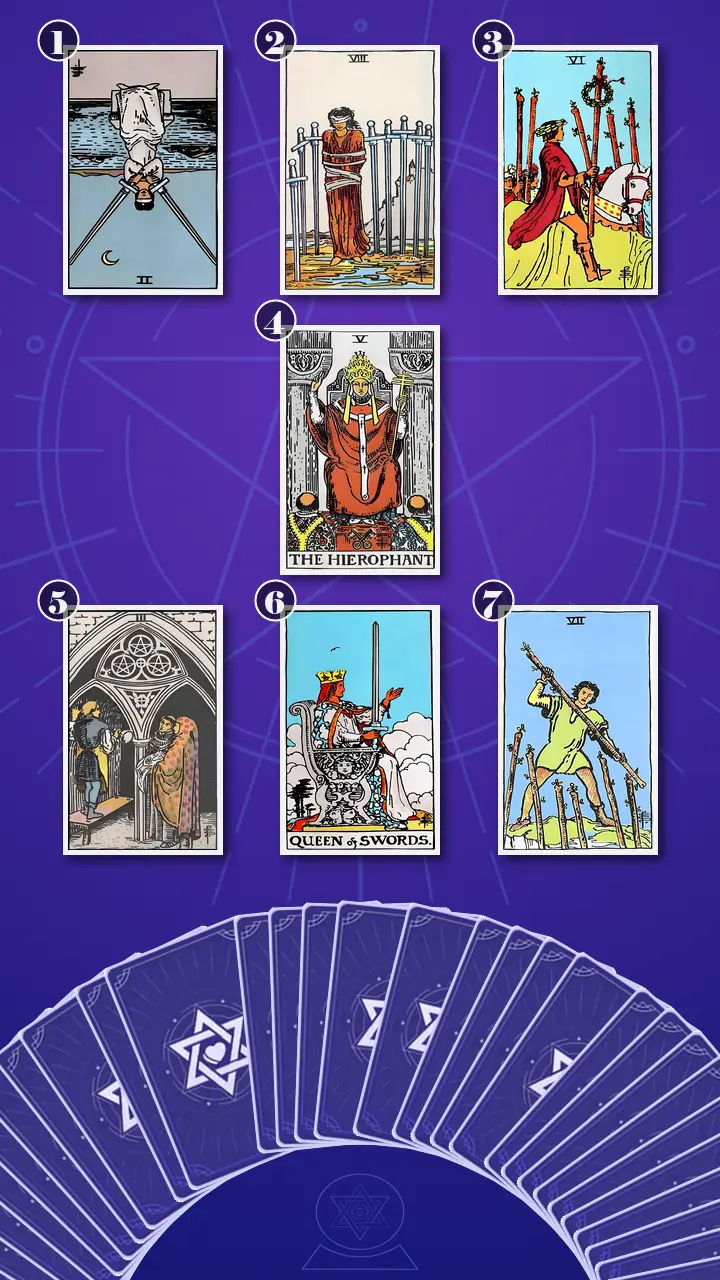
Here’s why this spread works for a career crossroads moment that isn’t really a crossroads—it’s a loop. This problem is happening in public (meetings), but it’s maintained in private (the after-the-fact clean-up). The map moves in a tight sequence: surface symptom → inner tug-of-war → external reinforcement → core blockage → usable resource → key transformation → next step. It treats boundary-setting as a skill you practice, not a one-time verdict.
I pointed to the layout as I placed the cards: “We’ll look at the exact in-meeting behavior first. Then what freezes you inside. Then what your environment rewards. Card 4 is the center—the deeper rule that keeps the pattern alive. And we’ll finish with language and a move you can use in the room.”
Reading the Map: When the Room Feels Like a Stage
Position 1: The moment you go silent
“Now turning over,” I said, “is the card that represents Capture the exact in-meeting behavior pattern where you get volunteered and don’t correct it in real time.”
Two of Swords, reversed.
This card always makes me think of a muted mic. And in Jordan’s life, it was painfully literal: the meeting moment where your face stays neutral and agreeable while your internal alarm goes off. Someone volunteers you, you nod to keep the vibe smooth, and you tell yourself you’ll ‘clarify later’—even though you can already feel your calendar taking the hit.
Reversed, the energy isn’t balance—it’s blockage. Communication isn’t absent because you have nothing to say. It’s absent because your system is trying to protect you from the social impact of saying it.
I described it the way it happens: camera on, leadership watching, Slack open. Your coworker speaks like they’re doing everyone a favor. You keep your face soft. Inside: Don’t make it weird. I’ll fix it later. Then the meeting ends and your fingers start typing three versions of “just to clarify…” while your stomach is still dropped and your shoulders are still up by your ears.
Jordan let out a small laugh that didn’t have much humor in it. “Wow,” they said. “That’s… exactly it. It’s almost mean how accurate that is.”
I nodded. “It’s not mean. It’s honest. And honesty is useful.”
Position 2: The push-pull inside you
“Now turning over,” I said, “is the card that represents the internal conflict between protecting time/role clarity and protecting social standing in the room.”
Eight of Swords, upright.
This is the no-win story card. The modern-life scenario is exactly what Jordan already told me: every option feels bad—speak up and you’ll look uncooperative, stay quiet and you’ll be overworked, DM later and you’ll feel sneaky.
Upright, it’s a contraction—not because there are truly no choices, but because fear narrows the menu until it looks like “suffer now” or “suffer later.”
I told Jordan, “Listen to the way your thoughts stack, like a browser with too many tabs open:”
If I speak up, I’m difficult.
If I don’t, I’m stuck.
If I DM, it’s sneaky.
Then I punctured it with one real option: “A clarifying question in the room creates choices. It’s not confrontation—it’s coordination.”
Jordan’s reaction came in three tiny steps: their breath caught (like a brief freeze), then their eyes unfocused for a second as if replaying last week’s standup, and finally their shoulders dropped with a quiet exhale. “So I’m not… dramatic,” they said. “My brain is just trapping me.”
“Exactly,” I said. “Your nervous system is trying to keep you belonging.”
Position 3: What the environment rewards
“Now turning over,” I said, “is the card that represents the meeting culture dynamics that reward quick agreement and public competence.”
Six of Wands, upright.
Meetings, under this card, aren’t just meetings. They’re a stage. The modern-life scenario is that performative, fast, confident vibe—especially when leadership is present—where helpfulness becomes reputation currency.
Upright, the energy is excess visibility. The “crowd watching” isn’t imaginary; it’s the Slack recap thread that becomes a scoreboard. Your coworker volunteering you can land like a tiny applause line, and the room keeps moving before you can even locate your voice.
Jordan’s mouth tightened at that. “It’s like… if I correct them, I’m breaking the flow. And everyone loves the flow.”
“Right,” I said. “And the ‘flow’ is costing you your evenings.”
My own mind flashed—quickly, involuntarily—to Wall Street: a room where confidence is mistaken for truth, and whoever speaks fastest controls the narrative. Not because they’re right, but because they’re loud. “This isn’t you being weak,” I said. “It’s your environment rewarding speed and certainty over accuracy.”
Position 4: The rule you’ve been living by
“Now turning over,” I said, “is the card that represents the underlying rule you’re following about being ‘good’ at work that prevents direct boundaries.”
The Hierophant, upright.
This is where the story stops being about the coworker’s behavior and starts being about the script Jordan is obeying. The modern-life scenario is that unwritten workplace rule: Good teammates don’t correct people in public. They keep things smooth.
Upright, The Hierophant is structure—but here it’s structure that has become a silent contract you didn’t sign. It’s the office’s default settings. It can look like “professionalism,” but it’s actually self-erasure in a blazer.
I pointed to the keys at the base of the card. “This is the part of you that believes politeness is safer than accuracy.”
Jordan swallowed. Their hands—resting on their mug—tightened and then loosened. “I hear my own voice in my head saying: ‘Don’t embarrass them. Don’t be the problem.’”
“That’s the script,” I said. “And scripts can be rewritten.”
Position 5: The resource you can actually use
“Now turning over,” I said, “is the card that represents a collaborative, practical way to reset ownership and workload so boundaries feel legitimate rather than personal.”
Three of Pentacles, upright.
Relief lives in this card because it’s not asking you to become a different person. It’s offering process. The modern-life scenario is a simple, end-of-meeting checkpoint: owner, timeline, capacity—said out loud, written down, confirmed.
Upright, this is balance and craftsmanship. It says: your boundary doesn’t have to be a personal confrontation; it can be a system upgrade. The blueprint on the card is the shared agreement that makes “volunteered” stop masquerading as “confirmed.”
I used one of my favorite anchor lines here: “Clarity is not conflict. Clarity is coordination.”
Jordan’s face changed—barely, but meaningfully. Their eyebrows lifted as if a door had opened. “That actually sounds… normal,” they said. “Like something a team would do anyway.”
“Exactly,” I said. “You’re not asking for special treatment. You’re asking for accurate ownership.”
When the Queen of Swords Held the Room
Position 6 (Key Transformation): The sentence that breaks the loop
When I reached for the next card, the room got quieter—not in a spooky way, in the way it does when a truth is about to have to fit into a single sentence.
“Now turning over,” I said, “is the card that represents the communication stance and boundary language that directly breaks the ‘volunteered-by-default’ pattern.”
Queen of Swords, upright.
The modern-life scenario is precise: the moment you stop trying to be perfectly likeable and choose clean truth. Calmly: “I can’t take that on this week. I can do X, or we can find another owner.” No apology spiral. No debate-by-essay. Just clarity—and a pause.
Upright, the Queen’s energy is clean direction. Not harshness. Not coldness. A boundary that’s firm because it’s accurate.
And here’s the setup I named out loud: Jordan was still trapped in the call-moment—the jaw-clench + stomach-drop combo—while their polite smile stayed glued on, trying to find a perfect diplomatic speech fast enough to outrun the discomfort.
Not “I have to be agreeable to be safe,” but “I can be clear and still be respected,” like the Queen of Swords who sets the line with a steady gaze and a clean sentence.
I let it hang there for a beat.
Jordan’s reaction came like a wave in three parts. First: their body went still—breath paused, chin slightly lifted, as if their system didn’t trust what it was hearing yet. Second: their eyes got glossy, not dramatic, just that sudden heat behind the eyes that comes when something shifts from “concept” to “permission.” Third: the release—shoulders lowering, jaw unclenching, a shaky exhale that sounded like relief and grief mixed together.
“But if I do that,” Jordan said, and the edge in their voice surprised even them, “doesn’t it mean I’ve been… wrong this whole time?”
It was anger, but not at the coworker—not even at themselves. Anger at how much quiet labor they’d donated to keep rooms comfortable.
I kept my tone steady. “It doesn’t mean you were wrong. It means you were protecting belonging with the only tool that felt safe: silence. The Queen of Swords isn’t here to shame you. She’s here to upgrade the tool.”
This is where I brought in my Mondrian Grid Method—my artist brain’s way of making messy dynamics usable. “Mondrian painted order out of chaos with clean lines,” I said. “We’re going to do that with your boundaries. Three boxes. No poetry.”
Box 1: What I can own. (One deliverable.)
Box 2: What I can support. (Review, intro, template, 15 minutes of context.)
Box 3: What I can’t take on. (Any new ownership this week.)
“In the meeting,” I continued, “you’re not giving your whole life story. You’re placing the task into the right box. That’s it.”
Then I asked the question that locks the insight to real life: “Now, with this new lens—can you think of last week’s meeting? A moment where one clean sentence would’ve changed how you felt for the rest of the day?”
Jordan nodded slowly. “The standup on Monday. I could’ve said, ‘I’m at capacity for new ownership, but I can review a draft.’ And then… stopped.”
“Yes,” I said. “One clean sentence + one alternative. That’s it.”
And I named the emotional transformation directly, so it didn’t stay theoretical: “This is the move from braced, reputation-driven silence to calm, in-the-room clarity and self-respect.”
Position 7: Holding the line when the room pushes
“Now turning over,” I said, “is the card that represents a concrete, in-the-moment move you can use in the next meeting to hold the boundary calmly.”
Seven of Wands, upright.
The modern-life scenario here is the follow-through: someone tries to re-volunteer you after you’ve set the boundary. You repeat the line once, keep your tone even, and don’t get pulled into a long justification.
Upright, this is steadiness under pressure. Not aggression. Higher ground as self-respect and capacity management.
I looked at Jordan and said, “Repeat the boundary once. Don’t write an essay with your mouth.”
They laughed—this time with a little oxygen in it. “I do write essays with my mouth,” they admitted.
“Most people-pleasers do,” I said. “And you don’t have to sound perfect to be accurate.”
From Insight to Action: The 5-Second Boundary That Changes the Slack Recap
I pulled the whole spread into a single, practical story for Jordan:
“You’ve been living a pattern where you go silent in the exact moment your time gets assigned (Two of Swords reversed), because inside you believe every option will cost you belonging (Eight of Swords). The environment makes it worse by rewarding public helpfulness and fast agreement (Six of Wands). Underneath, you’re following an inherited rule that ‘good coworkers don’t correct people in public’ (The Hierophant). The way out isn’t a confrontation—it’s a craft: make ownership structural (Three of Pentacles), speak one clean sentence in the room (Queen of Swords), and hold it once if someone pushes (Seven of Wands).”
The cognitive blind spot was clear: Jordan had been treating public accuracy as optional and private clean-up as professionalism. But the spread asked for the opposite: professionalism as clarity, in the room, while it’s being written into the team’s reality.
“So the transformation direction,” I told them, “is exactly this: shift from fixing it privately afterward to naming the boundary calmly in the moment with one clear sentence and one alternative.”
Then I gave Jordan concrete next steps—small enough to start, specific enough to repeat.
- The “Clean Sentence” Note (before the meeting)Open your meeting notes and put one line at the very top: “I can’t take that on this week. I can do X, or we can find another owner.” Keep it visible during the call so you can read it if you freeze.If your voice shakes, read it verbatim. No improvising required—think of it like Oscars Speech Training: a 2-minute script you can deliver under pressure.
- The 5-Second Scope Question (in the moment)When someone says “Jordan can take that,” respond within five seconds with: “Quick check—what’s the timeline and what would I be owning?” If it’s not workable, follow with your clean sentence + one alternative.If over-explaining kicks in, allow one reason max (“I’m at capacity”), then go straight to the alternative and stop talking.
- Correct the Record Where It Was Created (recap thread)If your name still gets attached in the Slack action-items recap, reply publicly and briefly: “Confirming owner: [Name]. I can support with [specific small support] by [date].”Lower the difficulty: do it once in a low-stakes meeting first. You’re not calling anyone out—you’re keeping the tracker accurate.

A Week Later: Ownership, Not Certainty
Six days later, Jordan sent me a message. It wasn’t triumphant. It was quiet—the kind of proof I trust.
“It happened again,” they wrote. “They said my name. I felt the stomach drop. But I asked the timeline/owner question. Then I said the sentence. My voice shook, but I didn’t apologize. And… nobody made it a thing. The recap had the right owner.”
They added, “I still felt weird after. But I didn’t spend my evening cleaning it up.”
That bittersweet contrast mattered: they didn’t become fearless; they became clear. They didn’t win the room; they stopped donating themselves to keep it smooth.
Later that night, Jordan sat alone at their kitchen table with a half-eaten dinner—same laptop glow, same weekday fatigue—except this time there was no secret task to fix. They stared at the empty Slack thread for a moment, then exhaled like their body finally believed them.
In my work, this is what a real Journey to Clarity looks like: not a dramatic personality change, but one clean sentence delivered in the room that used to mute you.
When your name gets used as a yes in a room full of watching faces, it’s not just the workload that hits—you can feel your body brace, because part of you is trying to protect belonging by staying silent.
If you let yourself believe you can be clear and still be respected, what’s the smallest sentence you’d want to try in the next meeting—just once, just to see how it lands?
Every reading at AceTarot is a Journey to connect with inner wisdom and empower next step.
Learn more about our Journey to Clarity.