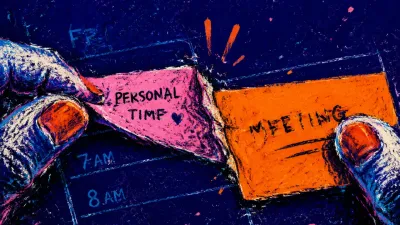
The Note-Taker Trap at Work—and the Fair Rotation I Asked For
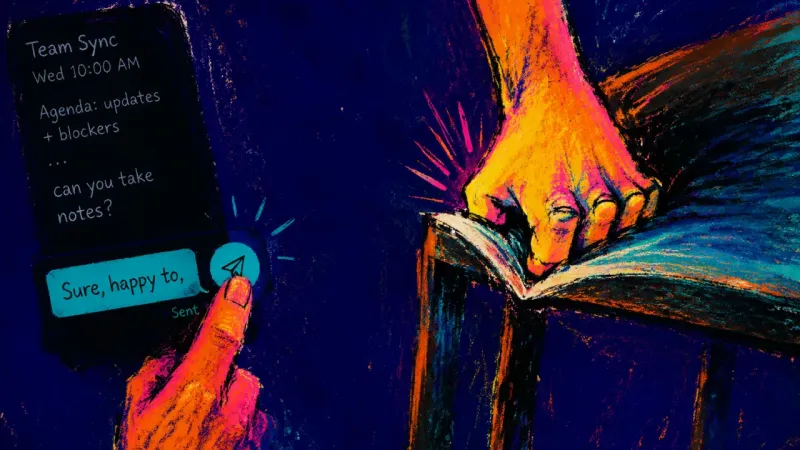
Finding Clarity in the 8:41 a.m. Calendar Invite
You’re an early-career coordinator in London and the meeting invite lands with “can you take notes?” tacked on like an afterthought—instant jaw-clench, instant “sure,” instant resentment (hello, office housework).
Taylor (name changed for privacy) said that to me like it was a confession and a résumé line at the same time. She’d booked our session in the thin slice of time between two recurring meetings, the kind that multiply on your calendar like damp in an old flat: quietly, then all at once.
She described the exact moment: 8:41 a.m., Wednesday, Shoreditch coworking space. Fluorescent lights with that faint electrical hum. Coffee that tasted slightly burnt—Pret as coping mechanism, she joked, but her mouth didn’t quite smile. She opened the invite, saw the sentence at the bottom, and her thumbs hovered over Slack as if her body already knew what her brain hadn’t agreed to yet.
“I type, ‘Sure, happy to,’ before I even decide,” she said. “And then my shoulders are basically earrings.”
The frustration wasn’t loud. It was dense. Like trying to swallow with a throat that’s decided it’s safer to stay tight. She wanted to be known for her thinking—stakeholder judgment, coordination, the work that actually moves projects—and yet she kept being nudged into the role of default scribe, the keeper of the Google Doc edit history: her effort everywhere, her name nowhere headline.
What she was really asking me, beneath the note-taking question, was this: how do you set a boundary with a friendly manager without making it awkward forever? How do you say no professionally when the request is framed like “no big deal,” but it eats your evenings and quietly reshapes your professional identity?
I leaned forward a little, softening my voice the way I do when someone has been carrying resentment in silence so long it’s started to feel like muscle memory. “We can find clarity here,” I said. “Not a pep talk. A map. Because you’re not ‘overreacting’—you’re reacting to a pattern.”

Choosing the Compass: The Six-Card Cross Spread for Workplace Boundaries
I asked Taylor to take one slower breath before we touched any cards—not as theatre, but as a switch in the nervous system: from reacting to observing. I shuffled deliberately, the way I used to sort pottery sherds on a dig table—patient, consistent, letting the story reveal itself through structure rather than urgency.
“Today I’m going to use a spread called the Six-Card Cross,” I said.
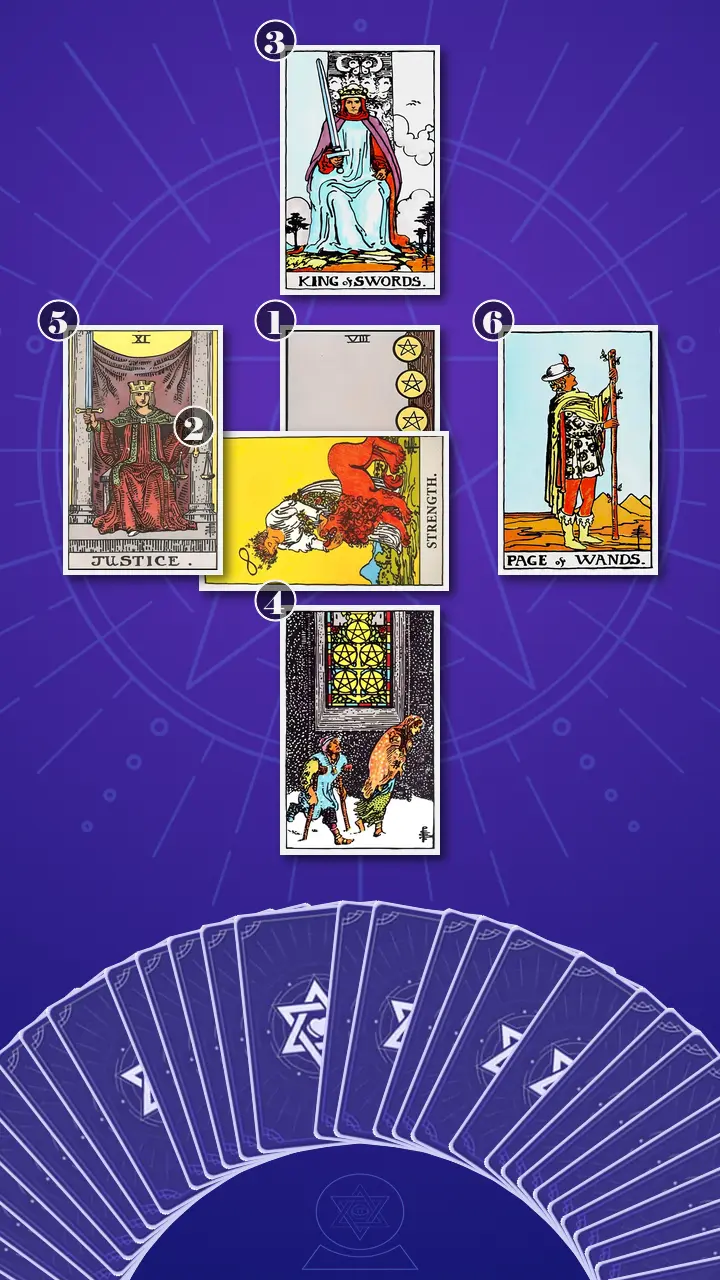
For you reading this: this spread works well for workplace boundaries because it separates what’s happening on the surface from what’s driving it underneath. Card 1 and 2 show the visible pattern and the real-time block—why you keep saying yes even when you don’t want to. Card 4 drops below the surface into the root driver (often fear of exclusion or being judged). And Card 5 gives us the most powerful part of this kind of question: a values-based reframe and language you can actually repeat in Slack without sounding like an HR handbook.
In other words: it’s a tarot spread for being undervalued at work that doesn’t just diagnose the emotional mess—it gives actionable advice and next steps.
“We’ll name the pattern,” I told her, “then we’ll name the fear that keeps it running, and then we’ll build a process-based boundary you can use more than once.”
Reading the Map: From Glue Work to a Voice You Can Use
Position 1 — The visible work pattern: Eight of Pentacles (upright)
“Now we’re turning over the card that represents the visible work pattern: what’s happening in real life when you’re asked to take notes again, and what role you’re currently occupying,” I said.
The Eight of Pentacles, upright.
This card always makes me think of the person at the workbench—skilled, reliable, producing something neat and useful. In modern office terms, it’s exactly this: you’re the person who always creates the clean meeting doc—headings, bullet points, action items with owners, follow-up emails—work that keeps everything moving but quietly positions you as admin support instead of a contributor with equal standing.
Energetically, the Eight of Pentacles is balance tipping into excess. Competence becomes repetition. Repetition becomes expectation. And expectation becomes a quiet job description no one ever discussed.
Taylor let out a small laugh that sounded like the edge of a sigh. “That’s… brutal,” she said. “Like, accurate. But brutal.”
“It is accurate,” I agreed, “and accuracy is a form of kindness. This isn’t about you being ‘too sensitive.’ This is about your reliability being treated like an infinite resource.”
I asked her the question I ask when someone is stuck at a career crossroads inside a single meeting series: “What are you practising here?” I tapped the card lightly. “Because you’re becoming very practised at being the invisible glue.”
Position 2 — The immediate block: Strength (reversed)
“Now we’re turning over the card that represents the immediate block: what makes it hard to set the boundary in the moment,” I said.
Strength, reversed.
Reversed Strength isn’t weakness. It’s power held back by impression-management. It’s your nervous system hitting safe mode the second you anticipate judgement.
And I could see it as I described it—because Taylor’s jaw tightened just listening, as if her body recognized the script before her mind could argue with it.
“Picture it in real time,” I said. “Camera on. Your lead says, ‘Taylor—notes?’ There’s that half-second pause. And inside you it’s: Say it now… no, don’t make it weird… just do it. Calm boundary versus ‘nice’ compliance.”
This is a blockage—not of logic, but of access. Under social pressure, the words you rehearsed vanish, and the old reflex takes over: “Sure, happy to.”
She winced, then laughed again—smaller this time, like she’d been caught mouthing the exact line. “Yep,” she said. “That’s the moment. My throat just… closes.”
“That’s the card,” I said gently. “Strength reversed is the throat-tightening. Not because you’re incapable, but because you’re trying to be liked and safe at the same time you’re trying to protect your time. Those goals collide.”
Position 3 — Your conscious goal: King of Swords (upright)
“Now we’re turning over the card that represents your conscious goal: how you want to show up professionally when you respond,” I said.
King of Swords, upright.
This card is executive presence without the LinkedIn cringe. Calm, concise, neutral. The raised sword is the one clean sentence that cuts through the fog.
In modern life, it looks like this: you respond like someone with authority, even if you’re early-career: calm, concise, and neutral. Not “I’m sorry, I just have so much on,” but “I’m not able to take notes today—can we assign someone else?” and you let the silence exist.
Energetically, the King is balance: clarity without aggression. He doesn’t plead. He doesn’t over-explain. He states.
I had Taylor imagine two Slack drafts—because that’s where so many workplace boundaries go to die.
“Draft A,” I said, “is a paragraph: ‘Sorry, I’ve got a lot on, and I totally don’t mind helping, but…’ You can feel yourself auditioning for ‘easy to work with.’”
“Draft B,” I continued, “is two lines: ‘I’m not able to take notes today. Can we rotate note-taking for this series?’”
She straightened without realizing it. Shoulders dropped a fraction. A posture shift—not dramatic, but real. “Draft B sounds… like an adult,” she said.
“Exactly,” I replied. “Clarity is not conflict.”
Position 4 — The root driver: Five of Pentacles (upright)
“Now we’re turning over the card that represents the root driver: the deeper fear that gets activated by the request,” I said.
The Five of Pentacles, upright.
This is the card of scarcity and exclusion—the cold outside the bright window. In your life, it’s this: the request triggers a belonging panic. You imagine being subtly punished if you set a boundary. Note-taking becomes your proof-of-safety: ‘If I’m useful, I’ll be kept close.’
I watched Taylor’s eyes shift slightly away from the table—not avoidance, more like her brain running an old film reel.
“It’s wild,” she said quietly. “The second I even think, ‘Can we rotate?’ my brain goes straight to… performance reviews. Being left off projects. London rent. Like it’s all connected.”
That was the scarcity flash-forward in motion: one small boundary turning into a whole imagined exile.
Energetically, the Five is deficiency—not of money or talent, but of felt safety. The system inside you says: don’t risk warmth. Don’t risk belonging. Just be useful.
“You’re not dramatic,” I told her. “You’re pattern-recognizing. In an expensive city, ‘workplace vibes’ can feel like a survival resource.”
And then I said the line I’ve learned to say when someone is stuck in the psychology of optics: “Contribution and compliance aren’t the same thing.”
When Justice Put the Task on the Scales
As I reached for the next card, the room went oddly quiet—like the moment on a dig when the brush hits something that isn’t just dirt. Not treasure, necessarily. But truth.
Position 5 — A fair reframe and language: Justice (upright)
“Now we’re turning over the card that represents a fair reframe and language: the most grounded, values-aligned way to set the boundary,” I said.
Justice, upright.
Here is the shift from “Do they like me?” to “What’s the policy?” In modern office terms: you stop treating note-taking as a personal favour you owe, and start treating it like workload distribution. You say, matter-of-fact: ‘I’ve taken notes the last few times—can we rotate so everyone shares it?’
This is where I bring in one of my own tools—what I half-jokingly call Relic Authentication. In archaeology, you don’t just accept an artifact’s label because someone wrote it on a bag. You verify provenance. You ask: Who assigned this? Why? When did it become “normal”? Because sometimes what looks like tradition is just an unexamined shortcut.
Justice is that verification applied to “office housework.” It asks: is this a fair distribution—or simply the path of least resistance because you’ve proven you won’t push back?
A boundary isn’t a vibe. It’s a process.
Setup. Taylor was caught in the loop: “Can you take notes?” appears like an afterthought. Jaw tightens. Fingers type “Sure, happy to” before consent is even consulted. Later, at 9:30 p.m., she’s formatting action items while her real project work slips into tomorrow.
Delivery.
Stop proving you’re ‘easy to work with’ by carrying the extra load; put the task on Justice’s scales and ask for a clear, shared rotation.
Reinforcement. Taylor’s breath stalled for a beat—like a tiny freeze-frame. Her eyes unfocused, not on the card anymore but on some memory of her own Slack drafts. Then her shoulders lowered, slowly, as if someone had finally put down a box she’d been holding without realizing she was bracing for impact. “Oh,” she said, and the word came out thin, almost embarrassed. “So it’s not… me refusing. It’s… the system being lazy.”
I nodded. “Exactly. If we don’t rotate, the system is broken.” I watched her jaw unclench in stages—first the muscles around the mouth, then the whole face softening. There was relief in it, and also a flicker of new vulnerability: because if this is solvable with process, then she can’t hide in perfect notes anymore. She has to choose herself, even a little.
“Now,” I said, “use this new lens and look back at last week. Was there a moment when this could have changed how you felt?”
She blinked hard once. “Tuesday. He typed it into the invite at the end. I could’ve replied before the meeting instead of… freezing live.”
Position 6 — Next step: Page of Wands (upright)
“Now we’re turning over the card that represents your next step: the small, workable action you can actually do this week,” I said.
The Page of Wands, upright.
The Page doesn’t wait to feel fearless. The Page tries Version 1.
In modern life, it’s this: you send the first imperfect message before the meeting: ‘Who’s on notes today?’ You treat it like an experiment you’ll iterate, not a one-shot test of whether you’re ‘difficult.’
Energetically, this is fire in balance: courage as momentum, not drama. It’s a tiny flare that says, “A new norm can start with one line.”
“Your first attempt is allowed to be Version 1,” I told Taylor. “You’re collecting data, not defending your character in court.”
The One-Page Justice Sheet: Next Steps Without Over-Explaining
When I looked at the whole cross together, it told a clean story.
The Eight of Pentacles showed the visible pattern: you’re competent, so you get repetitious support tasks. Strength reversed showed why it sticks: in the live moment, you freeze into “nice” compliance. The Five of Pentacles explained the emotional fuel: a belonging fear that turns one boundary into an imagined exile. And then King of Swords plus Justice offered the antidote: clear language and fair structure.
The cognitive blind spot here is subtle but common: you’ve been treating this like a likability test. As if the only acceptable “no” is one you can justify so thoroughly nobody can be disappointed. Justice says: stop debating your personality. Start naming workload ownership.
The transformation direction is exactly this: from automatic compliance to a neutral, process-based boundary—capacity plus rotation—so you protect your time and your professional identity without making anyone a villain.
I used my other private strategy here—Megalith Transport, the ancient art of moving something heavy by breaking it into units a human can actually shift. We weren’t moving her entire team culture. We were moving one meeting.
- The two-sentence “Justice Script” (10 minutes, once)Open your Notes app or a draft Slack DM and write two lines: (1) “I’m not able to take notes this one.” (2) “Can we rotate note-taking so it’s shared across the team?” Read it out loud once in a neutral voice—no extra justification.If your throat tightens, pause, drop your shoulders, and try again softer. One clean rep beats a perfect performance.
- Pre-meeting rota nudge (before the next recurring meeting)Message your lead (or the group chat): “Quick one—can we rotate note-taking for this meeting series? I’ve done the last few and want to make sure it’s shared.” Then stop. Let the question do the work.Expect the awkward spike—awkward doesn’t mean wrong. Repeat the process line once if needed; don’t debate your personality.
- Real-time line (if you’re asked on the spot)Say, “I can’t take notes today—who can grab them?” and then don’t fill the silence. If you want to contribute, offer an alternative role: “I can timekeep, but I can’t do minutes.”If you start over-explaining, delete everything after the first sentence—literally. Save your script as a text shortcut (e.g., “;notesrotate”).
I ended the list with one sentence, because sometimes one sentence is the whole technique: “If it’s shared work, it needs shared ownership.”

A Week Later: Ownership, Not Certainty
A week later, Taylor sent me a message that was almost aggressively short.
“Did it,” she wrote. “Sent: ‘Who’s on notes today?’ in the group chat. Waited. Someone else volunteered. I didn’t rescue the doc afterward. Felt weird. Survived.”
She added, “I slept through the night, which I honestly didn’t expect. Woke up and my first thought was still, ‘What if I was annoying?’—but then I remembered: rota. Not a moral failing.”
That’s what I mean by a Journey to Clarity. Not certainty. Ownership. A shift from resentment-driven people-pleasing and belonging anxiety to calm, process-based self-respect and consistent boundaries—built through repeatable reps, not one heroic confrontation.
When you’re asked to take notes again, it’s not the task that tightens your throat—it’s the feeling that your belonging at work is somehow tied to being endlessly agreeable.
If you treated note-taking like a normal team rota instead of a personal favour, what’s the smallest sentence you’d be willing to try once this week?
Every reading at AceTarot is a Journey to connect with inner wisdom and empower next step.
Learn more about our Journey to Clarity.