From Refresh-Mode Panic to Focused Career Moves: A Two-Week Experiment

The 8:57 a.m. Line 1 Refresh
If a vague layoff rumor hits Slack and you instantly stop doing real work to decode the thread—welcome to career uncertainty spiraling.
Jordan didn’t say it like a confession. She said it like a weather report—something happening to her, not something she was choosing. She’s 29, a mid-level PM in Toronto, the kind of person who can run a roadmap meeting and make chaos look organized. But lately, her days had started before her laptop even opened.
“It’s 8:57 on Line 1,” she told me on our call, eyes flicking up as if she could still see the subway lights. “I’m wedged between coats, the train lurches, and my phone is warm from unlocking it over and over. I refresh Slack with one hand, grip the pole with the other. My leg won’t stop bouncing.”
She paused, and I heard the small, sharp inhale that comes before someone admits the part they’ve been arguing with all week.
“I want to focus on my day,” she said. “But I’m scanning for the one message that will prove I’m safe—or not.”
Her question was blunt, and I appreciated that. After the layoff rumors hit Slack, what’s my next career move?
Underneath it, I could hear the core contradiction humming like a live wire: wanting a decisive move, while fearing that any move made under uncertainty will be the wrong one.
Uncertainty isn’t an abstract feeling in moments like this. It’s physical. Jordan described it exactly: a tight chest with restless, jittery energy—like her body had taken a double espresso shot of adrenaline and never came down.
“We’re not going to try to predict your company’s next headline,” I told her. “We’re going to do something more useful: we’ll map the loop you’re stuck in, find the lever that shifts you back into agency, and leave you with next steps you can actually do—without needing perfect certainty.”
Choosing the Compass: The Celtic Cross · Context Edition
I asked Jordan to take one slow breath—not as mysticism, just as a way to move her brain out of alert mode for ten seconds. Then I shuffled, steady and unhurried, and invited her to hold the question in the simplest form: “What’s the most grounded next move I can make in the next 2–3 weeks?”
“Today we’ll use a spread called the Celtic Cross · Context Edition,” I said.
For readers who’ve only seen tarot on TikTok: this is one of the most practical layouts when you’re at a career crossroads and your mind is doing that decision-fatigue thing—collecting information, running scenarios, and still feeling stuck.
The reason it fits here is simple. Jordan isn’t just asking “what should I do?” She’s asking “why am I frozen, and what shifts my agency?” The Celtic Cross lets me trace a full chain: from present symptoms, to the deeper driver underneath, to the most empowering direction forward. In this version, I frame the “near future” as a trajectory—not a prediction—and the final card as an integration strategy, not a deterministic outcome. It keeps the reading ethical and usable for career decision-making under uncertainty.
I previewed three anchor points so Jordan—and you—would know how we’d navigate:
“Card 1 shows what your nervous system is doing right now. Card 3 reveals what’s fueling it underneath. And Card 10 will give us the mindset-and-strategy direction—the lever that turns this from rumor-driven urgency into an agency-first plan.”
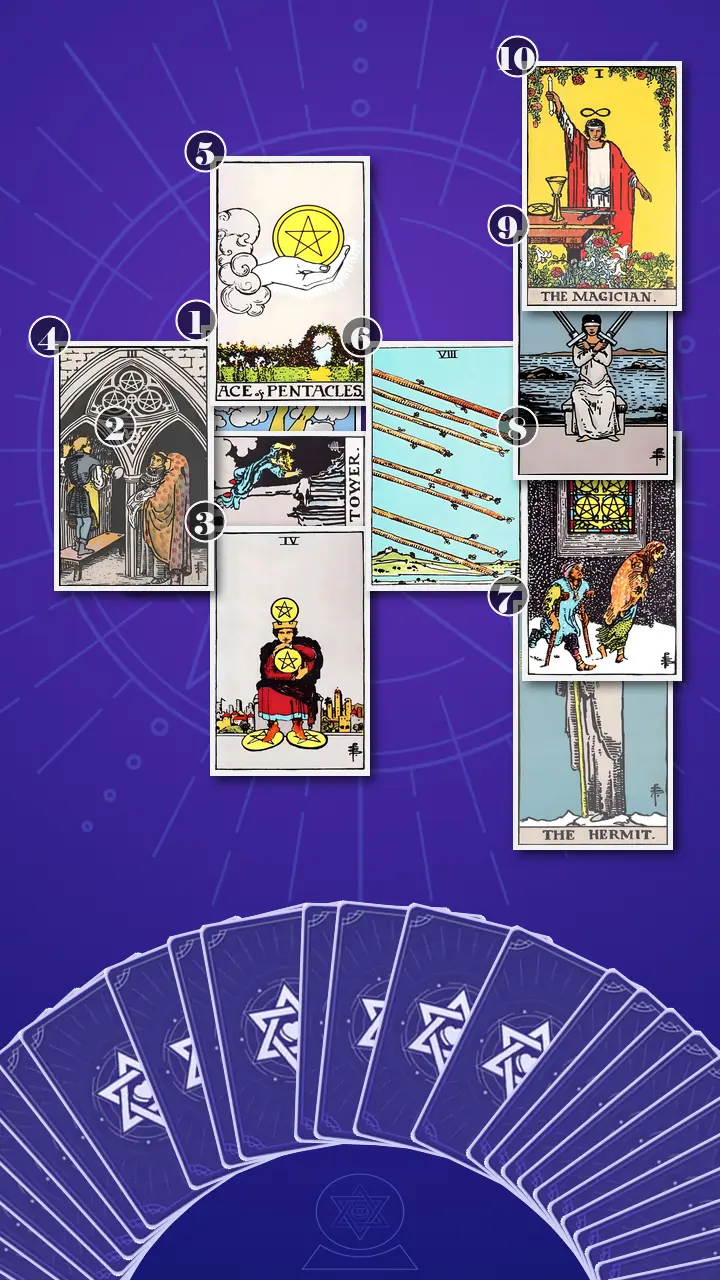
Reading the Map in a Two-Screen Life
Position 1: The current moment
Now we turn over the card representing the current moment: what your nervous system and behavior are doing right now in response to the layoff rumors.
Page of Swords, reversed.
I didn’t need to dramatize it. The card basically narrated Jordan’s browser history back to her: It’s 2:14 PM and you’re trying to write a PRD update, but Slack is basically your second heartbeat—refreshing rumor channels, screenshotting vague comments, then flipping to LinkedIn to see if anyone else is ‘quiet quitting’ their company.
This is Air energy in overload: curiosity turned into surveillance. Not “information gathering” as a tool—information gathering as a sedative.
I watched Jordan’s mouth tighten, then soften into a small, bitter laugh.
“That’s… yeah,” she said. “That’s kind of brutal.”
“It’s brutal because it’s accurate,” I said gently. “And because you’ve been calling it ‘being responsible.’”
Then I used a phrase I’ve learned people need to hear without shame attached: Monitoring isn’t the same as preparing—and your nervous system knows the difference.
Her shoulders dropped about a centimeter, like her body recognized the distinction before her brain fully agreed.
Position 2: The main challenge
Now we turn over the card representing the main challenge: what’s blocking clarity or making the situation feel harder than it needs to be.
The Tower, reversed.
The Tower reversed is a very specific kind of stress: not the lightning strike itself, but the long, exhausting attempt to control the timing of the lightning.
Jordan’s modern-life version showed up instantly: You’re bracing for impact without moving your feet—waiting for a ‘real announcement’ while your nervous system acts like the layoff already happened.
Energetically, this is blockage. Change is trying to arrive as a truth you can respond to, but you keep it in the realm of rehearsal—like running an emergency drill every day, but never stocking the actual kit.
I nodded toward the invisible “two screens” I could almost see in her home office: Slack on one side, LinkedIn on the other, while the real deliverable sat untouched.
“There’s a tight contrast here,” I said. “Your mind says, ‘I’m not panicking, I’m preparing.’ Your body says, ‘I can’t breathe and I haven’t moved.’”
Jordan’s jaw flexed. She didn’t argue. She just stared at the card a second longer than she had stared at the Page.
Position 3: The root driver
Now we turn over the card representing the root driver: the deeper need, fear, or belief that’s fueling your current response.
Four of Pentacles, upright.
Underneath the Air frenzy, we hit Earth. The Four of Pentacles is the clench: the coin held to the chest, the feet planted like, nothing moves because moving might cost me.
And in Jordan’s life, the translation was painfully modern: Underneath the Slack spiral is a tight grip on security… Toronto cost-of-living makes ‘risk’ feel personal.
This isn’t weakness. It’s logic under pressure. When rent is real and groceries are real, your nervous system treats career instability like a direct threat.
But the card also shows the cost of over-control: if you hold everything too tightly, nothing circulates. No options. No relief. Just a locked chest and a brain trying to buy safety with more tabs.
Jordan pressed her palm flat to her sternum without realizing she was doing it.
Position 4: Recent past
Now we turn over the card representing the recent past: what patterns or conditions led up to this point at work.
Three of Pentacles, upright.
This card is one of my favorites for product people. It’s the worksite and the blueprint—the proof that you know how to build.
In her modern scenario: Before the rumors, you were building real credibility… shipping features, coordinating stakeholders, translating chaos into a plan.
Energetically, this is balance. Competence. Collaboration. A reminder that your value isn’t theoretical—it’s documented and portable.
Jordan blinked, slower this time. “I forget that,” she admitted. “Like… I know it, but I don’t feel it lately.”
“Rumor culture has a way of making Slack feel like the only reality,” I said. “But your work artifacts are louder than a thread.”
Position 5: Conscious aim
Now we turn over the card representing your conscious aim: what you think you should do (or the outcome you’re trying to force).
Ace of Pentacles, upright.
The Ace of Pentacles is a hand offering something real—a seed of stability. Not a fantasy. Not a vibe. A tangible next step.
Jordan’s translation was exactly what she’d been trying to force into existence through scrolling: a ‘small but real’ next opportunity… stable, pays fairly, lets you grow.
This is where people often get trapped: they want the Ace to appear as certainty first. But the Ace appears as an opening—something you cultivate through follow-through.
Jordan exhaled through her nose, almost a laugh. “So… I can’t just refresh my way into an offer.”
“Not unless LinkedIn starts mailing pentacles,” I said. That got a real smile.
Position 6: Emerging next steps (trajectory)
Now we turn over the card representing emerging next steps: what’s likely to accelerate soon if you keep responding in the same reactive way (not a prediction, a trajectory).
Eight of Wands, upright.
This is speed. Messages. Motion. The wands fly in parallel—focused, aligned.
In Jordan’s modern-life scenario: Once you pick a channel… momentum can move surprisingly fast: replies come in, recruiter screens get scheduled, interviews stack up.
Here’s the nuance: Eight of Wands can be “everything is happening at once,” which—without structure—feeds panic. But with boundaries, it becomes “things move because I moved.”
I offered her a pace device: “A 24-hour rule for rumor spikes,” I said. “If it’s not a direct scope change, a manager 1:1, or a calendar event that affects you, you don’t have to react in the next hour.”
Jordan nodded—one clean nod, like her brain liked having a rule more than having a guess.
Position 7: You as the actor
Now we turn over the card representing you as the actor: how you’re showing up, what stance you’re taking, and what inner resource you can access.
The Hermit, upright.
The room got quieter in the way it does when a card names the medicine, not the wound.
The Hermit isn’t isolation. It’s discernment. A limited, usable light.
Jordan’s modern scenario was practically a prescription: You close Slack for an hour, put your phone in another room, and write a simple decision rubric… You don’t need a crystal-clear future—you need a lantern.
This is the shift from “crowd-sourcing your nervous system” to “choosing a tight signal-to-noise ratio.”
I pointed out the symbolic dialogue I wanted her to feel in her bones: “Later we’ll see the Two of Swords—blindfold energy,” I said. “The Hermit is the opposite. You’re not waiting for certainty—you’re choosing a smaller light you can actually use.”
I watched Jordan’s hands unclasp. Not dramatically—just enough to count as a change.
“Close the noise, light the lantern, then use your tools,” I added, and she mouthed the words once like she was testing how they sounded in her own voice.
Position 8: The environment
Now we turn over the card representing the environment: what the workplace climate and external conditions are signaling to you.
Five of Pentacles, upright.
This is the cold office AC turned into a worldview. Scarcity. Exclusion. The fear that everyone else has the memo and you don’t.
In her modern-life translation: The workplace vibe feels like scarcity… but there are ‘lit windows’ you might be walking past—peers, mentors, recruiters, savings levers.
This is where my old life on trading floors flashes in—not as nostalgia, as pattern recognition. When a desk is scared, everyone hoards information. Nobody wants to be the first person to say, “Are we okay?” because it risks status. That’s a workplace Nash equilibrium: silence feels individually safer, but collectively it makes everyone worse off.
“Your environment is incentivizing quiet fear,” I told Jordan. “And your brain is responding by trying to become the best rumor analyst in the building.”
She frowned. “That’s… exactly it.”
“The lit window here,” I said, “is one trusted person. One real conversation. Not a thread.”
Position 9: Hopes and fears
Now we turn over the card representing your hopes and fears: what you secretly want to be true and what you’re afraid will be confirmed.
Two of Swords, upright.
This is choice paralysis as self-protection. The blindfold isn’t ignorance—it’s an attempt to avoid regret. The swords aren’t options—they’re tension.
Jordan’s modern-life scenario could’ve been a screenshot: You tell yourself you’re ‘keeping options open,’ but it’s really a blindfold… the tension of not choosing becomes its own job.
Here’s what I needed her to see without judgment: when you refuse to choose a next step, you don’t stay neutral. You stay stuck.
And comparison pours gasoline on it, so I said the line I wish every tech worker had taped to their laptop: LinkedIn is a highlight reel, not a deadline.
Jordan’s eyes went glossy for a second—not tears, just that sheen of being caught.
“I keep thinking everyone is moving faster than me,” she said, voice low. “Like if I don’t decide this week, I’m already behind.”
“That’s the blindfold,” I said. “It makes your whole timeline feel like a trap.”
When The Magician Put the Tools on the Table
Position 10: Integration and direction
When I reached for the last card, the air in my office felt a touch denser—like even the radiator had decided to listen.
Now we turn over the card representing integration and direction: the most empowering next career move mindset and strategy to adopt from this reading.
The Magician, upright.
The Magician is agency without theatrics. Tools on the table. A plan that starts with what you already have.
Setup. I brought Jordan back to the exact trap her week kept replaying: that moment when a vague Slack thread pops up mid-day, her chest tightens, and she tells herself she’ll update her resume after “one more check.” It feels like she’s trying to pick the right door in a hallway full of alarms—and the alarms keep winning.
Delivery.
Not “I need perfect certainty before I move,” but “I create my next option with what’s in my hands,” like The Magician turning tools on the table into a plan.
I let that sit. Then I added the sentence that turns it from insight into leverage: You don’t build safety by out-monitoring uncertainty—you build it by using one tool consistently until it creates a real option.
Reinforcement. Jordan’s reaction came in a three-beat chain. First: a tiny freeze—breath held, eyes fixed, hand hovering near her mouth like she’d been interrupted mid-scroll. Second: a soft unfocus, like her brain replayed every time she’d refreshed Slack “just to be safe.” Third: the release—her shoulders sank, and she exhaled so slowly it sounded like she was setting down something heavy she’d been carrying in her ribs.
“But—” she started, and for a second there was anger in it. Not at me. At the whole situation. “If I do that… doesn’t it mean I’ve been wasting time?”
I didn’t rush past it. “It means your nervous system has been trying to protect you with the only tool it trusted: more information,” I said. “We’re just upgrading the toolset.”
This is where my Wall Street brain and my tarot brain line up perfectly. I call it Human Capital Valuation: instead of pricing your worth by company stability, you price it by competencies you can take anywhere. The Magician’s table becomes your model—clarity (sword), relationships (cup), initiative (wand), and runway (pentacle). When those are stocked, you don’t need rumors to tell you whether you’re okay.
I leaned in. “Now, with this new lens—look back at last week. Was there a moment when you reached for Slack, and this insight could’ve changed how you felt?”
Jordan swallowed. “Thursday,” she said. “Someone said ‘reorg’ near the kitchen. My skin went hot. I walked away and doom-scrolled for an hour.”
“Right,” I said. “This isn’t just about a decision. It’s your first step from rumor-driven alarm to grounded, self-directed career clarity—cautious confidence built through small actions.”
From Insight to Action: The Agency-First Plan
When I zoomed out and told Jordan the story the spread was telling, it was almost painfully coherent.
“You started in Air overload—Page of Swords reversed—living in notification mode instead of project mode,” I said. “The Tower reversed crossed it: bracing for disruption while trying to control timing, which keeps you in prolonged dread. Underneath, the Four of Pentacles shows why: you’re gripping security because stability has been tied to a paycheck and a title. But your recent past proves your value is real and portable—Three of Pentacles. Your conscious aim is a practical opportunity—Ace of Pentacles. Momentum is available—Eight of Wands—if you choose structure. The Hermit is your stabilizer: limited-but-usable light. And the Magician is your direction: build options with tools, not rumors.”
The cognitive blind spot was the quiet villain: Jordan had been treating information volume as a substitute for control. In her mind, monitoring equaled preparedness. In her body, monitoring equaled adrenaline.
The transformation direction was clear: shift from rumor-driven monitoring to an agency-first plan—a 2–3 week experiment with specific outreach and application targets. Not dramatic. Repeatable.
Jordan nodded, then immediately hit me with the real-world obstacle (because of course she did): “Okay, but I don’t even have time. My calendar is a war zone. And when I finally stop, I’m fried.”
“Good,” I said. “Then we design this like something you can execute on a bad day, not just a good one.”
Here’s the actionable advice I gave her—small steps, real outputs, built for decision fatigue:
- Two Check-In WindowsPut two 10-minute ‘rumor check’ windows on your Google Calendar (one mid-morning, one late afternoon). Outside those windows, turn off Slack desktop notifications for non-critical channels and keep Slack minimized—not full-screen.If 10 minutes feels impossible, start with 5. Pre-plan the boundary sentence: “If it’s urgent, someone will DM me or it’ll show up as a meeting invite.”
- One Concrete Output (Micro-Task)Use the first 15 minutes you would’ve spent checking to rewrite one resume bullet from a shipped project using one measurable outcome (launch metric, revenue impact, retention lift, cycle-time reduction). Save it—even if it’s rough.Two check-in windows. One concrete output. That’s the deal. Done counts more than perfect.
- The 2–3 Week Agency-First ExperimentPick one channel for Week 1: (A) networking, (B) applications, or (C) skills/portfolio. If you choose networking, send 3 messages this week (former coworker, recruiter, weak-tie) in 5 sentences, asking for a 15-minute chat. If you choose applications, pick 3 roles max, tailor top bullets, and submit by Friday—no adding new roles until those are sent.Pick the channel that feels 10% more doable—not 100% correct. You don’t need perfect certainty to move—you need a plan you can repeat.
Then I layered in one of my own “ex-Wall Street turned tarot” strategies that fits the Magician perfectly: LinkedIn optimization: Profile-as-prospectus redesign.
“If your resume is the financial statement,” I told her, “your LinkedIn is the S-1—the prospectus. This week, don’t rebuild your whole Notion career dashboard. Do one prospectus edit: headline + first two lines of About. Make it read like a product launch: what you shipped, who it helped, and what you do next.”
Jordan’s face did that subtle shift I love—the look of someone realizing “I can do that.” Not “I can solve my life,” just “I can do that.”
A Week Later: The Quiet Proof
Seven days later, Jordan messaged me a screenshot—not of Slack, but of her calendar. Two tiny blocks sat there like guardrails. Under them: “Resume bullet (15 min).”
“I did the windows,” she wrote. “I hated it the first two days. My chest still did the thing. But I sent three messages anyway. One person replied in ten minutes. I have two chats booked.”
It wasn’t a dramatic ending. It was better: a small loosening.
She told me she slept through the night once—then woke up and had the first thought, What if I’m wrong? The difference was, she didn’t reach for Slack. She stared at the ceiling for a beat, then opened her notes and read her decision rubric like it was lantern light.
That’s what a Journey to Clarity usually looks like in real life. Not certainty. Ownership. The shift from reacting to noise to building options you can stand on.
And if tonight, the Slack rumors hit and it feels like your chest locks up because you’re trying to pick the ‘right’ door in a hallway full of alarms—so you keep scanning for certainty instead of letting yourself move with what you already know—remember: you’re not broken. You’re just stuck in a loop that confuses vigilance for control.
If you didn’t need perfect certainty—just enough light for the next step—what’s one tiny, concrete move you’d be willing to try for the next two weeks?
Every reading at AceTarot is a Journey to connect with inner wisdom and empower next step.
Learn more about our Journey to Clarity.