From Bootcamp Checkout Anxiety to Grounded Commitment: A 7-Day Test

Finding Clarity in the 11:45 p.m. Checkout Glow
If you’ve ever left a bootcamp checkout open in three tabs while toggling between Reddit reviews, LinkedIn success posts, and your bank balance like it’s a full-time job—welcome to choice paralysis.
Jordan (name changed for privacy) appeared on my screen from a Toronto condo living room that looked like midnight had taken over. Her laptop was open to the bootcamp checkout page; the blue light bounced off a water glass on the coffee table. Her phone—warm from being held too long—kept waking up with LinkedIn notifications. Somewhere behind her, a fridge hummed steadily, and through a cracked window I could just make out a faint streetcar bell cutting across the night.
“I keep hovering,” she said, almost laughing at herself, like the words tasted bitter. “The checkout page is open, and then I’m reading one more alumni post, one more salary thread, one more ‘is this worth it?’ comment. I want a real career change. But I can’t tell if I’m excited… or if I’m about to pay for validation.”
Her chest rose and fell too high, as if her lungs were trying to do math. Her thumb kept doing that restless micro-scroll even when there was nothing new on the screen. The anxiety wasn’t an abstract feeling—it was a tight, buzzy loop in her body, like a cursor hovering over “Pay now” as if the button were a trapdoor.
I let the silence hold for a moment, the way I used to pause over a trench in a dig site before touching anything—because rushing is how you miss the story.
“We’re not here to force certainty,” I told her, gentle and direct. “We’re here to find clarity. We’ll treat this bootcamp like a tool you can evaluate—not a verdict on your worth. Let’s draw you a map through the fog.”

Choosing the Compass: The Transformation Path Grid (6)
I asked her to take one slow breath—not as a ritual for the universe, but as a small physiological reset. Then I shuffled the cards with the steady, practiced care of someone handling fragile artifacts. Focus first; interpretation second.
Today, I told her, we’d use a spread I rely on when a decision is tangled with identity: Transformation Path Grid (6) · Context Edition.
For the reader watching from the outside: this is a tarot spread for bootcamp checkout decision paralysis because it separates what most people mash together in their head at 11:45 p.m. The top row diagnoses the loop: (1) the visible pattern, (2) the mental blockage, (3) the deeper validation hook. The bottom row turns it into movement: (4) the key shift that restores agency, (5) a one-week experiment for real feedback, (6) a sustainable definition of progress.
In other words, it’s built for moments like Jordan’s—when choice paralysis about paying for a bootcamp isn’t really an information problem, but a fear that the purchase is an expensive attempt to feel valid rather than a real career change.
“We’ll start with what the checkout moment looks like in real life,” I said. “Then we’ll name the no-win sentence your mind repeats. Then we’ll go underneath—because the root matters. And once we see it clearly, we’ll build next steps that are small enough to actually do.”
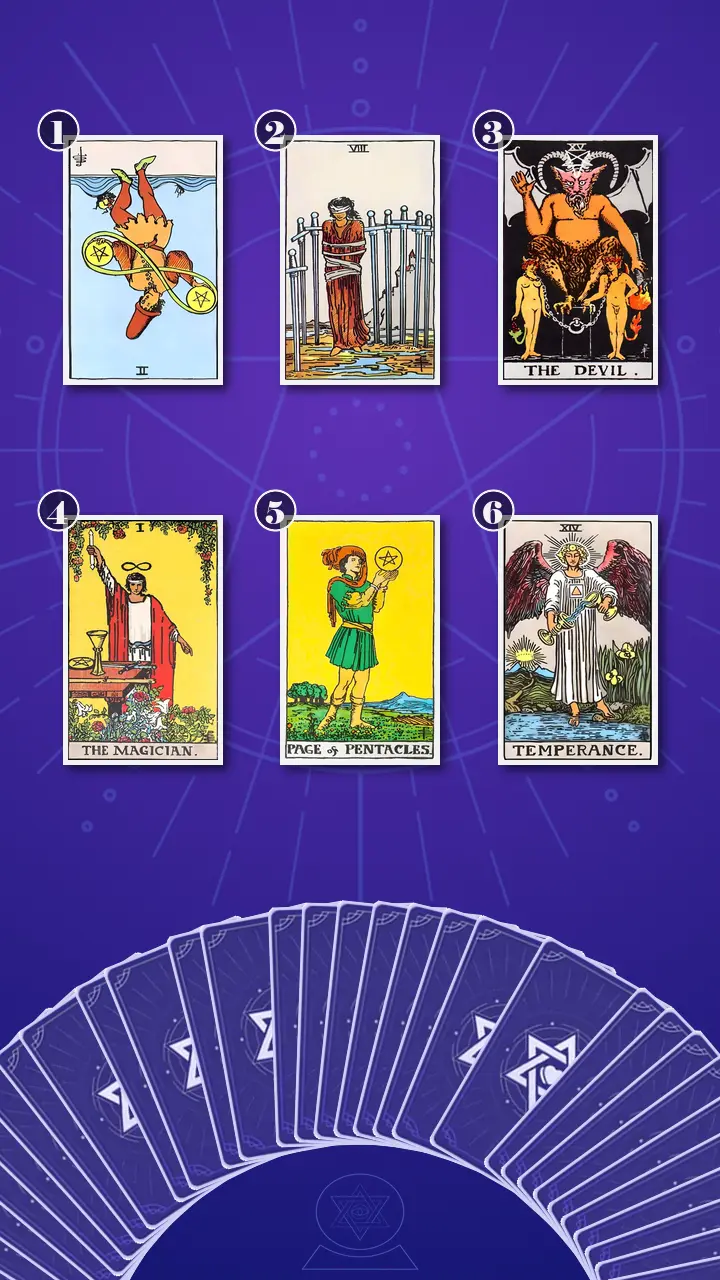
Reading the Map: The Loop, the Trap, the Hook
Position 1: The Pattern You Can See (and Feel)
“Now we turn over the card that represents what the bootcamp checkout moment looks like in real behavior and energy right now—the visible pattern.”
Two of Pentacles, reversed.
It landed like a snapshot of her living room. “It’s 11:45 p.m., and your screen looks like a juggling act: checkout tab, tuition calculator, LinkedIn, Reddit reviews, and a spreadsheet that keeps growing. You’re trying to balance budget fear, timeline pressure, and the need to feel like you’re ‘finally getting serious’—and the more you juggle, the shakier everything feels.”
Reversed, the Two of Pentacles isn’t “you’re bad at balancing.” It’s an energy problem: overload. Balance has become frantic tab-switching. The juggler has lost the rhythm. That infinity loop—on a modern night—reads like the endless circuit: money math → reviews → curriculum → LinkedIn → back to money math.
Jordan gave a small, sharp laugh that didn’t reach her eyes. “That’s… too accurate. Like, kind of rude.” She covered her mouth with her hand, then dropped it, embarrassed at her own reaction.
“Accurate doesn’t have to be cruel,” I said. “This card is simply naming the nervous system reality: you’ve been trying to juggle ten variables at once. No one makes a clear choice in choppy water.”
I also warned her, as a practical matter, what the reversal can tempt: an overcorrection into all-or-nothing. If I don’t pay tonight, I’m failing; if I pay tonight, I’m saved. Either extreme would be a way to stop the wobble without actually restoring balance.
Position 2: The Thought-Loop That Keeps You Stuck
“Now we turn over the card that represents what is mentally or emotionally blocking a clear decision—the stuck point sustaining the loop.”
Eight of Swords, upright.
“You’re not stuck because you lack choices—you’re stuck because every choice has been labeled ‘high stakes,’” I said, and I watched her eyes flick down to the checkout button as if it were listening. “The checkout button feels like a trapdoor: if you pay and it doesn’t work, it ‘proves’ something awful about you; if you don’t pay, it ‘proves’ you’re falling behind. So you keep researching to feel safe, while real movement stays on hold.”
This is the Eight of Swords at its most modern: too many tabs open, none of them loading—because your bandwidth is the bottleneck, not the information.
I gave her the internal monologue the card always carries when it shows up in a decision reading, tight and relentless:
“If I choose wrong, I waste money. If I don’t choose, I waste time. If I try and fail, it’s public.”
Then I drew the contrast, because this is where relief can begin: “You’re not stuck because you lack options; you’re stuck because every option is being treated like a verdict.”
She exhaled—long, slow, involuntary—like someone finally putting down a heavy grocery bag. A small nod followed. “Okay,” she said quietly. “Yeah. That’s exactly what my brain does.”
Position 3: The Validation Contract Underneath It All
“Now we turn over the card that represents the deeper motive underneath the decision—the validation hook or fear driving urgency.”
The Devil, upright.
This is not a moral card; it’s a clarity card. It points to attachment—what we’ve asked to do a job it cannot do.
“The bootcamp stops being just education and starts acting like a badge,” I said. “In your head, the purchase itself becomes proof you’re not average, not behind, not wasting your potential—even before you’ve done a single lesson. That’s why the urge feels urgent: you’re not only choosing a program, you’re trying to buy relief from shame.”
I gave her a scene-based analogy, gentle but plain: “It’s like the receipt becomes a status badge you can screenshot in your head. You get to feel ‘serious’ immediately—without the discomfort of being a beginner.”
Her shoulders twitched, a slight flinch, and then her mouth tightened in recognition—caught in the act of bargaining with her own worth. She looked away from the camera, toward the dark window.
“What are you hoping the purchase will silence?” I asked, not as a trap, but as a lantern.
After a beat she said, “The voice that says I’m… just a marketing coordinator who peaked early.”
“That,” I said softly, “is the chain. And the important thing about The Devil in this deck is that the chains are visible—and removable. The card isn’t accusing you of wanting more. It’s asking you to notice when a tool gets promoted into a judge.”
I felt, in my own mind, an archaeologist’s familiar discomfort: the way people sometimes confuse a civilization’s shiny surface for its true strength. In excavations, you can find gilded ornaments in a settlement that was collapsing from water mismanagement. The gold isn’t the proof. The infrastructure is. The Devil loves gold. It distracts you from the irrigation channels.
When The Magician Spoke: Agency at a Career Crossroads
Position 4: The Shift That Gives You Your Hands Back
I let the room quiet before I turned the next card. Even on video, the atmosphere changed—less noise, more focus—like a browser finally closing its extra tabs.
“Now we turn over the card that represents the key psychological shift that restores agency and reframes the decision in a healthier way.”
The Magician, upright.
“Instead of asking, ‘Will this make me legitimate?’, you shift to, ‘What structure will I actually use?’” I said. “You set one calendar block, pick one starter project, and define one realistic budget cap. The power moves from the checkout page to your hands: you create proof through practice, not through a purchase that’s trying to do emotional work for you.”
And because my mind works the way it works—professor, archaeologist, long-view thinker—I brought in my Historical Case Matching, the diagnostic tool that has served me more reliably than any prophecy.
“I’ve spent a lifetime studying moments when societies stood at crossroads,” I told her. “Not the dramatic movie versions—real ones. A city deciding whether to pour resources into spectacle to feel powerful, or into systems that quietly make it resilient. In those layers, you can spot the same choice you’re facing: status now versus capacity over time. The Magician is the moment a culture stops begging an idol for protection and starts building the tools—roads, ledgers, ships—that actually move it forward.”
Jordan blinked, and I saw the defensive part of her brace. “But… if I stop treating it like a big deal,” she said, voice tightening, “doesn’t that mean I’ve been, like, shallow? Or desperate? I hate that.”
This was the unexpected reaction—the sting that often comes right before clarity lands. I kept my tone steady.
“It doesn’t mean you’re shallow,” I said. “It means you’re human in a world that sells ‘career glow-up’ like a product. The Devil doesn’t show up because you’re bad. It shows up because something in you wants relief. The Magician doesn’t punish that. It simply says: you don’t have to buy your worth back. You can build evidence.”
Then I moved into the aha moment—the part where the reading stops being interesting and becomes usable.
Setup: You know that moment: the checkout tab is open, your chest feels tight, and you keep thinking one more review will make the decision obvious. But somehow you end up with five tabs, a bigger spreadsheet, and the same question—am I investing in skills or buying reassurance?
Delivery:
Not a magic purchase that proves you’re enough—choose the tools on the table and create proof through practice, one focused step at a time.
I let it sit in the air, like a verdict reversed back into a choice.
Reinforcement: Jordan’s reaction came in a three-step wave. First, a physiological freeze—her breath caught mid-inhale, and her hand stopped scrolling, hovering over the phone as if it had suddenly become heavier. Then the cognition seeped in—her eyes unfocused for a second, not zoning out, but replaying a memory: the performance review comment, the Line 1 commute, the moment she opened checkout for relief. Finally, the emotion released—her shoulders dropped a fraction, and she let out a shaky exhale that sounded like surrender, but wasn’t. It was recognition.
“So the program doesn’t grant me permission,” she said, slower now. “My consistency builds the proof.”
“Exactly,” I replied. “And failing doesn’t prove you’re not smart—it proves you tried a method that didn’t fit. That’s data, not shame.”
I guided her through the reset I use when a decision has become a courtroom:
“Ten-minute ‘Tools on the Table’ reset,” I said. “Close every tab. Set a timer for ten minutes. On paper—not a spreadsheet—write two lists: (1) ‘What I’m trying to learn’—maximum three bullets. (2) ‘What I’m secretly trying to feel’—respected, caught up, not average, whatever is true—maximum three bullets. Circle one bullet from list one. Then do one tiny action right now: open a free lesson, code one prompt, outline one mini-project. Stop when the timer ends—even if you want to keep going. If shame spikes, name it: ‘this is the worthiness hook.’ And pause.”
“Now,” I asked her, “with this new lens—can you think of a moment last week when this would have changed how you felt?”
She nodded, eyes wet but steady. “Wednesday,” she said. “After the meeting. I opened checkout like… like a pressure-release valve. If I’d done ten minutes of the actual work instead, I’d have had something real. Not just the idea of being serious.”
That was the turning. Not from doubt to confidence in one leap, but from comparison-fueled bootcamp checkout anxiety and worthiness-seeking to the first, usable edge of agency-based self-trust.
The Apprentice Week: Turning Imagined Outcomes into Lived Data
Position 5: The One-Week Experiment That Creates Real Feedback
“Now we turn over the card that represents a grounded next step that creates real feedback within one week—a low-risk experiment.”
Page of Pentacles, upright.
“You run a seven-day trial like an apprentice, not a desperate buyer,” I said. “You pick one mini-syllabus—free lessons or sample modules—track 20 minutes a day, and finish one tiny deliverable. The goal isn’t to become a new person in a week. It’s to see whether you show up when nobody is clapping, and whether the work itself holds your attention after the initial panic fades.”
The Page is Earth energy in its healthiest form: measurable, tactile, grounded. It’s the opposite of spiraling through testimonials. It says: make one thing. Get lived data. Let your hands tell the truth your mind can’t theorize.
Jordan’s face changed into something I’ve seen on first-year students and seasoned field teams alike—relief, not hype. “Yeah,” she said. “I can do twenty minutes. That’s… not scary.”
Position 6: What Healthy Progress Looks Like When You’re Not Performing It
“Now we turn over the card that represents how to integrate the decision sustainably—what ‘healthy progress’ looks like after the experiment.”
Temperance, upright.
Temperance always reads like an adult in the room. “You define progress that fits your actual Toronto life—commute, rent, workload, energy,” I said. “You stop treating speed as proof of worth and choose a rhythm you can repeat for three months. The decision becomes calmer because it’s no longer ‘change everything now’—it’s ‘build steadily, evaluate honestly, adjust without self-punishment.’”
This is where I brought in my Long-Term Value Assessment—not as a lecture, but as a sanity check. “Short-term intensity can feel like certainty,” I said. “But civilizations don’t endure on bursts of panic. They endure on repeatable systems: a budget you can sleep with, a pace you can maintain, a plan that doesn’t require you to become a different person overnight.”
Jordan looked at her laptop and, for the first time in the session, it looked less like a trap and more like an object. “Healthy progress isn’t fast,” she murmured, almost testing the words. “It’s repeatable.”
From Insight to Action: A One-Week Plan You Can Actually Do
I summarized what the spread had revealed, threading it into one coherent story—because insight without narrative tends to leak away the moment the phone lights up again.
“Here’s the arc,” I said. “Right now, the checkout moment is wobbling because you’re juggling too many variables at once (Two of Pentacles reversed). Your mind keeps you in rehearsal mode by turning every option into a no-win trial (Eight of Swords). Underneath that, the real pressure is a hidden contract: if you buy, you’ll finally be ‘legit’—and if it doesn’t work, it proves you’re not (The Devil). The turning point is The Magician: you stop pleading with the purchase and you put tools on your own table—time, structure, budget boundaries, and a starter project. Then the Page of Pentacles turns it into lived data within a week, and Temperance makes sure your progress is sustainable instead of performative.”
“The cognitive blind spot,” I added, “is that you’ve been treating the decision like it can prove something about your worth. That framing makes everything feel dangerous. The transformation direction is the opposite: from seeking proof that you’re worthy to running a small, time-boxed experiment that shows whether the work itself energizes you.”
Jordan hesitated. “But I barely have time,” she said. “I commute, I’m exhausted, and when I finally sit down, my brain just wants to… scroll.”
“Good,” I said, not unkindly. “That’s not a character flaw. That’s a systems problem. And systems can be redesigned.” I offered her a strategy I use in fieldwork and in life—my Voyage Log Technique: plan like an ancient navigator. Don’t try to predict every storm; set a heading, track small signals, adjust weekly.
Then I gave her the next steps, clean and concrete—actionable advice, not hype:
- The 20-Minute Decision Window (7 days)Set a phone timer for 20 minutes once per day for the next week. In that window, do one task only: (a) list non-negotiables for a program, (b) check real budget numbers, or (c) do one short practice exercise (a free lesson, one coding prompt, one tutorial step).If your mind says, “This is too small to count,” that’s the worthiness hook talking. Keep it time-boxed so it can’t morph into another 2-hour research spiral.
- One Tiny Proof DeliverablePick one beginner project you can finish in under 60 minutes total this week (a simple landing page, a tiny script, a data-cleaning notebook, a GitHub README). Make it so small it’s almost annoying—and finish it anyway.You don’t need more tabs. You need one tiny piece of proof. Finished beats impressive.
- The Two-Metric Voyage LogFor seven days, track only two metrics in your Notes app: (1) minutes practiced and (2) after-practice feeling (energized / neutral / drained). At the end of the week, look for the pattern—no storytelling, just data.If comparison spikes, do a seven-day LinkedIn boundary (remove it from your home screen or choose one check-in time). Reducing noise isn’t avoidance—it’s protecting signal.
If you want a single decision criterion to hold all of this without drama, I offered one: “If I can stick to 20 minutes/day for 5 of 7 days and the work feels engaging after day 3, I’ll consider paid options; if not, I’ll adjust the plan.”
That was the point: bootcamp as tool, not court ruling. Proof through practice, not proof through purchase.

A Week Later: The Quiet Proof
Six days later, Jordan sent me a message. No grand announcement. No “new identity.” Just a photo: a messy little project folder on her desktop and a single line beneath it—“Day 5. Twenty minutes. I actually lost track of time.”
She told me she’d kept her job steady, did her practice blocks after dinner, and muted LinkedIn for the week. She didn’t feel magically fearless. She still woke up once with the thought, What if I’m wrong?—but this time she smiled, because she had something to point to that wasn’t a spreadsheet: lived data, her own hands proving she could show up.
This is what a Journey to Clarity often looks like in real life: not certainty descending like a spotlight, but a nervous system unclenching because the decision is no longer carrying the weight of your worth. The spread didn’t tell her what salary she’d earn or which program would “work.” It helped her separate compulsion from capacity—and return the power to her table of tools.
When the checkout page feels like it could either save you or expose you, your body tightens—not because you’re indecisive, but because you’ve been asked to treat a learning choice like a verdict on your worth.
If you let this be a one-week experiment instead of a lifelong identity purchase, what’s the smallest piece of proof you’d want to create—just for you—before you decide anything?