The Night I Couldn't Hit Send on the Offer Email—And What Shifted

The Offer That Expires Tomorrow
If you’ve opened the promotion offer email so many times your inbox search autofills it—and you still haven’t hit send because “expires tomorrow” triggers instant deadline panic—then you already know the specific kind of tired I’m talking about.
Jordan showed up on my screen from a Toronto condo living room, camera angled a little too high like they’d been on back-to-back calls all day. It was 8:52 p.m., Monday. The only light in the room was laptop glow; somewhere off-screen a fan hummed like it had been working overtime. Their phone kept lighting up—Slack notifications, a group chat, one more “Congrats!!” LinkedIn post they swore they wouldn’t look at.
“It expires tomorrow,” they said, and even through video I could see it land in their body first: jaw set, shoulders rising like they were bracing for impact. “I’m not scared of hard work. I’m scared of getting stuck in the wrong version of my life.”
They told me the loop like a confession they’d repeated to themselves all weekend: lunch break in the PATH food court, offer PDF open, then a Google Sheet called something like Promotion Decision v7, then LinkedIn “just for a second,” then back to a Gmail draft. Cursor blinking. No send.
Pressure doesn’t always feel like panic. Sometimes it feels like a buzzing in the chest—like your nervous system is trying to sprint while your calendar is pinning you to a chair. Jordan looked exactly like that: wired, stalled, and weirdly irritated at everything because the email felt like a survival test.
I nodded, keeping my voice steady in the way my old trading floor mentors taught me to: calm is contagious. “A deadline turns uncertainty into a countdown—but it doesn’t turn your choice into a verdict,” I said. “Let’s make this practical. We’re not here to predict a perfect future. We’re here to find clarity—enough clarity to choose one value, set one boundary, and communicate cleanly.”

Choosing the Compass: The Decision Cross Tarot Spread
I asked Jordan to put both feet on the floor. “Three slow breaths,” I said. “No new tabs. Just you and the question.”
That’s not mysticism. That’s a pre-commitment ritual—something I used on the trading floor when the screen was screaming and my job was to make one sane move anyway. We’re teaching the brain: we act from focus, not from noise.
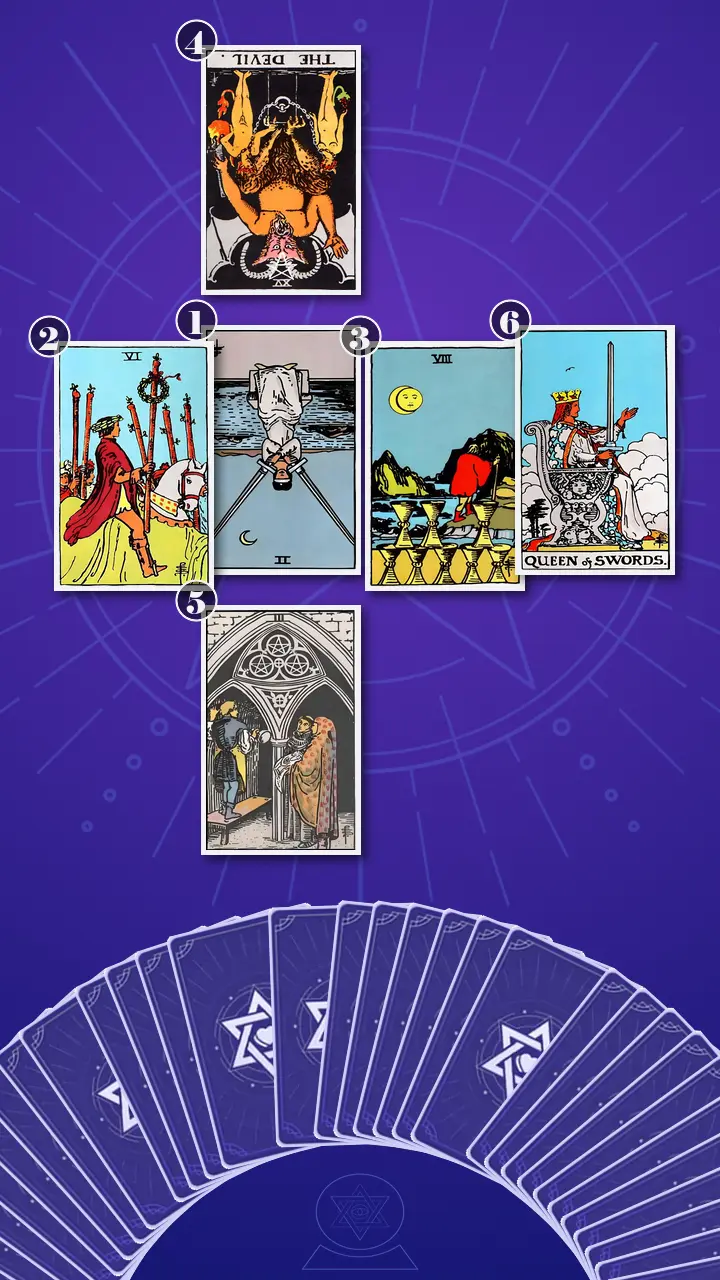
“For a yes/no choice under time pressure, I’m using a Decision Cross,” I explained—both to Jordan and, honestly, to anyone reading this who’s ever Googled how tarot works for a career decision with a deadline. “It’s designed to do one thing well: hold a fork in the road without turning it into an identity crisis.”
The layout is a compact cross: one center card for the stuck point, one card for the ‘accept’ path, one for the ‘decline’ path, one for the deeper psychological hook, one for the practical stabilizer you can use today, and one final card for how to execute the decision with clean communication.
“Think of it as an intersection,” I told Jordan, “with one sign overhead and one map underfoot—then a lane you actually step into.”
Reading the Map: Where the Deadline Turns Into a Loop
Position 1 — The immediate stuck point under the deadline
“Now we turn over the card representing the immediate stuck point under the deadline—the observable decision paralysis behavior,” I said.
Two of Swords, reversed.
I didn’t have to reach for poetry; the card already spoke Jordan’s browser history. “This is the night-before-deadline loop,” I said, using the blunt modern translation. “You keep your face calm in meetings, but at home you’re refreshing the offer email, opening five comp tabs, and rewriting the same reply draft—because if you don’t send anything, you don’t have to feel the finality of choosing.”
Reversed, the energy isn’t ‘balanced neutrality.’ It’s a stalemate that’s becoming physically unsustainable—Air energy in blockage. The blindfold is slipping. Your body is done holding two futures in tension.
Jordan let out a laugh that wasn’t humor so much as self-recognition with teeth. “Yeah… that’s literally what I’m doing,” they said, and then softer: “That’s kind of brutal.”
“I know,” I said. “And also—good. Because it means the loop is visible. And once it’s visible, we can change it.” I paused. “More tabs won’t give you more trust.”
Position 2 — What accepting the promotion activates
“Now we turn over the card representing what accepting the promotion activates—benefits, demands, identity shift,” I said.
Six of Wands, upright.
“Accepting looks like the Slack congrats, the internal announcement, the ‘finally’ feeling,” I said, letting the spotlight metaphor land. “And then the reality of being more visible: more stakeholders wanting time, more people watching outcomes, and your work becoming a public scoreboard, not just a craft you do quietly.”
Upright, this is Fire in balance—recognition, momentum, legitimacy. But Fire also burns oxygen. The energetic question isn’t “Is this a win?” It’s “What is this win buying you emotionally: status, impact, learning, leadership exposure—and what is it costing your bandwidth?”
Jordan’s face brightened for half a second—then their throat tightened; their shoulders braced like they’d just watched next week’s calendar auto-fill. The excitement was real. So was the weight.
“The spotlight is real,” I said, “but so is your bandwidth.”
Position 3 — What declining the promotion activates
“Now we turn over the card representing what declining the promotion activates—values, trade-offs, what you move toward,” I said.
Eight of Cups, upright.
“Declining cleanly looks like sending a respectful email, closing your laptop, and feeling a strange calm,” I said. “Because you’re choosing fit over optics. You’re not saying the role is bad; you’re saying it’s not aligned with what you want your days to be filled with right now.”
This is Water in balance—alignment, inner truth, the quiet exit. Not dramatic. Not scorched earth. Just honest. The card’s energy says: if you decline, you need to be walking toward something, not just running away from pressure.
Jordan’s chest lifted on an inhale they didn’t realize they’d been holding—then a flicker of guilt crossed their face, like relief wasn’t “allowed” unless they could justify it in a spreadsheet.
“You’re allowed,” I said gently. “Optics and alignment can be different things. That doesn’t make you ungrateful. It makes you aware.”
Position 4 — The deeper fear/attachment driving the pressure
“Now we turn over the card representing the deeper fear—the psychological hook that’s turning this into an identity test,” I said.
The Devil, reversed.
I exhaled slowly, because this card—reversed—always feels like a chain you didn’t realize you were holding. “You notice the ‘people would kill for this’ voice in your head and realize it’s acting like a chain,” I said. “The offer starts to feel like a cage before you’ve even clarified it—not because the company is evil, but because you’re afraid that saying yes proves you can’t steer your own future once the status machine grabs you.”
Reversed, the Devil is the loosening—not the chain disappearing overnight, but the moment you see where it hooks. The energy is autonomy waking up. And it comes with a risk: to prove you’re not controlled, you might be tempted to decline reactively, sharply—freedom as a dramatic exit.
Jordan’s eyes went glassy for a beat. Then they blinked hard and looked away from the camera, like they were replaying a sentence they’d heard a hundred times: You’d be crazy not to take it.
“Complete this sentence,” I said. “I’m scared I’ll be stuck if ______.”
They swallowed. “If I say yes, and then it’s just… meetings. Forever. And people think that’s who I am.”
“Okay,” I said. “Now rewrite it: ‘Even if that happens, I can…’”
They hesitated. “Even if that happens, I can reassess in six months. I can move teams. I can… course-correct.”
“Exactly,” I said. “Freedom isn’t a dramatic exit. Sometimes it’s a calm boundary in plain text.”
Position 5 — The practical factor you can use right now
“Now we turn over the card representing the practical factor you can use right now to get clarity before tomorrow,” I said.
Three of Pentacles, upright.
“Instead of asking everyone’s opinion,” I said, “you ask one informed person one specific question—‘What does success in the first 90 days look like, and what support is available?’—and the decision shifts from identity panic to role design: scope, metrics, resourcing, and authority.”
Upright, this is Earth in balance: structure, standards, collaboration. The card is basically a blueprint on the table. It’s the antidote to vague dread.
I watched Jordan’s posture change—small, but real. Their eyes focused. Their shoulders dropped a centimeter, as if the problem had finally moved from “my entire future” to “a set of role requirements I can evaluate.”
“You don’t need more opinions,” I said. “You need one piece of concrete information.”
When the Queen of Swords Lifted One Clean Sword
Position 6 — The clean next step: communicate and execute
I let the silence sit for a moment. The room on Jordan’s side was quiet except for the fan. On my side, I could hear the faint city noise through my window—cars, distant sirens—like a reminder that life keeps moving even when an inbox feels like it’s holding you hostage.
“Now we turn over the card representing the clean next step—how to communicate and execute the decision with boundaries and professionalism,” I said. “This is the exit point.”
Queen of Swords, upright.
“This is the short, respectful email that doesn’t try to manage everyone’s feelings,” I said, using the modern-life scenario without sugarcoating it. “Decision in the first line. One reason. One boundary or next step. Gratitude. Done.”
Upright, her energy is refined Air—clarity as precision, not as certainty. She’s not cold. She’s clean.
Jordan’s eyes narrowed, like their brain wanted to argue with the simplicity. I’d seen that look on analysts at 2 a.m. on Wall Street: the panic-search for the one more model tweak that would eliminate risk. In finance, you learn the hard way: you can reduce uncertainty, but you can’t erase it. You choose with a framework anyway.
Setup: Jordan was trapped in that 11:46 p.m. moment where the laptop glow is the only light, and rewriting the first sentence for the fifth time feels safer than letting “expires tomorrow” become real. Their mind kept asking for a guarantee their life doesn’t offer.
Delivery:
Stop negotiating with the blindfold and start speaking with one clean sword: a simple decision, a clear reason, and a respectful boundary.
I let the sentence hang there, no extra commentary, the way you let a clean number speak for itself.
Reinforcement: Jordan froze first—breath caught, fingers still on the mug they’d been gripping like an anchor. Then their gaze unfocused, not on the card anymore but somewhere past the screen, as if they were replaying every draft they’d written that tried to be grateful-but-not-weak, confident-but-not-cocky, clear-but-not-final. Their jaw worked once, like it was trying to unclench but didn’t know it had permission. When it finally did, their shoulders dropped in a slow, reluctant surrender, the kind that looks almost like exhaustion until you realize it’s relief. Their eyes went wet at the edges, and they laughed again—this time quieter, softer, almost embarrassed. “I’ve been treating the email like… like it’s grading my whole potential,” they said, voice thin on the last word. They took one deeper breath, and I watched their chest stop buzzing for a second. “Clean doesn’t mean cold,” they added, testing it. “Clean means clear.”
“Exactly,” I said. “And clarity isn’t something you earn by suffering long enough. It’s something you practice.”
I leaned in. “Now—with this new perspective—think back to last week. Was there a moment where one clean sword would’ve changed how you felt? One moment you reopened the email and your body spiked?”
Jordan nodded immediately. “Thursday. After my manager said, ‘This is a big vote of confidence.’ I went straight to Levels.fyi and spiraled for hours.”
“Right,” I said. “That’s the blindfold negotiation. Tonight, we replace it with a script.”
And here’s where I used my own framework—what I call Strategic Crossroads Analysis. “Pretend this is an M&A decision,” I told them. “No deal is risk-free. You don’t wait for 100% certainty; you run three scenarios and pick the move that matches your value and your risk tolerance. Your ONE criterion is your valuation method. Your ONE boundary is your risk control.”
From Insight to Action: The One-Criterion, One-Boundary Check
I summarized the story the spread had told us, end to end.
“The Two of Swords reversed shows why you feel stuck: you’ve been trying to hold two futures open until certainty arrives, and your body is done. The Six of Wands shows what ‘yes’ really activates—recognition and visibility, with a real bandwidth cost. The Eight of Cups shows what ‘no’ can be—alignment without drama, if it’s toward something. The Devil reversed is the hidden engine: golden-handcuffs thinking, the internal rule that worth equals title. The Three of Pentacles gives you the missing lever: role structure. And the Queen of Swords turns the whole thing into one adult action: clear, boundary-forward communication.”
“Your blind spot,” I added, “is that you’ve been treating this as a referendum on your worth. That’s why you keep rewriting. The shift is smaller and more powerful: choose based on one value and one boundary you can put in writing today.”
Jordan frowned. “But I don’t have 20 minutes. Tomorrow’s already chaos. I’ve got back-to-back meetings. I can’t even get five minutes without someone pinging me.”
That was the real world, right on schedule. I nodded. “Perfect. Then we do the five-minute version. Clarity doesn’t require a weekend retreat. It requires a container.”
I pulled from my “boardroom” toolkit—a SWOT-TAROT rapid assessment plus a decision ledger like we’d use in an investment committee: weighted scoring, not vibes.
- Send the 90-day blueprint questionToday, message ONE person who actually understands the role (manager/hiring manager/senior PM): “Before I confirm, can you share what success looks like in the first 90 days, and what support/resources are in place?”If you can’t get a call, send it async on Slack/Teams. You’re not asking for a life plan—just one concrete data point.
- Do the One-Criterion, One-Boundary timerSet a 10–20 minute timer. Write: “My ONE criterion is: autonomy / learning curve / sustainability / leadership exposure.” Then add ONE boundary you can communicate (scope clarity, success metrics, decision authority, or a timeline to reassess).Expect resistance (“one isn’t enough”). That’s the pattern. Keep it small: you’re choosing what you can stand behind today, not forever.
- Draft the One-Sword email (and score it)Write 4 lines: (1) decision in the first sentence (accept/decline), (2) one concise reason, (3) one boundary/question/next step, (4) gratitude. Then, in a simple decision ledger, score each option 1–5 on your ONE criterion and on “reversibility in 6 months.”If you start over-explaining, delete 30%. Clean doesn’t mean cold. Clean means clear.
“This isn’t about making the ‘right’ choice,” I said. “It’s about making a choice you can own—and making it reversible where you can. That’s agency.”

A Week Later: Ownership, Not Certainty
Six days later, Jordan messaged me a screenshot—not the entire email thread, just the first four lines of what they sent. The subject line was boring. The first sentence was decisive. There was one boundary: a request for clarified success metrics and decision authority in the first 90 days.
“I hit send,” they wrote. “My jaw unclenched. Like instantly.”
Their follow-up wasn’t a victory lap. It was more honest than that: they slept a full night, but the next morning their first thought was still, what if I’m wrong? Then, apparently, they made coffee, reread their own email, and thought, Even if I’m wrong, I can course-correct. That was the new muscle forming.
That’s the whole Journey to Clarity in one small proof: moving from countdown-driven analysis paralysis to grounded agency and clean, boundary-forward communication.
When the deadline is loud, it’s easy to treat a single email like it’s grading your entire future—so you keep rewriting, jaw tight, hoping one perfect sentence will make the risk disappear.
If you let this be a choice (not a verdict), what’s one value you’d be willing to choose from—and one boundary you’d feel okay putting in writing today?