From On-Call Guilt to Business Hours: Resetting Coworker Vent DMs

The 10:06 a.m. Slack Vent DM Spiral
If you’re a hybrid office worker in a city like Toronto and your coworker uses Slack DMs like a daily vent diary, you know the “emotional labor creep” feeling—your focus disappears the moment their name pops up.
Taylor (name changed for privacy) sat down across from me with her laptop half-closed, as if the screen itself might interrupt us. She was 28, a marketing specialist, the kind of person teams quietly rely on because she’s competent and calm. The trouble was: her calm had become a public utility.
She described a Wednesday morning in her Toronto apartment: 10:06 a.m., campaign deck open, Slack glowing on a second monitor. The fluorescent kitchen light had that faint electrical hum you don’t notice until you’re stressed. Her phone screen felt warm in her palm. Then the DM preview: “I’m losing it…”
“My shoulders just… jump,” she said, lifting them toward her ears without meaning to. “And I start writing the perfect reply like I’m defusing a bomb. I’m not trying to be cold. I just can’t be someone’s daily processing space.”
What she didn’t call it—what her body called it—was a reflexive bracing: jaw set, breath shallow, stomach dropping as if the floor had shifted a few centimeters. Overwhelm isn’t always loud. Sometimes it’s the feeling of trying to do deep work while wearing a too-tight winter scarf you can’t loosen in public.
“You want to be kind and professional,” I reflected, “but you’re afraid that if you set a limit you’ll be seen as cold, dramatic, or… unsafe to be around at work.”
She gave a small, tired nod. “Exactly. It’s work, not group therapy, and I hate that I have to say that.”
I leaned in the way I do when I’m about to ask someone to stop surviving on reflex and start choosing on purpose. “Let’s make this practical,” I told her. “No moralizing. No diagnosing your coworker. Just a map. We’re aiming for clarity you can actually use: how to set boundaries with a coworker who vents in DMs without making it awkward—or blowing anything up.”

Choosing the Compass: A Relationship Spread for Workplace Boundaries
I asked Taylor to take one slow breath in, and an even slower breath out—not as ceremony, but as a physiological reset. Then I shuffled. The sound of cards sliding is oddly grounding; it’s the opposite of a notification ping. It has weight. It has an ending.
“For this,” I said, “I’m using the Relationship Spread.”
And for you reading this: the reason is straightforward. This isn’t a timing question, and it’s not primarily a multi-option career tree. It’s a relationship-and-communication dynamic inside a workplace—two people, two roles, and one messy channel (Slack DMs) that’s become an always-on support line. The Relationship Spread separates your lane, their lane, and the shared dynamic, then ends with advice you can act on.
I gestured to the layout: two vertical columns of three cards, like two parallel lanes in a chat thread—your inbox and theirs, side by side. “The first card shows your lived experience of this DM pattern,” I said. “One of the middle cards will name the reciprocity—where the exchange has gotten uneven. And the final card will show the healthiest, boundary-forward stance: what you can say and repeat without drama.”
Taylor exhaled through her nose, that tiny sound people make when they’re hoping the solution isn’t going to require a personality transplant.
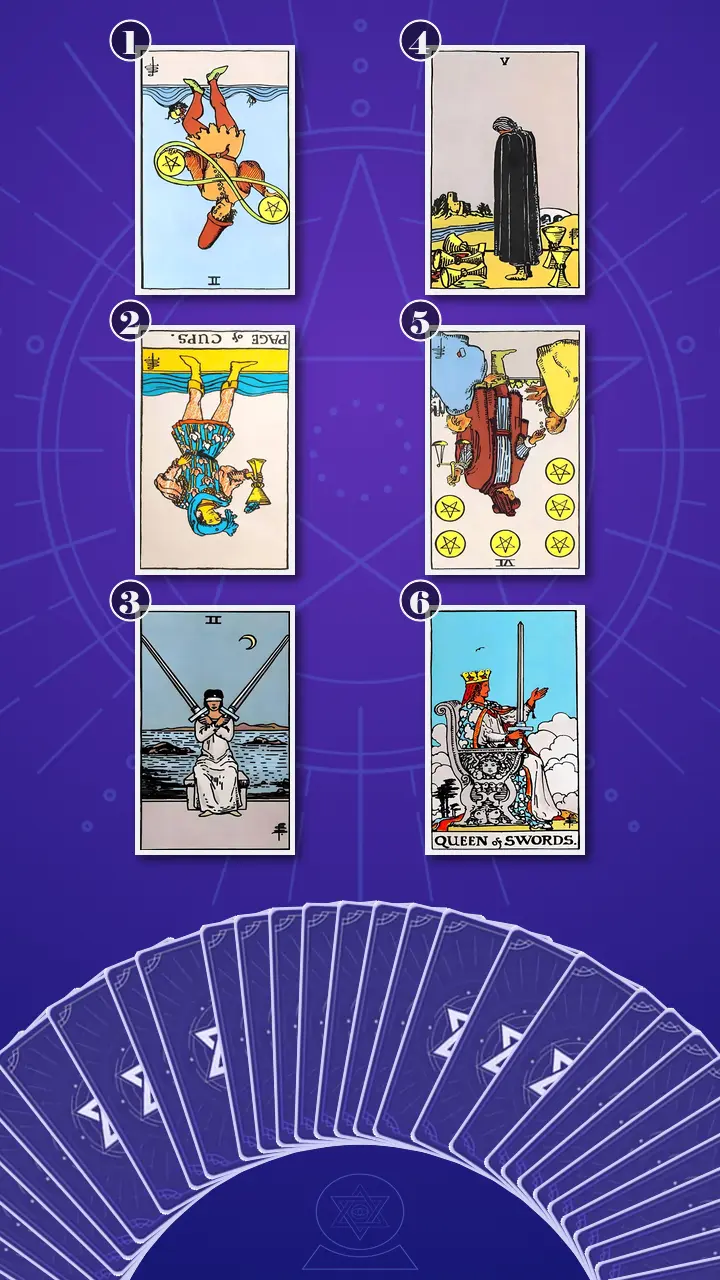
Two Inboxes, Six Cards: Reading the Pattern
As I turned the cards, I noticed something that always makes me trust a spread: a coherent visual argument. Hands kept appearing—hands juggling, hands giving, hands holding a blade. In archaeology, we look for repeated motifs in the soil: the same pottery fabric in different trenches, the same tool marks across layers. It tells you the story is consistent.
This spread did the same. It moved from overloaded Earth (time, attention, capacity) into Water (feelings, venting, rumination), and then into Air (words, boundaries, clean structure). In other words: the solution isn’t “be nicer.” It’s build a container.
Position 1: Your current lived experience — Two of Pentacles (reversed)
“Now we turn over the card representing your current lived experience with the daily DMs—the observable drain and disruption pattern,” I said.
The Two of Pentacles, reversed.
I pointed to the infinity-shaped ribbon and the choppy sea behind the figure. “This is the card of juggling,” I told her. “Reversed, it’s not ‘busy.’ It’s unsustainable. It’s the feeling that you’re never done, never caught up, because something keeps forcing a priority switch.”
And I used the scene it demands: “It’s 10:00 a.m., you’ve blocked off 90 minutes for deep work. Their DM pops up, and you do the ‘just one quick reply’ move—except you keep the thread half-open, alt-tab back and forth, and end up working in fragments. By lunchtime you’re behind, slightly sweaty with stress, and you’re already planning to catch up after hours.”
I described it as a split-screen, because that’s how it lives in the body: left side, a Google Calendar focus block you meant to respect; right side, a DM thread that acts like customer support with no posted hours. In the middle: your nervous system, yanked back and forth. Shoulders creeping up. Jaw tightening. Fingers typing, deleting, typing again.
“Energy-wise,” I said, “this is blockage—your attention can’t flow in a single direction long enough to make anything feel complete.”
Taylor let out a tight laugh—more like air escaping than amusement. “That’s… too accurate. Like, almost rude.” She shook her head once. “I lose an hour without noticing.”
“That laugh makes sense,” I said gently. “It’s the moment you realize you’re not ‘bad at focus.’ You’re trying to work with every app notification on, then blaming yourself for not concentrating.”
Position 4: Their underlying driver — Five of Cups (upright)
“Now we turn over the card representing their underlying emotional driver—what the venting is trying to accomplish for them,” I said.
The Five of Cups, upright.
The figure mourns the spilled cups while two full cups stand behind them. “This card is rumination,” I explained. “Selective attention to what hurts. A filter that keeps returning to the same disappointments.”
I translated it into Taylor’s life: “Their DMs orbit the same few frustrations—same unfairness, same ‘can you believe this?’ tone. Even when there are practical options, the thread stays in replay mode. What they’re seeking is a witness to the disappointment more than a solution.”
“Notice what that does,” I added. “It depersonalizes the behavior. It doesn’t make it your job. But it explains why the messages feel urgent and repetitive: they’re trying to offload an emotional weight, not request a work deliverable.”
Taylor’s eyes softened—not into sympathy exactly, but into comprehension. Her shoulders dropped a few millimeters, as if her body had stopped treating the coworker’s mood as a fire alarm she was required to answer.
Position 2: Their communication style — Page of Cups (reversed)
“Now we turn over the card representing the coworker’s communication style—how they’re showing up in the DM pattern,” I said.
The Page of Cups, reversed.
“This is the messenger of feelings,” I told her. “Reversed, the cup becomes spillable. It’s emotional spillover, impulsive messaging, poor timing—seeking reassurance without much self-regulation.”
I kept it firmly non-pathologizing. “Not malice,” I said. “More like… Slack is their immediate mood outlet.”
Then I anchored it in the exact modern scenario: “They send a ‘quick rant’ that turns into a long thread with multiple follow-ups. You notice they DM at the moments you’re busiest, and your warm replies unintentionally make you the fastest route to relief.”
“Energy-wise,” I added, “this is a deficiency of containment on their side—so the feelings come out raw. And it creates a temptation on your side to become the container.”
Taylor’s mouth pressed into a line, not angry, more like she’d been given permission to stop interpreting their behavior as a personal referendum on her kindness.
“So when I respond like… super soothing,” she said, “I’m training it.”
“Exactly,” I replied. “Not because you’re foolish. Because you’re trying to keep work from feeling tense. You’re trying to prevent discomfort by paying for it immediately.”
Position 5: The reciprocity dynamic — Six of Pentacles (reversed)
“Now we turn over the card representing the reciprocity and boundary dynamic between you—where the exchange has become uneven,” I said.
The Six of Pentacles, reversed.
The scales in the giver’s hand—tilted, failing the fairness check. “This is the card that names the core dynamic,” I told her. “An uneven exchange. Your attention and emotional labor are going out more than what’s coming back in a healthy way.”
I framed it the way I often do when I’m teaching students how to read an excavation ledger: not moral, measurable. “Think of it as an attention budget audit,” I said. “The scale tips when you donate prime focus to their processing and then pay for it at 6:30 p.m., catching up after hours.”
As an archaeologist, I’ve handled ancient weights—stone and bronze—designed to make trade fair when trust was imperfect. A market could be friendly, even warm, and still require a scale. That inner memory surfaced, uninvited but useful: fairness isn’t a feeling; it’s a structure.
“If it’s always in your DMs,” I added, letting the words land, “it’s not ‘just a quick rant’—it’s a recurring task.”
Taylor went very still for a moment—breath held, fingers hovering near her mug as if she’d forgotten what she was reaching for. Then her gaze drifted slightly to the side, like she was mentally replaying a week’s worth of notifications. Finally, a soft, surprised sound: “Oh.”
“I’m not mad,” she said, almost to herself, “so why do I feel resentful?”
“Because resentment is often just information,” I answered. “It’s your body’s way of saying: the terms of this exchange were never negotiated.”
Position 3: Your inner need — Two of Swords (upright)
“Now we turn over the card representing your inner need and the decision you’re postponing—the peace-keeping stance that blocks boundary-setting,” I said.
The Two of Swords, upright.
The blindfold. The crossed swords. The calm water that looks peaceful until you realize it’s stagnant. “This is your strategy: stay neutral, delay the decision, hope the discomfort resolves itself,” I told her.
Then I used the exact lived scenario: “You open the message, feel your chest tighten, and spend the next hour rehearsing five possible replies in your head—most start with apologies, none clearly name the boundary. You stay ‘neutral’ in the moment, then later feel quietly resentful and avoid them in the hallway.”
“Here’s the line I want you to keep,” I said, and I kept my voice calm because this is where people tend to self-blame. “Not choosing is still choosing. It’s choosing to keep paying the cost.”
Taylor looked down at the card and then up at me with a kind of resigned honesty. “I keep waiting for the perfect phrase,” she said. “Something that won’t make me look cold.”
“You don’t need the perfect tone,” I said. “You need a repeatable line.”
When the Queen of Swords Drew a Two-Sentence Line
I paused before the final card—not for drama, but because I could feel Taylor’s whole system bracing for it. The way people brace for a difficult email: shoulders up, breath shallow, mind already arguing with an imaginary response.
“Now we turn over the card representing the healthiest boundary-forward way to respond—a clear, sustainable communication stance you can practice,” I said.
The Queen of Swords, upright.
The card’s sky is clear. The sword is upright. The Queen’s gaze is steady, not cruel. “This is professional directness,” I told her. “Firmness without theatrics. Structure that protects kindness from turning into depletion.”
I translated it into her modern life immediately: “You send a short message that doesn’t debate or over-apologize: ‘That sounds stressful. I can’t do vent DMs during the day—I’m in focus blocks. If you want to debrief, I can do 10 minutes after lunch.’ Then the next day, you repeat it without re-litigating your reason.”
At this point I brought in my own analytical habit—what I call Skill Archaeology. “Taylor,” I said, “you’re a marketer. You already have an overlooked talent you’re not using here: you know how to write clean copy. Two sentences that mean something. You’re treating this like a fragile artifact you have to wrap in twelve layers of bubble wrap so nobody gets upset. But the Queen of Swords is asking you to use your actual skill: clarity.”
She swallowed, and I saw the shift: not from fear to bravery in one leap, but from fear to coherence.
And then I followed the arc of the aha moment exactly, because this is the pivot where “how tarot works” stops being abstract and becomes actionable advice.
First, the setup—the moment that traps her: mid-morning, finally trying to get a real focus block in, DM preview appears. Shoulders jump. Jaw locks. She writes like she’s defusing a bomb because she believes one wrong tone could make work weird.
Not endless soft replies—one clean line, like the Queen of Swords’ raised blade, turns daily DMs into a boundary you can actually hold.
The sentence hung in the air the way a cleanly drawn line on a site plan hangs over messy ground: simple, undeniable, and suddenly everything organizes itself around it.
Taylor’s reaction came in layers—three small movements that told me more than any speech. First, a brief freeze: her breath caught, and her eyes widened just slightly, as if she’d been handed a possibility her body didn’t quite trust yet. Second, the cognition seeped in: her gaze unfocused for a beat, replaying a memory of last week’s Slack thread and the way she’d added apology after apology like sandbags against a flood. Third, the release: her shoulders sank, and she let out a long, shaky exhale that sounded like someone putting down a bag they didn’t realize they’d been carrying.
“But—” she began, and there it was, the reflexive protest. Her brow tightened. “If I’m that direct… won’t they think I’m mad?”
I kept my tone steady, almost academic in its calm. “This is where people get it backward,” I said. “You don’t prevent a blow-up by being endlessly available—you prevent it by being clear early, then staying consistent. Clarity early prevents drama later.”
Then I gave her the permission that the Queen always gives, if you let her: “Kind doesn’t have to mean constantly accessible.”
I watched her face shift again—relief, yes, but also that odd dizziness that comes when you realize the next step is simple and therefore unavoidable. When you’ve been tone-policing yourself for months, a clean sentence can feel like stepping into brighter light.
I asked her, exactly as I always do at this point: “Now, with this new lens, can you think back over last week—was there a moment when this would have changed how you felt? Even if the external situation didn’t change?”
Taylor nodded slowly. “Tuesday. I was in a meeting and saw the typing bubble. I sent three separate ‘omg’ replies during the meeting just to keep them… calm. I felt my face get hot. And then I stayed late.” She looked down at the Queen again. “I could’ve just… let it sit.”
“Yes,” I said. “And this is the emotional transformation in one sentence: from on-call guilt and tone-policing anxiety to calm, professional clarity with sustainable workplace boundaries. Not because you become colder. Because you become clearer.”
From Insight to Action: Your 7-Day “Business Hours” Experiment
I summarized what the cards had said in plain language, weaving them into a single story: your day is being split into fragments (Two of Pentacles reversed). Your coworker’s feelings spill into the easiest container available (Page of Cups reversed), driven by a disappointment loop that keeps replaying (Five of Cups). The exchange has become uneven—default access to your attention (Six of Pentacles reversed). You keep the peace by postponing the line (Two of Swords). The remedy is not a grand confrontation; it’s a clean, repeatable boundary (Queen of Swords).
“Here’s the blind spot,” I said. “You’ve been acting as if perfect softness is what prevents workplace tension. The spread says the opposite: structure prevents tension. Consistency prevents tension. A boundary isn’t a breakup. It’s business hours.”
This is where I brought in one of my intervention frameworks—something I call Megalith Transport. When ancient builders moved stones that seemed impossible to move, they didn’t rely on heroics; they relied on increments: rollers, ropes, coordinated steps. Boundaries work the same way. Not one dramatic push—many small, repeatable moves.
Taylor hesitated, then offered the kind of practical objection that tells me we’re finally in the real world. “But I can’t even find ten minutes,” she said. “I’m slammed. And if I don’t reply fast, I’m scared it’ll get weird.”
“Good,” I said—warmly, not sharply. “That’s not failure. That’s data. So we lower the bar without changing the meaning. Five minutes counts. One Focus block counts. The goal is a sustainable container, not a flawless performance.”
- Draft the Two-Sentence Blade (once)Open Notes (or create a Slack snippet) and write a 2-sentence template you can reuse: one line of validation, one line stating your access rule + a specific window. Example: “That sounds frustrating. I’m heads-down during the day—if you still want to debrief, I can do 10 minutes after lunch (12:40–12:50).”If you start rewriting to not sound rude, stop at two sentences. Extra paragraphs often read like an opening for negotiation.
- Post your Business Hours (7-day experiment)Choose one daily “reply window” you can actually keep (even 5–10 minutes) and put it on your calendar like a meeting: “DM check-in.” Outside that window, you don’t engage with vent threads in real time.Treat it like customer support hours: consistent beats generous. You can reassess after 7 days.
- Run Focus Mode + Send OnceDuring your next deep-work block, turn off Slack previews or enable Do Not Disturb / iPhone Focus for 25 minutes. Let their next DM sit. When the timer ends, send your template once—no drip-feeding attention across the hour.If your body spikes (tight jaw/chest), do one slow exhale before you hit send. Calm is a physical skill, not a personality trait.
I added one more piece—my Relic Authentication check, because workplaces differ. “If you set the boundary and they respond normally—maybe a little awkward, but fine—you keep going,” I said. “If they get retaliatory, guilt-trippy, or start escalating in ways that affect your job security, you don’t keep negotiating in DMs. You route it to appropriate channels: manager, HR, EAP—whatever is safest in your company. Your wellbeing and employment come first.”
Taylor nodded, and for the first time in our conversation her nod didn’t look like surrender. It looked like consent—to her own limits.

A Week Later: The Quiet Proof
Six days later, Taylor sent me a brief update. “I used the snippet,” she wrote. “My stomach flipped when I hit send. And then… nothing exploded. They said ‘ok’ and vented less. I got my focus block back.”
She added something small and honest that I appreciated: “I still felt guilty for like, ten minutes.”
That, to me, is the most believable kind of progress. Clear but not invincible. She slept a full night, then woke up and briefly thought, What if I did it wrong?—and this time she didn’t spiral. She made coffee, opened her campaign deck, and let the question pass like streetcar lights sliding over a window.
I thought about the spread again—the way it ended in Air. In my work, whether I’m lecturing at Cambridge or kneeling in a trench with a brush, clarity is rarely a thunderclap. More often it’s the moment the outline appears: the edge of a wall, the clean line between layers. You don’t argue with it. You work with it.
When a coworker’s name pops up and your body braces like you’re about to get graded on your kindness, it makes sense you’d rather stay available than risk being seen as “difficult”—even if it’s draining you.
If you trusted that one clear, repeatable line could keep things calmer than a hundred perfectly softened replies, what boundary would you want to try for the next seven days—just as an experiment?