From PR Freeze to Calm Ownership: A Code Review Boundary Journey

The 8:47 p.m. PR Diff That Wasn’t Mine (and the "coworker rewrites my code" spiral)
You get a GitHub PR notification and your stomach drops because it’s not comments—it’s your coworker pushing a full rewrite, and suddenly you’re doing tone management instead of engineering.
Maya (name changed for privacy) sat down across from me and didn’t even bother with the polite small talk. She had that particular kind of stillness I’ve seen in students right before an oral exam: not calm, just braced.
She described Tuesday at 8:47 p.m. in her Toronto condo living room—the laptop balanced on a throw blanket, the fridge hum oddly loud, Slack quiet but not quiet—and her phone warm from refreshing GitHub like it might change the laws of physics if she checked again. She opened the PR and the diff was suddenly massive: whole blocks of her code replaced. Her jaw tightened like a vise. Her shoulders crept up without permission. And her stomach did that sinking thing that feels less like emotion and more like gravity.
“I’m not against feedback,” she said, staring at a spot on my desk instead of at me. “I just want it to be a conversation instead of a takeover.”
I watched her thumb rub the edge of her phone case—small, repetitive, like she was sanding down a sharp corner. What she was holding in her body wasn’t abstract anxiety. It was a contracted, on-alert readiness: the tight jaw, the shoulders pinned, the jittery readiness to defend herself—while also being terrified to look “defensive.”
Under the surface, the contradiction was painfully clean: she wanted to be seen as competent and collaborative, yet she feared conflict and being judged as not good enough. So in PRs, she’d accept the rewrite, let it merge, then pay for that “peace” later—late-night refactors, over-explaining, quiet resentment, and a slow drift away from ownership.
“We’re not here to turn you into a combative person,” I told her. “We’re here to help you find clarity—so you can stay collaborative and still draw a professional boundary that protects your authorship.”

Choosing the Compass: A Relationship Spread for Workplace Boundaries in Code Reviews
I invited Maya to take one slow breath in through her nose and out through her mouth—not as a ritual for the universe, but as a signal to her nervous system: we’re switching from reaction to observation. Then I shuffled while she held the question in plain language: “My coworker rewrites my PR code—how do I set a boundary without sounding defensive or difficult?”
For this, I chose a classic Relationship Spread—a cross layout. People hear “relationship” and think romance, but in my work it’s often the most practical tool for workplace conflict, coworker dynamics, and communication boundaries. The issue isn’t only technical; it’s a pattern of power, standards, and voice, showing up through pull requests.
This spread works because it separates what gets tangled in real life: your stance, their stance, and the dynamic you accidentally co-create. Then it pinpoints the block keeping the loop alive, and it offers a resolution that’s behavioral—something you can actually type in a PR thread.
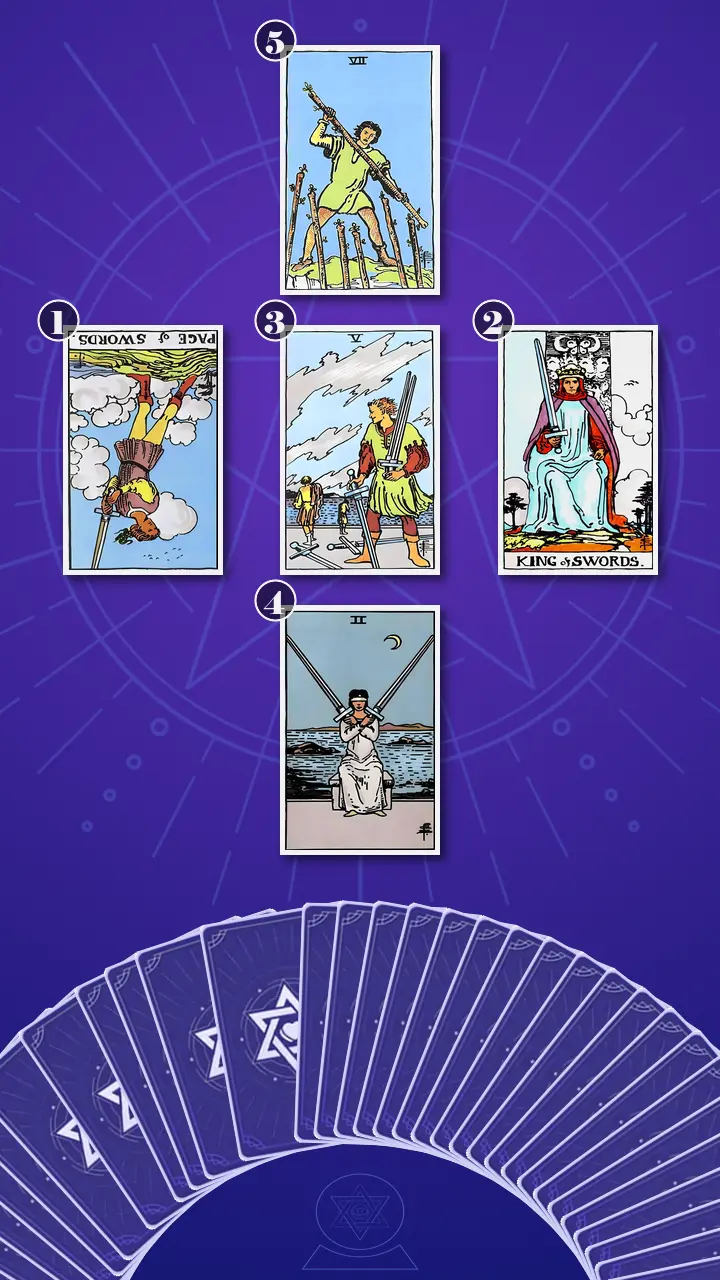
I explained the layout as I set the cards: Card 3 at the center as the current PR dynamic. Card 1 to the left—her stance. Card 2 to the right—her coworker’s stance. Card 4 below as the core block (what keeps repeating). Card 5 above as the boundary and bridge—the most workable next step.
“We’ll read left-to-right to name the tension,” I said. “Then we’ll drop down to the root of what keeps you stuck. And we’ll lift to the one move that changes the whole system.”
Reading the Map: When a PR Thread Becomes a Battlefield
Position 1 — Your current stance in PRs
“Now we turn over the card representing your current stance in PRs: the specific communication habits you default to when your code is challenged,” I said, and revealed Page of Swords, reversed.
I pointed to the Page’s raised sword—then traced an invisible line downward in the air. “Upright, this is curiosity and clean communication. Reversed, it’s the same sharp mind… but it gets stuck in midair. Ready to respond, not grounded enough to land the message.”
And the modern translation landed exactly where Maya lived: you open a PR comment box and start composing a technically solid explanation, but halfway through you switch into ‘how will this sound?’ mode. You add disclaimers, soften verbs, apologize for having an opinion, then delete the whole thing. You tell yourself you’ll come back later—then you quietly accept the rewrite so the thread doesn’t feel tense.
Maya gave a small laugh that had no joy in it—more like steam escaping a kettle before it whistles. “I literally rewrite my comment until it says nothing,” she said. “It’s… humiliating.”
“It’s not humiliation,” I replied. “It’s a strategy. Your brain is trying to keep you safe.”
I described what I call the inner courtroom—your mind building exhibits and counterarguments while your fingers don’t move: draft → soften tone → add apology → delete → refresh the thread. In this card, the energy is blocked Air: too much analysis, not enough delivery. And in a high-speed team culture—tickets, merges, “ship it”—that blockage doesn’t just cost time. It costs voice.
“Exit ramp,” I offered gently, already steering her toward something actionable: “Before you defend, ask one clean clarifying question. You’re not pleading for permission—you’re gathering requirements. Engineers understand that.”
Position 3 — The present PR dynamic
“Now we turn over the card representing the present PR dynamic: what the review process turns into between you two when rewrites happen,” I said. The card was Five of Swords, upright.
This is the conflict-aftertaste card. I’ve always found it brutally honest: the visible outcome can look like a win, while the human cost collects quietly in the background like technical debt.
I put it in PR language. “The PR merges. The diff looks clean. The thread is technically ‘resolved’—but it feels like someone won by force of commit access.”
Maya’s eyes narrowed, not in anger, but in recognition. She nodded once, small and bitter. “The PR merges,” she said, “but I’m the one who feels smaller. Then I go into standup and I’m smiling like it was teamwork.”
That’s Five of Swords energy as excess: correctness and efficiency over-relied on, until the interaction becomes win–lose. I said one of the sentences I keep for moments like this, because it’s both true and stabilizing: A rewrite isn’t feedback if there’s no shared goal behind it.
I saw her shoulders lift again at the word “shared,” as if her body was asking, Am I allowed to ask for that?
Position 2 — Coworker’s stance
“Now we turn over the card representing your coworker’s stance: how they approach standards, feedback, and control in reviews—as you experience it,” I said. We revealed King of Swords, upright.
“Ah,” I said, and this time my tone shifted into what my students used to call my ‘tutorial voice’—not lecturing, just naming structures. “This is ‘rubric brain.’ Principles. Consistency. Speed. It can be genuinely well-intentioned.”
In modern terms, I translated it the way Maya’s world would recognize immediately: “They’re acting like a linter with admin permissions.”
She snorted—quick, surprised. “That is… painfully accurate.”
I continued, carefully avoiding villain narratives. “The King of Swords enforces standards through decisive action. In a PR, that looks like: instead of asking why you chose your approach, they push a rewrite because it’s faster and ‘more correct’ by their internal rubric.”
Then I did the crucial relational reframe: “This doesn’t have to be a referendum on you. It can be a standards negotiation. You don’t need to match their coldness—just match their clarity.”
I gave her a micro-snippet, because in workplace boundary-setting, the words matter: “What principle are you applying here—performance, readability, consistency?”
King of Swords is Air in excess—clean logic, sometimes missing the human layer. And when it meets Page of Swords reversed—Air in blockage—the mismatch is almost guaranteed: one person pushes a decisive diff; the other person writes a careful essay and then deletes it.
In my mind, I flashed to an excavation in Turkey decades ago: brilliant, opinionated specialists arguing about how to remove a fragile mosaic. The most senior would simply do it their way—until someone finally said, calmly, “Name the principle. Preservation? Speed? Minimal intervention?” The moment the principle was named, the conflict dropped three notches. The King loves principles. So do good teams, when they remember to say them out loud.
Position 4 — The core block
“Now we turn over the card representing the core block: what keeps the pattern repeating instead of becoming a clear, respectful feedback process,” I said. It was Two of Swords, upright.
I didn’t rush. This card is quiet, and it asks for quiet. “A blindfold,” I said. “And crossed swords across the chest. In modern life: tone-management autopilot.”
I mirrored the scene back to her with the precision of a camera, because shame dissolves when a pattern is seen clearly. “Slack is popping off. Standup starts soon. You reread the thread. Your cursor hovers over ‘Add comment.’ Jaw clenches. Shoulders rise. And then—micro-choice—you close the tab. Peace now. Clarity later.”
Maya’s breath caught—just a tiny pause. Her gaze unfocused, like she was replaying a clip. Then the exhale came out slow, resigned. “Yeah,” she whispered. “I do freeze like that.”
Two of Swords is the block as balance that’s gone stale: a pause that protected you once, now turning into paralysis. It makes the Five of Swords dynamic inevitable—because if nobody names the rules of engagement, the loudest or fastest diff becomes the default authority.
This is where I used one of my own frameworks—something I’ve learned both in archaeology and in academia: Relic Authentication. “When we find an artifact,” I told her, “we don’t just accept the label on the tag. We assess provenance, context, and intent. In a code review, a rewrite is an artifact. Before you ‘accept’ it, authenticate it: what outcome is it optimizing for? What standard is it enforcing? What risk is it reducing?”
“So… I don’t have to accept it just because it exists,” she said, half-question, half-relief.
“Exactly,” I said. “Clarity is not conflict.”
When the Seven of Wands Took the Hill: Finding Clarity Without Escalation
Position 5 — Boundary and bridge
I let my hands rest on the deck for a beat. “We’re turning over the most important card in this reading,” I said. “This is the boundary that doesn’t burn the bridge.”
We revealed Seven of Wands, upright.
The image is simple: someone on higher ground, holding position while pressure rises from below. I watched Maya’s face as I translated it into her exact situation: In the PR thread, you write one calm paragraph that changes the whole tone: you state what you optimized for, name what you’re open to changing, and draw one clear line—if the approach is being replaced, you want a quick sync first to align on the standard.
Seven of Wands is Fire in balance: assertive action without aggression. Not a fight. A stance.
Setup (the stuck moment): I said, “You know that moment: you click the PR notification, see a huge diff that isn’t yours anymore, and suddenly you’re rewriting your reply for the fifth time so you don’t sound ‘defensive.’ You’re trying to protect your reputation by staying pleasant, even as your ownership disappears.”
Delivery (the sentence that changes the frame):
Not hiding behind the blindfold of keeping the peace—stand your ground on your own hill and name the boundary plainly.
I didn’t add anything for a second. I let it sit in the room the way a bell tone hangs in a chapel after the strike.
Reinforcement (what her body did with the truth): Maya’s reaction came in layers, not theatrics. First: a physical freeze—her fingers stopped moving on the phone case, and her breath paused high in her chest. Second: the cognition landed—her eyes widened slightly, then drifted off to the side, as if she was watching herself hover over “Add comment” and close the tab, over and over. Third: the emotion broke through—not tears, but heat. Her eyebrows pulled together and she looked straight at me, suddenly irritated.
“But if I do that,” she said, voice sharper than before, “won’t I just be… the difficult one? The ‘can’t take feedback’ engineer?”
I nodded, because that’s the honest fear. “That’s your nervous system confusing clarity with attack,” I said. “And it’s also your team’s ‘low ego’ mantra getting misread as ‘never push back.’”
I leaned in a little, grounding it in something practical. “Collaboration isn’t ‘letting someone take over.’ Collaboration is agreeing on the goal, then choosing the change on purpose.”
Her shoulders lowered a fraction. Her jaw unclenched like a fist opening. Then she gave a shaky exhale—the kind that makes room inside your ribcage. Relief, yes. But also the slight dizziness of responsibility: if she can name the boundary, she can’t pretend the boundary doesn’t exist.
“Now,” I said gently, “with this new perspective, can you think back to last week—was there a moment in that PR thread where one sentence could have changed how you felt, even if the code outcome stayed the same?”
Maya blinked, then nodded slowly. “When they pushed the rewrite,” she said. “I could’ve asked what they were optimizing for. I could’ve said I’m open to changing X, but not swapping the whole approach without a quick sync.”
And that—right there—was the emotional transformation becoming real: from tight frustration and self-doubt in PR threads to calm, assertive ownership and values-based collaboration. Not bravado. Just an adult-to-adult stance.
This was also the moment I brought in my favorite diagnostic lens—Skill Archaeology. “Often,” I said, “when someone keeps getting rewritten, the story becomes ‘I’m not good enough.’ But what I see here is a buried talent: you’re already thinking in tradeoffs, systems, and long-term maintainability. That’s senior thinking. The skill isn’t missing. It’s been covered over by tone management.”
“So Seven of Wands,” I concluded, “is you upgrading from defending yourself to defending a principle: ‘If it needs a debate, it needs a standard—or a sync.’”
The One-Page Rules-of-Engagement Comment (Megalith Transport, but for PR boundaries)
I gathered the cards into a line so Maya could see the story they were telling: Page of Swords reversed—your voice trapped in drafts. King of Swords—rubric brain with admin permissions. Five of Swords—the win–lose aftertaste where the PR merges but you feel smaller. Two of Swords—the polite freeze that keeps repeating the pattern. And then Seven of Wands—the first clean boundary that turns a takeover into a conversation.
“Here’s the blind spot,” I said. “You’ve been treating this like a personality problem—yours or theirs. But the spread shows a process vacuum. With no explicit review agreement—what’s a blocker vs a preference, when it’s okay to push commits vs leave suggestions—the system defaults to whoever moves fastest. You’re not failing at engineering. You’re missing a shared rubric.”
Then I named the transformation direction in the simplest terms: “Your shift is from silent compliance to explicit agreements. Ask for intent. State your tradeoff. Define what you’ll change now versus what needs discussion.”
And because big stones don’t move in one heave, I used my strategy I call Megalith Transport: you move something enormous by breaking it into steps small enough that your body doesn’t panic. Here are your next steps, designed to be realistic inside a fast-moving Toronto tech week:
- The Intent-First QuestionThe next time they push a rewrite to your branch, don’t accept it yet. In the PR thread, ask one clean question: “What outcome are you optimizing for with this rewrite—consistency, performance, or readability?”If you worry it sounds confrontational, remove all emotion-words and keep only process-words (outcome, standard, tradeoff). Post it, then step away for 2 minutes—water, stretch, anything.
- The Two-Sentence BoundaryOnce this week, use the template (in-thread, not a DM): (1) “I chose X because Y.” (2) “If the team prefers Z as a standard, I’m happy to switch—can we confirm that’s the goal here?”Two sentences beats a perfectly polite essay you never post. Read it out loud once. If it feels too sharp, remove adjectives—not your point.
- Blocker vs Preference LabelingIn one review comment, explicitly label the category: “Is this a blocker (correctness) or a preference (style)?” If it’s a preference, propose: “Can we leave it as a suggestion rather than pushing a rewrite commit?”This is King of Swords language—clear categories. Standards-driven people often respond well to it because it turns tension into a rubric instead of a vibe.
Before we ended, Maya raised an immediate real-world obstacle—exactly the kind that makes advice either usable or useless. “But I don’t have time,” she said. “We merge fast. If I slow it down, I’m the blocker.”
I nodded. “Then we authenticate the opportunity,” I said, returning to Relic Authentication. “Not every hill is worth taking. Your boundary isn’t ‘I will debate everything.’ It’s ‘If you want to replace the whole approach, it needs a standard—or a 10-minute sync.’ That’s not slowing work down; it’s preventing the same debate from recurring every sprint.”
“A calm boundary is like a rate limit,” I added. “It doesn’t ban requests. It prevents one pattern from consuming the whole system.”

A Week Later: Ownership, Not Certainty
Six days later, Maya sent me a screenshot—not of a perfect outcome, but of a real one. A PR thread. One short comment from her:
“I optimized for readability here (clear branching) over micro-perf. If we’re optimizing for perf instead, I can adjust. If you want to swap the whole approach, can we do a quick 10-min sync to align on the team standard first?”
Under it, her coworker replied—brief, but different: “Perf. Agree on a quick sync. Also good callout on the tradeoff.”
She added a second message to me: “I still felt my jaw clench when I hit send. But I slept. Like, a whole night. In the morning my first thought was still ‘what if I sounded prickly?’—and then I laughed because at least I said the thing.”
That’s what a Journey to Clarity looks like in the real world: not certainty, but ownership. Not winning, but opting out of the silent compliance loop and choosing explicit agreements instead.
When someone rewrites your PR, it’s not just the diff—it’s that tight, hot mix of “I want to be easy to work with” and “I need my thinking to count,” trapped behind a polite silence you can feel in your jaw.
If you let yourself be collaborative and firm at the same time, what’s the smallest boundary sentence you’d be willing to try in your next PR thread?