From Late-Night Slack Spirals to Rested Dates: Rebuilding Weeknights

Finding Clarity in the 11:38 p.m. Slack Glow
You tell yourself you’ll do a “quick check” of Slack from bed, and 40 minutes later you’re still rereading the thread like your career depends on tone analysis (always-on work culture).
Jordan said that to me like she was confessing to something embarrassing—except her eyes didn’t look embarrassed. They looked wide awake in the way people look when they’ve been awake too many nights in a row.
She was 29, a product manager in New York, the kind of job that sounds clean on paper and feels like living inside a group chat. She came to see me on a Tuesday evening, still wearing the day like a tight collar. When she sat down, she placed her phone face-down on my table with the careful precision of someone putting away a lit match.
“It’s always the same,” she said. “I’m under the covers, radiator clicking, room dark except for the phone glow. Slack pings. It’s ‘optional’—nobody says it’s urgent. But my body hears, ‘Answer now or you’ll look unreliable.’ So I answer. And then I can’t sleep. And then dating feels… impossible.”
She gave a small, tired shrug. “I either cancel, or I show up and I’m there-but-not-there. Like I’m on a date with my team’s backlog.”
I watched her inhale—sharp, high in the chest—and exhale like her breath had to squeeze past something. Pressure, yes, but also guilt and a quiet loneliness that sat behind her words the way street noise sits behind a closed window.
“What you’re describing,” I said gently, “isn’t a productivity problem. It’s your nervous system learning that your bed is a workplace doorway that never closes.”
Her eyes flicked up, relieved at being understood and annoyed that it was true.
“Let’s do this the practical way,” I continued. “We’ll treat tonight like a Journey to Clarity: not a grand overhaul, not ‘just turn off your phone,’ but a map. We’re going to find where the loop starts, what it’s protecting, and what the smallest next step is that actually sticks.”
Choosing the Compass: How the Celtic Cross Works for a Career Crossroads
I’m Hilary Cromwell—emeritus professor by title, archaeologist by training, and in this strange second career, a tarot reader who thinks in systems. I don’t use cards to float above reality. I use them the way I used site maps on a dig: to see what’s buried under what, and why a structure keeps collapsing in the same place.
I asked Jordan to take one slow breath, then another. Not as a ritual of mystery—just a clean mental transition. I placed the deck in her hands and asked her to think of one specific moment: the late-night ping, the tap, the spiral.
“Tonight,” I told her, “we’ll use the Celtic Cross.”
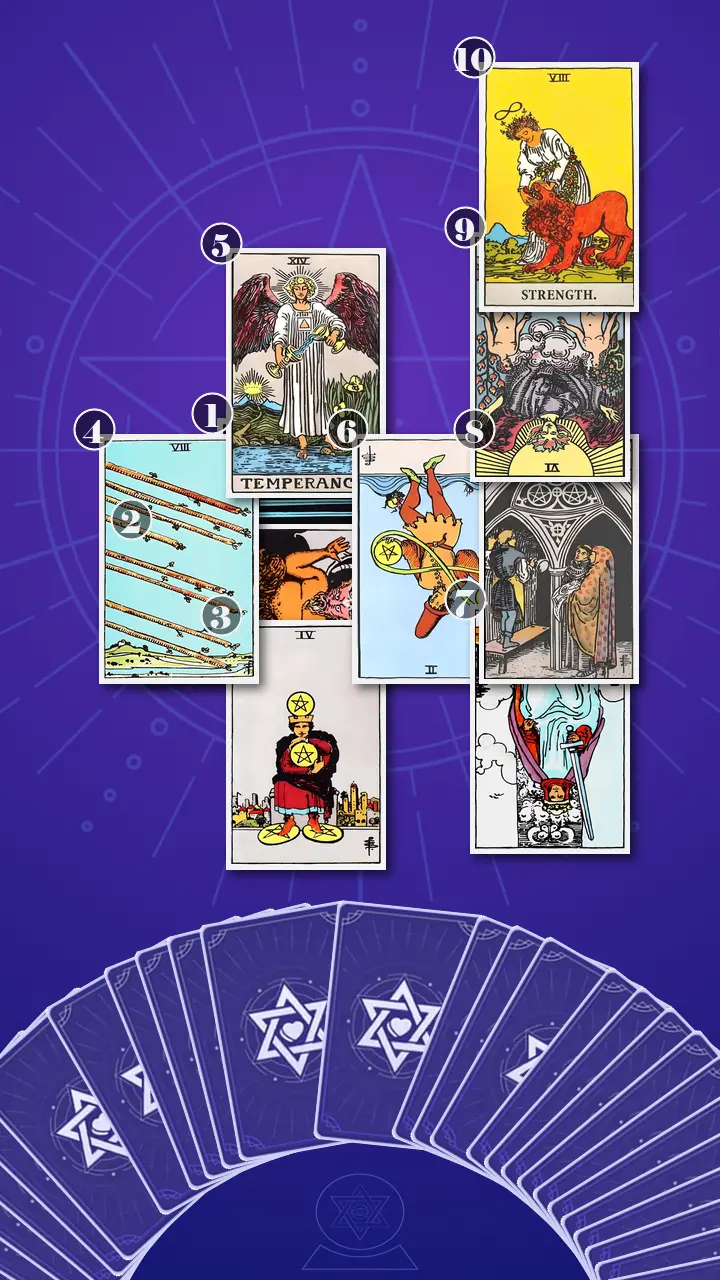
For readers who wonder how tarot works in a situation like this—work, sleep, dating tugging at the same person—this spread is ideal because it tracks the full chain: the visible symptom, the obstacle, the underlying driver, the recent acceleration, the conscious goal, the near-future consequence, your inner stance, the system around you, the hopes and fears, and finally the integration path. It’s especially helpful when you’re at a career crossroads without it being a binary choice, because it reduces all-or-nothing thinking and points you toward actionable advice and next steps.
I gestured to the layout as I dealt: “The center shows the ‘right now.’ The crossing card shows what’s pressing on it. Below is the root. Above is what you’re aiming for—what rebalancing would look like if it were a daily practice. Then we climb the staff on the side: your inner voice, your environment, your hopes and fears, and the outcome.”
Reading the Map: Card Meanings in Context (Slack, Sleep, Dating)
Position 1: The most visible symptom — Nine of Swords (upright)
“Now flipping over is the card that represents the most visible symptom: what the late-night ping is doing to your mind-body state right now.”
Nine of Swords, upright.
The image is almost too on-the-nose: someone sitting up in bed, hands to face, nine swords lined on the wall like accusations you can’t take down.
“This,” I said, “is like when you close your laptop but keep working in your head—Slack threads replaying as if they’re pinned above your bed. The reply is sent, but your mind stays open like a tab you can’t close.”
In energy terms, the Nine of Swords is excess Air: thinking without landing. Not planning—spinning. It explains why you can be exhausted and still feel wired. Your body is in ‘rest mode,’ but your mind is still doing risk assessment: Did I miss an implied expectation? Did my tone sound wrong? What if they think I’m not committed?
Jordan let out a short laugh that had a bitter edge to it. “That’s… honestly kind of brutal.”
“Accurate can feel like that,” I said. “Let me ask you what this position always asks in real life: after you reply, what’s the exact next move? Refresh? Reread? Draft a follow-up you don’t send? And where do you feel it in your body?”
Her hand went, unconsciously, to the center of her chest. “Here. Like I’m bracing.”
Position 2: The core obstacle — The Devil (upright)
“Now flipping over is the card that represents the core obstacle: the attachment that keeps the always-on reflex in place.”
The Devil, upright.
I didn’t soften it. I didn’t need to. She’d already said the word “impossible” about dating, and people don’t say that unless something has begun to feel like a chain.
“Here’s the city-night version,” I said. “It’s 11:38 p.m. The room is quiet except the radiator clicking. Then the Slack notification sound cuts through the silence like a siren that only you can hear. On paper, it’s optional. In your body, it’s a test.”
Jordan’s jaw tightened—then she nodded once, small and sharp.
“The Devil is compulsion,” I continued. “And the classic symbol in this card is the loose chain. Loose enough to remove—meaning the bondage isn’t a law of physics. It’s a default setting.”
“It’s like your nervous system has a push alert that hijacks the algorithm,” I said, borrowing her world for a moment. “One tap, and your entire feed becomes work.”
She swallowed. “My thumb moves before I decide.”
“Exactly,” I said. “Freedom versus safety. The Devil offers a kind of false safety: Stay reachable, stay valuable. But the toll is paid in sleep debt, irritability, and that lonely half-presence on dates.”
She winced again—quietly, like she didn’t want to admit how much it hurt to hear it framed that way.
Position 3: The underlying driver — Four of Pentacles (upright)
“Now flipping over is the card that represents the underlying driver: what you’re trying to secure by replying at night.”
Four of Pentacles, upright.
The figure in the card holds a pentacle to their chest like a life raft. It’s not greed; it’s guarding. It’s the posture of: If I loosen my grip, something falls.
“This tells me the Slack reflex isn’t only about team culture,” I said. “It’s about a root-level grip on stability. Your reputation, your influence, your place in the room. The belief underneath is scarcity: If I’m not constantly available, I’ll lose standing. I’ll be replaceable.”
In energy terms, this is excess Earth in a very specific shape: control as comfort. It’s the same instinct I’ve seen at excavation sites, oddly enough—when a storm threatens, people cling to what they can carry instead of trusting the shelter we already built.
Jordan’s fingers curled around her own water bottle, as if proving the point without meaning to.
“Security,” I said, “can come from clear agreements. Or it can come from constant vigilance. One is sustainable. One keeps you in standby mode.”
Position 4: How the pace escalated — Eight of Wands (upright)
“Now flipping over is the card that represents how the pace escalated: what in the recent past normalized urgency.”
Eight of Wands, upright.
“This validates something important,” I said. “The speed is real. This isn’t you being ‘dramatic.’ The Eight of Wands is rapid communication, momentum, everything moving in the same direction.”
It reminded me of historic trade routes—caravans moving because the season demanded it, not because every step was a moral test. When a system accelerates, people start treating motion as virtue.
“In modern terms,” I told her, “this is the Slack-based workflow where the velocity doesn’t stop at 6 p.m. just because the calendar says it should. Time zones become the forever excuse. And once speed becomes normal, every message inherits that urgency—even the ones that don’t deserve it.”
Jordan stared at the card and said, softly, “It did get worse after the reorg.”
“That’s your timestamp,” I said. “That’s when the wands started flying.”
When Temperance Spoke: The Handoff That Changes Everything
Position 5 (Key Card): Your conscious aim — Temperance (upright)
I let the room go a shade quieter before I turned the next card. Even in Manhattan, you can feel a small hush when someone is ready to hear the thing they’ve been circling.
“Now flipping over is the card that represents your conscious aim: what rebalancing would look like if it were a principle you practiced daily.”
Temperance, upright.
Jordan leaned in without realizing she’d moved. The angel in the card pours water between two cups—measured, calm, deliberate. One foot on land, one in water. Not choosing one life over another. Learning the transfer.
And this is the moment where most people admit, finally, what the problem isn’t: it isn’t that they don’t know what to do. It’s that doing it feels like it might cost them something socially.
Setup. I said, “If you’ve ever been under the covers at 11:30 p.m., phone glow on your face, telling yourself ‘just one quick reply,’ and then somehow it’s 12:12… you already know this isn’t about time management.”
I watched her face tighten in recognition—like someone hearing their own private thought spoken out loud.
Delivery.
Stop treating every ping like a fire; start pouring your energy with intention, like Temperance moving water cup to cup.
I let the sentence sit for a beat, the way I used to let dust settle after brushing a mosaic—because rushing is how you miss the pattern.
Reinforcement. Jordan’s reaction came in layers: first a tiny freeze—her breath paused mid-inhale, her fingers hovering above her phone as if it had buzzed even though it hadn’t. Then her eyes unfocused, not sleepy but far away, like she was replaying a dozen nights in fast-forward: the tap, the polished reply, the refresh, the suspicious silence. Finally, a long exhale slid out of her—visible, almost physical—and her shoulders dropped a fraction, as if a strap had been cut from a heavy bag she’d forgotten she was carrying.
“So I don’t have to… stop caring,” she said, and there was a tremor of disbelief in it. “I just have to stop switching like it’s an emergency.”
“Exactly,” I said. “Temperance isn’t ‘quit your job’ energy. It’s systems design. It’s a clean handoff, not an emergency switch.”
This is where I reached for one of my own tools—what I call Skill Archaeology. “Let’s unearth something you’re overlooking,” I said. “You already have the talent you think you’re proving at midnight: clarity, follow-through, reliability. The overlooked part is that you can demonstrate it in daylight with consistency. Your ability isn’t in question. The method is.”
In other words: instant availability isn’t the same thing as dependable follow-through.
“Now,” I asked her, “use this new lens and think about last week. Was there a specific moment where a ping came in, you replied, and your body stayed on-call anyway—where this insight could’ve made you feel different?”
She blinked rapidly, as if pulling herself back into the room. “Thursday,” she said. “I answered at 11:47. Then I reread it like five times. Nothing happened. Literally nothing.”
“That’s Temperance’s proof,” I said. “The fire didn’t exist. But your body fought it anyway.”
And that’s the emotional shift on the table: from hyper-vigilance to cautious experimentation. From proving worth to building a rhythm you can repeat.
Position 6: The near-term trajectory — Two of Pentacles (reversed)
“Now flipping over is the card that represents the near-term trajectory if nothing changes.”
Two of Pentacles, reversed.
“This is the warning label,” I said. “Not apocalypse—just physics.”
Reversed, the Two of Pentacles is the juggling act tipping into unstable spinning: the infinity loop gets wobbly, the sea behind the figure rougher. It’s what happens when you try to keep everything afloat by switching faster.
“Modern translation,” I said: “three apps open, zero progress. Slack, Calendar, dating app. Constant switching, no landing. And the risk here is overcorrection—going rigid, blocking everything, snapping at people—because you’re so tired of dropping balls.”
Jordan’s mouth twisted. “I’ve definitely fantasized about throwing my phone into the Hudson.”
“A very New York solution,” I said dryly. “But this card says: a boundary you can repeat beats a boundary you can only announce. We’re going to make it boring. Boring is stable.”
Position 7: Your role in the pattern — King of Swords (reversed)
“Now flipping over is the card that represents your internal stance: the self-talk and decision style you bring to boundaries.”
King of Swords, reversed.
“Ah,” I murmured, and Jordan immediately tensed like she expected judgment.
“Not judgment,” I said quickly. “Identification.”
“This is the inner ‘courtroom voice,’” I explained. “The King of Swords upright is clear authority. Reversed, that authority turns punitive. It tries to solve a human problem—sleep and intimacy—with courtroom-level logic.”
I gave the voice words, because naming it is how you stop mistaking it for truth: “If you were serious, you’d respond now.”
Jordan half-laughed, the sound breaking into a sigh. “That is… exactly what it sounds like.”
“And here’s the calmer authority voice,” I said, the one Temperance is trying to teach: “I’ll handle it at 9:00 a.m.—on purpose.”
In energy terms, this is blocked Air: clarity turning into harshness under stress. When that king is running the show, you end up editing Slack replies to be bulletproof, then mentally arguing with imaginary criticism at 12:16 a.m. Your body can’t relax because the verdict is never final.
Position 8 (Catalyst): The system around you — Three of Pentacles (upright)
“Now flipping over is the card that represents the environment: team norms, time zones, implied expectations, and what can be negotiated.”
Three of Pentacles, upright.
This is the worksite card: collaboration, shared standards, the moment where people stop guessing and start building from a plan.
“This is your pivot,” I said. “Because it tells me the most effective boundary is not a private struggle of willpower. It’s an explicit agreement.”
I offered her a scene, because scenes make change feel possible: “Imagine it’s 2 p.m., not midnight. You’re in a project channel. You do a quick norms check like you would before a sprint: ‘Hey—can we align on what counts as urgent after hours versus can-wait?’”
Jordan’s shoulders loosened, visibly. A small surge of relief moved through her face—the look people get when they realize they’re not the only one responsible for holding up the ceiling.
“I could say it like process,” she said. “Not like… a personal issue.”
“Exactly,” I said. “That’s Relic Authentication in my language—assessing what’s real before you build your whole night around it. Not every artifact is valuable. Not every ping is urgent. But you need criteria.”
Position 9: The emotional truth-test — The Lovers (reversed)
“Now flipping over is the card that represents hopes and fears—especially about dating, availability, and presence.”
The Lovers, reversed.
“This isn’t telling me you don’t want love,” I said. “It’s telling me you’re afraid you can’t have both—ambition and being a person.”
Reversed, The Lovers is misalignment: choices made from pressure rather than values. It’s the fear narrative of, Dating will always lose to work—or the equally sharp fear, If I choose a relationship, I’ll have to sacrifice my trajectory.
“Here’s what I hear in your story,” I said. “Work is treated as mandatory. Intimacy is treated as optional. So the moment Slack pings, your ‘choice’ disappears.”
Jordan stared at the table, and for a second I saw the loneliness without the armor. “I hate that you’re right,” she said quietly. “Because I do want it. I just… show up as a drained version of myself.”
“That’s the truth-test,” I said. “Rebalancing isn’t just sleep hygiene. It’s values-based choice. The Lovers asks: what do you want dating to serve—connection, fun, partnership? Not because you have to decide everything now, but because exhaustion shouldn’t be the one making the decision for you.”
Position 10: Integration direction — Strength (upright)
“Now flipping over is the card that represents the integration path: the most sustainable way to hold boundaries so sleep and dating can recover without sabotaging work.”
Strength, upright.
“This is the ending I like,” I said. “Not because it’s dramatic—because it’s doable.”
Strength isn’t force. It’s gentle control. The woman closes the lion’s mouth without a fight. The lion isn’t killed. It’s trained.
“This tells me you don’t win by attacking yourself,” I said. “You win by building calm, repeatable practices that reduce reactivity to pings.”
I nodded at her phone, still face-down. “Don’t fight the lion at midnight. Train it at 10:30.”
The Temperance Rhythm: Actionable Advice You Can Start Tonight
I leaned back and gave Jordan the full story the spread had told, stitched into one thread—because clarity isn’t just insight; it’s coherence.
“Here’s the map,” I said. “The Nine of Swords shows the symptom: you’re in bed, but not resting. The Devil crossing it shows the obstacle: the reflex has become compulsion—optional on paper, mandatory in your body. The Four of Pentacles explains why: you’re gripping security, trying not to be replaceable. The Eight of Wands shows how it got normalized: speed and time zones trained everyone to treat everything like it’s in motion. Temperance is the pivot: a repeatable handoff that keeps work expectations clear without keeping your nervous system on-call. Two of Pentacles reversed warns that if you keep juggling reactively, something drops—sleep, mood, or dating follow-through. King of Swords reversed names the inner mechanism: harsh self-leadership. Three of Pentacles shows the exit: team norms can be renegotiated. Lovers reversed names the emotional cost: connection loses by default. Strength is your integration: calm discipline, practiced kindly.”
“Your blind spot,” I added, “is that you’ve been trying to prove reliability through instant access. That makes sense in an anxious moment—but it’s a narrow definition of reliability.”
“The transformation direction is this,” I said plainly, because she deserved plainness: “Shift from proving reliability through instant availability to proving reliability through clear expectations, consistent follow-through, and protected recovery time.”
Then I gave her what she actually came for: next steps. And I used my most practical strategy—what I call Megalith Transport. When ancient builders moved stones too heavy for one person, they didn’t ‘try harder.’ They broke the task into stages, used rollers, and moved the weight steadily. Your boundary is a megalith. We move it in steps.
- The 7-Minute “Temperance Pour” (Tonight)Set a timer for 2 minutes and write a one-line “tomorrow morning” note in your phone: “First thing: respond to X / clarify urgency on Y.” Then turn on Do Not Disturb until a specific time you can keep. Finally, put your phone on a charger across the room (or outside the bedroom if doable).If anxiety spikes, move the phone closer. This is an experiment, not a moral test.
- Your Copy-Paste Boundary Script (Slack-to-Sleep Handoff)Create one reusable reply and pin it somewhere easy: “I’m offline for the night—happy to pick this up first thing tomorrow. If it’s urgent, please tag it urgent.” Use it when a late ping arrives so you don’t spend midnight drafting “perfect wording.”Your brain will call this “dramatic.” Treat that as a signal, not a verdict.
- The 10-Minute Norms Check (Three of Pentacles Move)Schedule 10 minutes with your manager or team lead and ask one boring process question: “Can we agree what counts as urgent after hours vs can-wait until morning?” Propose a convention: “Use @here only for urgent; otherwise schedule-send for morning.”Frame it as sustainability: “I want to be consistently responsive during core hours.” Ask questions instead of defending.
- One Protected Date Window (Lovers Realignment)Pick one date or social plan this week and schedule it when you’re realistically rested (e.g., Saturday afternoon, not a squeezed Wednesday night). Before you go, send: “FYI I’m trying a phone-down date—if I check it, it’s just a work habit I’m working on.”Reduce variables. You’re testing presence, not performing perfection.
“Notice what none of these require,” I said. “A personality change. We’re not deleting work. We’re changing the mixing ratio.”
“And if you want one litmus test,” I added, giving her my Relic Authentication lens in plain language: “Before you tap Slack in bed, ask: Is this actually urgent—or is it just loud? If it’s urgent, it will survive a definition.”
A Week Later: Ownership, Not Certainty
Six days later, Jordan texted me a screenshot I didn’t ask for: her Slack status at 10:30 p.m.—“Offline—back at 9am ET.” Under it, a second screenshot: a short note to her manager, calendar invite titled “After-hours urgency norms (10 min).”
Her message was even shorter: “Did DND two nights. First night felt like withdrawal. Second night I slept. Still woke up thinking ‘what if I missed something?’—but I didn’t grab the phone. Also: Saturday afternoon date. Phone stayed in my bag. I was actually… there.”
It wasn’t a fairy tale ending. It was better than that: a small, repeatable proof.
I thought of Strength—gentle hands, steady practice. And Temperance—cup to cup, not fire to fire. This wasn’t Jordan choosing between ambition and being a person. This was her choosing a rhythm where reliability didn’t require self-erasure.
When your phone lights up at night, it can feel like your whole worth is on trial—so you keep proving yourself in minutes, then pay for it in hours of restless sleep and half-present connection.
If you didn’t have to prove you’re reliable with instant access, what’s one tiny boundary you’d be curious to try this week—just to see how your body and your dating life respond?
Every reading at AceTarot is a Journey to connect with inner wisdom and empower next step.
Learn more about our Journey to Clarity.