The Bullet-Point Rewrite Spiral—And How I Learned to Communicate, Not Audition

Finding Clarity in the 8:14 a.m. Calendar Wall
If the 30 minutes before a meeting-heavy day turns you into a human Notion dashboard—rewriting bullets, rereading Slack, and feeling your chest tighten—this is for you (hello, Sunday Scaries in calendar form).
Casey (name changed for privacy) popped onto my screen from a tiny NYC kitchen that looked like it was lit entirely by laptop glare. It was 8:14 a.m. her time: Google Calendar packed into a solid brick of rectangles, Slack already doing that relentless little ping, espresso tasting slightly burnt because she’d forgotten it on the counter while she rewrote the same three bullets—again.
Even through a webcam, I could see the body part of the story: the jaw locked like she was bracing for impact, the chest moving in quick, shallow sips, the stomach-drop that hits right before you have to sound “crisp.”
“I can do the work,” she said, voice low like she didn’t want the stress to overhear her. “But the meeting is the part that wrecks me. And then I don’t know if that means I’m in the wrong career, or my nervous system is fried, or… I keep canceling dates because I’m too wired to be human.”
The pressure in her sounded like a smoke alarm going off when you burn toast—loud, real, impossible to ignore—while part of you is still insisting, There’s no fire. Don’t be dramatic.
I nodded, letting the silence do what it does when someone finally says the unsent text out loud. “Let’s not treat this like a verdict,” I told her. “Let’s treat it like a signal. We’ll map what’s out of sync—and find a next step you can actually live with.”

Choosing the Compass: The Energy Diagnostic Map (7)
I was sitting in a quiet back room of the Tokyo planetarium after the last show, the air faintly metallic from equipment and the star projector’s soft hum still in my bones. I asked Casey to take one breath that was more about arriving than “calming down,” then I shuffled slowly—not as a ritual for luck, but as a way to let the question become one clean sentence in the room.
“Today,” I said, “we’ll use a spread I call the Energy Diagnostic Map (7) · Context Edition.”
For a question like “Is this career, body, or dating?” you need more than a yes/no pull. This seven-card map is the smallest structure that still shows: the surface symptom, the inner tug-of-war, the external pressure, the core blockage, the available resource, the key transformation, and one grounded next step. It keeps the reading empowering—more like troubleshooting a system than predicting your fate.
I previewed the bones of it for her (and for you, if you’ve ever Googled “why do I panic before meetings even when I’m prepared” at 1 a.m.): “We’ll start with how the stress shows up right now. We’ll name what you’re juggling inside. We’ll locate what your work culture is demanding. Then we’ll go straight to the knot in the center—and pivot down into the resource, the transformation, and one practical action for this week.”
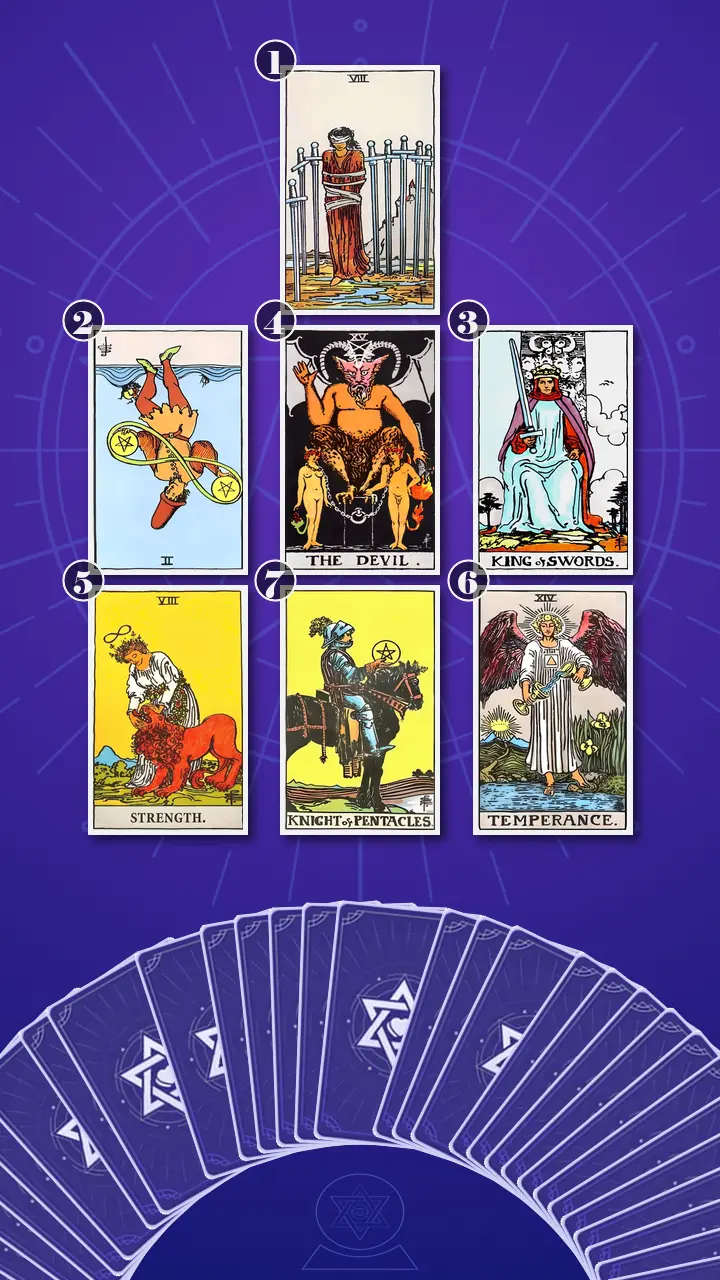
Reading the Map: The Air-Room Before You Speak
Position 1 — Surface symptom: The Eight of Swords (upright)
“Now flipped,” I said, “is the card representing Surface symptom: how meeting stress shows up right now in mind/body behavior.”
The Eight of Swords, upright.
This is the blindfold-and-loose-bindings card—the one that looks like being trapped, when the exit is technically right there. And the modern translation landed instantly: It’s 9:05 a.m., you have three solid points for the stakeholder call, but you keep rechecking your notes because your brain only sees one lane: ‘don’t mess up.’
In energy terms, this is blockage—Air (mind) narrowing into a single choke point. The mind tries to keep you safe by reducing options: say it perfectly, anticipate every question, don’t give them anything to challenge. But the cost is physical: tight chest, shallow breathing, eyes scanning the screen for danger like Slack threads are a crime scene.
Casey let out a small laugh that wasn’t amused so much as exposed. “That’s… rude,” she said. Then, softer: “It’s exactly me.”
I kept my voice gentle. “Yeah. And also—this is the first clue that it’s not ‘you’re incompetent.’ It’s ‘your nervous system thinks you’re cornered.’ The bindings are loose. Which means we can work with this.”
Position 2 — Inner tug-of-war: Two of Pentacles (reversed)
“Now flipped is the card representing Inner tug-of-war: the competing priorities between career, body regulation, and dating capacity.”
Two of Pentacles, reversed.
This one always makes me think of calendar Tetris—everything fits until one meeting runs long and the whole day collapses. The modern scene was painfully clean: you’re toggling between ‘career fix,’ ‘health fix,’ and ‘dating fix’ like tabs you can’t close—new meeting-prep template, then a new workout plan, then re-opening the dating app—then guilt in all three lanes when none of it sticks during a heavy meeting week.
Energetically, this is deficiency of rhythm—too many moving parts, no stabilizer. Control on paper, chaos in the body. It’s like a Notion workspace with twelve trackers and no actual week.
Casey did the rueful half-laugh the card predicts, shoulders lifting like, caught. “I literally did a ‘weekly reset’ on Sunday,” she said. “And I still felt more scattered after.”
“Because the spread isn’t asking for a prettier dashboard,” I said. “It’s asking for one real stabilizer. One thing your body can trust.”
Position 3 — External pressure: King of Swords (upright)
“Now flipped is the card representing External pressure: what the environment is signaling to you.”
King of Swords, upright.
This is the meeting culture card. The raised sword is “logic as authority.” The modern translation: in your org, the sharpest person sets the tone—quick frameworks, decisive language, no meandering. You walk into meetings trying to match that energy, so you optimize your phrasing instead of staying connected to your actual message.
Energetically, this is excess of Air from the outside. It doesn’t mean the culture is evil; it means it rewards speed and crispness, and your nervous system tries to sprint to keep up.
Casey’s eyes narrowed in recognition—less self-blame, more accuracy. “It’s like… the room has a tempo,” she said. “And if I’m not at that tempo, I feel behind.”
“Exactly,” I said. “Meetings aren’t a courtroom. You don’t have to argue for your right to belong. But the King can make it feel like you do.”
The Knot in the Center: The Invisible Contract
Position 4 — Core blockage: The Devil (upright)
“Now flipped is the card representing Core blockage: the belief or attachment that keeps the stress cycle running.”
The Devil, upright.
This is the card of the invisible terms-and-conditions you didn’t realize you accepted: “I’m only allowed to relax after I perform perfectly.” The modern scenario is brutal because it’s true: you tell yourself, ‘I can relax after the next meeting goes perfectly,’ and then the finish line moves. Meetings become the gatekeeper to your self-respect, your sleep, and your ability to show up on a date without feeling guarded or fried.
Energetically, The Devil is attachment—a sticky loop that convinces you the chain is the only way to be safe. The chains in the card are loose, which is tarot’s way of saying: it feels absolute, but it’s sustained by consent.
Casey’s reaction came in three beats. First: a tiny freeze—breath held, hand hovering near her mug. Second: her eyes unfocused like she was watching a replay—seven faces on Zoom, one senior stakeholder, her jaw clamping. Third: the emotion arrived, sharp. “But if I stop doing that,” she said, and there was anger under it, “then what—my work gets sloppy? People notice?”
I didn’t rush to soothe it away. “That anger makes sense,” I said. “Because it’s the moment you realize how much of your life has been paying rent to a belief. The Devil isn’t ‘you’re bad.’ It’s ‘you’ve been signing a contract in your own head.’ And we can renegotiate it.”
Position 5 — Available resource: Strength (upright)
“Now flipped is the card representing Available resource: what you can access to steady your nervous system and reclaim agency.”
Strength, upright.
Strength isn’t the “be fearless” card. It’s the dimmer switch card. The modern micro-scene is almost cinematic: right before you unmute, you slow your exhale and feel your feet on the floor. You choose steadiness over speed for your first sentence. The meeting doesn’t become easy—but you stay in your body long enough to actually communicate.
Energetically, this is balance—Fire expressed as calm courage, not adrenaline. You’re not forcing the lion (stress) to disappear. You’re holding it gently enough that it stops thrashing.
I slowed my own cadence as I said it, on purpose. “Finger hovering over ‘Join.’ One palm on your chest. Longer exhale than inhale. Not to be zen—just to be here.”
Casey’s shoulders dropped by maybe half an inch, like her body understood the instruction before her brain could critique it. “I could try that,” she said, almost surprised at herself.
When Temperance Spoke: A New Ratio for Work, Body, and Dating
Position 6 — Key transformation: Temperance (upright)
The room felt different as I reached for the next card—quieter, like when the planetarium lights dim and a whole audience unconsciously takes one synchronized breath.
“Now flipped is the card representing Key transformation: what alignment looks like when career, body, and dating are in the same rhythm.”
Temperance, upright.
Setup: You know that 30 minutes before a calendar-stacked day—Slack starts popping off, your coffee is already making your heart race, and you’re rewriting the same bullets like the right wording could keep you safe. Your mind treats the stress like proof you should make a dramatic decision: quit, overhaul, fix everything, immediately.
Delivery:
Stop treating every area like a separate emergency; start blending your time and energy like Temperance mixes the cups—one sustainable ratio at a time.
I let it sit. No extra explanation for a beat.
Reinforcement: Casey’s face changed in layers. First, her eyebrows lifted—tiny shock, like she’d been bracing for “you’re in the wrong career” and got something kinder and more precise. Then her mouth pressed into a line and softened again; I saw her swallow, as if her throat had been holding back a whole day’s worth of words. Her shoulders, which had been up near her ears when we started, eased down, and she took a long exhale that sounded like she’d finally found the bottom of her lungs.
“I keep treating everything like it’s on fire,” she said, and her voice wobbled on the last word—relief and grief together. “Like if I don’t fix work perfectly, then my body collapses, and then dating is just… not even an option.”
“Exactly,” I said. “And here’s the crucial reframe: Your body isn’t the problem to outthink—it’s the signal to recalibrate. If your body is sounding the meeting alarm, it’s not proof you can’t handle it—it’s data telling you your inputs and boundaries need a new ratio.”
Temperance always makes me think of my Orbital Resonance lens—how systems behave when their rhythms match. In astronomy, when orbits resonate, a small, steady influence can create powerful, predictable change. When they’re out of sync, everything wobbles; you spend more fuel correcting than moving forward. “Your week doesn’t need a dramatic reroute,” I told her. “It needs resonance: one clear priority and one boundary that keeps the orbit stable.”
Then I asked, just as gently as I could: “Now, with this new perspective—can you think of one moment last week where the alarm went off, and instead of listening, you tried to silence it with more prep?”
She stared at the upper left corner of her screen, searching memory, then nodded once. “Monday. I stayed up rewriting a doc. I told myself it was ‘being responsible.’ But I was terrified.”
“That’s the contract,” I said. “And that’s also the exit.”
This wasn’t a career-crossroads verdict. It was the beginning of a shift: from tight, hypervigilant meeting performance pressure to grounded, body-led calm—the kind that leaves room for boundaries, and room for dating to be real instead of another performance lane.
Position 7 — Next step: Knight of Pentacles (upright)
“Now flipped is the card representing Next step: one grounded action to practice this week so the change becomes real.”
Knight of Pentacles, upright.
This is the antidote to the all-or-nothing brain. The modern scenario is simple on purpose: you pick one routine you can keep even during stakeholder chaos—like a 3-breath reset before calls and a short decompression walk after. You treat consistency like training, not like a moral scorecard, and your nervous system starts trusting your schedule again.
Energetically, the Knight is steady momentum. Not intense. Not impressive. Repeatable. The kind of next steps that survive a Tuesday.
Casey exhaled again, smaller this time. “So I don’t have to fix my whole life?”
“No,” I said. “Consistency is the flex you can actually live with.”
From Insight to Action: The Ratio You’ll Test in the Next 48 Hours
I pulled the whole map together for her in one clean story: the Eight of Swords showed the surface bind—your mind narrowing to ‘don’t mess up.’ The Two of Pentacles reversed showed the frantic juggling—work, body, dating—without a rhythm that can hold them. The King of Swords named the external pressure—an environment that rewards crisp speed. The Devil revealed the knot—an invisible contract tying worth to performance. Strength offered the bridge—regulate first, then speak. Temperance gave the destination—one sustainable blend. And the Knight of Pentacles grounded it—do the smallest version consistently.
The cognitive blind spot was clear: you’ve been treating your stress as a personal flaw to outthink, instead of information that your current pace is out of resonance. The transformation direction was equally clear: from “prove I’m fine” to “use the body’s signal to choose one clear priority and one boundary for how I show up.”
Then I gave her a plan that fit on a sticky note, not a new life philosophy. I also added one of my planetarium-adjacent tools—an Earth-rotation perspective I use before morning meetings to stop the mind from turning one Zoom into a whole identity crisis: if the planet can rotate through night into morning without panic, you can rotate through one meeting without making it a referendum.
- 3 Long-Exhale Pre-Zoom ResetBefore your next Zoom, put one hand on your chest. Do 3 cycles of inhale for 4, exhale for 6—then click “Join.”Expect your brain to call it “too simple.” Keep it private (camera off for 30 seconds if needed). If you feel dizzy, stop and look at one object in the room—no pushing through.
- 20-Minute Meeting Prep Cap + One-Sentence AnchorFor one key meeting this week, set a hard 20-minute prep timer. When it ends, write one line: “If I only communicate one thing, it’s ___.” Close all extra prep tabs after that.This is data-gathering, not self-improvement homework. If the urge to keep prepping spikes, say out loud: “Over-prep is often just fear wearing a productivity badge.”
- One-Stabilizer Week (Pick Just One)Choose one stabilizer for the next 7 days: (a) a protected sleep window, OR (b) a post-meeting decompression block, OR (c) one low-pressure social plan that ends by a set time (like 9:30).If dating feels like “too much,” choose the smallest version (coffee or a walk). You’re blending a ratio, not proving anything. Put “Communicate, not audition” near your laptop as a boundary cue.
Finally, I offered the practice I call Space Debris Clearing—because half the panic isn’t the meeting, it’s the orbiting clutter: extra tabs, extra trackers, extra imagined conversations. “Your ‘Prep Stop’ is debris removal,” I said. “Not because you should be minimalist. Because your brain can’t navigate with junk in the flight path.”

A Week Later: The Quiet Proof
Six days later, I got a message from Casey while I was walking past the planetarium lobby, schoolkids buzzing with post-show sugar. Her text was short: “Did the 3 long exhales before a director-heavy Zoom. Still nervous. But I didn’t speed-run my first sentence. Also didn’t cancel my Thursday date—made it a 45-min walk, home by 9:15. Felt… normal?”
That’s what clarity usually looks like in real life: not fireworks—just the alarm getting quieter because you listened to it instead of taping over the dashboard light.
And if tonight you’re living in that pass/fail meeting world—chest tight, jaw clenched, terrified one imperfect moment will cost you respect, control, and the right to relax—please hear me: that doesn’t mean you’re broken. It means some part of you is trying to protect you with the only tools it knows.
If you treated that pre-meeting stress as information instead of a verdict, what’s one tiny boundary you’d be curious to test this week—just to see how your body responds?