Adding One Monday Buffer Block First: From Calendar Dread to Pacing

Finding Clarity in the 9:27 p.m. Calendar Glow
If your Sunday Scaries don’t start with a feeling—they start with you opening Google Calendar and seeing back-to-back meetings like a wall.
Jordan said that to me like they were confessing something embarrassing, not describing a totally normal nervous system response. They were on my video call from a Brooklyn walk-up, perched on the edge of the couch the way people sit when they’re telling themselves they’re “just going to do one quick thing.” Their laptop was open anyway—calendar on one side, Slack on another, Notes app hovering like a safety net. The only light in their living room was that bluish screen glow. Somewhere off-camera a radiator clicked like it had opinions.
“It’s 9:30,” they said, glancing at the clock the way you glance at a deadline. “And I already feel like I’m losing.”
When they described it, the pattern had a brutal little rhythm: you tell yourself it’ll be a quick check → it turns into a rewrite → suddenly it’s late and your body’s buzzing. Jordan didn’t use the word dread. They didn’t need to. It was in the way their jaw held on like a vise and in the restless bounce of one knee under the frame. It was like watching someone try to fall asleep in a room where the smoke alarm keeps chirping—quiet enough to ignore, loud enough to keep you on edge.
“I don’t even want less ambition,” they told me. “I just want breathing room. But if I loosen my grip… I’m scared I’ll fall behind, and everyone will see I’m not competent enough.”
I nodded slowly, letting that land without rushing to fix it. “That makes so much sense,” I said. “We’re not here to shame the habit. We’re here to understand why your system thinks Sunday night is a threat—and then we’ll find one next step that makes Monday meet a more rested version of you. Let’s draw a map through the fog.”

Choosing the Compass: The Celtic Cross · Context Edition
I asked Jordan to take one breath that wasn’t performance—just data. “Notice your chest, your jaw, your legs,” I said. “No fixing yet.” While they did that, I shuffled, not as a mystical flourish, but as a clean transition: from spiraling inside the problem to looking at it from the outside.
“Today,” I told them, “we’ll use a spread called the Celtic Cross · Context Edition.”
And for you reading this: I chose the Celtic Cross because the question isn’t really, “Should I do this or that?” It’s, “Why does this spike happen, and what do I do next?” This spread gives a full chain—from the present symptom, to the deeper driver, to the exact ignition moment, to a concrete near-future adjustment. It’s a practical map for a cycle like Sunday-night calendar dread, where the problem lives in timing, habit, and nervous system response.
I previewed the parts that would matter most for Jordan: “The center will show what Sunday night feels like in your body. The crossing card will show the main obstacle—the thing that turns a quick check into an hour. One card will go underneath, like the basement: the belief running the whole system. And the near-future card will give us your next step for Monday—something you can actually try.”
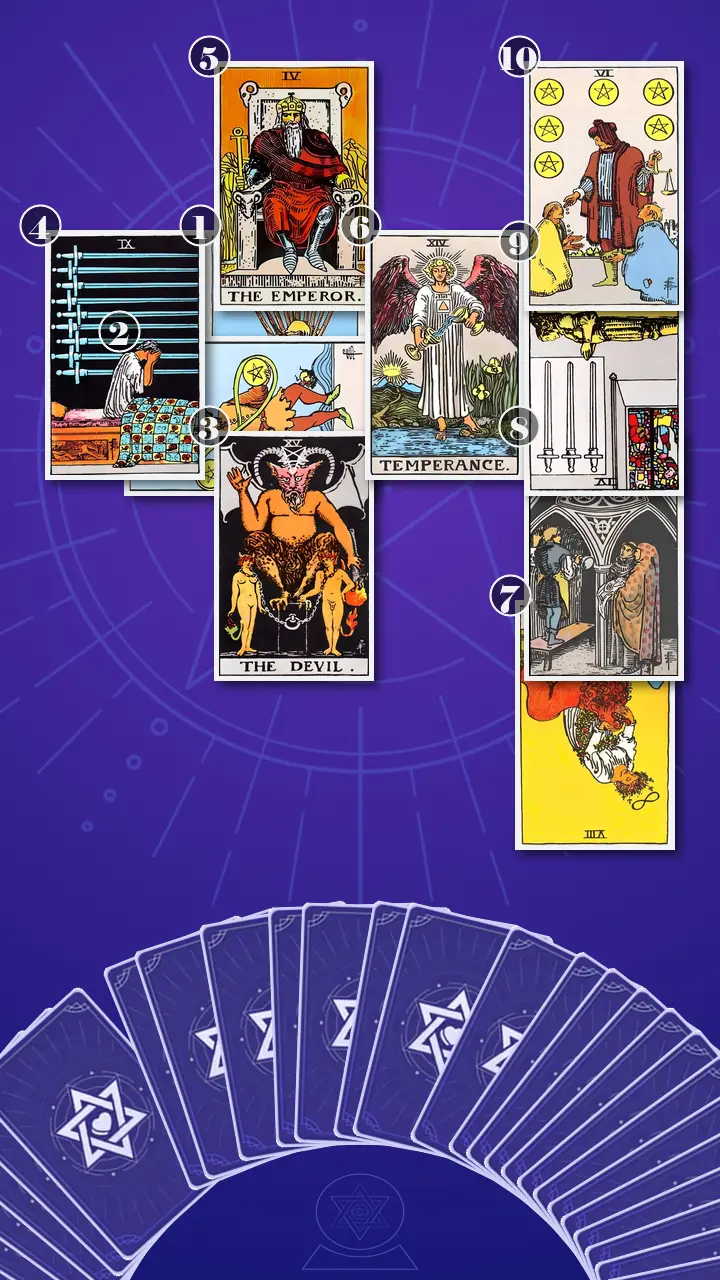
Reading the Wall of Meetings: When the Week Becomes a Threat Dashboard
Position 1 — The immediate spike in your body: Ten of Wands (upright)
“Now flipping over,” I said, “is the card that represents the Sunday-night calendar spike: the immediate felt experience of overload as you look at the week.”
Ten of Wands, upright.
In the illustration, someone is bent forward under a bundle of wands so big it blocks their view. I pointed to that first—not as symbolism for symbolism’s sake, but because it’s exactly how Jordan described Monday: a wall.
“This is what it looks like when your calendar stops being information and starts being weight,” I said. “It’s like you open Outlook and every block reads as an alert. Not a plan. An emergency.”
I connected it directly to their lived Sunday: the 45–90 minutes of color-coding, the reshuffling, the tiny bursts of relief followed by a bigger wave of pressure. “The Ten of Wands is Fire energy in excess—drive and responsibility, but strained. Your ambition is real. Your reliability is real. But the way it’s currently bundled means it blocks priorities and blocks breathing.”
Jordan let out a small laugh that had no joy in it. “That’s… too accurate,” they said. “Like, weirdly accurate. Almost rude.”
“I know,” I said, keeping my voice gentle. “But notice what that laugh did—it made space. That’s our first crack of air.”
Position 2 — The main challenge: Two of Pentacles (reversed)
“Now flipping over,” I said, “is the card that represents the main challenge: what makes the schedule feel unmanageable and triggers the over-planning reflex.”
Two of Pentacles, reversed.
“Okay,” I said, and I watched Jordan’s eyes tighten like they’d already recognized it. “This is the juggling card—but reversed, it’s not flexibility anymore. It’s wobble.”
I narrated it the way it actually happens on a Sunday night, because the point of Tarot—when it’s done well—is that it names the loop precisely enough that you can interrupt it.
“Calendar tab,” I said, almost like a film montage. “Drag a meeting to ‘make room.’ Notes app: rewrite Monday. Back to calendar: add a ‘prep’ block. Slack: ‘just in case.’ Back to calendar: now it looks even fuller. And the more tabs you open to fix the lag, the slower the system gets.”
Jordan covered their mouth with one hand and laughed—small, embarrassed, and painfully relieved to be seen. Then they exhaled like they’d been holding their breath since Friday. Exactly that.
“Here’s the hard truth in a kind way,” I said. “When the week has no slack, ‘juggling better’ just means dropping things more quietly.”
This card is Earth energy blocked: your practical system can’t hold what you’re asking it to hold. So every Sunday, your brain tries to build stability by moving pieces—but because there’s no buffer, every adjustment creates three new problems. That’s why it feels endless.
“Your next step isn’t ‘more clever scheduling,’” I told them. “It’s building slack first—before you rearrange anything.”
Position 3 — The hidden driver: The Devil (upright)
“Now flipping over,” I said, “is the card that represents the hidden driver: the deeper belief that ties safety and self-worth to control and output.”
The Devil, upright.
I’ve worked as a Jungian psychologist long enough to know: most people don’t burn out because they’re lazy about boundaries. They burn out because some part of them is convinced that boundaries are dangerous.
“This is the pressure loop,” I said. “Not a villain. Not a moral failing. A rule.”
In the card, the chains are loose. That detail matters. It’s not about being trapped by fate—it’s about being bound to a standard you didn’t consciously sign, but you’ve been living under.
“Here’s what I hear underneath your Sunday night,” I told Jordan: “If I’m not fully on top of it, I’m failing.” And when that belief is running, the calendar becomes a judge. A courtroom. A status board where your worth is measured in ‘preparedness.’
I let one of my own anchor lines come through—because they needed it in plain language. “Your calendar isn’t a judge—it's a container. If it feels like a courtroom, something’s off.”
Jordan’s face shifted in that specific way people change when they’re named correctly: a sting first, then relief. Their shoulders dropped a millimeter.
“Yeah,” they said quietly. “It’s like… if I’m not anticipating everything, I’m choosing to be exposed.”
“Exactly,” I said. “And that’s why planning doesn’t calm you. You’re not planning for priorities. You’re planning for safety.”
Position 4 — The ignition moment: Nine of Swords (upright)
“Now flipping over,” I said, “is the card that represents the Sunday-night trigger loop: what reliably happens right before bed that spikes the burnout feeling.”
Nine of Swords, upright.
“This,” I said, “is the card of the night mind.”
I zoomed it into Jordan’s real scene: 11:13 p.m., room dark except for notification glow. The hum of the AC. The phone warm in the palm. That tiny buzz of a Slack @mention that isn’t even there—but your body reacts like it is.
And the internal script, predictable as a push notification:
“What if I miss something?” → “What if I look incompetent?” → “I should just check.”
“Your mind thinks it’s protecting you,” I said. “It rehearses worst cases like a fire drill. But the cost is sleep—so Monday starts with a nervous system that’s already pre-spent.”
I watched Jordan press their tongue against the inside of their cheek, jaw clenching in real time, like the card had reached through the screen and touched the exact muscle it needed to.
“That’s my cue,” Jordan said, almost to themselves. “Jaw. Restless legs. And then I’m like, okay, open the calendar again.”
“That’s an important detail,” I told them. “Because that body cue is your ignition moment. If you can catch it, you can intervene.”
Position 5 — What you’re aiming for: The Emperor (upright)
“Now flipping over,” I said, “is the card that represents what you’re aiming for: the kind of structure or certainty you think will finally make the week feel safe.”
The Emperor, upright.
“I respect this,” I said. “This card is structure that protects. It’s boundaries. It’s leadership. It’s a container that holds you.”
But I also named the edge: “The Emperor can be built on priorities—or built on fear. If it’s fear-built, it becomes an inner boss who keeps moving the goalposts.”
Jordan nodded fast. “That’s it. I keep thinking if I engineer a perfect Monday, I’ll finally relax.”
“And yet Sunday night becomes the penalty for trying,” I said.
As I looked at Emperor next to Devil, my Jungian brain did what it always does: it spotted the shadow. The shadow of the Emperor isn’t chaos—it’s tyranny. Not from your manager, necessarily. From the part of you that equates control with worth.
“We’re going to upgrade ‘control’ into something wiser,” I told Jordan. “Not less responsible. More sustainable.”
When Temperance Spoke: The First Small Pour That Changes Monday
Position 6 — Next step for Monday: Temperance (upright)
I slowed down before I turned this card. Even through a screen, you can feel when the air shifts—like when the city noise outside your window drops for a second and you realize how loud it was.
“Now flipping over,” I said, “is the card that represents your next step for Monday: the most helpful immediate shift to reduce the spike and protect capacity.”
Temperance, upright.
I exhaled. “Good,” I said softly. “This is medicine.”
Temperance is an angel pouring water between two cups. Not dumping. Not flooding. A steady transfer. One foot on land, one in water—practical reality and emotional capacity, held at the same time.
“This is the opposite of the Sunday-night slam,” I told Jordan. “It’s pacing. It’s rhythm. It’s a week that’s mixed like a soundboard, not like you’re slamming the master volume to 100.”
And this is where I brought in my Energy State Diagnosis—my three-dimensional lens: environment, relationships, self. Because Jordan didn’t need inspiration. They needed a clean, usable diagnosis of where their energy was leaking.
“Environment leak,” I said, “is the calendar acting like a threat dashboard—bright blocks, no breathing room, ‘busy’ as a public performance report.”
“Relationship leak,” I continued, “is the unspoken workplace exchange: you absorb overflow because you’re reliable, and ‘reliable’ quietly becomes ‘available.’”
“Self leak,” I finished, “is the belief that safety requires perfect anticipation. That’s the Devil-Emperor handshake.”
Jordan stared at the card like it was a tiny mirror. “So the fix isn’t… become even more intense?” they asked.
“No,” I said. “The fix is regulated intensity.”
Stop trying to ‘win’ Sunday night with perfect control, and start mixing your week like Temperance—small, steady pours between work and recovery until the system becomes livable.
Jordan went still in a three-part sequence I’ve seen thousands of times—on ships crossing the Atlantic, in therapy offices, in late-night video calls where someone is finally naming what’s been running them.
First: a physical freeze. Their breath paused. Their hand hovered over the trackpad like they were about to rearrange their life again.
Second: cognitive seep-in. Their eyes unfocused, as if they were replaying last Sunday—tab-switching, jaw clenched, telling themselves “ten more minutes” until the night was gone.
Third: the release. A slow exhale. Their shoulders dropped. And then—because clarity can sting—they frowned. “But if I stop… doesn’t that mean I’ve been doing it wrong this whole time?”
I kept my voice steady. “It means you were doing what worked short-term to feel safe. That’s not ‘wrong.’ It’s just expensive.”
“Here’s a line to keep,” I added, and I saw Jordan’s mouth twitch with recognition: “Buffers aren’t laziness; they’re how you stop paying for Monday with Sunday night.”
I let the silence do its job, then asked the question that turns insight into a memory: “Now, with this new lens—can you think of one moment last week when you felt that jaw clench, and if you’d had permission to do one small pour instead of fixing everything, you would’ve felt different?”
Jordan blinked hard. “Friday. A last-minute invite. I accepted instantly. And then I told myself Sunday would be my cleanup day.”
“That’s it,” I said. “This is the shift—from ‘I need a perfect plan to be safe’ to ‘I need a balanced pace and clear boundaries to be effective.’ That’s not just calendar advice. That’s self-trust, built one repeatable boundary at a time.”
Climbing the Staff: From Capacity to Reciprocity
Position 7 — Your internal stance: Strength (reversed)
“Now flipping over,” I said, “is the card that represents your internal stance: how you’re relating to your capacity, pressure, and self-trust right now.”
Strength, reversed.
“This one is tender,” I said. “Because it’s not about being weak. It’s about being depleted.”
Strength upright is gentle steadiness—the hand on the lion’s mane, calm leadership of your own nervous system. Reversed, it’s self-force. It’s trying to wrestle the week into submission with caffeine, micro-scheduling, and grit.
“I want to call this what it is,” I told Jordan. “You’re trying to muscle your way into calm. But your body is already asking for a different kind of strength: one boundary that protects sleep even if the plan isn’t perfect.”
Jordan’s eyes softened. “Soft strength,” they repeated, like the phrase surprised them.
Position 8 — External reality: Three of Pentacles (upright)
“Now flipping over,” I said, “is the card that represents external reality: workplace expectations, collaboration dynamics, and what can be shared or clarified.”
Three of Pentacles, upright.
Three people stand around a plan. Not one person carrying the whole cathedral on their back.
“This is the card that says: your workload exists inside a system,” I told Jordan. “And systems can be edited. Not perfectly. But meaningfully.”
I watched Jordan’s expression tighten with that specific corporate-culture truth: asking for clarity can feel emotionally expensive.
“If you’re the default fixer,” I said, “your calendar becomes the place the overflow lands. This card suggests one conversation—one scope question, one ownership clarification—will do more for your Sunday nights than another Notion template.”
Position 9 — Hope and fear around rest: Four of Swords (reversed)
“Now flipping over,” I said, “is the card that represents hope and fear around rest: what you want recovery to fix and what you fear it will cost you.”
Four of Swords, reversed.
“You want rest,” I said. “And you don’t trust it.”
Reversed Four of Swords is lying down with your body while your mind stays at the office. It’s downloading Headspace and never pressing play because even meditation starts to feel like another task you’ll fail at.
“Rest isn’t a reward you earn—it’s a boundary you practice,” I said. “This card shows the paradox: downtime becomes another performance. You try to do ‘Sunday reset’ correctly. And then you don’t recover.”
Jordan nodded, and it was small but fierce. “I hate that you’re right.”
“I’m not trying to be right,” I said. “I’m trying to be useful.”
Position 10 — Integration path: Six of Pentacles (upright)
“Now flipping over,” I said, “is the card that represents integration path: what becomes possible when you rebalance, especially around boundaries and reciprocity.”
Six of Pentacles, upright.
There are scales in the card. Measurable exchange. Not vibes.
“This is where your calendar becomes a ledger,” I said. “Where does time go—and where does energy come back?”
Six of Pentacles isn’t about becoming less giving. It’s about giving with terms. It’s about a fairer exchange of time, energy, and responsibility. One renegotiated deadline. One clarified DRI. One protected buffer. Not a new personality.
And because I’m from Venice—because I grew up watching water behave—I gave Jordan the metaphor that matched Temperance: “Think of your week like canal currents,” I said. “If the current only goes out—out, out, out—eventually the whole system runs low. Balance isn’t a luxury. It’s how the city stays livable.”
The Temperance Rhythm Reset: Actionable Next Steps for Sunday Night Burnout
I leaned back and let the whole spread become one clear story, not ten separate meanings.
“Here’s what I see,” I told Jordan. “Your Sunday night spike starts with real overload (Ten of Wands). The system has no slack, so you juggle and reshuffle until you wobble (Two of Pentacles reversed). Underneath, there’s a quiet rule that says control equals safety and output equals worth (The Devil), which turns your calendar into a judge. Then the night mind takes over (Nine of Swords), and you try to build an Emperor-level perfect plan—structure as armor. But your capacity is already low (Strength reversed), and the solution lives partly in collaboration and clearer agreements (Three of Pentacles), plus rest as a practiced boundary (Four of Swords reversed), leading to a fairer exchange where you stop solo-carrying by default (Six of Pentacles).”
“So what’s the blind spot?” Jordan asked.
“That you’re treating Sunday night like a performance,” I said. “Like you have to prove competence with one more round of planning—right as your body is begging you to power down.”
That’s the transformation direction in one sentence: from perfect-plan safety to paced-week effectiveness. From a nervous system that braces on Sunday to one that can trust a repeatable rhythm.
Jordan hesitated, then hit me with the most real-world obstacle possible: “But I can’t find even five minutes. Monday is already stacked. People can see my calendar.”
“Then we’ll work with exactly that,” I said. “Tiny moves. Visible but defensible. We’ll make the current easier to steer.”
- Buffer-First Monday (Temperance Pour)On Sunday night, before you move a single meeting, add one 25–45 minute block on Monday labeled “Buffer: Think + Notes”. Mark it busy if you can. Do not fill it with “prep.” This block exists to make the week physically livable.If 45 minutes feels impossible, start with 15. Expect your brain to protest (“irresponsible”)—treat that as a cue, not a command.
- The Monday Two-Speed Plan (Must / Nice / Buffer)Write three lines where you’ll actually see them (Notes app, a sticky note on your laptop): (1) One essential outcome for Monday (one sentence), (2) one supportive task that helps but isn’t life-or-death, (3) one deliberate pause (your buffer block). Then stop planning.If you feel tempted to “fix the whole week,” reread only the Must line. Temperance is small pours, not full rewrites.
- One Scope Question (Three of Pentacles in the real world)Before Wednesday, send one message that clarifies expectations without over-explaining: “For this by Friday, what does ‘good’ look like—fast or thorough?” or “Who’s the DRI on this? I can support, but I can’t carry the whole thread.”Keep it small enough that you don’t get an emotional hangover. If live feels scary, do it async in Slack.
And one bonus, because Jordan’s night mind was loud: I offered a modern cleansing that doesn’t require becoming a monk. “If you need a digital detox that doesn’t feel like deprivation,” I said, “try organizing one photo album for ten minutes after you close work tabs. It gives your hands something to do while your nervous system downshifts. It’s a bridge, not a rule.”

A Week Later: The Quiet Proof
Eight days later, Jordan sent me a message at 8:58 p.m. on a Sunday. No long paragraph. Just a screenshot: a Monday calendar with one block—Buffer: Think + Notes—sitting there like a small act of self-respect.
Under it, they wrote: “Timer set for 10 minutes. Three edits only. Closing the tab even though it isn’t perfect.”
They didn’t tell me they’d become a different person. They told me they slept. Not flawlessly, not like an influencer’s “perfect Sunday reset”—but enough. Monday morning still had meetings. Their first thought was still, what if I mess up?—and then, they said, they noticed their jaw, took one breath, and opened only the Must line.
That’s the whole Journey to Clarity, in miniature: not certainty, but ownership. Not winning Sunday night—building a rhythm you can live in.
When Sunday night hits and your calendar lights up, it can feel like you have to prove your competence with one more round of planning—right as your body is begging you to power down.
If you didn’t have to ‘win’ Sunday night, what’s one small buffer or boundary you’d try this week just to let Monday meet a more rested version of you?