Hiding the UX Tab at 8:43 PM—and Learning to Leave It Open

Finding Clarity in the 8:43 PM Command-Tab
If you’re in your twenties, working a stable-but-not-quite-you job in a big city, and you keep switching away from your course tab the second a roommate walks by, this is probably not procrastination so much as fear of being seen trying.
That was the question Alex (name changed for privacy) brought to me: why do I hide my study tabs when someone walks by? When she joined my session from Toronto, the glow of her laptop still seemed to be sitting on her face. She described 8:43 p.m. at the tiny desk nook beside her kitchen in a west-end apartment: lukewarm tea, the fridge humming, a UX certificate lesson open, and then the soft scrape of her roommate’s slippers in the hall. Before thought could catch up, her fingers hit Command-Tab, the screen jumped to Gmail, her shoulders climbed toward her ears, and her stomach dropped as if her whole worth had ducked under the desk before the browser did.
“I hate looking like I’m catching up,” she told me. She could handle campaign decks, meetings, deadlines, all of it. But the second someone might witness the messy middle of learning, her body reacted as if visible effort were contraband. She lived in that very modern split between looking employable online and feeling unfinished offline, the same split those frictionless LinkedIn career-pivot posts are so good at amplifying. This isn’t laziness. It’s exposure management.
I let that sit for a breath. Then I said, “That little tab-switch is usually guarding an older rule. Let’s see if we can draw a map of it tonight, and maybe find the kind of clarity that lets you stay with your own work instead of hiding from the hallway.”

Choosing the Compass: The Situation-Obstacle-Advice-Outcome Spread
I asked her to put both feet on the floor, take one slow breath, and hold the exact question in mind: what old rule makes me hide my study tabs when someone walks past? Then I shuffled slowly. For me, that moment is never about theater. It’s a focusing device, a way to move from the blur of reaction into something we can actually look at.
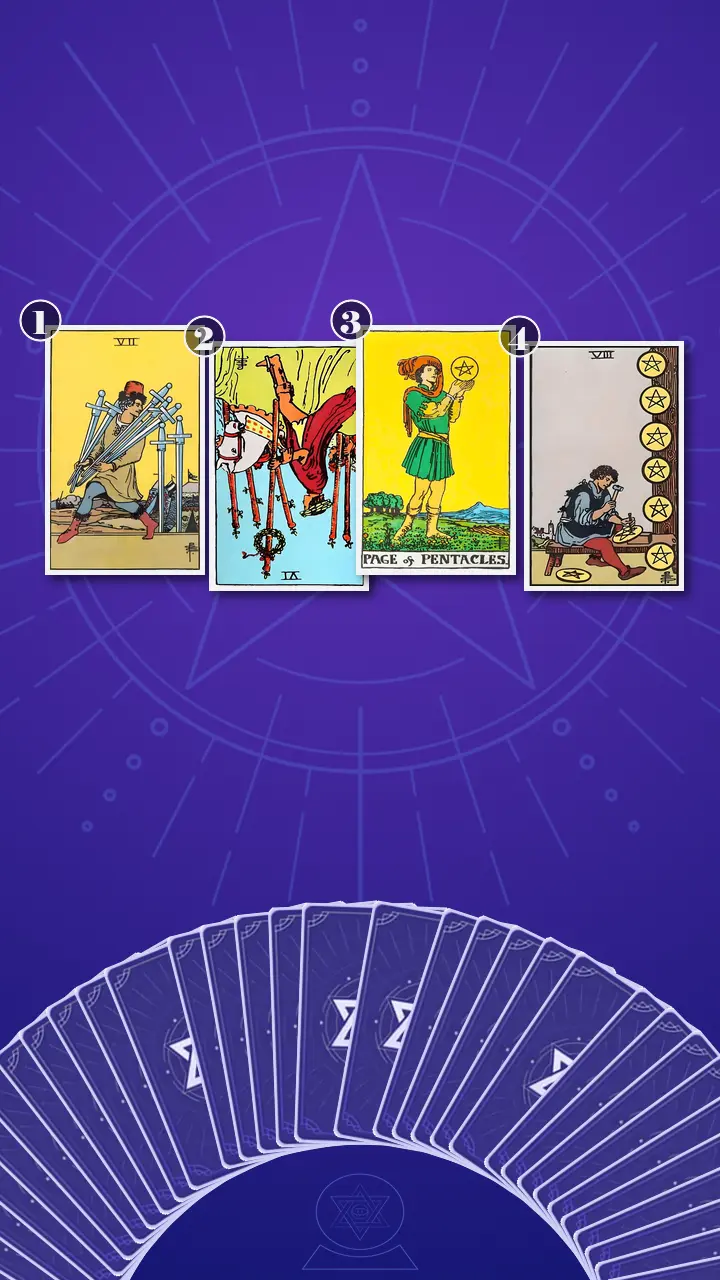
I told her I was using a Situation-Obstacle-Advice-Outcome spread, a classic four-card tarot spread that works beautifully for fear of being seen trying. This issue isn’t really about prediction. It’s about uncovering a hidden internal rule. One of the cleanest ways tarot works for an inner-pattern question is that it takes a split-second habit and lays out the chain beneath it in visible form.
This particular spread is small, direct, and psychologically precise. The first card shows the visible symptom: the Command-Tab reflex, the safe tab, the surface behavior. The second names the old belief underneath it: the place where visibility gets translated into judgment. The third card offers the corrective stance, the mindset shift that can turn secrecy into grounded beginner practice. The fourth shows what integration looks like once that shift starts to become real life.
I also told her why I like this layout for questions about feeling stuck, decision fatigue, and shame around learning in public: it moves in a clean line from symptom to root to reframe to next steps. No mystification. Just a map.
Reading the Hallway: Card Meanings in Context
Position 1: The Reflex That Pretends to Be Multitasking
The first card I turned over, the one representing the observable symptom, was the Seven of Swords, upright.
This card has a look I never ignore: the figure glancing over his shoulder while trying to carry something away unnoticed. In Alex’s life, it looked exactly like 8:43 p.m. in her apartment work corner, course module open behind a dashboard, ears tuned to hallway movement, then a fast switch to Gmail the second her roommate passed. She was still technically at her desk, still “being productive,” but half her attention had already left the lesson and gone into getting away clean.
Energetically, I read this as strategic Air in excess. Intelligence is present, but it has been recruited into concealment. Instead of helping her absorb information, her mind has become a lookout tower. She is studying the audience more than the material.
When I said that, she gave a short laugh with a bitter edge. “Okay,” she said, “that is so accurate it feels a little rude.” I watched the reaction travel through her in three quick beats: breath caught first, then her fingers stopped circling the mug beside her, then her mouth pulled into that tight half-smile people make when a truth lands before they’ve decided whether to welcome it.
“Only rude in the way a mirror is rude,” I told her. “The pattern is fast because your body learned it fast. That doesn’t make it trivial.”
Position 2: The Crowd That Isn’t in the Room
The second card, the one revealing the underlying blockage, was the Six of Wands reversed.
In real life, this position asks what old rule links being seen with being judged. And this card answered with unnerving clarity. Under the tab switch was a social spotlight that did not require an actual crowd. One roommate. One stranger passing behind her in a café. One coworker crossing an open office. That was enough for her nervous system to turn a passerby into an audience and a visible study tab into an unsolicited performance review.
This was the old rule: if someone saw ‘UX certificate’ or ‘Intro to Information Architecture’ on her screen, they would silently read it as evidence that she was behind, trying too hard, or not naturally capable. The reversed Six of Wands is recognition energy in blockage. Fire that should support confidence gets distorted into status sensitivity. Visibility stops meaning ‘I exist’ and starts meaning ‘I am being ranked.’
A lot of people aren’t afraid of learning. They’re afraid of being watched while learning. I said that out loud, and her eyes dropped to the card immediately. Her jaw flexed once. Then came the quiet wince.
“Yes,” she said. “That is exactly the thought. If they see this, they’ll think I should already know it.”
Outside my Brooklyn window, a siren moved past and faded. Inside, I had the strange clean feeling I always get when a spread catches the real mechanism. It reminded me of old black-and-white films where the camera makes a hallway feel longer than it is. Shame does that too. It turns one pair of slippers into a whole watching crowd.
Position 3: When the Page of Pentacles Held the Lesson in View
Then I turned the third card, and the atmosphere changed. This was the hinge card in the spread, the antidote, the point where the reading stopped describing the wound and started building a different way forward.
It was the Page of Pentacles, upright.
In modern life, this card is beautifully unglamorous. It looks like Alex keeping the course tab open, notebook beside the laptop, and deciding that tonight’s job is simply to understand one concept and take one page of notes. The beginner phase is no longer something to disguise. It becomes the visible, ordinary way skill gets built. The page holds the pentacle in full view. He does not hide it.
When I see this card, my mind goes to workshop scenes in classic cinema: hands on tools, repetitive light, the dignity of becoming. Mastery never looks impressive at the beginning. It looks ordinary. It looks like a person staying with the material long enough for it to change them.
I told Alex, “I want to use one of my favorite tools here—an Einstein thought experiment. Imagine two versions of you in the same apartment, at the same desk, with the same lesson open. In one version, you hit Command-Tab the second you hear slippers in the hall. In the other, you leave the tab visible for two minutes and keep taking notes. Same intelligence. Same ambition. Same course. What actually changes? Not your capability. Only the old rule about what visibility means.”
You know that tiny moment: a course tab is open, footsteps get close, your hand moves before your brain does, and suddenly you’re on email again pretending nothing vulnerable was happening.
Stop treating effort like contraband; hold the pentacle in view and let visible practice become proof of commitment, not proof that you’re behind.
Effort is not contraband.
Being seen learning does not make you less capable. It means capability is being built in real time.
She went still in layers. First came the physical freeze: her hand hovered above the keyboard on her desk as if the shortcut itself had just been named too clearly to use. Then came the cognitive seep: her gaze lost focus, not blank exactly, but busy replaying a dozen interrupted evenings at once—Gmail, Slack, Calendar, the little performance of looking casually busy while something more meaningful sat hidden underneath. Then came the emotional release: her shoulders dropped a fraction, her mouth opened, and a longer exhale left her than I think she meant to give me. Her eyes watered, not dramatically, just with the shock of being accurately seen. “That makes me weirdly sad,” she said softly. “Like… I’ve been acting as if learning basics is something I need to smuggle.”
“Yes,” I said. “And sad doesn’t mean wrong. It means the rule is old enough to have cost you something.” Then I gave her the smallest possible experiment, because the Page of Pentacles never asks for a grand performance. “Within the next ten minutes, open one learning tab and leave it visible for two full minutes. While it’s open, name three facts: what the lesson is, what your body is doing, and one thing you want to understand. If the discomfort spikes too hard, stop there. The point is not forced exposure. It’s proving that one visible rep is survivable.”
I asked her to look back over the last week through that new lens. “Was there a moment when this would have changed how you felt?”
She pressed her thumb into the edge of her notebook, then gave the smallest laugh—gentler this time. “Wednesday,” she said. “My roommate literally just wanted tea. She wasn’t auditing my life.”
That was the shift. Not from insecurity to perfect confidence, but from shame-driven concealment and audience-scanning to grounded visible practice and self-respect. In the language of this reading, she was moving out of personal-branding mode and into apprenticeship mode.
Position 4: Bench Mode, Not Performance Mode
The final card, showing the integrated direction, was the Eight of Pentacles, upright.
This is what happens when the Page stops being a one-night insight and becomes a routine. Same seat. Same playlist. Same drink. One lesson, one note page, one practice exercise. In Alex’s life, this looked like returning to the same module without making it a referendum on her worth every time someone crossed the apartment. The craftsperson in the card is not scanning the room. He is at the bench.
Energetically, this was Earth in balance. The spread had moved from Air and reversed Fire—mental surveillance and approval sensitivity—into double Earth. Less image management, more repetition. Less ‘How do I look doing this?’ more ‘What rep am I on?’ Bench mode: fewer vibes, more reps.
I watched some of the tension leave her face. Not all of it. Enough. She looked at the row of pentacles and said, “That actually sounds… calmer.” Exactly. The win is not looking advanced. The win is staying with the tab.
From Audience to Material: Actionable Advice for the Next 48 Hours
When I laid the whole line of cards side by side, the story became very clear. First came the Seven of Swords: the covert maneuver, the safe tab, the learned sidestep into email. Beneath it sat the reversed Six of Wands: the old rule that visible effort equals public judgment, and public judgment equals diminished worth. Then the Page of Pentacles opened the doorway out: a grounded apprentice identity that lets effort be seen without turning it into a trial. Finally, the Eight of Pentacles showed what integration looks like when the new rule is practiced often enough to become ordinary craft.
The blind spot was this: Alex had been treating visibility like verdict. She kept assuming the screen told a story about deficiency, when in reality it told a story about investment. And I noticed something else I always pay attention to in a spread’s architecture: there was no Water here. The feelings were not being named or soothed directly. They were being converted into posture, browser shortcuts, and late-night secrecy. So the transformation direction was not ‘become instantly fearless.’ It was simpler and more practical: stop studying the audience, start studying the material, and let the body learn through small survivable reps that open effort is not dangerous.
- The Five-Minute Tab-Stay ExperimentPick one study session this week and leave one clearly named course tab visible for the first five minutes, even if someone is moving around the apartment. Put a sticky note on the laptop edge that says, ‘Building skill, not performing competence,’ and keep both hands on the desk for one full breath before deciding whether to switch.If five minutes feels too exposed, make it two. The win is interrupting the secrecy reflex, not forcing yourself into overwhelm.
- The Audience-to-Material ResetWhen footsteps trigger you, quietly name, ‘Person passing, not a verdict,’ then bring your eyes back to the lesson title. If you do switch to Gmail, Slack, or Calendar, reopen the course within 30 seconds so it doesn’t become a full avoidance spiral.Hold a pen, notebook, or mug for one session so Command-Tab is not the first movement your body can make.
- Gallery Walk Bench ModeHere I added one of my own favorite study strategies: a tiny Gallery Walk Revision. Create two bench-mode study blocks this week in the same seat, with the same playlist and the same drink. Leave yesterday’s notes visible on the desk like a small exhibit of work-in-progress so returning to the material feels normal instead of like a covert operation.One lesson and one note page only. Track reps by time spent or task finished, not by how smart or polished you felt.
You don’t need public confidence first. You need one survivable visible rep. That is enough to begin rewriting the rule.

A Week Later, the Tab Stayed Open
Six days later, Alex sent me a message while she was on a break at work: “Did the two-minute version. Roommate came in to make pasta. My heart did the stupid drop thing, but I kept the IA lesson open and finished one page of notes. Nothing happened. Which is sort of the point, I guess.”
I smiled when I read it. That is how a real journey to clarity usually looks. Not a glamorous personality transplant. Just a small, clean piece of evidence. A screen left open. A body that spikes and survives. A learner who begins to trust her own practice more than the imaginary panel in her head.
That was the turn in her reading: from shame-driven concealment and audience-scanning to grounded visible practice and self-respect. Not perfect. Not final. Just honest enough to work.
Sometimes the hardest part is not the lesson itself, but that split-second stomach drop when someone might see the screen and you feel your whole worth rushing to hide before the tab does. If that’s where you are, please know that noticing the pattern is already a form of movement.
If visible effort counted as proof that you’re building skill, not proof that you’re behind, what would you let stay open for five extra minutes this week?
Every reading at AceTarot is designed to connect you with your inner wisdom and empower your next step.
Learn more about our Journey to Clarity.