Beginner Shame at Checkout—and Turning Class One into Practice

Finding Clarity in the 8:47 p.m. Checkout Freeze
When Jordan (name changed for privacy) sat down with me, I named the loop right away: if you are a junior creative in Toronto who can handle client feedback all day but still tabs out of a beginner-friendly class at checkout because your body suddenly acts like you are about to be publicly graded, that is not a scheduling issue. It is beginner shame. And beginner shame can look a lot like overresearch.
She told me about a Tuesday night in her downtown condo: half-watching Netflix, fridge humming, phone warm in her hand, a beginner pottery page open on one screen and the studio FAQ open on her laptop. The Apple Pay button was bright and stupidly simple. Her chest tightened, her face went hot, and her stomach dropped so fast it felt, as she put it, like missing a step in the dark. She wanted the class. She was already bracing for the version of the room where everyone else somehow knew where to stand.
What struck me was how familiar the split felt. By day, she could present brand concepts and take revision notes without falling apart. By night, at a checkout screen, the competent self and the panicked self lived side by side like a tiny private episode of Severance. Shame had turned one class link into a full social disaster trailer. It was like hovering over Apple Pay while her nervous system wrote a one-star review for an event that had not happened yet.
'I know it is small,' she said, twisting the sleeve of her sweater. 'But the second it gets real, I panic about looking dumb. Like, visibly dumb. And then I close the tab.'
I nodded. 'That makes sense to me. Fear of looking stupid in class gets into the body long before it becomes a thought you can argue with. So let us not bully it or romanticize it. Let us map it. Our whole journey today is about finding clarity inside that exact moment where curiosity turns into class booking panic.'

Choosing the Compass: A Four-Card Spread for Beginner Shame
I asked Jordan to put both feet on the floor, think of the class she had almost booked five times, and take one slow breath with me while I shuffled. I always treat this part less like a mystical performance and more like tuning a room before the music starts. Attention settles. The signal gets cleaner.
For her question, I chose a Situation-Obstacle-Advice-Outcome spread. When people ask me how tarot works for feeling stuck, this is one of the clearest examples: I do not need ten cards and a cosmic plot twist when the problem is one tight loop of interest, imagined judgment, and retreat. This spread lets me track the visible symptom, the deeper self-worth block under it, the medicine that steadies the nervous system, and the next practical step that makes being a beginner survivable.
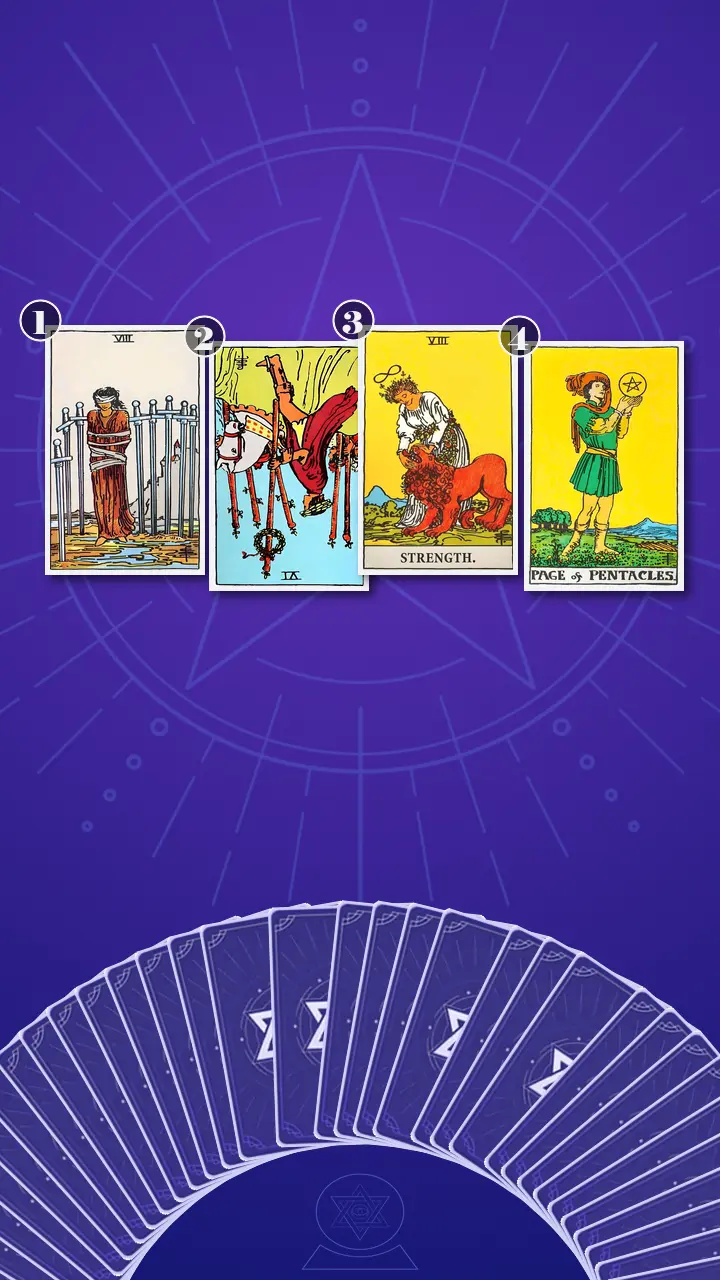
I told her what I was watching for as I laid the cards left to right. The first position would show the exact freeze point between wanting the class and paying for it. The second would name the deeper fear about public competence and why looking new feels so charged. The third, our hinge point and key card, would show the inner quality that could interrupt the shame loop without demanding instant confidence. The fourth would ground all of it in one embodied next step.
Reading the Map of Beginner Class Anxiety
Position 1: The Checkout Cage
I turned over the card representing the surface symptom, the exact moment the panic shows up between interest and booking. It was the Eight of Swords, upright.
I was not surprised. This card is the cleanest image I know for a mind that mistakes an open choice for a locked reality. In modern life, it looks exactly like Jordan staring at a beginner class checkout screen, rereading the details, comparing herself to imaginary classmates she has never met, and feeling her body react as if the room has already judged her. Nothing on the page is actually rejecting her. The rejection lives in the social movie her mind adds on top of the page.
This is blocked Air: overthinking so dense it starts to feel like fact. One tab. One payment button. Ten imagined disasters. The blindfold in the card is that mental movie that blocks out real evidence. The loose bindings are the part her body forgets, that she can still choose, pause, ask, learn, or go. The door is not locked. Her nervous system is just acting like it is.
'So the problem is not that you do not want the class,' I said. 'It is that the class becomes decided before it even happens.'
Her reaction came in a quick three-beat wave. First, her breath stalled. Then her eyes dropped to the card and stayed there as if she were replaying a dozen nearly-booked nights at once. Then she let out a tight, almost embarrassed laugh. 'That is... grossly accurate,' she said. 'I literally do the FAQ thing twice.'
I smiled, not to soften it, but to keep it human. 'Right. Beginner shame can look a lot like overresearch. You are not failing because you need information. You are freezing because your mind keeps treating visibility like danger.'
Position 2: When the Room Becomes an Audience
Next I turned the card representing the underlying block, the deeper fear about looking dumb, especially where public competence has gotten tangled up with self-worth. It was the Six of Wands, reversed.
This was the knot. In Jordan's life, this card looked like turning a beginner class into a referendum on whether she deserved to be there. She imagined mirrors, introductions, someone beside her picking up the first cue instantly, and herself being the only real beginner in the room. The deeper panic was not just awkwardness. It was being visibly awkward and reading that as proof she lacked value.
Reversed, the fire in this card is distorted by approval hunger. A room of strangers becomes a stage. Belonging feels conditional. Competence feels like the price of entry. I told her it had the same emotional logic as Instagram Story view-count brain: the second she felt seen, she assumed she was being ranked. No wonder her curiosity kept getting scorched before it could become action.
'This is the part that hurts,' I said quietly. 'Somewhere along the line, being new stopped meaning learning and started meaning exposure.'
She rubbed her palms on her jeans and stared past me for a second, toward the window and the blur of streetlights. 'Yeah,' she said. 'If I am obviously bad, it feels like it will mean something bigger than just... I have not done the thing yet.'
'Exactly,' I said. 'And that is why more tutorials do not fix it. They only keep feeding the image-protection team.'
When Strength Put a Hand on the Lion
Position 3: The Key Shift from Image Protection to Learning
When I turned the third card, the room changed. The rain against the window thinned to a hush, and even the radiator stopped clicking for a beat. This was the position of guidance, the inner quality that could steady her nervous system and interrupt the shame loop without requiring instant confidence. The card was Strength, upright.
In real life, this looked like Jordan on the way to class or right outside a studio door, adrenaline already rising, but choosing not to obey it automatically. Hot face. Tight chest. Urge to disappear. Shoulders softened anyway. Jaw unclenched anyway. The goal shrank to something humane: stay through the first ten minutes without turning discomfort into a verdict.
This is balanced Fire, not performative confidence. Strength does not ask her to dominate fear or fake chill. It asks her to regulate it. When I see this card, I always think about my years in radio. In a live studio, we never fix feedback by smashing the speaker; we lower the gain until the real voice can come through. That is how I read this card. And because I work with sound as much as symbols, I read it through what I call Chakra Sound Therapy: shame often hits the solar plexus and chest like an internal siren, and the first job is not to win an argument with it. The first job is to give the body one steadier note to follow.
Jordan was still trapped in the idea that the first class had to feel safe before she booked it, as if the presence of embarrassment meant something had already gone wrong. I could see her body doing the same thing her mind did, bracing in advance, protecting her image before the moment had even begun.
The sentence that changed the room
You are not meant to silence the lion by hiding from beginner moments; you are meant to place a steady hand on it and let learning happen in public.
She did not melt into instant relief. Her reaction moved in layers. First she went very still, fingertips hovering above the rim of her tea as if her body had lost the next instruction. Then her focus drifted, not away from me exactly, but through me, the way people look when a familiar pattern is replaying in quick cuts: the saved links, the closed tabs, the friend texts, the private tutorials, the little joke about bad coordination. Then the feeling landed, sharp and messy. Her shoulders dropped, but into anger before softness. 'But if that is true,' she said, voice tight, 'then I have been treating every class like some kind of audition. That is... awful.'
'Awful and changeable,' I said. 'A first class is not an audition for your worth. It is a practice room for being seen while you learn. Your first class is not a referendum on your worth. The fear does not have to disappear. It just has to stop running the whole scene.'
Her eyes brightened. Not tears exactly, more that glassy look that shows up when a body finally has somewhere to put the pressure. She took one long inhale, then a longer exhale, and I watched the line of her jaw release. For a second she looked almost dizzy, like people do when a heavy bag slips off one shoulder and they have to remember how to stand without it. I asked, 'Now, with this new perspective, think about last Thursday. If you had had this sentence in your pocket then, what would have felt different?' She pressed a palm to the center of her chest and answered so quietly I almost missed it: 'I think I would have left the tab open.' That was the shift in real time, from anticipatory shame and self-surveillance to the first flicker of grounded beginner courage.
Position 4: The Apprentice Who Shows Up Anyway
Then I turned the card representing the embodied next step, how to engage as a beginner in a practical, visible, non-performative way. It was the Page of Pentacles, upright.
I loved the honesty of that landing. In Jordan's life, this card was simple: water bottle, tote bag, actual beginner energy, one instruction at a time. Not a polished version of herself. Not a secret plan to seem naturally good. Just the student. Just the person who asks where to put her bag, follows the first cue, and lets repetition do the work that self-criticism never can.
This is grounded Earth, and after the first two cards it matters. The Eight of Swords had her scanning imagined disaster. The Six of Wands reversed had her scanning an imagined audience. The Page brings attention back to the task itself. When attention leaves the task and starts policing you, shame gets louder. When attention returns to the mat, the clay, the instructor's first sentence, the nervous system finally has something real to do.
'This is Karate Kid energy,' I told her. 'Training starts before mastery looks impressive. The goal of class one is attendance, not elegance.'
For the first time that night, she smiled without wincing right after. Small, but real. She nodded once and said, 'Okay. One instruction. Not the whole room.'
Practice, Not Proof: The Path Out of the Shame Loop
When I looked at the full line of cards, the story was brutally clear and strangely kind. The first two cards formed one internal system: the image-protection team. The Eight of Swords showed the trap at checkout, where ordinary commitment turns into a mental cage. The Six of Wands reversed showed why the cage feels so serious, because public competence has quietly become tied to worth, so beginner visibility feels like exposure. Then the second pair answered it. Strength replaced social performance with regulated courage. The Page of Pentacles replaced self-surveillance with student attention. In other words, the cards did not say Jordan lacked confidence. They said she had been feeding the wrong team.
The blind spot was subtle but powerful: she thought more preparation would make her safe enough to begin. In reality, endless prep kept the whole problem inside image management. The transformation direction was the opposite. Move from protecting the image before you start to treating the first class as practice, not proof. Move from social performance to participation. Move from feeling stuck at the checkout page to letting yourself be visibly new long enough to learn.
I gave her three practical next steps, each small enough to do this week and grounded enough to survive real life in Toronto, not just a perfect self-improvement mood.
- Use the 3-Minute Checkout RuleOn one evening this week, open one class link you have already saved in Notes, ClassPass, or a wishlist. Set a 3-minute timer. Read the class description once, check only the logistics you truly need, and then either book it or give it a clean 24-hour pause instead of hovering for days. Before you hit pay, type one line into your phone: Class one is practice, not proof.If your brain wants five extra tabs, more reviews, or one more TikTok to justify the panic, stop there. If money or timing are genuinely unclear, set one calendar reminder for the next check-in so maybe later does not quietly become never.
- Use the First-10-Minutes ResetIf you book the class, arrive 7 minutes early. Outside the studio door, on the sidewalk, or in the washroom, put both feet on the floor, drop your shoulders once, unclench your jaw, and do three longer exhales than inhales. Then borrow my mini 21-Day Sound Bath: on each exhale, hum one low note under your breath for about 5 seconds so your chest has a steady vibration to follow while the nerves are happening, and say once, I am allowed to look new and stay anyway.Keep it subtle. Nobody needs to know. The goal is not zero nerves; the goal is enough steadiness to stay in the room. If the space truly feels hostile or wrong for you, you still get to leave. This is support, not self-bullying.
- Switch to Apprentice ModeGo into class with one apprentice-level intention only: learn where to stand, follow the first cue, or ask the instructor, Hi, I am new. Is there anything I should grab before we start? One instruction. One rep. One honest beginner question.Do not secretly turn your tiny intention into a new performance target. Keep it boring and concrete. The goal of class one is attendance, not elegance.

A Week Later, the Quiet Proof
Five days later, just before 7 p.m., my phone lit up with a message from Jordan: 'Outside the studio. Want to bolt. Not bolting.' She had booked the pottery class she had been orbiting for weeks. She arrived early, did the shoulder drop, the jaw release, the three long exhales, and a tiny hum so soft only she could hear it. Then she walked in and asked the exact Page of Pentacles question: 'Hi, I am new. Is there anything I should grab before we start?'
After class she did not text me some cinematic transformation. She sent a photo of clay under one thumbnail and an oat latte on a café table. 'I was awkward for, like, eleven minutes,' she wrote. 'Then I was just... in class.' She said she still replayed one clumsy moment on the streetcar home, then caught herself laughing. Clear but fragile. Real but enough.
That is what a journey to clarity usually looks like when it is honest. Not a personality transplant. Not the end of nerves forever. Just the first visible step from image protection to learning, from self-consciousness to grounded curiosity, from hiding from beginner moments to surviving them with your kindness intact.
Sometimes the most exhausting part is not being new at all; it is bracing your whole body against the chance that someone might see you be new. If tonight you recognize that brace in yourself, I hope you also recognize this: the moment you notice it, you have already started to loosen it.
So when your hand hovers over checkout or a studio door next, what tiny way would you want to put a steady hand on your own lion if class one only had to be practice, not proof?