First Quiz Question, Notes Closed: From Shame Freeze to Self-Trust
The 9:18 PM Quiz Tab: When a Practice Quiz Feels Like a Verdict
When Maya (name changed for privacy) sat across from me, I already knew the shape of her problem. She was the final-year Toronto student who could build a perfect Google Calendar, keep a Notion dashboard immaculate, and still close the practice quiz tab before answering question one. By the time people bring me a question like this, they have usually already searched some version of “why do practice quizzes make me panic,” “fear of being wrong while studying,” or “why do I open a practice test and immediately close it?”
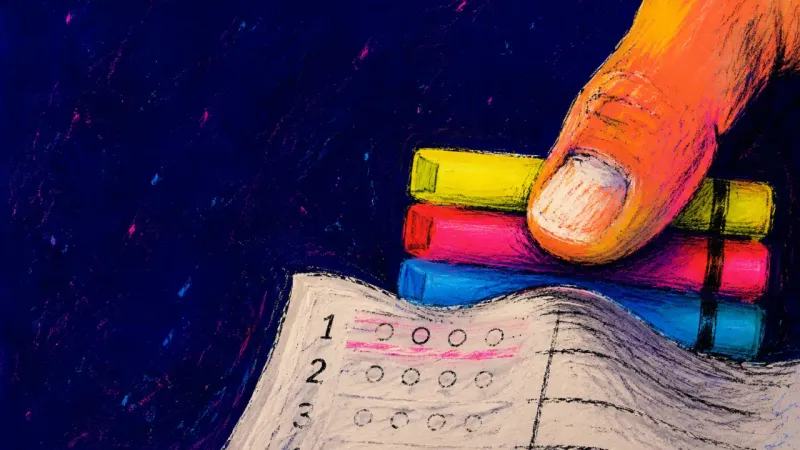
I could see the Tuesday scene as she described it: 9:18 PM, a small desk by the window, three highlighters lined up with almost ceremonial precision, the practice portal open, question one read twice. The radiator hissed. Her tea had gone lukewarm. The laptop light made everything look too bright. She hovered over an answer choice, felt her shoulders climb toward her ears, and clicked back into Google Docs to tidy headings instead.
“I know it is only practice,” she told me, looking almost irritated with herself. “It just doesn’t feel like only practice.” The contradiction was clear from the first minute: she wanted the practice that would help her improve, and she was afraid of the wrong answer that practice might reveal. Shame sat in her body like she had swallowed a cold coin and every breath had to bend around it.
I nodded. “That makes sense,” I said. “A lot of perfectionism paralysis before mock exams is really fear in a responsible outfit. Let’s not force confidence. Let’s map the fear beneath the tab and find the smallest path back to clarity.”
Choosing the Bridge: The Shadow Spread for Fear of Being Wrong
I asked her to put both feet on the floor, loosen her grip on the cup, and take one slow breath before she named the moment she dreaded most: reading question one and not knowing instantly. Then I shuffled. For me, that pause is not theater. It is a handoff from panic to attention.
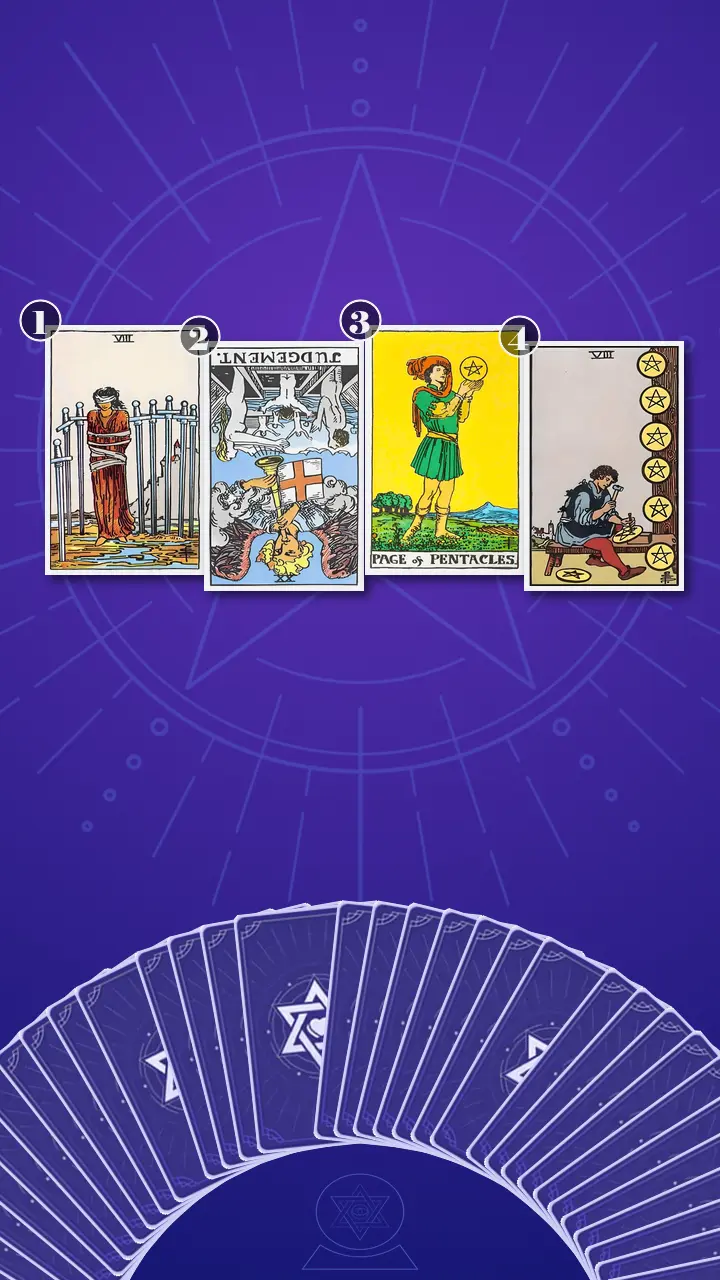
I chose The Shadow Spread. When readers ask me what tarot spread helps with fear of being wrong while studying, this is one of the cleanest answers I know. This issue is not about predicting an exam score or comparing life options. It is about uncovering the older fear that gives the untouched quiz its charge. This is how tarot works at its best for study anxiety: not as a mystical verdict, but as a symbolic mirror that shows card meanings in context. The Shadow Spread keeps the map tight—one card for the surface freeze, one for the older fear under it, one for the medicine that changes the meaning of the moment, and one for the study rhythm that can carry that insight into real life.
I told her what I was watching for. The first card would show the first thirty seconds after the quiz opens. The second would show the inner rule that turns mistakes into exposure. The third—our bridge card—would show the shift from self-verdict to learning signal. The fourth would translate that shift into something small enough to repeat after class, before a shift, on an ordinary Tuesday night.
Where the Freeze Lives
Position 1: The Tab That Opens and Closes Itself
The first card I turned over was the one representing the present symptom knot: the concrete freeze response around opening the practice quiz and not answering. It was the Eight of Swords, upright.
In real life, this was exactly what Maya had been living: opening the quiz after class, reading the first stem twice, hovering over an answer, then jumping to her notes app to clean up headings instead. It is that awful feeling of having twenty-three study tabs open and still being unable to click the one that matters. Nothing on the screen had actually trapped her. The trap was imaginative. The blindfold in this card is what happens when the mind reacts to imagined consequences instead of the actual question in front of it. The loose bindings matter too. This is blocked Air, not true helplessness. Her thinking had become so contracted that self-protection started impersonating incapacity.
“So I’m not lazy,” she said, then gave a short laugh that carried a bitter edge. “That’s almost rude, how accurate that is.” Her fingers kept circling the cup sleeve. I asked her the question this position always asks: “In the first thirty seconds, what consequence is your mind adding that the quiz itself never asked for?” She did not answer right away, but her eyes dropped to the table in a way that told me the answer had already landed.
Position 2: The Inner Notification Ping
The second card, representing the older inner rule that mistakes invite judgment, shame, or loss of worth, was Judgement in reversed position.
This was the real blockage. Under the untouched quiz was an older rule: being wrong did not feel like a normal part of learning to her. It felt like being summoned. In modern life, Judgement reversed sounds like a grade notification ping or being called on in class before you are ready. Her inner monologue moved fast: if I miss this easy one, that’s embarrassing. If it’s embarrassing, I should have known it. If I should have known it, what does that say about me? The quiz was built to help her learn. Her inner court had turned it into a verdict.
When I worked on Wall Street, I watched smart people make one expensive analytic error over and over: they treated a single bad quarter like a full company valuation. Judgement reversed carries the same distortion. One missed answer becomes a total rating of the self, like her brain has turned a low-stakes practice set into a Black Mirror score screen. That is excess evaluation, deficiency of self-forgiveness, and it keeps the body braced before any result even exists.
I asked quietly, “Whose tone do you hear when you imagine seeing a low score?” She went very still. First her breath caught. Then her gaze unfocused, as if some older classroom memory had replayed behind her eyes. Finally she exhaled through her nose and said, almost to the table, “Mine now. But it didn’t start as mine.” That was the chest-drop moment. The shame logic was no longer invisible.
When the Page Held Up One Coin
Position 3: The Card That Changed the Room
When I turned the third card, the room quieted in that particular way it does when a reading reaches its hinge. This position identifies the key shift that turns practice from self-evaluation into learning and loosens the fear of being wrong. The card was the Page of Pentacles, upright.
In the simplest language I could give her, this card said: stop asking the quiz to certify your value. Let one question teach you one true thing. The Page holds a single coin at eye level, and that image matters. He does not panic over the entire mountain range in the background. He studies what is in his hands. In Maya’s world, that means answering one question, checking it, and writing what the question was actually testing. Balanced Earth replaces panicked Air. The task gets smaller, truer, and survivable.
This is where I used one of my own frameworks, my Potential Mapping System. Maya is what I call a Deep Thinker, not a Sprinter. Deep Thinkers learn beautifully from pattern, depth, and careful review. But in shadow, that same strength mutates into catastrophic self-monitoring. They start trying to feel fully prepared before they make contact with reality. The Page of Pentacles does not ask a Deep Thinker to become fast or flashy. It asks her to put her intelligence in contact with one real data point. I told her, “You do not need this question to flatter you. You need it to tell you something true.”
Stop treating the quiz like a courtroom; hold the Page's coin like a first attempt, and let each wrong answer become something you can study instead of something that defines you.
She froze for half a beat, fingers suspended above the cardboard sleeve of her cup. Then her eyes went past me to the dark window, unfocused, replaying a dozen unopened tabs and half-finished study nights. When she looked back, her jaw had unclenched, but the first thing that surfaced was not relief. It was resistance. “But if I do that,” she said, voice thin with frustration, “then I have to admit I’ve been making this way bigger than it is.”
“Yes,” I said, and kept my voice warm. “But that doesn’t mean you were foolish. It means your system was protecting you from shame with the only move it knew.” I let that sit for a second. Then I gave her the line the Page was really carrying: “You do not need proof that you are good enough before you practice; practice is how you build that proof.” Her shoulders dropped a fraction. A longer breath came in. The light from the window caught the wet shine in her eyes, and for a moment she looked almost dizzy—the way people sometimes do when a burden lifts and leaves unexpected space behind. “Now,” I asked her, “with this new lens, think about last week. Was there a moment when one question could have been data instead of a verdict?” She nodded immediately. “Sunday. Coffee shop. I could’ve done one.” That was the bridge: not from fear to fearlessness, but from shame-tight freeze toward grounded curiosity and beginner self-trust.
Position 4: Reps Instead of Rumination
The final card I turned over represented the small, repeatable study action that builds self-trust. It was the Eight of Pentacles, upright.
I love this card after the Page because it refuses drama. In real life, it is a timer, a notebook margin, a few check marks, and a body that can stay seated long enough to learn. This is Maya setting a timer, doing a small batch of questions, marking each one right, wrong, or unsure, and reviewing without turning every miss into a personality story. The energy here is steady Earth—balanced, repetitive, craft-based.
I pointed out something I knew she would understand: the reading begins and ends with an Eight. The Eight of Swords showed repetition trapped in rumination. The Eight of Pentacles showed repetition redirected into reps. “You already know how to repeat,” I told her. “You’ve been rereading, rechecking, rehearsing. This card doesn’t ask you to invent discipline from scratch. It asks you to move repetition out of your head and into your hands.” She gave me the smallest real smile of the session. “Just reps,” she said, almost testing the words. Exactly. Confidence grows from reps, not from waiting to feel untouchable.
From Courtroom to Workbench: Actionable Next Steps
By then the whole story was clear. Maya’s surface problem was never lack of effort. She was working hard—just mostly at safe tasks. The Eight of Swords showed the freeze in the first thirty seconds. Judgement reversed showed the older shame rule turning feedback into exposure. The Page of Pentacles offered the key shift from verdict-thinking to data-gathering. The Eight of Pentacles translated that shift into a repeatable ritual. Preparation can look responsible while still protecting you from feedback. In her case, it had.
The blind spot was subtle but expensive: she kept assuming more preparation would finally make direct practice feel safe. My old analyst brain would call that a category error. This was not mainly a discipline problem. It was a meaning problem. As long as a wrong answer meant “something bad about me,” no amount of prettier notes or cleaner planning could create real confidence. A wrong answer in practice is data, not a character reference. The quiz had become a courtroom; it needed to become a workbench.
Before I sent her back into the week, I gave her one of my own tools from the coaching side of my practice: a 5-Minute Decision Tool with three headings—Advantage, Risk, Breakthrough. It is a quick tri-axis check I once used on time-sensitive decisions, and it works beautifully for study paralysis because it shrinks the next move without lying about the discomfort. Then I mapped the cards into action.
- The One-Coin StartAfter class, at the same desk where the tab usually wins, open one practice set, keep your notes closed, and answer only question one before you touch Google Docs, Quizlet, or a tea refill. Under it, write one line: “What is this question actually testing?”If the embarrassment spike hits, say “Data, not identity,” and let yourself stop after that single answer. A guessed answer still gives you real information.
- Two 12-Minute RepsPut two 12-minute “question + review” blocks into Google Calendar this week, ideally after class or before a part-time shift, when you already tend to sit down to study. Do a maximum of three questions, then mark each one right, wrong, or unsure.Use the same chair, same timer, same notebook. If twelve minutes feels weirdly too small or too hard, run the tri-axis check first: Advantage—one real data point. Risk—five minutes of discomfort. Breakthrough—proof that you can stay in the room.
- The Useful Data ReviewMake a two-column note titled “What I missed” and “What I learned.” After every wrong answer, write one neutral sentence about the correction with no words like stupid, basic, or embarrassing. If you study with a friend, swap one missed-question explanation instead of swapping scores.If the harsh line shows up first, write it down once, then translate it into workshop language. The goal is usable feedback, not self-prosecution.
I told her to protect repetition, not intensity. If she missed one block, she was to reschedule it without the self-lecture. The point was not a heroic turnaround. It was an answer-then-review ritual her nervous system could trust.
A Week Later, the Quiet Proof
Five days later, Maya sent me a photo from the same small desk. The highlighters were still there, but untouched. On the edge of a notebook page were three check marks and one line written in a calmer hand: “Q1 was testing causation vs correlation, not whether I’m smart.”
Then came the message underneath: “Still nervous. Still had the chest thing. I answered anyway.”
She slept a full night after three questions, but the first thought the next morning was still, what if I’m behind? This time she smiled, opened the portal, and answered one before her tea cooled.
That is what a real Journey to Clarity often looks like when I lay out The Shadow Spread—the tarot reading I trust most for study anxiety and fear of being wrong. Not instant certainty. Not a brand-new personality by Friday. Just a clean move from shame-tight freeze and overpreparation into grounded curiosity and steadier self-trust, one workable question at a time.
When your stomach locks and your breath goes shallow over a practice question, the pain usually isn’t just the question itself; it’s the old fear that “wrong” could somehow mean “less of me.” If that is where you are tonight, and your own practice tab is glowing like a tiny courtroom, what would you be curious enough to place on the workbench first—one question, one guess, or one honest line about what it taught you?