From Rent-Day Overplanning to a Weekly Rhythm That Feels Steady

Finding Clarity in the 8:43 a.m. Autopay Jump Scare
If you live in NYC and rent autopay hits like a jump scare, and you immediately open your bank app + calendar + Notes like you’re doing a full work-health-love audit… you’re not alone (hello, month-end reset anxiety).
Jordan (name changed for privacy) sat across from me in my little sound-treated studio—soft panels on the walls, a mug of tea steaming like it was trying to convince her nervous system to chill out. Outside, the city did what it always does: a siren two blocks away, a delivery truck backing up, somebody laughing too loudly on the sidewalk. Inside, her phone was face-up on the table like a dare.
“It’s always the same,” she said, rubbing her jaw like it was a stiff hinge. “Rent posts, and suddenly I’m… auditing my whole life. Chase app, then Google Calendar, then Notes. New page: ‘Reset.’”
I watched her shoulders lift a fraction, like she was bracing for impact that had already happened. It wasn’t just stress; it was the body’s version of a browser with twelve tabs all playing audio at once—tight chest, clenched jaw, that restless buzz in the limbs that says move, fix, optimize, don’t fall behind.
“And then I freeze,” she went on. “Because whatever I choose—work, health, dating—it feels like… I’m admitting the other two are failing.”
That was the core contradiction right there: wanting a clear next step across work/health/love, while fearing that choosing wrong will cost control and prove you’re falling behind.
I nodded, letting my voice stay steady the way I do on-air when callers start shaking mid-sentence. “We can work with this,” I said. “Not to judge you, not to predict some dramatic outcome—just to map what’s happening and find one realistic next step. A journey to clarity.”

Choosing the Compass: The Celtic Cross · Context Edition
I asked Jordan to take one slow breath—not as a mystical ritual, just a nervous-system handoff. “For ten seconds,” I told her, “let your brain stop being the accountant.” While she exhaled, I shuffled. The cards made that familiar papery whisper—like turning pages in a notebook you’re finally willing to read honestly.
“For your question,” I said, “I’m using the Celtic Cross · Context Edition.”
If you’ve ever googled how tarot works at 1 a.m., this is one of the classic spreads: it’s built for messy, multi-domain situations—exactly the kind of career crossroads / health reset / love uncertainty mash-up that shows up when rent autopay triggers a life-inventory spiral.
The reason it fits here is simple: it separates the snapshot (what’s happening right now) from the crossing pressure (what turns it into paralysis), then it drops into the root (the belief under your behavior). After that, it climbs back out into environment, hopes/fears, and finally an integration direction—not a fixed “fate,” but the most constructive path if you follow what the reading is inviting.
“We’ll start in the center,” I explained, laying the first card down. “That’s the rent-day moment as it really plays out. The card crossing it will show what’s actively complicating it. And the ‘near future’ card—over here to the right—will show what can realistically enter your life next if you stay engaged.”
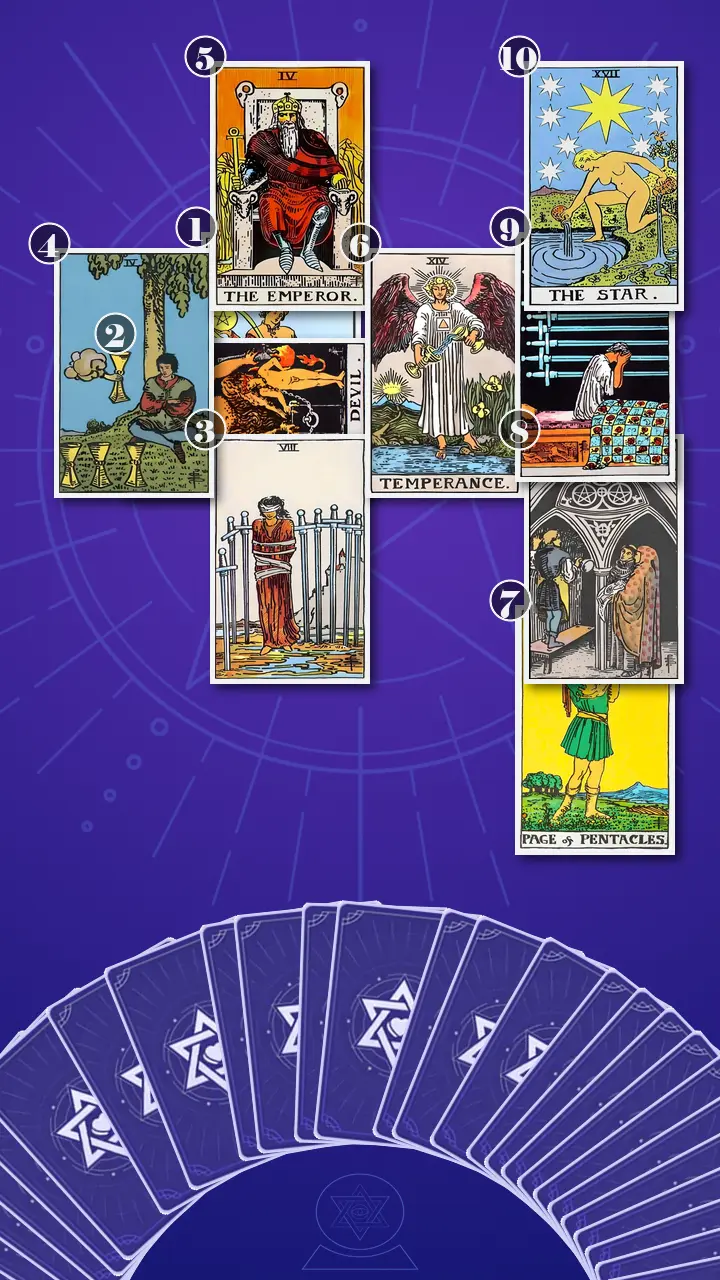
Reading the Map: When Planning Turns Into a Scoreboard
Position 1 — The current snapshot of the rent-autopay trigger and what the work-health-love inventory looks like in real life.
Now I turn over the card that represents the current snapshot of the rent-autopay trigger and what the work-health-love inventory looks like in real life.
Two of Pentacles, upright.
“Oh,” Jordan said, and then she let out a small laugh that wasn’t amused so much as exposed. The laugh did a three-step little truth-tell: first a tiny inhale-stall (like she’d been caught), then her eyes flicked down and away (like replaying a memory), and finally her shoulders dropped half an inch in reluctant recognition.
This card is the ultimate image of juggling—two pentacles looping in an infinity ribbon, waves rising behind the figure. In modern life, it’s exactly what you described: flipping between your budget app, a workout plan, and a dating chat in the same ten minutes, trying to keep everything afloat while the “waves” keep shifting.
Energy-wise, this is balance with a hidden excess: you can juggle, but the constant switching becomes its own kind of motion sickness. You’re not failing at adulthood—your system is just stuck in “keep everything in the air” mode, which looks like responsibility but feels like panic with good formatting.
I asked her, “When the rent autopay notification hits, what are the first three apps you open—and what are you hoping those numbers and lists will make you feel in your body?”
“Safe,” she said immediately. Then, after a beat: “Or… not behind.”
“Right,” I said softly. “Two of Pentacles isn’t judging you. It’s showing you the loop.”
Position 2 — What is actively complicating the inventory and turning it into paralysis rather than clarity.
Now I turn over the card that represents what is actively complicating the inventory and turning it into paralysis rather than clarity.
The Devil, reversed.
In the Rider–Waite image, there are chains—but they’re loose. That’s the first thing I always pay attention to when this card comes up reversed: the trap is real, and also partly optional. Not easy to step out of, but possible.
This is the “loose chain” in your real life: the extra reopen of the budgeting app. The “one more” edit to the spreadsheet. The doom-scroll of LinkedIn promotions. The refresh of Hinge messages followed by, “I’ll reply when I have my life together.”
Here’s the micro-confession I offered her—because it’s true for so many people with rent autopay anxiety spirals:
You’re not lazy—you’re bargaining with fear for five more minutes of certainty.
Energy-wise, The Devil reversed is a blockage loosening. You’re starting to notice the pattern. But the challenge is that you’ve been treating the inventory like a moral test—like if you don’t optimize all three areas at once, you’re failing. That turns planning into self-binding.
Jordan’s mouth tightened, then softened. “I call it discipline,” she said. “But it feels… mean.”
“Planning can be a form of control,” I replied, “and control can be a form of fear.”
Position 3 — The underlying psychological driver that keeps the pattern running even when you ‘know better.’
Now I turn over the card that represents the underlying psychological driver that keeps the pattern running even when you ‘know better’.
Eight of Swords, upright.
The blindfold. The bound hands. The corridor of swords that looks airtight—until you notice the open space beyond it. This is the internal rule you’re following that you never consciously chose: “I must optimize everything at once to be okay.”
Modern translation? You have time to do one thing—send a message, schedule a check-up, draft a work request—but your brain insists you need a full master plan first, so you do nothing. It’s not a lack of intelligence. It’s choice framed as danger.
Energy-wise, this is a deficiency of perceived agency. Not actual agency—you have that. But the felt sense of it gets blocked when your nervous system is activated.
I’m a radio host; I’ve spent years watching what happens when a studio feed gets noisy. People assume they need more data, more knobs, more complexity. But when a signal is distorted, the fix is often simpler: reduce the noise floor, narrow the bandwidth, stop trying to EQ every frequency at once.
“What’s the smallest choice,” I asked, “that would still be true even if you changed your mind later?”
She stared at the card like it was speaking for her. “Something that doesn’t trap me,” she said.
Position 4 — What you’ve been coming from emotionally and behaviorally in the weeks leading up to this check-in.
Now I turn over the card that represents what you’ve been coming from emotionally and behaviorally in the weeks leading up to this check-in.
Four of Cups, upright.
The figure sits with crossed arms. Three cups are right there, and another is being offered—almost gently, almost patiently—and still: no reach.
This often shows up when someone has been functioning, but not really nourished. In your life it can look like scrolling past invitations or messages and telling yourself you’re too busy to engage… then later wondering why love and health feel like chores instead of support.
Energy-wise, this is a blocked receptivity. Not because you’re ungrateful, but because you’ve been protecting yourself from disappointment—and calling it “standards.”
Jordan swallowed. “I keep telling myself I should be grateful,” she admitted. “But I’m… under-stimulated. Like I’m living in a to-do list.”
“That’s important,” I said. “Because the rent-day audit isn’t just about money. It’s also a check for emotional aliveness.”
Position 5 — The conscious ideal or ‘scoreboard’ you’re measuring yourself against during the inventory.
Now I turn over the card that represents the conscious ideal or ‘scoreboard’ you’re measuring yourself against during the inventory.
The Emperor, upright.
Ah. The Builder. The one who wants structure, stability, and the feeling of steering your life rather than reacting to it.
In modern life, The Emperor is that urge to design the perfect weekly schedule and budget rules—hoping that if the system is strong enough, you won’t have to feel uncertainty about work, health, or dating.
Energy-wise, The Emperor is powerful structure—but here it’s flirting with rigidity. When your nervous system is already lit up, “structure” can become a courtroom where you judge whether you’ve been disciplined enough.
I asked, “If your brain were grading you, what’s the rubric for ‘doing adulthood right’—and whose voice does that rubric sound like?”
Jordan’s eyes went a little distant. “Everyone’s,” she said. “LinkedIn. Instagram. My old boss. My friends who seem… effortlessly fine.”
“That’s a lot of voices in the mix,” I said, and I could feel the key card approaching like the moment a song finally resolves.
When Temperance Poured Between Two Cups
Position 6 — What’s next that can realistically enter your life if you stay engaged—an available direction, not a fixed prediction.
Now I turn over the card that represents what’s next that can realistically enter your life if you stay engaged—an available direction, not a fixed prediction.
Temperance, upright.
The room got quieter—not in a magical way, in a real way. Outside, a siren faded. Inside, Jordan stopped fidgeting with her sleeve. It was like her body recognized a different option: not more hustle, not a bigger plan, but a calmer rhythm.
Setup (the stuck moment): You know that moment rent autopay posts, you open your banking app, then your calendar, then a fresh note called “Reset”—and suddenly you’re auditing your entire life like it’s a quarterly earnings call. You’re trapped between “I must fix everything” and “If I choose wrong, I’m doomed,” so you keep switching apps because switching feels safer than committing.
Delivery (the sentence):
Stop treating rent day like a verdict and start treating it like alchemy—mix small, steady inputs like Temperance pouring between two cups.
And I let that sit there, the way I let a song’s last note ring out before I talk over it.
Reinforcement (what changed in her face and body): Jordan went still in a way that wasn’t freezing—more like landing. First, her brow lifted as if she’d been handed permission she didn’t know she was allowed to have. Then her eyes got shiny, not full tears, just that edge-of-waterline honesty that says a truth hit home. Her jaw unclenched in tiny increments, like a knot being picked open rather than cut. She inhaled, paused, and on the exhale her shoulders dropped all at once—so fast it almost surprised her. For a second she looked almost lightheaded, that strange vulnerability that can show up when control loosens: If I’m not bracing, what do I do with my hands?
Temperance is integration. Moderation. Patient calibration. It’s the difference between frantic app-switching (Two of Pentacles) and one blended ritual you can repeat without hating your life.
This is where my work in sound therapy snaps cleanly into tarot. Temperance is a mixing board. You don’t push every fader to max and call it “balanced.” You listen. You blend. You leave headroom. You stop chasing a perfect album at 1 a.m. and just choose the one track that sets the tone.
So I brought in my Space Tuning lens—my favorite way to make the “alchemy” practical. “Your rent-day spiral starts with a sound,” I told her. “A ping. A notification. Your body hears it like an alarm. We’re going to change the acoustics of that moment—not by pretending money isn’t real, but by changing the way the moment lands.”
I continued, “Let’s do a ten-minute Temperance Pour this week. And I’m going to ask you something specific: Now, with this new lens, think back to last week. Was there a moment where one blended, repeatable step would’ve changed how you felt?”
Jordan blinked twice, slowly. “Sunday night,” she said. “I was in bed, doing the whole… dashboard thing.”
“That’s it,” I said. “This isn’t about a perfect overhaul. It’s about moving from spiky urgency and self-scrutiny to a rhythm your nervous system can keep.”
Climbing the Staff: Support, Fear, and a Kinder North Star
Position 7 — How you are showing up, including strengths you’re underusing and the posture that will help you act.
Now I turn over the card that represents how you are showing up—your strengths you’re underusing and the posture that will help you act.
Page of Pentacles, upright.
The Page holds one pentacle like it’s the only thing in the world worth studying. Not twelve. Not a whole KPI dashboard. One.
This is your resource: beginner’s mind with practical follow-through. The energy here is steady and balanced, but underused because you keep demanding an expert-level plan before you allow yourself a beginner-level step.
In your life, it’s when you decide the next month is not a complete lifestyle redesign. It’s one consistent money date, or one consistent workout time, or one communication practice in dating—and you let that be enough.
I said it plainly: “One chosen step beats three perfectly worded intentions.”
Jordan nodded, and this time her nod wasn’t frantic agreement—it was a measured yes, like she could actually picture doing it.
Position 8 — External pressures and supports shaping your options across work, health, and love.
Now I turn over the card that represents external pressures and supports shaping your options.
Three of Pentacles, upright.
I almost laughed—not at her, just at the accuracy. This is the card that says: you’re trying to earn stability privately, when stability is often built with support.
Let me paint the workplace micro-scene it points to: Slack pings, shifting priorities, and a manager who drops a “quick question” at 6:12 p.m., blurring the edge of your day until you can’t tell if you’re behind or just drowning in inputs.
Energy-wise, Three of Pentacles is available support—a resource you can access if you stop trying to be a one-person infrastructure team.
Jordan’s face did that relief-plus-resistance thing: her lips pressed together (resistance), but her eyes softened (relief). “I hate asking,” she admitted. “It feels like… I should be able to handle it.”
“That’s the Emperor shadow talking,” I said. “Collaboration isn’t weakness. It’s design.”
Position 9 — The emotional tug-of-war that spikes at month-turn: what you secretly want and what you’re bracing for.
Now I turn over the card that represents the emotional tug-of-war at month-turn—what you secretly want and what you’re bracing for.
Nine of Swords, upright.
This is the 1:07 a.m. scene: you’re in bed, phone glow turning the ceiling a colder shade of white. Tabs open—banking, Notion, Hinge, maybe Apple Health. Wired-tired. Your body wants sleep; your mind wants a verdict.
And the inner monologue goes like this:
If I pick X, I’m neglecting Y. If I don’t pick anything, at least I’m not “wrong” yet.
Energy-wise, Nine of Swords is excess mental noise. Thoughts start feeling like evidence. Feelings get converted into scores. It’s the Air-heavy bind: the mind treats choice as danger, so planning replaces committing (and then punishes you for not committing).
Jordan’s hand went to her chest without her noticing. A quiet exhale slipped out—the kind that means, oh, that’s why I freeze.
Position 10 — Integration: the most constructive direction your next chapter can take if you follow the reading’s invitation.
Now I turn over the card that represents integration—the most constructive direction your next chapter can take if you follow the reading’s invitation.
The Star, upright.
The Star doesn’t shout. It doesn’t demand an outcome. It offers a calmer north star—hope without promises, guidance without a whip.
I gave Jordan a quiet-city image because it’s the only one that really fits this card in New York: late-night streetlight glow through the window, a glass of water, phone face-down. The world is still the world, but for a moment you’re not on trial.
Energy-wise, The Star is replenishment and gentle clarity. It’s what happens when you stop making decisions solely to reduce panic, and start making them to align with a value you actually want to live by.
“Rent day isn’t a verdict,” I reminded her. “It’s a signal.”
From Insight to Action: The Temperance Rhythm (and a Little Sound Science)
Here’s the story the whole spread told me, in one thread: the rent autopay trigger (Two of Pentacles) pushes you into juggling as a coping strategy. The crossing pressure is the fear-disguised-as-discipline loop (Devil reversed). Underneath, your mind frames choice as danger (Eight of Swords), especially after a stretch of emotional flatness where nothing feels nourishing (Four of Cups). Your conscious goal is stability and structure (The Emperor), but the next step isn’t a harsher system—it’s a repeatable blend (Temperance) you can approach like a beginner (Page of Pentacles), with support (Three of Pentacles), so nighttime rumination doesn’t run your life (Nine of Swords). If you do that, the integration direction is The Star: calmer self-trust, values over panic, and a steadier inner climate for decision-making.
The cognitive blind spot I wanted Jordan to see was this: she’s been using the inventory as a way to feel safe—so it becomes a courtroom, not a tool. The transformation direction is the key shift your reading keeps insisting on: from “a monthly life audit must produce the perfect overhaul” to “a weekly rhythm plus one small commitment per domain is enough to build stability.”
I offered her actionable advice—not grand, not vibe-y, not dependent on motivation. Small levers. Bounded experiments.
- The 20-Minute Inventory Timer (Daylight Version)Once this week, set a 20-minute timer for your work-health-love inventory before 6 p.m.. When the timer ends, choose one action that reduces pressure within 72 hours and put it on your calendar as a single event.Expect your brain to say, “This is too small to matter.” Treat that as proof you’re leaving the perfectionism loop. Stop when the timer ends—even if you feel unfinished.
- The Two-Domain Mix (Temperance’s Alchemy)Pick one blended habit that supports two domains and schedule it: e.g., “Walk + catch-up call (20 min)” (health + love) or “Meal prep one lunch + career podcast (25 min)” (health + work). Do it within 72 hours, not “sometime this month.”Label it realistically in your calendar. No heroic titles. If you only do the 10-minute version, it still counts.
- The 21-Day Sound Bath (3 Minutes, No Personality Required)For the next week, try the first 7 days of my 21-Day Sound Bath: once per day, play a 3-minute grounding track (low, steady tones; or even simple brown noise if you prefer) with your phone face-down. This is not “fixing” you—it’s lowering the mental noise floor so choices feel less dangerous.Do it right after your rent notification, or before bed. If it spikes anxiety, stop immediately and switch to one sip of water + feet on the floor. The win is consistency, not intensity.
Jordan raised a practical objection right on cue—because real life always shows up. “But I can’t even find five minutes,” she said, and her eyes darted to her phone like it would confirm the schedule was impossible.
I didn’t argue with her. I just made it smaller. “Then we don’t find five,” I said. “We take three. And we attach it to something that already happens—like brushing your teeth. The goal isn’t to become a new person. It’s to give your nervous system proof that you can choose one thing and survive it.”
Then I gave her one collaboration move (Three of Pentacles), because support is part of the system, not a bonus feature: “Send one Slack message: ‘For this week, what are the top 2 priorities you want me to focus on?’ That’s a ten-second action that stops the work tab from eating every other tab.”

A Week Later: Ownership, Not Certainty
Seven days later, Jordan sent me a message at 8:19 p.m.: “Did the 20-minute timer. Picked one thing. Scheduled a walking call with my friend and meal-prepped one lunch while listening to a work podcast. Also asked my manager for top two priorities. I slept.”
It wasn’t a dramatic transformation montage. It was a small, bright proof. She still woke up one morning with the first thought, What if I’m doing it wrong?—and then she exhaled, put her phone face-down, and did the three-minute sound bath anyway.
That’s the Journey to Clarity I trust most: not certainty, but ownership. Not a perfect overhaul, but a repeatable rhythm that makes you steadier over time.
When rent day turns into a private trial in your head, it’s not that you don’t know what to do—it’s that choosing one imperfect next step can feel like risking your sense of control.
If you didn’t have to solve work, health, and love tonight—what’s one small, mix-and-match step you’d actually be willing to repeat this week?