The Sunday Night Calendar Spiral—And the One Sentence That Broke It

Finding Clarity in the 9:13 p.m. Slack Spiral
You tell yourself you’ll stop working after dinner, then one Slack ping turns into an hour of tab-switching—email, calendar, Notion—until your head feels buzzy and you realize you forgot to eat.
Jordan (name changed for privacy) said that line like they’d been caught on camera. They were 29, living in Toronto, the kind of early-career product/project pro who’s competent enough that people keep adding “quick asks” to their plate—plus the kind of person who adds their own asks, too, like life is a roadmap you can optimize if you just keep tweaking the settings.
They described a Tuesday night so precisely I could see it: 9:13 p.m. in a condo kitchen, fridge humming, overhead light too bright, their phone warm from nonstop notifications. “I open my laptop for five minutes,” they said, “and then it’s an hour. I’m rewriting the to-do list again.”
As they spoke, their shoulders were inching up toward their ears like a reflex, and their jaw had that tiny, constant clench I see in people who are trying to hold the world in place. Overwhelm, in their body, looked like a bundle of invisible cords pulled too tight—like their nervous system was running at max screen brightness with no dimmer switch.
“What needs clearing first?” they asked. “Work, love, health—something has to go, but if I drop the wrong thing, I’m scared something blows up. Or I look flaky. Or I fall behind.”
I nodded, slow and steady. “Let’s make this practical,” I said. “We’re not here to judge your ambition or your care. We’re here to find clarity—what to clear first so your whole system can breathe.”

Choosing the Compass: How Tarot Works as a Whole-Life ‘Low Storage’ Diagnostic
I asked Jordan to take one breath in through the nose, one longer breath out through the mouth. Not as a mystical ritual—more like tapping ‘force quit’ on the mental apps that keep running in the background.
“Today,” I said, “we’ll use a spread I call the Energy Diagnostic Map (7) · Context Edition.”
For readers who wonder how tarot works in a situation like this: I’m not using the cards to predict a dramatic event. I’m using them like a mirror with structure. This spread is designed for the exact problem Jordan brought in—work, love, and health all feeling full at once—without treating those areas like separate planets.
The rationale is simple: we start with the presenting symptom (what the ‘low storage alert’ looks like day-to-day), then we split into the love channel (inner tug) and work channel (external pressure). We go to the center for the core “storage hog” belief that keeps you from deleting. Then we ground into health as a stabilizing resource, identify the single clearing priority (the first “delete”), and finally we build an integration routine so the storage doesn’t refill by Thursday.
“Think of it like a system reboot,” I told Jordan. “First we name the overheating CPU. Then we identify the background apps. Then we change the one setting that’s been eating your storage for years.”
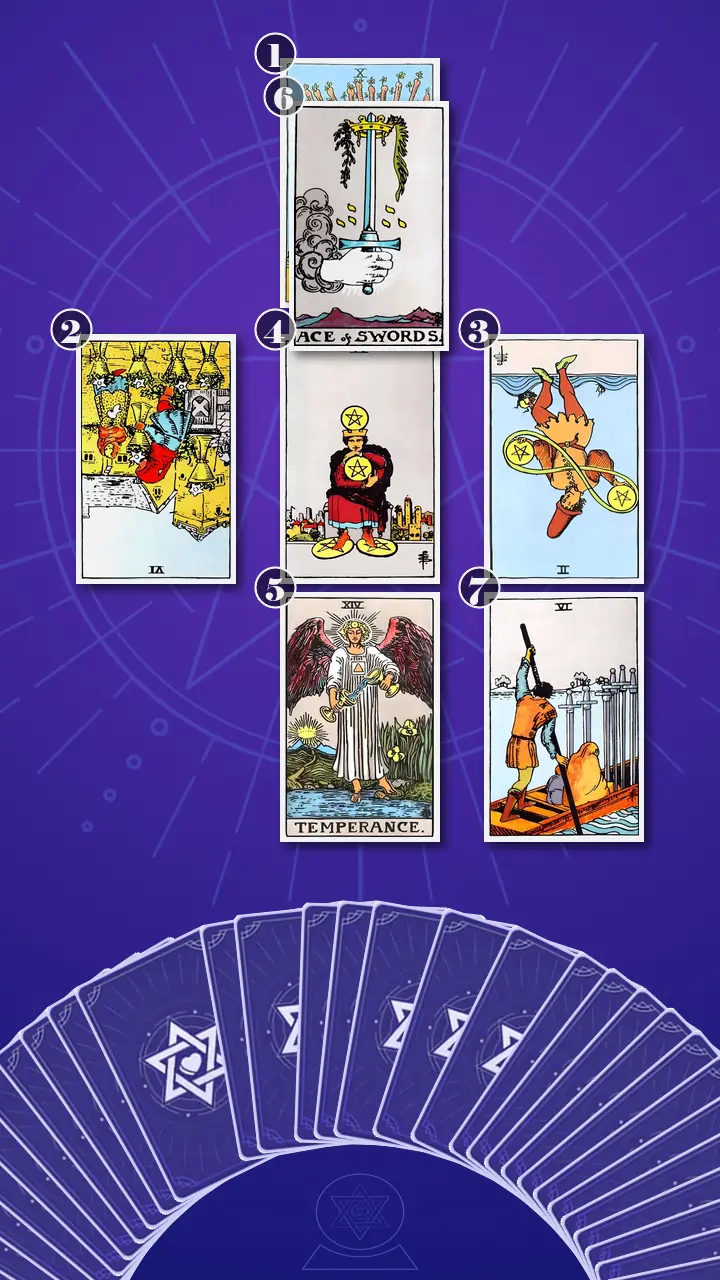
Reading the Map: Where Your Bandwidth Is Actually Going
Position 1 — Surface symptom: what ‘low storage’ looks like right now
“Now we turn over,” I said, “the card that represents the surface symptom—what ‘low storage’ looks like in daily behavior right now.”
Ten of Wands, upright.
I glanced at Jordan’s posture—already slightly hunched forward—and then back at the card: a figure carrying a bundle so big it blocks their face. “This is the exact vibe of: It’s 9 PM and Jordan is walking home from work with a tote bag digging into their shoulder, earbuds in, Slack still lighting up their lock screen… carrying a half-finished deck, a ‘quick favor,’ a date they said yes to out of guilt, and a fitness plan they keep promising they’ll restart.”
In energy terms, this is excess: too much effort, too much responsibility, too many open loops. It’s not that you’re doing nothing—it’s that you’re carrying so much you can’t even see what matters. Overwhelm isn’t a personality flaw—it’s a system running too many background apps.
Jordan let out a small, bitter laugh. “That’s… so accurate it’s kind of rude,” they said, but their eyes stayed on the card like it had just named something they’d been trying not to admit.
Position 2 — Love channel: emotional clutter taking up space
“Now we turn over the card that represents your love channel—what emotional or relationship clutter is taking up space.”
Six of Cups, reversed.
“This one,” I said gently, “is the midnight thumb that knows the route: Instagram → search bar → an old profile; iMessage → an old thread; photos → a memory from a different season of life.”
Reversed, the Six of Cups is a blockage in the waterline: tenderness that keeps re-opening itself at 12:41 a.m., not to heal, but to re-run. It can look like staying ‘friendly’ out of guilt, keeping someone on Close Friends “just in case,” or replaying old conversations like they’re files you can finally solve if you stare long enough.
Jordan’s gaze went unfocused for a second—like their brain had just opened a tab they didn’t mean to. They didn’t deny it. They just swallowed and said, quieter, “I don’t even want them back. I just… check. And then I feel gross.”
“That’s the reversal,” I said. “It’s not nostalgia. It’s a background process.”
Position 3 — Work channel: what’s consuming professional capacity
“Now we turn over the card that represents your work channel—what professional pressure and task-stacking is consuming capacity.”
Two of Pentacles, reversed.
I didn’t even have to reach for symbolism; Toronto gave it to us. “This is 10:04 AM on the TTC Line 1,” I said. “Stale air, train squealing, one hand gripping the pole while you toggle Slack → email → calendar invites → back to Slack.”
Reversed, this card is deficiency in balance and excess in switching. The infinity loop becomes the never-ending loop: being busy for hours, but nothing feels finished—just shuffled. The body cost shows up fast: clenched jaw, creeping shoulders, that wired feeling before the day even starts.
Jordan nodded hard. “If I reply fast, I feel on top of it,” they said. “And then it becomes… expected.”
I caught myself doing what I used to do on ships—watching not just the words, but the micro-shifts. On transoceanic voyages, you learn quickly: the sea doesn’t care about your calendar. Your body is the first instrument to tell you the system is off.
Position 4 — Core blocker: the real ‘storage hog’ belief
“Now we turn over the card that represents the core blocker—the belief or attachment that keeps you from deleting, declining, or releasing.”
Four of Pentacles, upright.
The image is unmistakable: coin pressed to chest, coin on crown, feet braced like they’re guarding the ground itself. “This is you keeping commitments like insurance policies,” I said. “Not because they’re nourishing—because releasing them feels like losing safety, status, or control. Especially in a high-cost city where it feels like everything is a competition you didn’t agree to enter.”
And then I did what I’m known for—my Energy Flow Diagnosis, but in plain language. “Notice your shoulders,” I said. “They’re not ‘just tense.’ They’re in a holding posture—like your body is trying to grip the week.”
I watched Jordan’s breath catch. Their shoulders lifted a millimeter higher, then froze. In my head I heard the core fear sentence so many people carry, like a hidden terms-and-conditions agreement: If I let go, it’ll be my fault.
“If holding on feels like safety,” I said, “letting go will feel like danger—at first.”
Jordan’s mouth tightened, but they nodded. It was the kind of nod that isn’t agreement—it’s recognition.
Position 5 — Health channel as a resource: what your nervous system is asking for
“Now we turn over the card that represents health as a resource—what your body and nervous system are asking for so clearing is sustainable.”
Temperance, upright.
Temperance is the regulator: water poured between two cups, one foot on land, one in water, a long path toward a rising sun. “This,” I said, “is the opposite of crash-cleaning your life on Sunday and collapsing by Tuesday. It’s micro-calibration.”
I offered a two-minute reset right there, because Jordan’s body was already telling us the truth. “Feet on the floor,” I said. “One hand on your chest. Inhale for 4. Exhale for 6. And ask: What am I trying to grip right now?”
Temperance is balance—not perfect wellness, not a dramatic reinvention. It’s the nervous system learning that steady is allowed. A calmer life usually starts as a calmer pace, not a perfect plan.
Jordan’s exhale came out like a release they hadn’t scheduled.
When the Ace of Swords Cut Through the Noise
Position 6 — Clearing priority: what must be cleared first
I let the silence settle for a beat. “We’re turning over the key card now,” I said. “The one that answers your actual question: what needs clearing first so space opens everywhere.”
Ace of Swords, upright.
“Here’s the modern scene,” I said, tapping the card lightly. “Jordan writes one boundary sentence and lets it be sharp and clean: one ‘no,’ one clear priority, one honest ask. It’s uncomfortable for ten minutes—and then multiple tasks, conversations, and expectations stop piling on because the system finally has a rule.”
In energy terms, this is balance through decisiveness. Not more effort. Not better juggling. Air energy: truth, clarity, the clean edge of a decision.
You don’t need a better juggling system. You need one clean cut.
For a moment, Jordan looked like they were back at 6:18 p.m. Sunday—opening the calendar to “get ahead,” chest tightening, hoarding time blocks like they’re oxygen. They were trapped in the idea that the only safe way forward was to keep everything open and somehow manage it.
Not “I’ll keep everything and somehow make it work,” but “I’ll make one clean cut”—let the Ace of Swords give you permission to choose clarity over carrying.
Jordan’s reaction came in a three-beat chain I’ve learned to respect. First: a tiny freeze—breath paused, eyes fixed on the sword like it might be too sharp to touch. Second: the mind absorbing it—focus drifting, like they were replaying every “sure, I can take that” they’d said this month. Third: the emotion landing—an exhale that shook at the end, shoulders dropping a fraction as if their body understood the assignment before their brain did.
Then the unexpected part: their face flickered with anger. “But if I do that,” they said, voice tight, “doesn’t it mean I’ve been doing it wrong? Like… all this effort was pointless?”
I kept my tone steady, city-smart, no drama. “No,” I said. “It means your system adapted to fear. That’s not stupidity—that’s survival. But you’re at a point where survival-mode settings are eating your storage.”
And because I’m careful with body-based language, I added: “This isn’t medical advice. I’m reading energy patterns. But your shoulders are giving you a very clear message: the cost of holding is real.”
“Now,” I asked, “with this new lens—think back to last week. Was there a moment when one honest boundary would have changed how you felt in your body? Even five percent?”
Jordan blinked fast, then said, “Thursday. A ‘quick’ request at 4:30. I said yes, and my stomach dropped instantly.”
“That drop,” I said, “is your inner wisdom. This card is you trusting it.”
What we were witnessing wasn’t just a productivity tweak. It was the first step of an emotional transformation: from frantic tab-switching and self-blame toward grounded confidence—confidence that you can choose what stays.
Position 7 — Integration: the path out that doesn’t refill your storage
“Now we turn over the card that represents integration—a realistic routine or boundary that prevents the storage from filling back up.”
Six of Swords, upright.
“This isn’t a purge,” I told them. “It’s a migration.” The card shows a boat moving across water—still carrying swords, but no longer fighting with them. “After the boundary, Jordan doesn’t try to fix their entire life in a weekend. They build a calm-waters plan: fewer active commitments, slower communication defaults, and a weekly check-in where things get archived instead of kept open forever.”
Six of Swords is movement with intention. You don’t drag corrupted files into the new laptop. You move what belongs and leave the noise behind.
The Boundary-First Delete: Practical Next Steps That Create Space Fast
I leaned back and let the seven cards speak as one story.
“Here’s the chain,” I said. “The Ten of Wands shows the overheating CPU—your baseline is carrying too much. The Two of Pentacles reversed shows the infinity loop at work—constant switching that creates ‘busy’ without completion. The Six of Cups reversed shows the emotional background app—old threads reopened at night. And at the center, the Four of Pentacles reveals the storage hog setting: holding equals safety.”
“Temperance tells us how you keep this sustainable—regulate first, not punish yourself. And the Ace of Swords tells us what to clear first: one clean, honest boundary. Then Six of Swords shows how you keep moving without snapping back into overload.”
The cognitive blind spot was tender and extremely common: Jordan believed they had to prove capability by keeping everything open. They didn’t realize that space itself was the resource they didn’t trust. The transformation direction was clear: shift from managing everything through more juggling to creating space through one clear boundary and one prioritized delete.
I offered actionable advice—small enough to do on a Tuesday, real enough to change the system.
- The One-Sentence Boundary Email (work)Open a draft and write one sentence like: “I can do A by Friday; if B is urgent, I’ll need C deprioritized—what should move?” Send it once this week to the person who keeps adding “quick” requests.If your chest tightens after you hit send, that’s the Four of Pentacles reflex. Set a 5-minute timer, draft it messy, and stop when the timer ends. Clean beats perfect.
- Two-Minute Temperance Reset (nervous system)Once per day for 5 days: feet on the floor, one hand on chest, inhale 4 / exhale 6, and ask: “What am I trying to grip right now?” Do it right before you open your laptop after work.Treat it like an OS patch, not a wellness performance. If 2 minutes feels impossible, do 30 seconds—still counts.
- A Calm-Waters Migration List (keep / archive / delete)Make a note with three columns: KEEP (still true), ARCHIVE (not for right now), DELETE (actively drains). Put exactly one item in each. For love, choose one past-linked habit to ARCHIVE for 7 days—no late-night rereading, no ex socials, no reopening the same thread.Archive isn’t denial. It’s choosing what doesn’t get to live in your daily bandwidth. If you feel tempted to hard-shutdown and delete everything, pause—archive first.
And because I’m from Venice—and because my brain thinks in waterways as naturally as Toronto thinks in streetcar lines—I added my own strategy. “Venetian Aqua Wisdom,” I said. “In canals, flow matters more than force. If you keep gripping every gate closed, the water stagnates. Your boundary is you opening one lock so life can move again.”

A Week Later: The Quiet Proof
Six days later, I got a message from Jordan. “I sent the one-sentence email,” they wrote. “My hands were shaking a little. But my manager actually replied: ‘Okay—drop C.’ I ate dinner before I opened my laptop. It wasn’t magical. But I slept.”
I read that twice, because it’s the kind of change people underestimate: not a whole new personality—just a system that finally has one rule protecting it.
That’s the Journey to Clarity I trust most: not a dramatic overhaul, but a single clean cut that makes your shoulders drop and your mind quiet enough to hear yourself again.
When your life feels like it’s flashing “low storage,” it’s often not because you’re doing nothing—it’s because you’re gripping every commitment like it’s proof you’re safe, and your body pays the price for that constant hold.
If you let yourself make just one clean cut this week—not a dramatic overhaul—what’s the smallest boundary that would give your mind (and shoulders) five percent more room to breathe?