My 'Perfect Study System' Was Avoidance: How I Switched to Practice Reps

Finding Clarity in the 8:47 p.m. “Start Quiz” Hover
If you’re a Toronto uni student who opens Notion, your notes, and a question bank… then somehow spends 45 minutes formatting instead of practicing, welcome to merit-badge studying.
Taylor (name changed for privacy) showed up on my screen with the kind of tired focus that looks like it was held together by a jaw muscle. It was 8:47 p.m. on a Wednesday, desk by the window, three tabs open—lecture notes, a Notion study planner, and a question bank. Behind them, a radiator clicked on and off like a metronome that couldn’t settle; the overhead light had that faint buzz that makes silence feel louder. Their phone sat face-up, still warm from scrolling.
“I can organize my whole life,” they said, eyes flicking to the question bank, “except the moment I have to start.”
I watched their cursor hover over Start Quiz—and then drift, almost on its own, to renaming a folder. Their chest rose shallow. One leg bounced under the desk, fast enough to blur the hem of their sweatpants.
They didn’t come to ask how to study harder. They came to ask why studying turns into this loop: wanting to feel competent and proud, while fearing that anything less than a gold-star result means they’re not enough—so they freeze at the exact moment the work becomes measurable.
The dread in the room had a specific texture: like standing at the edge of cold water, telling yourself you’ll jump, while your body quietly negotiates ten different reasons to stay on the tile.
“I’m not here to judge your discipline,” I told them. “I’m here to help you name the loop precisely—so we can change it. Let’s draw a map through the fog and find some clarity you can actually use the next time you sit down to study.”

Choosing the Compass: The Four-Layer Insight Ladder Tarot Spread
I had Taylor take one slow breath—not as a mystical ritual, just a nervous-system handoff from spiraling to observing. While I shuffled, I asked them to keep one sentence in mind: “Old gold-star chart—what study anxiety loop am I replaying, and what’s my next step?”
Today, I chose an original spread I use a lot for academic stress and perfectionism: the Four-Layer Insight Ladder · Context Edition. It’s designed for moments like this—when you’re not “lazy,” you’re stuck inside a repeatable system: surface behavior → what intensifies it → the old rulebook underneath → the fear knot → the inner pivot → the practical next step.
For readers who like to know how tarot works in real life: this spread keeps the card count minimal while still pinpointing the mechanics of a study anxiety loop—especially that sneaky form of productive procrastination that looks responsible (pretty notes, perfect plans) but avoids measurable practice.
“We’ll read this like a ladder,” I said. “Top card is the surface loop—the thing you do in the first 20 minutes when anxiety spikes. Mid cards show the trigger and the inherited ‘gold-star’ script. Then we name the core fear point. Under that is the hinge: the inner capacity that changes your relationship to mistakes. Last card is the grounded next step for this week.”
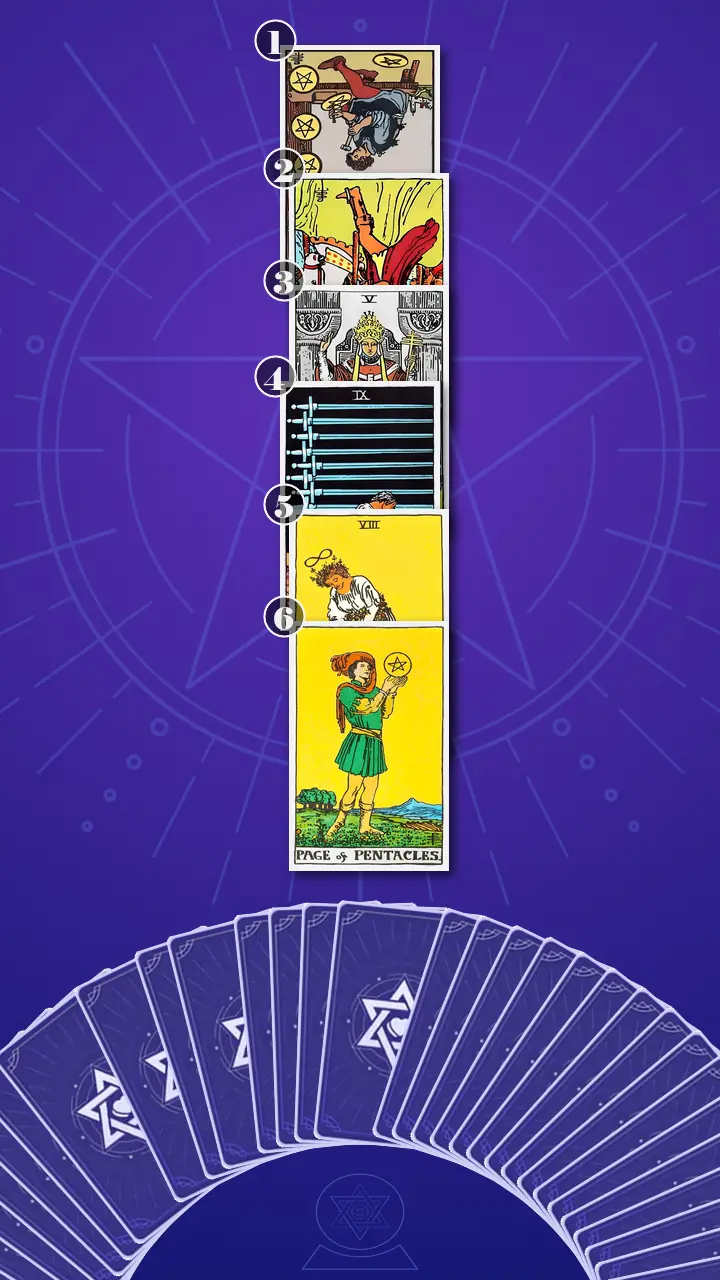
Reading the Ladder—Why You Rewrite Notes Instead of Doing Practice Questions
Position 1 — Surface loop: what repeats when anxiety spikes
“Now we turn over the card representing your surface loop: the specific, observable study behavior that repeats when anxiety spikes.”
Eight of Pentacles, reversed.
This card is almost too on-the-nose for “I study a lot, but I don’t feel like I’m actually learning.” The Eight of Pentacles is the craftsperson card—reps, skill, honest practice. Reversed, it’s effort turned sideways: work that looks busy but doesn’t build mastery.
In modern terms, it’s 8:55 p.m., fresh coffee, notes + Notion + question bank open—and instead of touching the practice set, you start “improving your system.” New headings. New folders. Maybe a new study method video. You get that tiny hit of control… and you avoid the one moment that could produce real data: answering a question and possibly being wrong.
“That’s brutal,” Taylor said, and gave a short laugh that landed bitter. “Like—yeah. I do that. I make it look like I’m studying. And then I tell myself it’s too late to start.”
Reversed here isn’t a moral failure. It’s an energy blockage: the learning energy is there, but it’s getting siphoned into performance. And the risk, if you overcorrect, is swinging into grind-mode—marathon sessions, no sleep, banning breaks—until your body starts treating studying like punishment.
I tapped the edge of the card lightly. “Practice is proof. Pretty notes are a delay tactic. Not because notes are bad—because you’re using them as a shield from being measured.”
Position 2 — Trigger amplifier: the pressure that keeps the loop running
“Now we turn over the card representing your trigger amplifier: what social or achievement pressure keeps this loop activated.”
Six of Wands, reversed.
Six of Wands is the applause card—the laurel wreath, the crowd, the public win. Reversed, it’s the shaky underside: needing recognition to feel safe, and feeling weirdly exposed when the win isn’t guaranteed.
In real life, it’s studying while mentally fast-forwarding to the grade reveal like it’s a public scoreboard. It’s the group chat “what’d you get?” vibe. It’s Instagram Stories with highlighters and “locked in” captions that make your own pace feel embarrassing.
This is Fire turned inward: ambition becomes self-surveillance. Not “I want to learn,” but “I must look like I’m winning.” That’s why a private stumble feels humiliating—even if no one is watching.
Taylor’s eyes darted to the side, like they could see their feed without opening their phone. “I hate how much it gets to me,” they said. “I’ll see someone say they’re ‘already done’ with a topic and… my stomach just drops.”
“That drop matters,” I said. “It’s your nervous system hearing ‘evaluation.’ Not just ‘material.’”
Position 3 — Root script: the old gold-star rulebook
“Now we turn over the card representing your root script: the old ‘gold-star’ rulebook you internalized about learning and worth.”
The Hierophant, upright.
The Hierophant is tradition, institutions, the official way. In a reading about academic anxiety, I often describe it like an invisible rubric hovering over your desk—formal, strict, and always watching.
Here’s the courtroom lighting: you’re not just studying. You’re testifying. The rules aren’t “learn this concept.” The rules are “prove you deserve to be here.”
I said it the way it sounds in people’s heads: “You can hear it, right? That old teacher-voice. The one that praises compliance and punishes uncertainty. The voice that says there’s one correct way to be disciplined, and if your notes are messy or you do open-book practice, it doesn’t count.”
Taylor blinked, then made a small, surprised sound—half laugh, half oh. “Oh my god,” they said. “Yes. It’s like… even when no one’s around, I’m still trying to be a ‘good student’ for someone.”
That’s the shift Hierophant offers: this isn’t laziness. It’s an old system still running in the background. And systems can be updated.
Position 4 — Core fear point: the mental consequence you’re avoiding
“Now we turn over the card representing your core fear point: the mental and emotional consequence you’re trying to avoid by over-prepping or stalling.”
Nine of Swords, upright.
This is the bottleneck. The reason practice questions feel like stepping onto a stage you didn’t rehearse for.
I stayed close to Taylor’s world: laptop glow at night, the hush outside like TTC silence between stations, the room too still. Nine of Swords is your brain writing a terrifying headline at 2 a.m. and then believing it’s journalism.
Here’s the inner monologue structure I hear all the time:
(1) The headline: “I’m going to fail.”
(2) The evidence-scramble: refreshing Canvas gradebook, scrolling old marks, replaying every missed lecture like it’s surveillance footage.
(3) The self-sentence: “I never deserved this.”
And the cruel twist: that makes “busy studying” feel safer than measurable practice. Because if you don’t test yourself, you don’t have to face the verdict your mind is itching to deliver.
Taylor went very still—like their body hit pause. Their eyes unfocused for a second, as if they were replaying a memory. Then they nodded slowly, once, like a door clicking shut. “Yeah,” they said quietly. “That’s exactly the 2 a.m. brain loop.”
“Studying as learning,” I said, “versus studying as a trial you’re about to lose.”
When Strength Spoke: Gentle Courage Instead of a Verdict
Position 5 — Key reframe energy: what changes your relationship to mistakes
I let the silence sit for a beat, because Nine of Swords always leaves a thin electrical hum in the air. “We’re about to turn over the hinge card,” I told them. “The one that changes how you relate to being evaluated.”
“Now we turn over the card representing your key reframe energy: the inner capacity that changes how you relate to mistakes and evaluation.”
Strength, upright.
Setup: You know that moment: you sit down to study, open the question bank… and suddenly you’re renaming folders, perfecting headings, anything except the first real question.
Delivery:
Stop trying to earn safety through gold-star perfection; start practicing with gentle courage, like Strength’s calm hand on the lion.
I watched it land in real time. Taylor’s breath caught—just a tiny freeze. Their fingers, which had been gripping a pen too hard, loosened. Their eyes went glassy for a second, not full tears, more like the pressure behind them shifted. Then they exhaled, long and shaky, as if their ribs finally got permission to drop.
“But…,” they started, and there it was—the resistance spike. Their brows pulled together, heat flashing in their voice. “If I stop doing the gold-star thing, doesn’t that mean I’ve been doing it wrong? Like I’ve wasted so much time?”
“No,” I said, gentle but clear. “It means you used the tools you had to survive an environment that rewards visible wins. Strength isn’t a scolding. It’s a different authority.”
Then I brought in the sentence I wish every high-achiever could borrow: “You don’t need more pressure or a prettier system—you need steadier self-trust so practice can be messy without turning every mistake into a verdict.”
Strength is nervous-system wisdom. It treats anxiety like a skittish animal you’re training, not a machine you can shame into output. Fear-driven grind says: go harder or you’re nothing. Strength says: stay present, stay kind, keep the boundary, do the rep.
And this is where I used one of my own frameworks—the one I built after years in finance and then refined in tarot work: my Potential Mapping System. I told Taylor, “Your studying energy reads like a Deep Thinker, not a Sprinter. Deep Thinkers build mastery through understanding and patterning—but when evaluation hits, they can get trapped in ‘preparing to prepare.’ Sprinters can brute-force a quiz. Deep Thinkers need a different doorway: one tiny measurable rep that proves, safely, that you can be wrong and still continue.”
They swallowed and nodded again—faster this time. Relief, but also that slightly dizzy vulnerability that comes right after relief, when you realize you might actually have to do the new thing.
“So here’s the immediate practice,” I said, keeping it concrete, because Strength is only useful when it touches the ground. “In the next 10 minutes, do a ‘Strength Rep’: set a timer for 6 minutes, answer exactly 3 practice questions—open-book is allowed—then write one sentence: ‘A wrong answer means ____.‘ and one sentence: ‘A wrong answer also means I now know ____.‘ If your chest tightens or you start bargaining—‘I should reorganize first’—pause and take one slow breath. You’re allowed to stop at 3 questions. Stopping at the boundary is part of the practice.”
I leaned in slightly. “Now, use this new lens and tell me—last week, was there a moment when one wrong answer could’ve been data, but your brain tried to make it identity?”
Taylor stared at the desk, then laughed once, softer. “Yesterday,” they said. “I got two questions wrong in a row and immediately thought, ‘This proves I’m slipping.’ And then I cleaned my kitchen. Like… aggressively.”
“That’s the pivot,” I said. “From tight dread and shame into self-compassionate confidence built through reps. Not overnight. But starting now.”
Position 6 — Next step: the practical study approach for this week
“Now we turn over the card representing your next step: one practical study approach that’s measurable and sustainable this week.”
Page of Pentacles, upright.
The Page of Pentacles doesn’t care about looking impressive. They care about one coin—one concept, one topic, one set of questions—held steadily. This is the student archetype who builds grounded pride through consistency, not spectacle.
In modern life, it’s choosing one realistic deliverable and repeating it: a short daily set of problems, a quick review of mistakes, and a tiny tracker. Not glamorous. That’s the point. Your confidence comes from showing up, not from chasing gold stars or waiting to feel ready.
Taylor’s shoulders lowered a fraction, like their body recognized “simple” as safer than “perfect.”
From Insight to Action: The Practice-First Protocol (Actionable Advice)
Here’s the story the whole ladder told—cleanly, like a risk memo (old habits die hard; I used to write them on Wall Street): you start with productive-looking busywork (Eight of Pentacles reversed) because social comparison and “grades as applause” keeps the stakes feeling public (Six of Wands reversed). Under that is an internalized institution—the invisible rubric, the gold-star rulebook (The Hierophant)—and beneath that is the real pain: the nighttime prosecution, the identity headline (Nine of Swords). The only thing that truly unlocks it isn’t a stricter schedule. It’s a new relationship to being wrong: calm, structured courage (Strength), translated into one steady, trackable routine (Page of Pentacles).
Your cognitive blind spot is thinking the problem is a lack of discipline or the wrong study method—so you keep trying to “earn” safety with better systems. But the transformation direction is different: shift from performing competence to building competence through small, testable reps you can track without judging yourself.
Taylor hesitated right on cue. “But I don’t even have time,” they said. “Like… five questions turns into an hour because I start spiraling.”
“That’s why we use boundaries,” I said. “And why we keep it tiny.” Then I pulled in one of my client tools—the one that’s saved more than a few Oxford grads and med students: my 5-Minute Decision Tools. “Before you start, you run a tri-axis check: Advantage (what this rep gives you), Risk (what your anxious brain predicts), Breakthrough (what changes if you do it anyway). It takes two minutes. Then you calibrate weekly. It’s not motivation. It’s navigation.”
“Here are your next steps for the next 48 hours,” I said, and I kept them deliberately unglamorous.
- 5-Questions-First RuleAt the start of your next study session, do exactly 5 practice questions before you open notes, rewrite anything, or watch a lecture. Untimed and open-book are allowed for week one.Expect your brain to call this “not real studying.” Do it anyway. Stop at 5 on purpose—stopping at the boundary is part of building self-trust.
- 3-Line Error Note (Right After)Immediately after the 5 questions, write a 3-line “error note”: (1) what you picked, (2) why it was tempting, (3) what you’ll look for next time. Then close the question bank.Keep it to three lines. If you want to punish yourself with an essay, that’s the gold-star chart trying to take over.
- Private Proof Tracker (7 Days)Pick one private metric for 7 days: “questions attempted” or “minutes in active practice.” Track it in Notes/Notion: date + number + one word about mood (tight/okay/stuck). Don’t share it with anyone.When comparison hits, say out loud: “Applause is not a study plan.” Then do one more question—just one.
“If you want a reward channel for the part of you that loves systems,” I added, “you get ten minutes of note-organizing after. Not as the entry fee—as dessert.”

A Week Later: Ownership, Not Certainty
Six days later, I got a message from Taylor. Just a screenshot of a Notes app tracker: dates, “Q attempted: 5,” and mood words like “tight” and “fine.” Under it they wrote, “I did the 5 first. I hated it. I didn’t die. Also… I didn’t clean my kitchen after.”
It wasn’t a movie-montage transformation. It was quieter than that: a small, private proof that their nervous system could stay in the room with data.
That’s the real Journey to Clarity here: studying stops being a gold-star audition and becomes an experiment you run—reps over results, information over identity, grounded pride built through practice.
When studying starts to “count,” your body tightens like you’re about to be graded as a person—so you reach for perfect plans and pretty notes because they feel safer than finding out where you actually are.
If you treated the next study session like a tiny experiment—not a gold-star audition—what’s one measurable rep you’d be willing to try first, even with the possibility of being imperfect?