A Calendar Link Is Not a Verdict—Shifting Into Adult Check-Ins

Authority-Triggered Regression at Work: The 10:47 p.m. Invite
If you’re an early-career office person in a city like Toronto and a calendar invite titled “Office hours” can trigger instant “I’m in trouble” dread, even when you’ve done nothing wrong—welcome to authority-triggered regression.
Jordan (name changed for privacy) sat down across from me with their laptop still half-open, like they didn’t fully trust the world not to ping them again mid-sentence. They were 26, sharp, articulate, the kind of person who gets described as “on it.” But their shoulders were pulled up toward their ears as if they were trying to disappear into a hoodie that wasn’t there.
They described Tuesday night: 10:47 p.m. in their Toronto condo living room, CN Tower glow faint through the window. Slack on one side. Google Calendar on the other. The screen’s blue light felt harsh; the fridge hum sounded like it had an opinion. They kept clicking the invite title—Office hours—like it might finally expand into a hidden agenda.
“It’s just a link,” Jordan said, and their voice did that thing where it tries to laugh while it’s also swallowing something. “But my body reacts like I’m about to be grounded.”
I watched their hand hover over the trackpad—tiny, repetitive movements, like their nervous system was running an always-on spam filter. Neutral text. Instant panic body. Their chest felt tight, breathing went shallow, stomach dropped—like stepping off a curb you thought was there.
Underneath it all was the contradiction that shows up in my practice constantly: wanting clarity and support through a straightforward conversation versus fearing the conversation is proof you did something wrong and will be judged.
“You’re not dramatic,” I told them. “You’re having a very specific, learned alarm response. Let’s try to give this fog a map—so the next step isn’t ‘brace for impact,’ it’s ‘walk in with purpose.’”

Choosing the Compass: The Four-Layer Insight Ladder
I asked Jordan to take one slow breath—not to “calm down” as a performance, but to mark a transition from spiraling to observing. While they held the question in mind, I shuffled slowly, the way I used to review a term sheet on a trading desk: not mystical, just deliberate. Focus is a tool.
“Today, we’re using a spread I designed for moments like this,” I said. “It’s called the Four-Layer Insight Ladder · Context Edition.”
To you, the reader: this spread works because the external stimulus is small (a link, a title, a lack of context) but the internal reaction is huge. You need a structure that separates layers: what happens (surface reaction), why it hooks you (root authority imprint), what belief distorts it (blind spot), and then how to respond differently (regulation, integration, and a practical next step). Six cards is the minimum that still gives both insight and actionable advice—especially for workplace anxiety that lives in Slack threads and calendar invites.
I pointed to the positions as I laid them in a vertical ladder, like stepping down into a stairwell and then back out into daylight. “Card one shows the exact ‘I’m in trouble’ routine. Cards two and three go deeper—authority imprint, then the belief that turns feedback into shame. Card four is your regulating resource. Card five is the transformation lever—the bridge. Card six lands it: what you actually do next.”
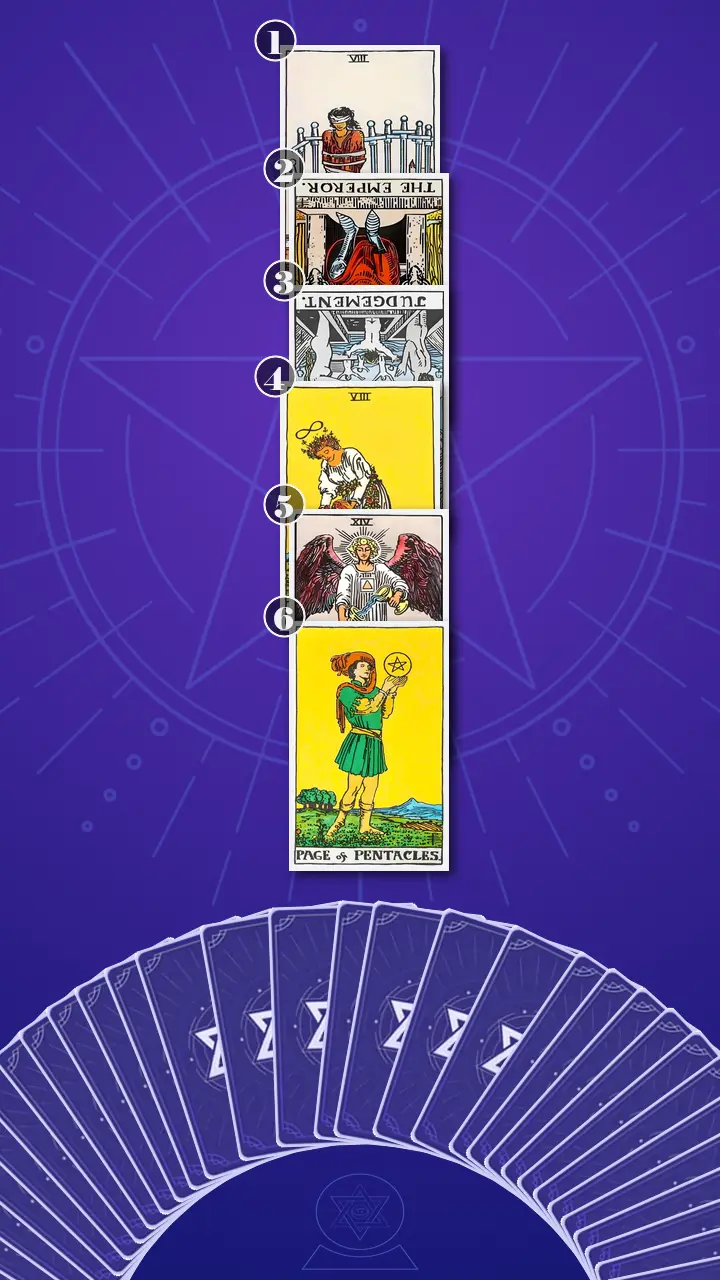
Reading the Map: How Tarot Works When Your Calendar Feels Like a Threat
Position 1 — Surface reaction: the loop you do in the first five minutes
“Now flipping over,” I said, “is the card representing your surface reaction: the specific, observable ‘I’m in trouble’ response you have to the office-hours link.”
Eight of Swords, upright.
“This one is blunt,” I told Jordan. “It’s the mental trap card. It’s what it feels like when your options narrow so hard you can’t even do the simplest thing—like asking a normal, adult question.”
I tapped the image lightly. “The blindfold and the loose bindings matter. The energy here is blockage: not because someone literally stopped you, but because fear built a perimeter around your attention.”
And I used their exact modern-life version, because tarot only becomes practical when it’s specific: “You see ‘Office hours’ on your calendar and instantly get stuck in the loop—reopen the invite, reread the title, scan Slack for clues, and then sit there unable to send a simple clarifying message. Like the ‘right’ move is blocked, even though nothing is actually stopping you.”
Jordan let out a tight little laugh, the kind that’s half recognition and half grief. “That’s… yeah. That’s exactly it. It’s almost mean.”
“It’s not mean,” I said. “It’s honest. And here’s the first interruption phrase I want you to borrow: A calendar link is not a verdict. When your brain reads it like a bank push notification—neutral text, instant panic body—that’s not evidence. That’s conditioning.”
Position 2 — Root trigger: the authority imprint that makes it feel dangerous
“Now flipping over,” I said, “is the card representing your root trigger: the authority dynamic or imprint that makes a neutral invite feel threatening.”
The Emperor, reversed.
Jordan’s jaw tightened before I even finished the card name—like their body recognized the senior-title energy the way dogs recognize the sound of a vacuum.
“Reversed Emperor is distorted authority,” I said. “The structure exists, but it doesn’t feel protective. It feels rigid, unforgiving, or unpredictable. The energy is excess control on the inside—an internalized authority voice that polices you.”
I gave it the name my clients remember: “This is The Manager in Your Head.”
“Because the invite isn’t just a meeting,” I continued, using the translation that matched Jordan’s life to the letter. “It becomes a power check. You start thinking about optics—how to sound respectful, how not to annoy anyone, how to seem ‘easy to manage.’ Your reply turns into a compliance performance instead of a normal adult workplace question.”
Jordan nodded hard, then swallowed. Their shoulders crept upward again, like their body was trying to pass an invisible inspection. “It feels like there are hidden rules,” they said. “Like… one wrong sentence and I’m done.”
My mind flashed—briefly—to my old life in finance: the way some people treated meetings as ambushes, the way a single line in a contract could be used as leverage later. In that world, “no context” could be strategy. But Jordan wasn’t on a trading floor. They were in a modern office where most “quick chats” are logistical, not lethal.
“The risk with reversed Emperor,” I said gently, “is overcorrecting. You become overly compliant, overly explanatory. Ironically, it can make you look less confident and invite more oversight. Not because you deserve it—because people follow the energy you bring into the room.”
Position 3 — Blind spot belief: the assumption that turns feedback into shame
“Now flipping over,” I said, “is the card representing your blind spot belief: the hidden assumption that turns feedback or a check-in into shame and self-prosecution.”
Judgement, reversed.
“This is the ‘summoned’ card,” I said. “Judgement is meant to be review and awakening. Reversed, it turns into condemnation—like your brain hears a trumpet and immediately assumes it’s calling you to trial.”
I gave Jordan the contrast I use when clients are stuck in tone-parsing: “This is courtroom mode versus whiteboard mode. In courtroom mode, you walk in with a guilty plea. In whiteboard mode, you walk in to align on next steps.”
Then I spelled out the behaviors, because shame loves vagueness. “Reversed Judgement tends to push you into extremes: you either over-confess—sharing every detail to pre-empt critique—or you under-share—staying vague and agreeable so you can’t be pinned down. Either way, you don’t get clarity.”
Jordan went still for a beat. Their eyes unfocused like they were replaying a memory on mute: past check-ins, a manager’s raised eyebrow, a moment of being corrected in front of someone important. Then their throat moved—small, controlled. “If I ask what it’s about,” they said quietly, “I feel like I’ll look guilty.”
“That belief is the blind spot,” I said. “Asking for context is normal workplace communication. It’s professionalism, not guilt.”
Position 4 — Regulating resource: the capacity that gives you bandwidth in real time
“Now flipping over,” I said, “is the card representing your regulating resource: the inner capacity you can access to stay present and think clearly in the meeting.”
Strength, upright.
“Good,” I said, and I meant it. “This card is body-first courage. Not ‘be fearless.’ Not ‘perform confidence.’ Strength is the moment you stop trying to win and start trying to stay present.”
In my language, the energy is balance: steady fire that warms instead of burns. “The lion is your body alarm,” I told Jordan. “It’s loud. It feels urgent. But it isn’t the truth. The calm hand is regulation.”
I embedded the micro-instruction right there, because it has to be usable: “Before you open Slack again, take one long exhale. Make the exhale longer than the inhale. Feet on the floor. Drop your shoulders once on purpose.”
Jordan tried it, right in the chair. Their shoulders lowered by maybe half an inch—small, but real. Their eyes got clearer, less darting. “That’s weird,” they said. “It’s like my brain loads faster.”
“Exactly,” I said. “Regulation is the new context. Not because you changed the invite. Because you changed your bandwidth.”
When Temperance Spoke: The Slow Pour That Replaces a Rehearsed Confession
Position 5 — Transformation lever: the bridge from ‘child in trouble’ to adult collaborator
I let my fingers rest on the next card for a half-second longer. The room got quieter in that way it does when someone finally stops arguing with their own thoughts.
“Now flipping over,” I said, “is the card representing your transformation lever: the mindset shift that helps you move from ‘child in trouble’ to ‘adult collaborator’.”
Temperance, upright.
“This is integration,” I said. “Measured response. Two realities at once: a younger part of you feels scared, and your adult self can still ask clear questions and participate. The energy here is balance—the steady pour between two cups.”
Jordan stared at the card like it was a door they didn’t know they were allowed to open. I could feel the old loop trying to reassert itself—the urge to make the fear disappear before doing anything. That’s the trap: waiting to feel ‘ready’ so you don’t have to risk being seen.
Setup (the familiar trap): Jordan knew this moment too well—staring at an “Office hours / Check-in” invite, Slack still open, stomach dropping like they’d been summoned. Their brain building a case even though all they actually had was… a link.
Delivery (the line I wanted to land cleanly):
Not a courtroom where you must defend yourself—choose Temperance’s slow pour, and let a measured question replace a rehearsed confession.
I let that sentence hang. No rushing. No fixing.
Reinforcement (what changed in the room): Jordan’s breathing stopped for a fraction of a second—the freeze of recognition. Their fingers, which had been pinching the edge of their sleeve, loosened like they’d just realized they were gripping the wrong thing. Their gaze slid off the card and into the middle distance, as if their brain was rewinding the last dozen “quick check-ins” to replay them under new lighting.
Then it happened: a visible exhale, longer than the inhale, almost a small surrender. Their shoulders dropped further. Their mouth opened, closed, and opened again—like they were choosing a new sentence out of a menu they didn’t know existed.
“But…” They frowned, and for a moment the resistance showed up as irritation. “If I stop defending myself, doesn’t that mean I was wrong to be this scared? Like I wasted all that energy?”
“No,” I said, keeping my voice steady. “It means you’re updating your method. Fear was trying to protect you. Temperance doesn’t punish fear. It titrates it—small, manageable doses. You can feel 12 and still act 26.”
Here’s where I brought in my signature diagnostic lens—because this is the kind of moment where a tool can become a lever. “I use something I call a Potential Mapping System,” I said. “It’s an energy profile. Some people are Deep Thinkers—brilliant at analysis, pattern recognition, anticipating risk. Others are Sprinters—clear in action once they start.”
“Under authority pressure,” I continued, “your Deep Thinker strength flips into an overdrive loop: tone-parsing, rehearsing, building a defense doc. Temperance is asking you to blend the cups: keep the Deep Thinker for facts, then borrow a little Sprinter energy for one clean question. That’s the slow pour.”
I leaned in slightly. “Now, with this new lens—think about last week. Was there a moment where you were about to write a paragraph, and this would’ve been the better move?”
Jordan’s eyes got wet, not dramatically—just honest. “Yesterday,” they said. “My manager wrote ‘Can you hop on a quick call?’ and I started drafting… an apology? For what? Nothing had even happened yet.”
“That’s the shift,” I said. “From shame-driven dread to grounded steadiness. From defending yourself against a story to co-creating clarity with a question.”
Position 6 — Next step: a practical way to use office hours for clarity
“Now flipping over,” I said, “is the card representing your next step: a grounded, specific way to show up and use office hours for clarity.”
Page of Pentacles, upright.
“This is the dignity of being in training,” I told them. “Not on trial.”
The energy here is balance leaning toward action: earth energy that becomes a plan. I used the modern-life scenario that makes this card instantly copy/pasteable: “You walk into office hours with a tiny agenda doc—goal, one example, one question. You listen for concrete guidance, confirm next steps, and leave with something actionable for this week instead of leaving with a bigger spiral.”
Jordan let out a different kind of breath—less dramatic, more relieved. “That sounds… normal,” they said, and they almost smiled. “Like something a competent person would do.”
“Exactly,” I said. “And you are one.”
Stop Building a Case. Start Building Clarity: Actionable Advice for Your Next Check-In
I pulled the whole ladder together for Jordan, because insight without a path can become another form of overthinking.
“Here’s the story your spread is telling,” I said. “A neutral trigger (Eight of Swords) hits an old power imprint (Emperor reversed), which activates a blind spot belief that feedback equals condemnation (Judgement reversed). You cope by over-preparing—either a long defense or going quiet—which gives short-term relief but keeps reinforcing the idea that authority equals danger. Strength interrupts the loop through regulation—body first, story second. Temperance changes the meaning of the meeting from verdict to collaboration. And Page of Pentacles lands it: bring something small, practical, learner-shaped.”
“Your cognitive blind spot,” I continued, “is thinking that asking for context makes you look guilty. The transformation direction is cleaner: from ‘I need to defend myself’ to ‘I can co-create clarity with one direct question and a calm presence.’”
Then I gave them a plan that matched their life, their calendar, and their actual capacity on a busy week.
- The Long-Exhale Reply Ritual (60 seconds)Before you respond to the invite or Slack ping, plant both feet on the floor and do 3 long exhales (exhale longer than inhale). Then reread the invite title exactly once—no looping.If your brain says “this is pointless,” treat the breath as a prerequisite for clear thinking, not self-care theater. Even one longer exhale counts.
- Temperance’s Two-Line ClarifierSend a 1–2 line message: “Hey—quick question so I can prep well: what would you like to cover in office hours?” If you start drafting a paragraph, pause and rewrite it into one question.Fear will push extremes (over-confess or go silent). This is the middle. One fact. One question.
- My 5-Minute Decision Tool: Advantage / Risk / BreakthroughOpen a note and write three bullets: Advantage (what clarity this meeting could give you), Risk (what you’re afraid will happen), Breakthrough (what changes if you show up as a collaborator). Then choose your opener: “I’d love to use this time to align on X and make sure I’m on the right track.”Keep it brutally short—five minutes max. This is calibration, not a Notion dashboard you build to avoid the actual conversation.

A Week Later: Clear, Not Perfect
Six days later, Jordan sent me a screenshot—not of the invite, not of the dread spiral. A two-line Slack message they’d actually sent. It was almost boring, which is the point:
“Hey—quick question so I can prepare well: what would you like to cover in office hours?”
Under it, their manager’s reply: “Mostly project priorities + how I can support. Bring any blockers.”
Jordan wrote, “I still felt my stomach drop when I saw the invite. But I did the long exhale. I didn’t write a defense doc. I showed up with three bullets. It was… fine. Helpful, even.”
Clear but vulnerable: they slept a full night after the meeting, but the next morning their first thought was still, “What if I messed it up?”—and then they noticed the thought, exhaled once, and kept making coffee.
That’s the Journey to Clarity I trust: not the disappearance of fear, but the return of choice. Not certainty—ownership. Temperance’s slow pour, Strength’s steady breath, and a Page of Pentacles plan you can actually carry into a room.
When a simple “office hours” link makes your chest tighten and your brain starts building a defense, it’s not because you’re dramatic—it’s because part of you learned that being questioned equals being judged.
If you didn’t have to prove you’re not “in trouble,” what’s the one clean question you’d actually want answered in that meeting?
Every reading at AceTarot is a Journey to connect with inner wisdom and empower next step.
Learn more about our Journey to Clarity.