From Gifted-Kid Pressure to Workshop Drafting: Building Self-Trust in V1s

The 10:33 p.m. Cursor Blink: Gifted Kid Perfectionism Meets Draft Paralysis
If you were the “gifted kid” and now you’re an adult with Draft Anxiety, you know the moment a blank doc feels like a verdict instead of a workspace.
Taylor (name changed for privacy) sat across from me at my little Italian café table—the one by the window where the streetlight turns the glass into a soft, late-night mirror. Outside, Toronto was doing its usual quiet hum: a streetcar bell somewhere far off, the whisper of tires on wet pavement. Inside, the espresso machine had finally stopped hissing for the night, but the air still held that warm, toasted smell of coffee the way a sweater holds perfume.
She didn’t look dramatic. She looked… held tight. Shoulders slightly lifted like they were bracing for impact. Hands heavy in her lap, as if even lifting a finger to type would cost interest.
“It’s always the same scene,” she told me. “10:30 p.m. I’m in my condo, laptop open, Google Docs glowing. Cursor blinking like it’s waiting to judge me.”
She swallowed, and I could see the swallow catch—like her throat was trying to close the door before she said the honest part.
“I open Notion ‘just to outline.’ Then I fix headings. Then I re-read sources. Then I rewrite the first paragraph until it’s… perfect. And the rest is empty. It’s like I’m weirdly great at planning and terrible at drafting.”
Her voice dipped into something that wasn’t self-deprecation; it was the quiet sting underneath it.
“I used to be the gifted kid,” she added. “I miss when being smart felt effortless.”
I watched her fingers make a tiny pinching motion, like she was trying to pick up something invisible off the air. That’s what shame looks like in real life: not an emotion, but a reflex—an attempt to erase yourself before you can be erased.
When she described starting a draft, her body described it too: a tight chest, a throat that narrowed, hands that went oddly numb and heavy—like trying to type while wearing winter gloves you didn’t ask for.
Under it all, the contradiction was loud even when she wasn’t: wanting the work to prove she was still exceptional, and fearing that an imperfect draft would expose her as not actually talented.
“We can work with this,” I said, keeping my tone the way I keep my coffee—strong, warm, not sugary. “Not by forcing you to ‘just be disciplined,’ but by mapping what’s happening in the first sixty seconds—when the freeze hits. Then we’ll find one small lever that makes drafting feel less like a courtroom and more like a workshop. That’s our journey to clarity tonight.”

Choosing the Compass: The Transformation Path Grid (6) Spread
I slid the tarot deck between us the way I slide a demitasse across the counter—steady, no theatrics. “Before we read anything into symbols,” I told her, “we’ll use the cards like a structured mirror. Not fate. Pattern.”
I invited Taylor to take one slow breath in through her nose, out through her mouth—longer exhale than inhale. Not as a ritual for the universe, but as a signal to her nervous system: we’re not in danger; we’re just looking.
“Today I’m using a spread I like for this exact kind of loop,” I explained. “It’s called the Transformation Path Grid (6) · Context Edition.”
To you, reading this: I choose this spread because draft paralysis is rarely one single problem. It’s a repeatable system—freeze → over-prepare → stall—that needs both a root-cause insight (what the draft is being forced to mean) and a practical workflow shift (what you do next, on purpose, when the blank page shows up). Six positions are enough to cover the whole arc without turning the reading into a maze.
“We’ll read the top row first,” I said, laying the grid in my mind before the cards even hit the table. “Present state—what happens in the camera moment. Then the main blockage—what jams you right after you start. Then the root cause—what the draft is symbolically carrying about your worth.”
I tapped the space where the bottom row would go. “Then we drop down to the turning point—the one energy shift that loosens the bind. After that, we land in action and integration: a repeatable drafting approach, and how to make it stick with support instead of secrecy.”
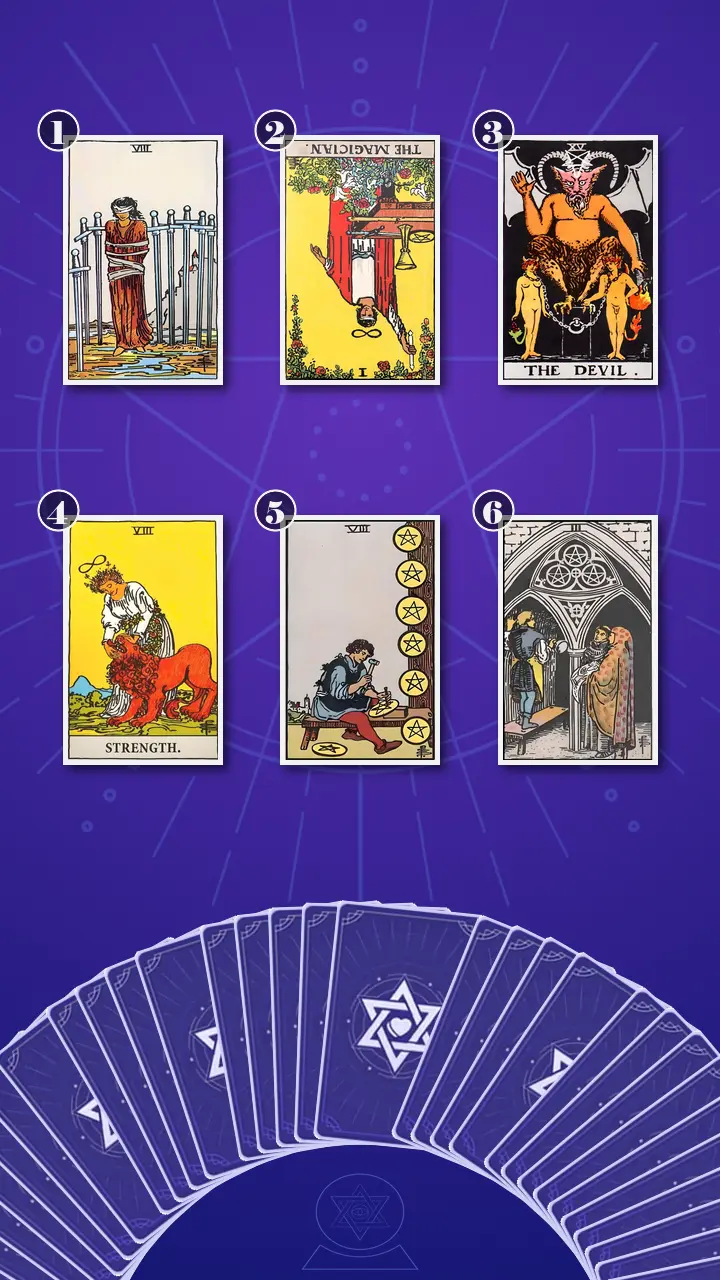
Reading the Map: Card Meanings in Context for the Blank-Page Freeze
Position 1 — The Camera Moment at the Blank Page
“Now flipped, this is the card that represents the presenting draft-stall behavior and the immediate felt experience when you sit down to write—the camera moment,” I said.
Eight of Swords, upright.
I didn’t need to embellish it. The image alone—blindfold, loose bindings, the narrow enclosure—already speaks a language your body understands.
“This is like sitting at your desk at night with Google Docs open, cursor blinking, and your body reacting like you’re about to be graded,” I told her, using the most literal translation of her own lived scene. “Even though you have the skills and time, your hands hesitate, your chest tightens, and you convince yourself you need to ‘think it through’ first—because writing anything feels like stepping into public judgment.”
In terms of energy, the Eight of Swords is blocked Air. Thought doesn’t move; it cages. The mind runs negative pre-mortems—how this line will be judged, how that claim could be torn apart—before the sentence even exists.
“Your draft isn’t a verdict,” I added softly, letting the phrase land. “It’s a workshop pass.”
Taylor did something I didn’t expect—but it was real. She let out a small laugh that had no humor in it, like a cough made of recognition. “That’s… kind of brutal,” she said, then looked down at the card as if it had said her password out loud.
“Brutal is what it feels like,” I replied. “But the card is also telling you something practical: the bindings are loose. That means the trap is meaning, not ability. Which means there’s a way out that doesn’t require becoming a different person.”
Position 2 — The Productive Detour That Blocks Momentum
“Now we’re turning over the card that represents the specific internal mechanism that blocks momentum right after you start—the perfectionism and self-trust issue,” I said.
The Magician, reversed.
“This is tools without trust,” I told her, and I saw her jaw tighten like she already knew where I was going. “You have everything you need—brief, notes, experience, examples—but you keep switching tools to avoid the vulnerability of making a messy first pass. Notion outline → new template → another article → ‘maybe I should use a different framework’—and suddenly an hour is gone with zero paragraphs.”
I leaned in slightly, like I was about to tell her a secret, but really I was naming the pattern with clean edges. “It’s like the draft is a stage, and ‘prep mode’ is obsessively checking the mic, lighting, and slides so you never have to speak.”
Reversed, the Magician is not a lack of talent. It’s agency withheld. Capability is present. The channel is kinked because the work is being asked to perform identity—prove giftedness, protect reputation, prevent judgment.
Her eyes flicked toward her phone face-down on the table, as if she could feel Slack notifications through the wood.
“I do the tab thing,” she admitted. “It feels so… responsible. Like I’m being thorough. But it’s actually me hiding.”
“Exactly,” I said. “Tools don’t ship. Reps ship.”
She winced, then nodded once—sharp, like a pin going into fabric.
Position 3 — The Identity-Level Root: What the Draft Is Forced to Prove
“Now we turn the card that represents the deeper root—what the draft is symbolically made to mean about worth, safety, and belonging,” I said, and I made my voice gentler on purpose. This is where people accidentally shame themselves if they go too fast.
The Devil, upright.
The café felt quieter the moment the card showed itself. Even the fridge hum sounded louder, like the room was cooperating with the truth.
“Before you write,” I said, “you’re negotiating with an invisible audience.”
And because Taylor is a content designer—because her work is visible, commentable, reviewable—I could almost see them behind her screen: a manager, cross-functional peers, a hypothetical critic with perfect grammar and a slightly raised eyebrow. LinkedIn colleagues with ‘Thrilled to announce…’ posts. Even an older version of herself, the one who got praise for being fast and correct.
“The Devil isn’t saying you’re lazy,” I continued. “It’s saying you’re attached. Not to the work itself—attached to what the work is supposed to prove. The gifted label can become a chain: ‘If it’s not impressive, I don’t get to belong.’”
I repeated the sentence once more, slower, so it sounded like what it is: an old contract you never signed but still keep obeying.
“If it’s not impressive, I don’t get to belong.”
Taylor went still. A three-step reaction I’ve learned to trust because it means the insight is landing in the body, not just the brain: (1) her breathing paused; (2) her eyes unfocused like her mind was replaying old classrooms, old gold stars, old ‘wow, you’re so smart’; (3) then a long, quiet exhale that didn’t fix anything—just told the truth.
“That’s… literally it,” she whispered. “If it’s not good, I don’t want anyone to see it.”
“Of course,” I said. “Of course you’d protect yourself that way. The chains in this card are always looser than they look. Which means the shift isn’t a dramatic escape. It’s a choice you practice.”
When Strength Held the Lion of the Inner Critic
Position 4 — The Catalyst: The Energy That Loosens the Bind
“We’re turning over the most important card in this grid,” I said, and I let my hands slow down. “This is the turning point—the energy that changes how you relate to discomfort during drafting.”
The air felt different, the way it does right before the espresso starts pouring—quiet, concentrated, no room for extra motion.
Strength, upright.
Here’s what I saw in Taylor before I even spoke: she was still stuck in the 10:30 p.m. moment, trapped between ‘I have to do it perfectly’ and ‘I can’t risk being seen messy.’ Like standing under a spotlight on an empty stage, trying to perform the final show before any rehearsal.
Then I gave her the card’s plain translation. “Strength says you don’t beat perfectionism,” I said. “You soothe it and move anyway. This isn’t brute willpower. It’s gentle courage—staying present with the exposed feeling while your hands stay on the work.”
Not ‘taming’ your work into perfection, but gently holding the lion of your inner critic while you write the next sentence is the Strength move.
I let a pause stretch—just long enough for her nervous system to hear that this wasn’t another productivity lecture.
Her reaction came in layers, exactly the way a real turning point does. First: a freeze. Her fingers hovered above the table as if they were above a keyboard, suspended in that familiar pre-typing dread. Second: a crack of recognition—her throat moved as she swallowed, but this time it wasn’t a choke; it was a shift. Third: the release. She exhaled, small and shaky, and her shoulders dropped a fraction like she’d been holding grocery bags for miles and finally set them down.
“But if I feel exposed,” she said, and there was a flicker of irritation in it—an honest one—“doesn’t that mean I’m not confident enough to be doing this job?”
“No,” I answered immediately, because this is where people get hurt by the wrong interpretation. “It means you’re human in a role that requires iteration in public-sized steps. Strength doesn’t promise you’ll feel ready first. It says: ‘I don’t feel ready… and I can still write the next sentence.’”
She blinked fast, like she was trying not to tear up in a café. The corner of her mouth lifted—not a smile, more like relief finding a way to exist without permission.
And this is where my café life becomes part of my tarot work, naturally. I’ve pulled tens of thousands of shots. Espresso doesn’t happen because you believe in it. It happens because you show up, grind, tamp, pull—again. Sometimes it channels perfectly. Sometimes it chokes. And you don’t take it as a verdict on your worth. You adjust and pull the next one.
“Let’s make this doable in your body,” I said. “Set a 10-minute timer. Open a blank doc and write an intentionally ‘bad’ version of just one section—or a bullet list pretending to be paragraphs. When the timer ends, stop—even if you want to fix it. Then write exactly three sentences: (1) what’s here, (2) what’s missing, (3) the next tiny step.”
Her chest rose a little higher, like she was testing whether breathing could be safe while talking about drafts.
“And when you feel that tight throat or chest?” I added. “Put one hand on your sternum for three slow breaths. You’re allowed to pause. You’re allowed to come back later. Strength is staying in the room with the discomfort—not winning the mood first.”
I watched her do it right there, almost unconsciously: fingertips pressed to her chest, exhale long. A micro-proof. Not transformation as a fireworks show—transformation as a nervous system learning it won’t be punished for being mid-process.
“This is the key shift,” I told her. “From trying to prove your worth in one perfect attempt to building self-trust through small, imperfect iterations you can actually finish. That’s how you move from shame-driven freezing toward grounded pride that isn’t dependent on being the best.”
Position 5 — The Action Step: Reps Over Reputation
“Now we turn the card for a concrete, repeatable next-step approach—what you do next,” I said.
Eight of Pentacles, upright.
“This is craft,” I said, and I felt Taylor’s shoulders ease again because craft is a kinder word than giftedness. “Progress comes from repetitions, not from proving innate brilliance. This card loves versioning: V1 rough on purpose, V2 clearer, V3 polished—because the work improves through planned reps, not panic.”
In energy terms, this is balanced Earth. Steady, measurable. The opposite of the Eight of Swords’ spinning Air.
“Notice the mirrored loop,” I pointed out, because it’s one of the cleanest ways to make the reading memorable. “You have two eights. Eight of Swords is a repetition loop of fear-based thinking. Eight of Pentacles is a repetition loop of skill-building action. Same intensity. Different direction.”
Taylor nodded slowly, as if she could feel the difference between spiraling and practicing. “So it’s not that I need a better system,” she said. “It’s that I need… more reps.”
“Yes,” I said. “And reps that don’t require you to feel fearless.”
Position 6 — Integration: Collaboration Instead of a Private Trial
“Now the final card,” I said, “represents how this change stabilizes long-term—the support loop.”
Three of Pentacles, upright.
“Drafts are for collaboration,” I told her. “This card is like a design critique culture at its healthiest: not ‘is it good,’ but ‘what’s working and what’s unclear.’ It suggests one safe reviewer, one specific question—so your nervous system learns that being seen mid-process doesn’t equal humiliation.”
Taylor’s eyes widened slightly. “I hate feedback,” she admitted. “Or… I hate what my brain does with feedback.”
“Then we make it narrow,” I said. “We don’t ask for a verdict. We ask for a flashlight. ‘Where did you lose the thread?’ That’s all.”
The Workshop-Not-Courtroom Method: Actionable Advice for Your Next Draft
I gathered the whole grid into one story, the way I blend beans into something you can actually drink.
“Here’s the arc,” I said. “You sit down to write and the Eight of Swords hits: the blank page feels like a test you can fail, so your body tightens and your mind runs pre-mortems. Then the Magician reversed kicks in: you escape into ‘prep mode’—Notion, tabs, frameworks—because tools feel safer than messy sentences. Underneath it, the Devil is the quiet contract: the draft must prove you deserve belonging, admiration, the gifted label. Strength changes the relationship: not deleting the inner critic, but gently holding it while you write anyway. Then the two Pentacles cards make it real: craft reps on purpose, and feedback that’s collaborative, not catastrophic.”
“Your cognitive blind spot,” I added, “is that you’ve been treating version 1 like it’s supposed to protect your identity. It’s not. Version 1 is supposed to be editable. Your transformation direction is simple, but not easy: from performance to process—workshop, not courtroom.”
Then I offered next steps that would actually survive a real week in Toronto—Slack pings, TTC fatigue, Sunday Scaries and all. I also brought in the tools I know best: coffee, focus, and the practical chemistry of attention.
- Two “Ugly V1” sprints (reps over reputation)Twice this week, set a timer for 25 minutes (or 10 if your body clenches). Open a plain Google Doc—no formatting, no headline polishing. Produce 200–400 messy words or a bullet-outline that reads like sentences. When the timer ends, stop even if you want to fix it.If your brain says, “This is pointless unless it’s good,” label it “red-pen voice,” then return to the next sentence. Ending on a timer trains safety.
- The 3-bullet “V2 note” (so the draft becomes editable)Right after each sprint, write exactly three bullets: (a) what the draft is trying to say, (b) what’s unclear/missing, (c) the next smallest section to write next time.Keep it strict. Three bullets is a latte-size container—enough to hold the next move, not enough to spiral.
- One safe reviewer, one question (integration through collaboration)Pick one person who feels steady (teammate, mentor, friend). Send them one rough section and ask one question: “Where did you lose the thread?” Schedule a 15-minute slot or ask for async comments.Avoid “Is it good?” That turns review into a courtroom. One narrow question keeps feedback constructive and survivable.
Before she left, I added one more piece—because I’ve watched too many smart people blame themselves when it’s partly biology.
“I want to use one of my café tricks as a focus diagnostic,” I told her. “I call it Focus Period Diagnosis. Your brain isn’t a machine—your drafting window shifts with caffeine sensitivity.”
“Most people accidentally draft at their worst time,” I continued. “Late-night, depleted, doom-scrolled, comparing themselves to LinkedIn. So for the next week, track one thing: when does coffee help you feel calm and steady, and when does it make your thoughts feel like a comment thread running too fast?”
“If caffeine makes your mind jittery, do your Ugly V1 sprint earlier, or switch to half-caf, or even just the smell ritual,” I said. “In my café, aroma alone can be a cue: a small anchor that says ‘this is a workshop session.’ You’re building a system, not waiting for a heroic mood.”

A Week Later: The Quiet Proof of Finding Clarity
Six days later, I got a message from Taylor while I was wiping down the counter, the morning rush already fading.
“Did the ugly sprint,” she wrote. “Hated it for two minutes. Then it got… normal. Sent a rough section to my teammate with the ‘where did you lose the thread’ question. She replied with three comments and zero judgment. I didn’t die.”
I could picture it: not fireworks, not a montage—just a small, clean proof. And a bittersweet contrast that made it real: she’d done the brave thing, and the morning after she still woke up with the first thought, What if I’m wrong?—only this time she didn’t obey it. She made coffee, opened the doc, and let version one exist anyway.
That’s the real Journey to Clarity: not certainty, but ownership. Drafting becomes a workshop, not a courtroom—because your identity isn’t on trial each time you create.
When you’re used to being “the gifted one,” a blank page can feel like a spotlight—so you keep polishing the opening not because you don’t know what to say, but because an imperfect first pass feels like it could expose your worth.
If drafting didn’t have to prove anything about you, what’s one small, imperfect version you’d be willing to let exist this week—just long enough to become version two?