10:52 p.m., Two Drafts Open—And the Rule That Ended the Spiral
Finding Clarity in the 10:52 p.m. Submit Spiral
It’s the night before the deadline, the Submit button is right there, and you still open the doc again—classic application spiral meets Sunday Scaries energy.
Alex (name changed for privacy) said it like she was confessing a crime. She’d come into my little Italian café in Toronto on a rainy Saturday, the grinder whining behind the counter, her table wobbling just enough to make her knee bounce harder. She set her laptop down anyway, like it weighed as much as her whole future.
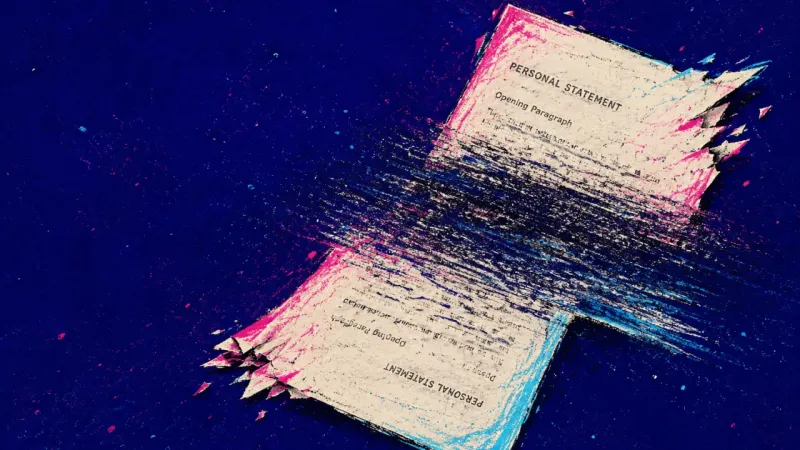
As she opened it, I could almost see the weeknight she described: 10:52 p.m. in a condo living room, harsh screen-glow against a black window, fridge humming like a metronome. Two Google Docs side-by-side. Suggesting mode on. The same intro sentence highlighted pink in Draft A, yellow in Draft B. Delete three words. Undo. Retype. Toggle. Toggle.
Her jaw was tight in a way you don’t notice until someone points it out—like she was trying to hold in steam. Shoulders lifted, breath shallow, a buzzy urge in her hands to “just fix one line.” Pressure, not as a feeling, but as a physical clamp.
“I don’t want to overshare,” she said, voice low. “But I also don’t want to sound like a robot. And I keep thinking if I pick the wrong tone, that’s it—game over.”
I nodded, slow and steady, the way you do when you’re trying to help someone’s nervous system stop sprinting. “You’re not choosing between two drafts—you’re choosing between being seen and being safe.” I watched her swallow at that. “Let’s make this less of a verdict and more of a map. Our whole journey today is about finding clarity—so your next step is something you can actually do.”

Choosing the Compass: The Decision Cross Spread
I asked Alex to put her phone face-down and take one breath that went all the way down—like she was smelling coffee for the first time that day, not just using it as fuel. While I shuffled, I kept it practical. Not mystical. The point of the ritual is focus: it moves your brain from spiraling into observing.
“For this,” I told her, “I want to use a spread called the Decision Cross.”
To you reading this: the reason I chose it is simple. When someone is stuck between two personal statement drafts—honest vs safe—it looks like a writing problem. But it’s usually a clarity problem driven by tone anxiety and fear of judgment. The Decision Cross is the smallest structure that still shows: what’s keeping you stuck, what each option protects, what you need to integrate, and the most actionable next step. It doesn’t try to predict a fixed outcome. It’s a decision tool.
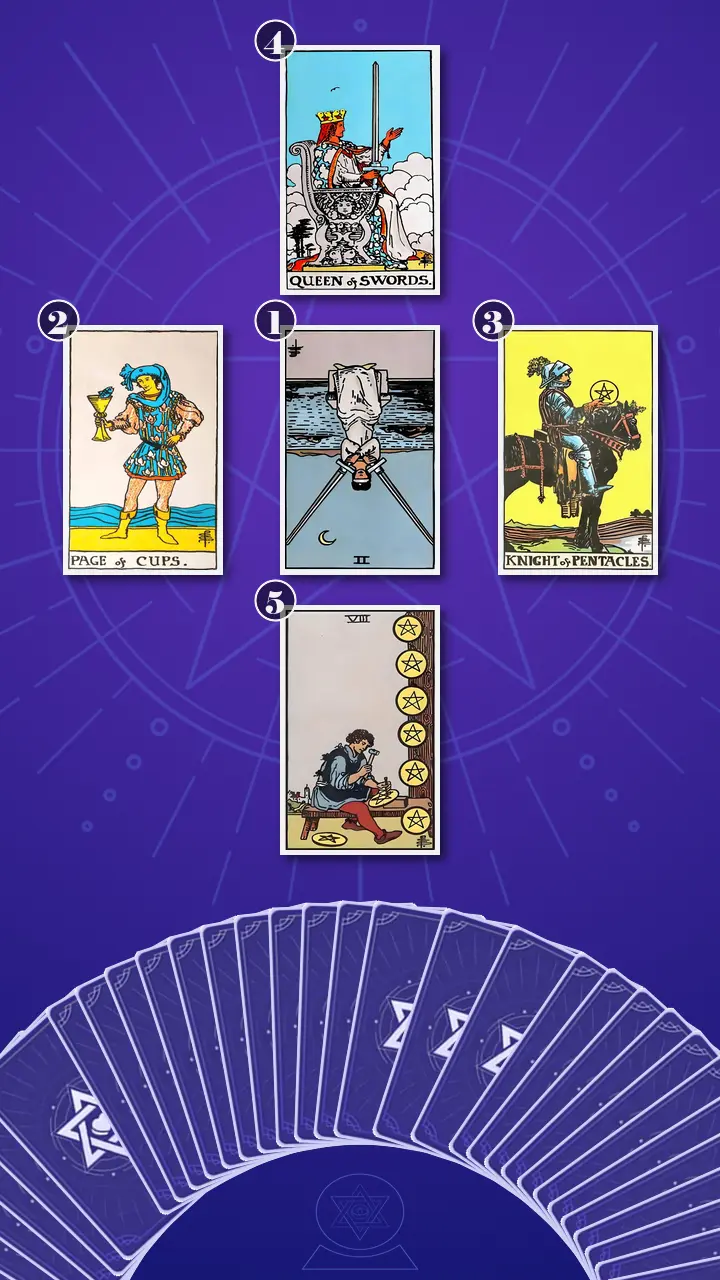
I pointed to the layout as I placed the cards. “The center is your current stuck loop. Left is Path A—the honest draft. Right is Path B—the safe draft. Above is what you integrate—the mindset and criteria that make the choice coherent. Below is your next step this week, so you can stop re-litigating and actually finish.”
Reading the Map: Card Meanings in Context
Position 1: The Loop That Looks Like ‘Being Responsible’
“Now flipped over,” I said, “is the card that represents the current stuck point: the observable behavior and inner posture that keeps you toggling between drafts instead of committing.”
Two of Swords, reversed.
I didn’t even have to reach for poetry. This one was literal. “This is you on a weeknight after work,” I said, “with two Google Docs open side-by-side, Track Changes on, highlighting the same intro in two colors. You keep toggling because choosing one voice feels like choosing which version of you gets judged.”
Reversed, the energy isn’t calm indecision—it’s a blocked kind of Air: overactive thinking with nowhere to land. “You’re tone-policing,” I told her. “Like every sentence needs legal review. You’re treating your draft like a risk dashboard—red/yellow/green—rather than a story.”
Alex gave a short laugh that had no humor in it. “Okay,” she said, almost wincing. “That’s… brutal. But yeah.”
I stayed gentle but precise. “This is why you feel stuck even though you’re ‘working.’ The loop is: deadline triggers the belief there’s one correct version that won’t get judged → you cope by endless polishing and removing emotionally specific lines → you get ten minutes of relief because it feels controlled → and then you feel erased, so you start again.”
I tilted my head. “When you open the doc, what do you do first—rewrite the intro, open the other draft, ask for feedback—and what feeling are you trying to get rid of in that moment?”
Her fingers worried the edge of a napkin. “The exposed feeling,” she admitted. “Like… if I make it cleaner, they can’t use it against me.”
“Polishing isn’t progress when it’s just fear in nicer font,” I said, and I saw her nod—sharp, uncomfortable, then relieved. Named is not shamed.
Position 2: Path A — The Honest Draft, the Line You Keep Treating Like Contraband
“Now we’re looking at Path A — the honest draft: what it gives you, what it risks, and what part of you it wants to express.”
Page of Cups, upright.
“This is the honest draft where one specific, slightly vulnerable detail makes the whole statement sound like an actual person,” I said. “It’s the line you write and immediately think, ‘Is this too much?’—and also, ‘If I delete this, it turns into a template.’”
This card’s energy is Water in balance: sincerity that doesn’t need to over-explain itself. “The Page isn’t oversharing,” I told her. “It’s letting one true motive be felt without pre-defending it. Like the one unpolished voice memo at 1:12 a.m. that finally sounds human.”
I glanced at Alex, then back at the card. “Which sentence in your honest draft makes you feel more like yourself—and also makes you immediately want to soften it?”
She stared at the tabletop a second too long. Then: “There’s a line about my mom’s hospital room. It’s… the reason I care about this field. I keep deleting it.”
I watched her face—fear and relief side-by-side, like she’d opened a window in a stuffy room and immediately worried about the cold. “That’s your fish in the cup,” I said. “Surprising. Memorable. And exactly the thing your anxiety wants to cut because it’s ‘weird’ or ‘messy.’”
Position 3: Path B — The Safe Draft, the Reliable Suit That Can’t Breathe
“Now we’re looking at Path B — the safe draft: what it protects, what it costs, and what part of you it tries to control.”
Knight of Pentacles, upright.
“This is the draft that reads like a reliable, well-structured application package,” I said. “Polished. Methodical. Credential-forward. It proves you can do the work.”
The energy here is Earth in excess—stability so controlled it risks becoming anonymous. “It can start sounding like you’re answering a prompt from HR,” I said, “or like a performance review: technically correct, emotionally flat.”
Alex’s shoulders dropped a millimeter. Not relief—recognition without self-attack. “Yeah,” she said. “It’s the one I show people because it feels… respectable.”
“And that makes sense,” I told her. “Playing it safe isn’t a character flaw. It’s a protective strategy. The question is cost: if you submit the safe draft as-is, what do you gain—credibility, calm, control—and what would you quietly grieve losing?”
She didn’t answer right away. Her eyes flicked to her laptop, like she could see the words she’d flattened. “I’d lose… stakes,” she said. “It wouldn’t sound like I actually care.”
Position 4: When the Queen of Swords Put Down the Blindfold
I let the café noise soften around us: the hiss of the espresso machine, the tiny clink of cups, a lull in the grinder. “We’re turning over the core of this reading now,” I said. “This card shows what to integrate: the decision criteria and mindset that transform this from a binary choice into a coherent statement.”
Queen of Swords, upright.
“This is the moment you stop trying to sound uncriticizable and start writing to be clearly understood,” I said. “You choose criteria—what’s relevant, what proves fit, what’s specific, what’s unnecessary. Then you cut with self-respect: you remove filler, apology language, and vague ‘I’m passionate’ fog.”
Alex’s face tightened again, like she was bracing for the part where I’d tell her to just ‘be authentic.’ I didn’t.
“Here’s the editorial truth,” I said. “Your honesty doesn’t need to be risk-free; it needs to be intentionally edited.”
The Aha Moment: Clean Truth, Not Less Truth
It was easy to imagine her at 10:47 p.m.—both drafts open, shoulders up by her ears—rewriting the first paragraph like it’s the only part that counts, trying to find the one tone that can’t be criticized. That’s the trap: treating clarity like something you earn by removing all risk.
Stop trying to disappear behind a “safe” voice—choose the Queen of Swords’ clear blade and cut toward a story that’s both honest and deliberate.
The sentence landed and just… sat there between us, louder than the espresso machine. Alex’s reaction came in a chain: first, a small freeze—her breath paused, fingers hovering above the trackpad like they’d forgotten what to do. Then her eyes unfocused, as if she was replaying every night she’d deleted the hospital-room line and replaced it with something “appropriate.” Then her mouth pulled into a tight, sudden frown.
“But if I do that,” she said, and there was heat in it—brief, honest anger—“doesn’t that mean I’ve been doing it wrong? Like… all this time?”
I kept my voice even. “No,” I said. “It means you’ve been protecting yourself with the only tool that felt available: control. The Queen isn’t here to shame you. She’s here to give you a better tool: discernment.”
I tapped the card lightly. “Think of how coffee filters work. They don’t erase the coffee. They separate. Grounds stay out. The good stuff comes through. That’s what we’re doing with your story: letting the honest essence through, filtering out defensive fog. Clarity is what makes honesty feel safe—not less truth, just cleaner truth with proof and purpose.”
Her shoulders sank on a long exhale, like she’d been holding a bag of groceries in midair. She blinked fast, once, eyes bright but steady. The café window behind her showed the rain thinning, streetlights softening into halos. “Okay,” she whispered. “So… criteria first. Not tone first.”
“Exactly.” I leaned in a little. “Now, with this new perspective, think back to last week. Was there a moment—one edit, one sentence—where this would’ve changed how you felt?”
She nodded, slow. “The moment I replaced the hospital line with a generic ‘I’ve always been passionate.’ I hated it as soon as I wrote it.”
“That’s you moving from deadline pressure and approval-seeking tone-policing to grounded confidence through clear criteria,” I said. “Not by being louder. By being cleaner.”
Position 5: The Eight of Pentacles and the Finish-Line Mindset
“Now we turn over your next step: the most actionable move you can take this week to finalize, not re-litigate, your statement.”
Eight of Pentacles, upright.
“This card is craft,” I said. “Not adrenaline. Not vibes. It’s the apprentice at the bench, doing the same action on purpose until it’s solid.”
And the modern translation was painfully perfect: “Instead of rewriting your intro for the fifteenth time, you treat finishing like a workflow. Three passes—on purpose—and only those: clarity/structure, evidence/proof of fit, voice/line-level polish. You stop when the pass ends. You rename the file something ridiculous like ‘FINAL_final_ACTUALLY.pdf,’ read it out loud once, run a typo sweep, and submit.”
I watched her eyes as she pictured it: the quiet after you close the tab, the sudden absence of the blinking cursor. Motivation, but calm.
“Do passes, not rewrites: clarity pass, evidence pass, voice pass—then you’re done,” I said. “Completion is part of the skill.”
The One-Page Queen Edit: Actionable Advice for Two Personal Statement Drafts
When I looked at the whole spread, the story was clean: Two of Swords reversed showed the present loop—draft-switching and tone anxiety masquerading as productivity. Page of Cups showed the living core you keep sanitizing. Knight of Pentacles showed the competent structure you’re afraid to lose. Queen of Swords bridged them: strategic framing, boundaries, and clear criteria. Eight of Pentacles grounded it: disciplined craft so you can actually hit submit.
The cognitive blind spot was the one Alex had been living inside: she thought she was deciding between two drafts. But she was really deciding between two editing motives—editing to be clearer vs editing to be less visible.
“Write to be understood by the right reader, not liked by every reader,” I told her. “That’s the Queen’s boundary. And it’s how you stop writing for the imaginary comment section in your head.”
Then I slid her a napkin and a pen—because in my café, plans should fit next to a cup. “Here’s your next 48 hours,” I said. “Small, strict, doable.”
- The One-Sentence Thesis Test (30 minutes)Open a new doc and write at the very top: “I’m applying because ____, and I’m ready because ____.” Set a 30-minute timer. When the timer ends, pick the draft that supports that sentence with the fewest edits, and paste it into a new file titled: “Statement — Working Master.”If your brain screams the thesis is “too simplistic,” treat that as tone anxiety, not insight. Keep it simple anyway.
- The Queen Criteria Checklist (10 minutes)Create a 3-bullet checklist in the doc header: (1) Relevant to the program, (2) Specific (not generic), (3) Proof of fit (a concrete example). Anything that doesn’t hit at least one bullet gets cut or rewritten—no negotiating.This is my “Knowledge Filtration” lens: like a coffee filter, you’re not erasing your story—you’re separating grounds (defensive filler) from the drinkable truth (clear point + evidence).
- Passes-Not-Rewrites Workflow + a Submission WindowDo three timed passes this week: Pass 1 (15–25 min): structure/clarity. Pass 2 (15–25 min): add/verify one proof-of-fit example. Pass 3 (15–25 min): voice/line polish. Then schedule a submission window (example: Thursday 7:30–8:00 p.m.). After a final read-aloud and typo sweep, submit and close the tabs.Use my “Focus Period Diagnosis”: if late-night coffee makes you jittery and extra nitpicky, do Pass 1 in the morning (or go half-caf after 3 p.m.). For the submission window, build an “Exam Emergency Kit”: water, a steady snack, and a coffee that keeps you clear—not frantic.
Alex stared at the list, then laughed—this time with relief. “It’s weird,” she said. “This feels… finishable.”
“That’s what structure does,” I said. “It turns a career crossroads into next steps.”

A Week Later: Ownership, Not Certainty
Six days later, during my morning rush, my phone buzzed between cappuccinos. Alex’s text was short: “Did the three passes. Kept the hospital line. Added one framing sentence right after it. Submitted Thursday at 7:42. Closed the tabs. I’m shaking a little but I did it.”
I pictured her afterward: not fireworks, not a movie montage—just her alone in a café corner with a cooling drink, staring at an empty browser bar for three quiet minutes, surprised by the space where the spiral used to live.
That’s the real Journey to Clarity I see again and again: not certainty, but ownership. A coherent story you can stand behind, built by clear criteria and disciplined craft—so your honesty reads as competence.
And if tonight you’re feeling that specific kind of pressure when the submit button is right there—and suddenly every honest sentence feels like it could be used as evidence that you’re “not enough,” so you keep rewriting to disappear and still be chosen—let me leave you with the same compass I gave Alex.
If you let yourself aim for being clearly understood (not perfectly approved), what’s one line you’d keep exactly as it is—just long enough to build the rest of the story around it?